

Last year, I was at an IT career fair at my daughter’s high school here in Singapore. They had a Tech Panel, and my daughter and I attended that to see what’s buzzing. I was particularly inspired by one of the senior leaders at the panel, so I decided to talk to him later.
As I walked up to him after the panel ended, I noticed his lanyard. It said “Head of Strategic Initiatives and Transformation.” It was quite a mouthful with 6 words, and I asked him what he actually did.
He smiled and said he was responsible for “stakeholder alignment, cross-functional orchestration, and strategic enablement.”
After trying to decipher that for a few seconds, I asked again, more directly this time: “What exactly are you responsible for?”
At that point, he froze. His polish, which he’d been carrying for the past 1+ hour, suddenly disappeared. He looked over my shoulder, mumbled something about needing to find someone, and suddenly walked off.
As I was driving back home from the fair, I reflected on what happened.
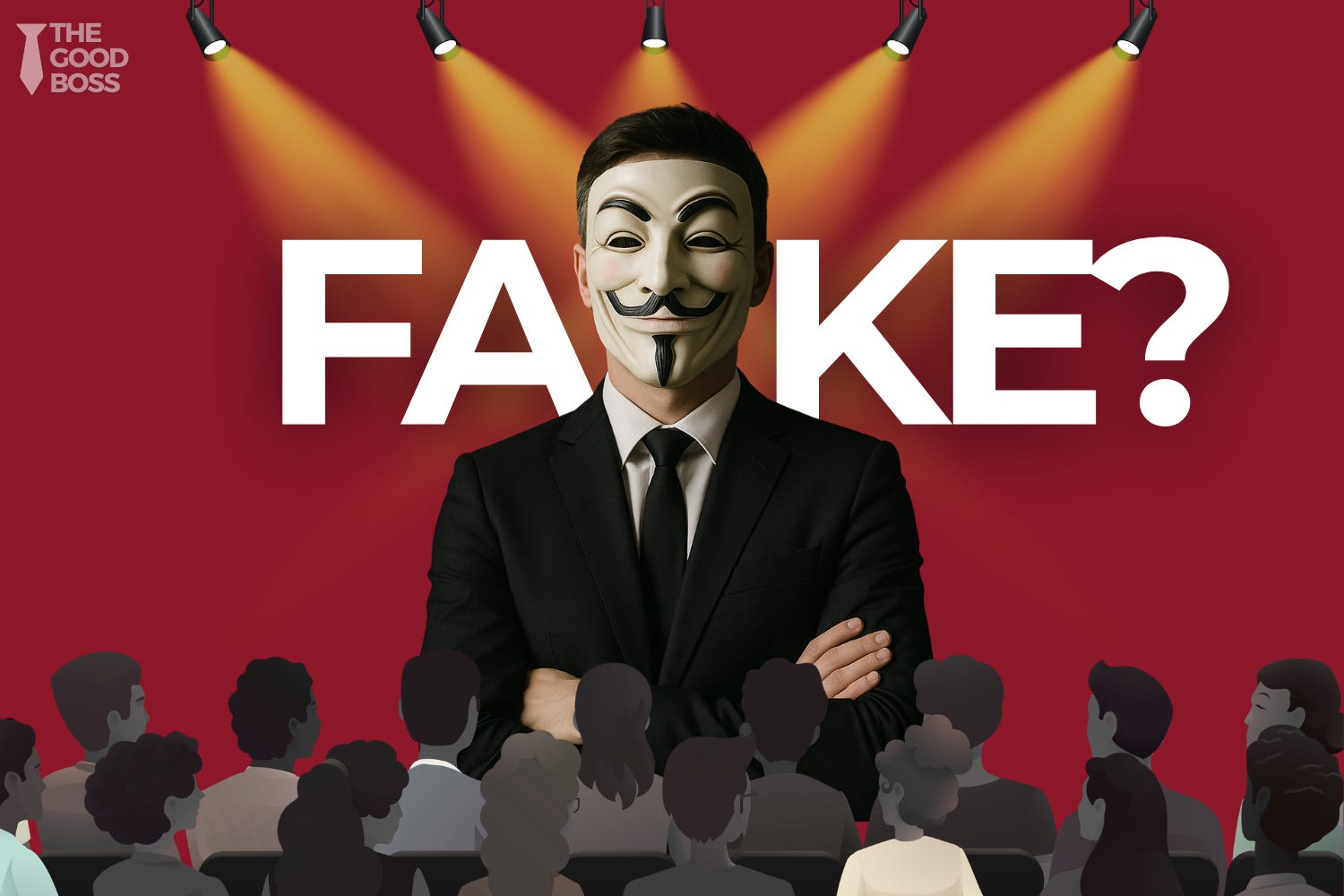
I realized that he wasn’t the only one. I’ve spent 20+ years in tech leadership, and I have observed that the leader’s job has been split into two parts: the identity and the work.
Most people are doing the first one and calling it the second.
So how can you know if you are doing the same? Here are 8 signs I’ve seen again and again to watch out for.
Sign 1: Your title takes longer to say than your job does
Just look at any org chart in a large company, and you’re likely to find a small army of “Heads of Transformation,” “Directors of Enablement,” and “Leads of Innovation.”
If you ask three different people what any of them actually own, you’re likely to get three different answers, or a long pause (like the one I got at the career fair).
Truth be told: I am guilty of this myself. Several years ago during a reorg which was meant to flatten our hierarchy, I created a number of new titles: Tech Lead, Program Lead, Functional Owner, and a few more.
I remember feeling “empowered” for a few months, but soon enough, I realized the mistake. The sprint planning meeting now had three “leads” in the room, and none of them wanted to own the roadmap.
Here’s what I’ve realized: A title gives you the permission, but doesn’t necessarily give you the power.
Permission lets you speak in the meeting, but real power is something you build by making decisions and living with the outcome of those decisions.
👉🏼 Takeaway: If you can’t say what you’re accountable for in one sentence, your title is doing the work your job should be doing.
Sign 2: You’re closer to the VP than you are to the work
Throughout my career, I’ve noticed people with fairly ordinary jobs who carry themselves like executives. And they do this purely because they report to someone senior.
In such cases, it seems that their proximity to power becomes its own badge, and it has almost nothing to do with what they actually deliver.
💬 Have you noticed this too? Let me know in the comments!
So how can you tell such people apart? Just ask them what they delivered this quarter, not who they had lunch with. If the answer is fuzzy, you can be sure that their “seniority” is borrowed, not real.
👉🏼 Takeaway: Sitting near power isn’t the same as creating value. The former gets noticed, but the latter is what gets results.
Sign 3: You have three buzzwords for your job and zero outcomes
I’m sure you’ve heard these a gazillion times, in broadcast emails from leadership after a re-org, merger, or in promotion announcements.
“Driving transformation.”
“Enabling alignment.”
“Accelerating outcomes.”
All those words sound polished, but they’re equally vague, and they’re intentionally built to sound important without saying anything.
In my experience, real leadership is actually much simpler: You see the problem, make a decision, and own the outcome. That’s all.
So why do so many people fill their vocabulary with buzzwords? Because making decisions is risky, and one of the risks is becoming unpopular. So they decide to hide behind buzzwords and vague language.
👉🏼 Takeaway: It’s easier to sound important than to do something that might be risky. Buzzwords are how you hide behind the risk.
Sign 4: Your meetings settle nothing, and everyone’s relieved about it
I remember observing two people on the team spend two weeks debating whether a button in our product UI should sit in the “top-right” or the “bottom-left”.
Both of them had strong opinions, but neither had real ownership. And guess what - the feature got scrapped eventually.
When I thought about it later, I realized that the real issue wasn’t even the button. The real issue was fear - nobody wanted to make the call and risk being “wrong”, so the team “performed collaboration” instead of making a decision.
👉🏼 Takeaway: A meeting that ends with “let’s take this offline” for the fourth time isn’t “collaboration”. It’s two people avoiding a decision that needs to be made.
Sign 5: You’ve hired more people to manage communication than to build the thing
At one point in my career, I realized we had more people coordinating between teams than people actually shipping the product.
From one angle, it may have looked like “structure” - organized and process-oriented. But in reality, it was just confusion and chaos.
Again, I’m guilty of creating some of those roles myself. I thought that bringing them in would bring some structure and order in how we work as a team. But what we ended up building was nothing but a maze that we weren’t able to find our way out of.
👉🏼 Takeaway: If your coordination layer is growing faster than your output, you’re not managing complexity. You’re manufacturing it.
Sign 6: You end the day exhausted and can’t point to what you actually did
There were several times in my career where I would log off every evening completely drained and exhausted. I would have gone through 10+ meetings, “enabled”, “facilitated”, “reviewed” all day, and yet couldn’t name a single thing I had actually accomplished on that day.
Through the day, I would discuss decisions, but wouldn’t make any.
💬 Have you experienced this too? Let me know in the comments!
👉🏼 Takeaway: Motion isn’t the same as movement. You can be busy all day and still have nothing to show for it by dinner.
Sign 7: “Busy” is your proof that you’re leading
You’ll recall what happened in 2020, when the COVID-19 pandemic swept the planet.
When offices shut down and people started working from home, a lot of people found out that their full-time job took three or four hours to actually do. The rest of the day went to “signaling”: green dots on Slack, back-to-back calls on Zoom, status updates on email, etc.
But who are we to blame? We built this ourselves:
We schedule the meetings.
We ask for the updates.
We reward the person who’s always visible over the one who’s just doing the work.
We promote the culture that as long as you’re “in a meeting,” you don’t have to make a decision.
“Busy” is the safest place to hide.
👉🏼 Takeaway: A packed calendar makes you visible, but it doesn’t prove that you’re valuable.
Sign 8: Your best people have stopped pushing back
It always amuses me when a manager thinks he is one step ahead of his team.
Your team isn’t a bunch of kids. They’re grown-up people, and they know exactly when a meeting is just theater. They notice when “momentum” and “alignment” are just code words for your lack of courage to actually decide.
The brutal reality is that, at first they play along, but then they stop playing.
Leaders who “perform” confidence usually think they’re building trust, but they’re doing quite the opposite. The moment your team senses you’re performing instead of deciding, they lose trust in you, and eventually, respect in you.
👉🏼 Takeaway: If your best team members are silent, it may not mean “engagement”. They might just be giving up on you.
🎁 Feedback is a gift!
If you found this post helpful, would you do me a favor and leave a quick testimonial here? As a thank-you, I’ll send you a free copy of my book. Takes two minutes. 🙏
The good news
Okay, time for some good news :)
For years, this performance worked because the “props” were expensive.
Preparing a polished deck took hours.
Building an elaborate dashboard took days.
Coordinating a meeting took real effort.
So working on them made it look like “real” work.
But today, AI has taken all that away. PowerPoint decks that used to take days now take minutes, and reports that used to justify an entire role can be spit out of a single ChatGPT or Claude.ai prompt.
What is left today is the part AI can’t do: judgment, courage, clarity, and owning the outcome when it goes wrong.
And those are exactly the things real leadership is all about. That’s the good news.
My honest take
I find that the hard part is the unlearning of old habits.
I still catch myself doing it from time to time: Spitting out buzzwords to sound “strategic”, waiting for “alignment” before I decide, and so on.
Real leadership is actually simpler than that, and frankly more uncomfortable (and who said leadership was easy?)
My honest take: the leaders who matter most today aren’t the ones with 6-word titles or the busiest calendars. They’re the ones who ask the simplest, yet the hardest questions. They’re the ones who bring clarity in the middle of chaos.
💬 So, which of these 8 signs hit closest to home for you? Let me know in the comments. 👇
❤️ Found this helpful?
If you found this post helpful, please like and share it with other managers who can benefit from it, including your boss :) If you have any feedback, please drop your comment below - it helps me keep improving the content. Thank you!

Thank you for your perspective, this has definitely given me the cause to pause for the introspection that I was delaying for many years.
It feels like you described my own work environment. I used to care about my title bur after I had to create my own title, I realized that the titles don’t mean much. Your post confirms that what really matters is what you can deliver. Sadly, the other part of the job is to ensure that the right people know your results.