In this issue:
The Rollout Nobody Followed
How the ADKAR Model Works
Why This Matters for Leaders
Putting ADKAR Into Practice: Worksheet & Mind-map
The One Question: Which Stage Are We Stuck On?
How This Plays Out in Real Teams
Common Pitfalls (and How to Avoid Them)
Final Thoughts
The Rollout Nobody Followed
A few months ago, I watched a fellow engineering manager roll out spec-driven development (SDD) across her team. SDD is the practice of writing a detailed spec before any AI-assisted coding begins, so the LLM has a clear contract to build against instead of a vague prompt.
She did the due diligence of sharing this new approach with her team in a team meeting. She explained why the old “just prompt and iterate” habit was producing inconsistent, hard-to-review code, and SDD was the way to go. In the meeting, her team was very receptive, and they seemed to be bought in.
Three weeks later, however, half the team was still skipping specs and prompting directly.
I remember her telling me over coffee that she thought her team was just resistant to the change. She thought that engineers didn’t want the extra upfront step, and were comfortable with direct prompting. So she sent another reminder to the team on their team Slack channel, and restated the ‘why’. But still, not much changed after that.
Eventually, she got what was missing. Her team wasn’t resisting the change - in fact, they agreed the new process made sense. They just didn’t know exactly how to write a good spec: what level of detail to include, how to scope it, what “done” looked like for a spec versus for code. Nobody had ever walked them through it.
She’d explained the why, but she never covered the how.
They weren’t resisting. They were stuck.
How the ADKAR Model Works
ADKAR was developed by Jeff Hiatt, founder of the research firm Prosci, in the early 2000s, based on Prosci’s studies of how individuals actually experience organizational change. He later expanded it in his 2006 book ADKAR: A Model for Change in Business, Government and Our Community.
The model breaks any successful change down into five sequential building blocks:
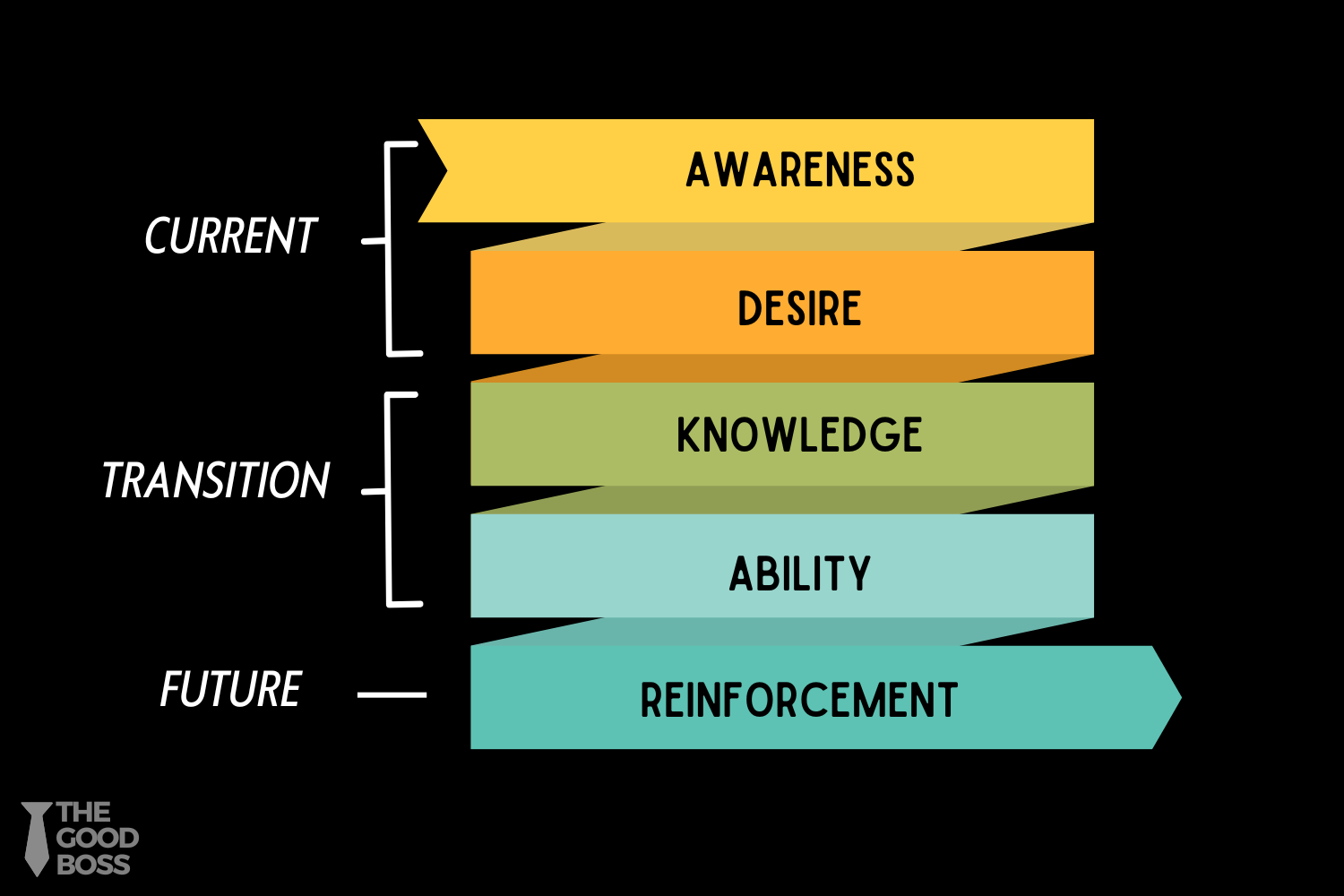
Awareness — understanding why the change is happening
Desire — wanting to support and participate in it
Knowledge — understanding how to change
Ability — having the skill to actually do it
Reinforcement — sustaining the change so it doesn’t quietly reverse
The key insight isn’t the five words themselves, it’s the order.
Each letter depends on the one before it, and skipping one doesn’t make the next one happen anyway.
You can’t build Desire without Awareness. You can’t build Ability without Knowledge. A team can be fully aware of a change, genuinely want it, and still fail simply because nobody built their skill to execute it.
Most change efforts don’t fail because people are against the change. They fail because leaders manage the first step and assume the rest will follow on its own.
Why This Matters for Leaders
Most managers are fluent in exactly one step of ADKAR: Awareness. We’re comfortable with the announcement: the all-hands, the Slack post, the deck explaining the “why.” What we’re far less comfortable with is everything after it.
The “I told them why, so they should want to” gap. Awareness and Desire are not the same thing. A team can fully understand why a change is happening and still not want to be the one to make it happen, especially if the change adds short-term friction to their workload with no visible upside for them personally.
The skills-vs-tools confusion. Knowledge and Ability get treated as interchangeable, but they’re not. Knowledge is understanding the new process in theory. Ability is doing it under real conditions: mid-sprint, under deadline pressure, with muscle memory that hasn’t formed yet. A single training session builds Knowledge, but it rarely builds Ability.
The “it seems to have stuck” trap. Reinforcement gets skipped entirely because, by the time you’d revisit it, the change looks like it’s working. Old habits don’t disappear the moment a new process launches. They fade slowly, and they come back the moment nobody’s watching.
If you only ever manage Awareness, you’ll keep re-announcing a change that never actually took hold.
Putting ADKAR Into Practice
For the rest of this article, we will focus our attention on putting the ADKAR model into practice in your own organization. As we do that, don’t forget to download the ADKAR Worksheet.
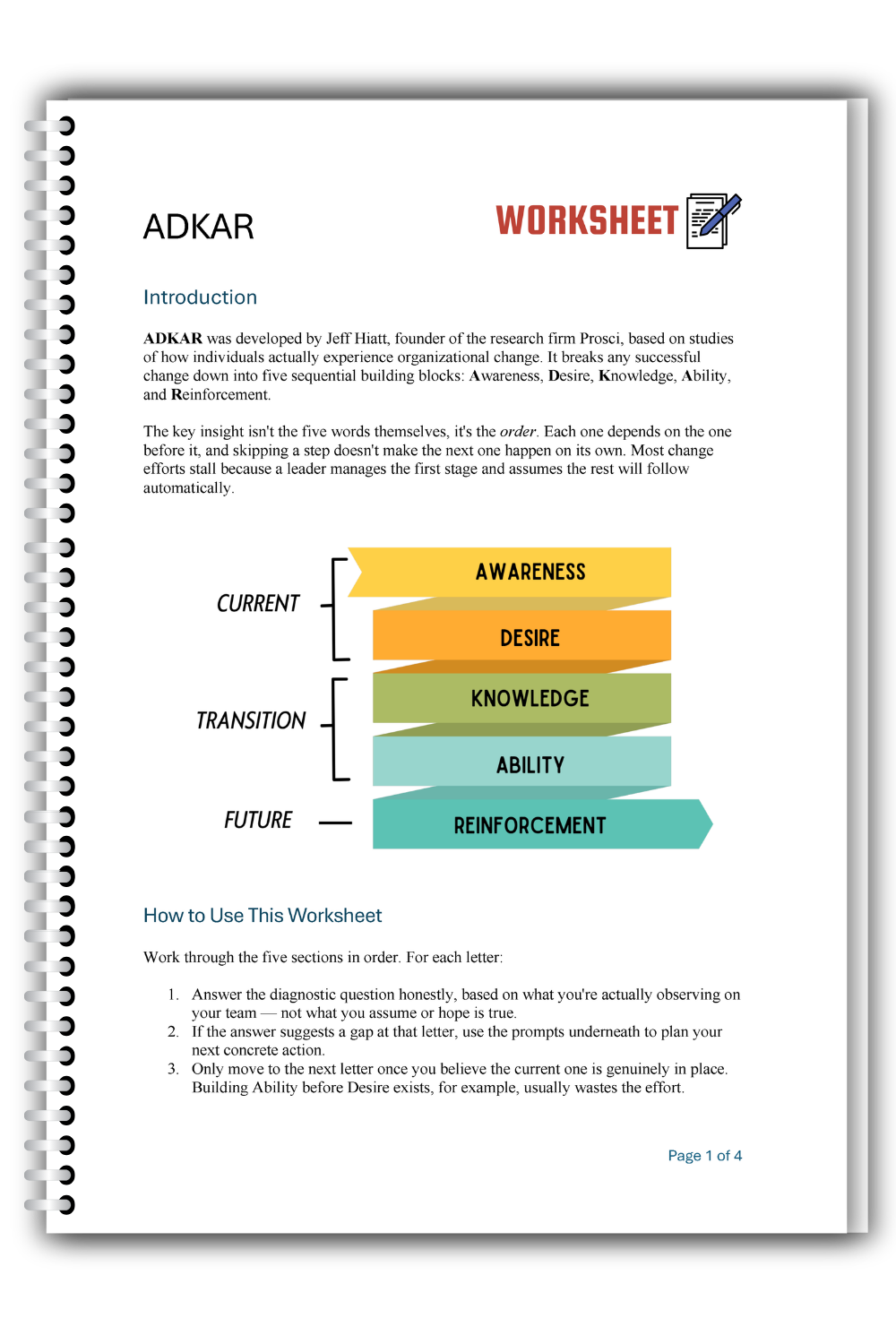
Use this worksheet to:
Pinpoint exactly which stage a stalled change is stuck on, instead of guessing at “resistance”
Plan the right next action for that specific stage
Prepare a rollout so every stage gets deliberate attention, not just the parts that come naturally
How to download the worksheet
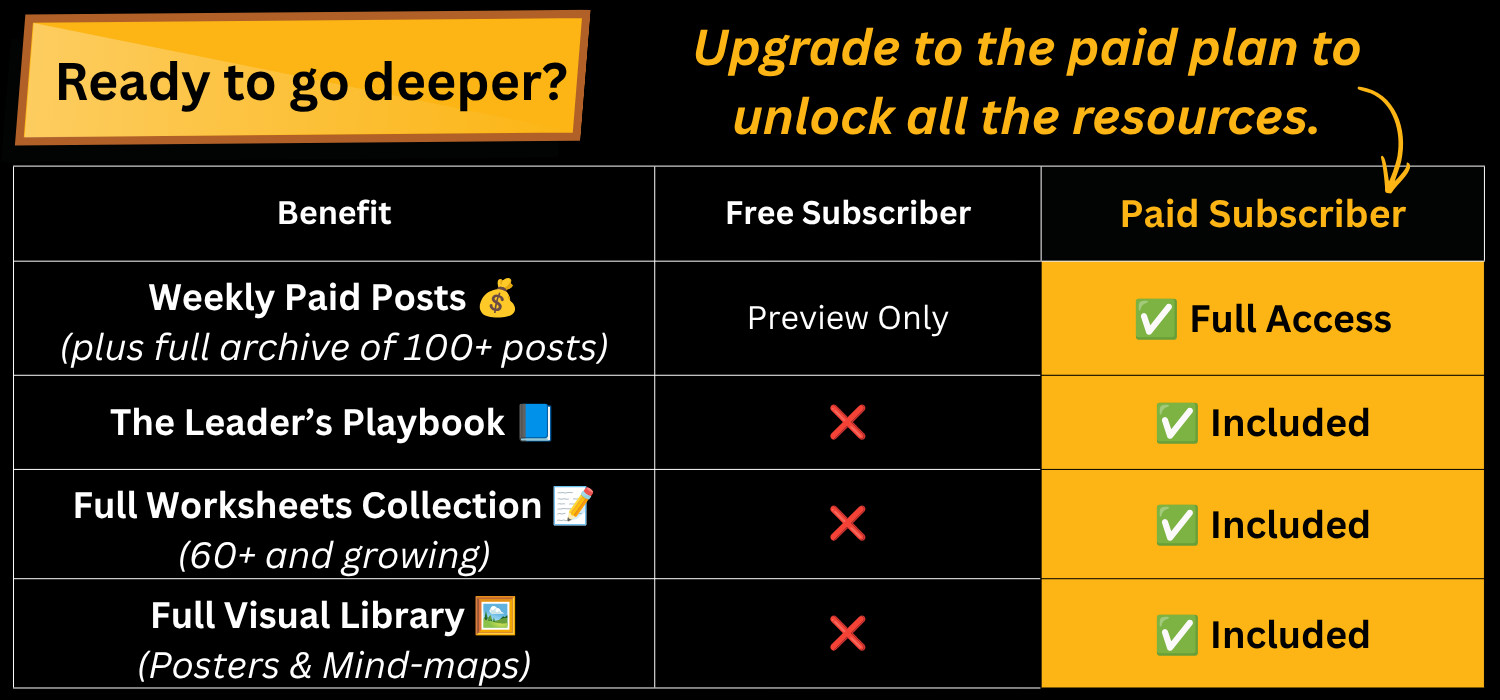
This worksheet is part of the Worksheets Collection, available to all paid subscribers to The Good Boss.
👉🏻 Upgrade to paid now and get instant access to the entire collection, including this worksheet.
If you prefer the standalone worksheet, you can purchase it from here.
The One Question: Which Stage Are We Stuck On?
When a change effort stalls, most leaders ask “why aren’t they doing this?” That question is too broad to act on. It invites vague answers like “resistance” or “culture,” and neither one tells you what to actually do next.