

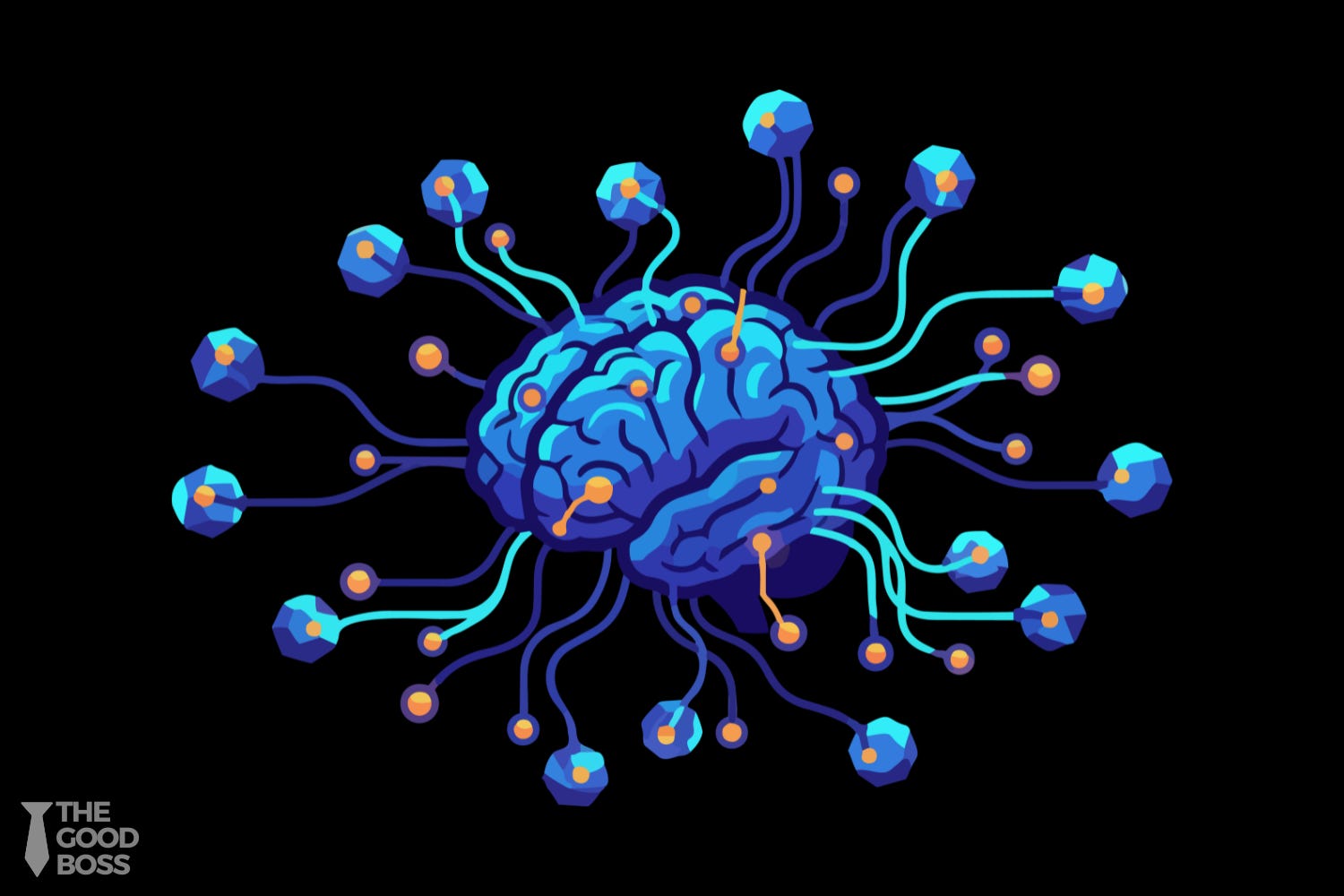
A manager I know spent three hours last week writing a performance review.
He was careful with the language, balanced it with the feedback, and inserted specific examples to make it more grounded. Like many managers, he was a bit anxious over every sentence.
Then a colleague showed him how to do the same thing in four minutes with AI.
He laughed about it. But later, over coffee, he said something that stuck with me: “If we can do all that with AI, what exactly should managers be doing today?”
I think it’s a great question to ask ourselves, and something I’m going to try to answer in this post.
The Uncomfortable Truth About “Management”
If you think very objectively, a huge chunk of what we call “management” is information processing.
Summarizing releases, actions, and notes.
Tracking status, releases, operations.
Writing down what was decided.
Flagging what’s at risk.
Reporting upward.
Translating downward.
and the list goes on.
For decades, this work was glued to the manager role because it required human time and human judgment to do it. Now, increasingly, it doesn’t.
AI can summarize your team’s sprint.
It can draft the stakeholder update, or the email to your leadership.
It can flag the performance pattern before you notice it yourself.
and a whole lot more.
So, we can now see a glaring gap in what we used to do, and what we should do. The way I look at it is this:
AI didn’t create this gap. It just made it visible.
When I speak with leaders across levels these days, I find a subtle pattern in their take on AI:
The leaders who feel most threatened right now are often the ones who built their value on being the most organized, most responsive, most on-top-of-it person in the room.
Granted, that is a real skill, and it has genuine value.
But with AI, it is no longer scarce. And as the fundamental principle of value goes: value, in any system, flows to what is scarce, not abundant.
What AI Cannot Do
Now let’s be real - AI can’t do everything. After all, it’s ‘artificial’.
AI can’t sit across from Sarah on your team who is burning out, and know that what she actually needed is not a ‘performance plan’. What Sarah really needed was someone who could have a real, human conversation with her.
It can’t make a call with 70% information, own the risk publicly, and rally a team to move, knowing that a lack of decision costs more than a wrong decision later.
It can’t build trust. It can’t make your team members believe it will be right by them when they need that support.
Some people think of these as ‘soft skills’ and dismiss them as if they don’t matter.
But honestly, I think they are the highest-leverage things a leader does. They are also the hardest to develop, the hardest to measure, and the easiest to deprioritize because there was always an urgent email to answer or a Slack message to respond to.
Well, guess what: that excuse is gone now, thanks to AI.
The Distinction That Changes Everything
Here’s the fundamental distinction that I want you to understand:
Management is a function. Leadership is a relationship.
A function can be optimized. A relationship has to be earned.
You can automate a workflow. You can’t automate trust.
To be clear, this is not a new idea.
The best leadership thinkers have been saying it for years: your job is not to “manage deliverables”, it’s to create conditions where people can do their best work. That’s what leadership really is.
But most organizations were too busy running the machine to actually operationalize that.
The good news is that AI is now running parts of the machine, which means you finally have to decide what you’re actually here to do.
Here’s my honest take: the managers who will struggle in the next two to five years are not the ones who can’t use AI tools. They’re the ones who can’t answer this question:
If the administrative work disappeared tomorrow, what would I do with the time?
If the answer is “I’m not sure”, the next section should help you find out the answer for yourself.
Three Questions Worth Asking Yourself
Here is a simple reflective exercise. Take out a piece of paper (or your Notes app) and answer these questions, honestly:
Do my team members come to me for tasks, or for judgment? There’s a difference between a manager whose team needs them to unblock tickets and a leader whose team needs them to help think through hard calls. Both are real, but only one is irreplaceable.
Am I growing my team, or just managing their output? Output can be tracked, but growth takes presence, coaching, and the kind of human judgment that can tell when someone is ready for more before they ask for it.
What would my team say I’m actually here for? This is more open-ended, but really - what does your team find most value out of your role as their leader? If you’re comfortable, ask them. If not, just write what comes to mind instinctively and honestly.
The Real Opportunity
If you ask me honestly about how AI impacts leadership, I’ll say it in one sentence:
AI is not shrinking the leadership job. It’s clarifying it.
For decades:
The urgent crowded out the important.
Status reports crowded out strategy.
Shipping faster crowded out the coaching conversation that would have changed someone’s trajectory.
Over my 25 years in the corporate world, the best leaders I’ve known spent their time on the deeply human work: the coaching, the conflict, the clarity, the trust-building.
And it’s not that they didn’t have the administrative pressure or the release timelines. Of course they did. But they refused to let those pressures own them - they protected time for what mattered most.
The best managers didn’t prioritize their schedule - they scheduled their priorities.
The beauty of AI is that it is about to hand that gift of the most important parts of leadership to the rest of us. Now we have more time, and fewer excuses.
The question now isn’t whether AI will change how you manage. For sure, it will, and it already has. The real question is whether you’ll use the space it creates to finally lead.
💬 Let me know in the comments - what aspect of your role do you see changing with AI?
If you found this useful, you might also like:
❤️ Found this helpful?
If you found this post helpful, please like and share it with other managers who can benefit from it, including your boss :) If you have any feedback, please drop your comment below - it helps me keep improving the content. Thank you!

Love these insights - AI is rocking my world but also reminding me what makes us good leaders, and it certainly isn't our tools!
One of the best articles I have read on AI and leadership. Thank you @GaurayJain