

In this issue:
The Deck That Almost Fooled Everyone
The AI Confidence Trap Explained
How AI Is Pulling Confidence and Competence Apart (The Three Shifts)
Why This Matters for Leaders
The One Shift: Assess the Thinking, Not the Output
How This Plays Out in Real Teams
Common Pitfalls (and How to Avoid Them)
Final Thoughts
The Deck That Almost Fooled Everyone
A few days ago, our VP dropped a message in Slack asking for numbers to substantiate a new initiative we were considering.
Within an hour, our PM had responded with a polished deck. The deck had lots of data, just like what was asked: clean charts, lots of data points, and a compelling narrative.
I’ll be honest: my first reaction was impressed. The argument it made was convincing, but something inside me couldn’t settle just yet.
A few of the numbers didn’t quite match my intuition about what the data should look like. So I asked the PM a simple question: had he verified these numbers with the data engineering team?
Apparently, he hadn’t.
I took the figures to my data engineers, and what they found was an eye-opener. Data was being used to support interpretations it didn’t actually support. Numbers were cited without the context that would have completely changed their meaning. A few of the figures were just wrong.
The deck looked authoritative, but the underlying analysis was broken.
What struck me most wasn’t that the PM had cut corners: he was responding quickly to a senior ask, which is exactly what you’d want someone to do. What struck me was how convincing the output was. If I hadn’t pushed, that deck might have sailed straight into a VP conversation and shaped a real decision. Nobody in the room would have known the foundation was shaky.
This is the risk that keeps me up a little more than it used to.
AI can produce a polished, confident, well-structured argument for almost anything, including things that aren’t true. And in a world where that capability is available to everyone on your team, the leaders who don’t learn to look past the polish are going to get burned.
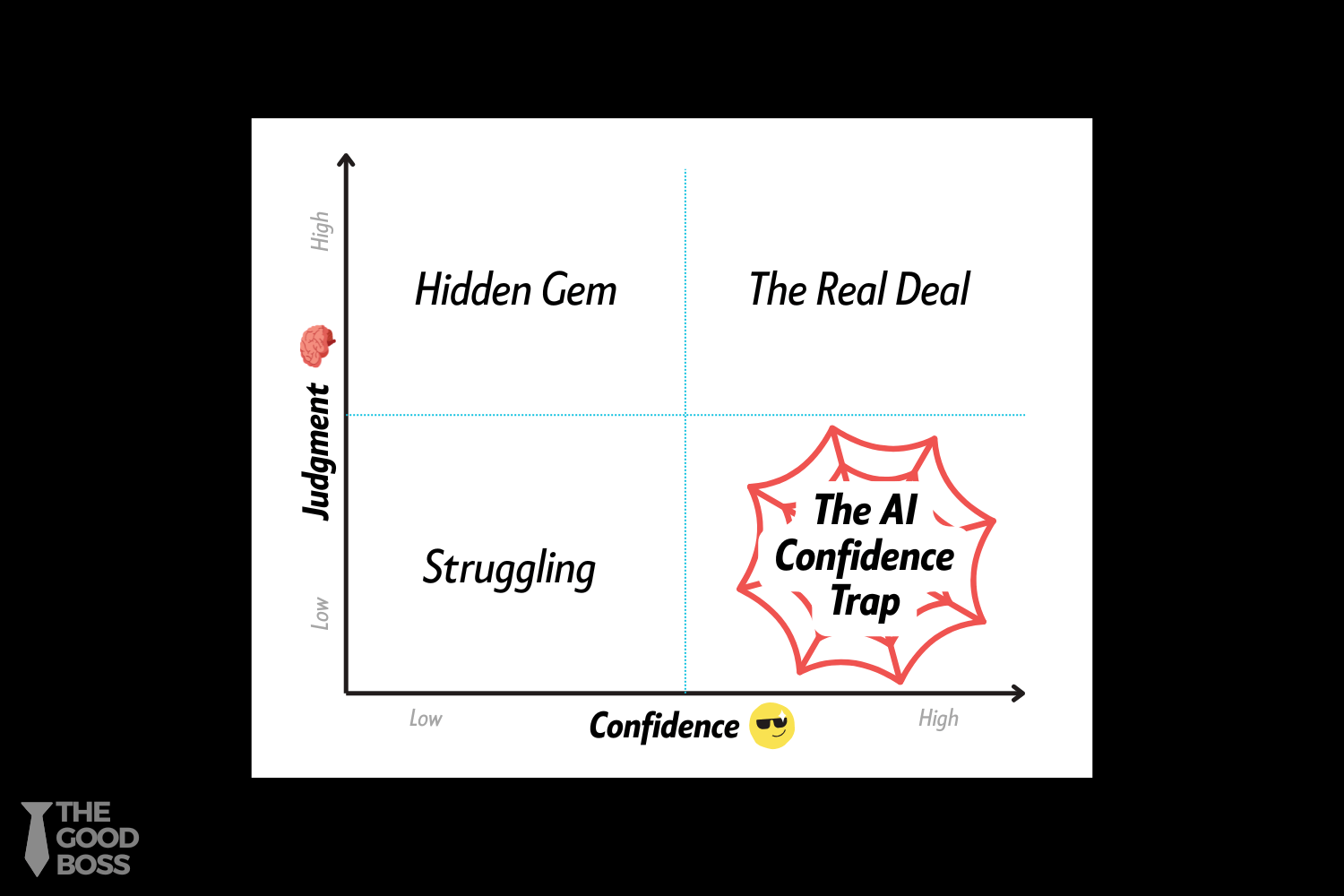
This is what I’ve come to call the AI Confidence Trap.
The AI Confidence Trap Explained
The AI Confidence Trap is what happens when AI-generated polish creates the appearance of competence that isn’t fully there, and leaders and even individuals themselves mistake that appearance for the real thing.
To be clear, in most cases, the person using AI isn’t trying to deceive anyone. They’re doing what any sensible professional does: using the best available tools to produce the best possible output.
The problem is that AI has made it genuinely difficult to tell, from the output alone, how much “thinking” actually went into it.
For most of professional history, the quality of someone’s written output was a reasonable proxy for the quality of their thinking.
A well-written document usually meant a well-thought mind had produced it.
A clear, confident recommendation usually meant someone had done the work to arrive at it.
A detailed thesis usually meant the student or researcher had spent months on extensive research.
A striking piece of visual art usually meant someone had spent years developing a craft.
Output and capability moved together, not exactly in tandem, but closely enough that leaders could use one to infer the other.
Today, AI has broken that relationship.
Now, a well-reasoned document might mean a well-reasoned mind… or it might mean a capable prompter and a powerful language model.
A confident, comprehensive analysis might reflect deep expertise… or it might reflect a good template and fifteen minutes.
A striking piece of visual art might mean years of developed craft… or it might mean a well-written prompt and a image generation tool.
The problem is: from the outside, these can look identical.
And this creates a new leadership challenge, which is the heart of the AI Confidence Trap:
How do you assess judgment, develop capability, and make good decisions about people when the primary signal you’ve historically relied on (output quality) is no longer reliably telling you what you think it is?
How AI Is Pulling Confidence and Competence Apart (The Three Shifts)
The AI Confidence Trap shows up differently depending on where you look. Here are the three places it’s most likely to be affecting your team right now.