

In this issue:
The Rollout Nobody Noticed
Understanding Amara’s Law
The Two Mistakes
Applying Amara’s Law in Practice
The Two-Horizon Check
How This Plays Out in Real Teams
Common Pitfalls (and How to Avoid Them)
Final Thoughts
The Rollout Nobody Noticed
In 2024, I introduced GitHub Copilot, one of the first popular AI coding tools, to my team.
I’ll be honest - initially, I was skeptical, and so was my team. Some of the engineers tried it for a week and went back to typing code by hand. I remember one of them telling me, half-joking, referring to it as a “fancy autocomplete”.
Initially, the adoption was slow, and I started feeling like I had pushed the team toward something that wasn’t really helping.
Then, a few months later, I introduced Cursor, and later, Claude Code. By this time, the quality of the code and the reliability of these tools had dramatically improved. I saw adoption picking up, slowly at the beginning, and fast later.
Fast forward to today, and my entire team is using Claude Code or Cursor for pretty much all their engineering work, including coding, testing, documentation, and even full spec-driven development workflows.
Nobody is asking whether they should use AI any more.
And, interestingly, nobody on my team remembers being skeptical. I barely remember it myself until I look up the old adoption numbers.
I’ve noticed this pattern before. Whenever I introduce something new to the team, such as a tool, a workflow, a process, it tends to go the same way, almost every time.
Turns out, there’s a name for this phenomenon, Amara’s Law, which is exactly what we will discuss in this post. We will discuss how it works and how you can leverage it as a manager.
Ready to dive in? Let’s go!

Understanding Amara’s Law
Amara’s Law was introduced by Roy Amara, who was a researcher at the Institute for the Future.
Roy’s idea was simple:
We expect too much from a new technology in the short run, and too little from it in the long run.
In plain terms: the hype and the reality move at different speeds, and they cross at a point almost nobody is watching for.
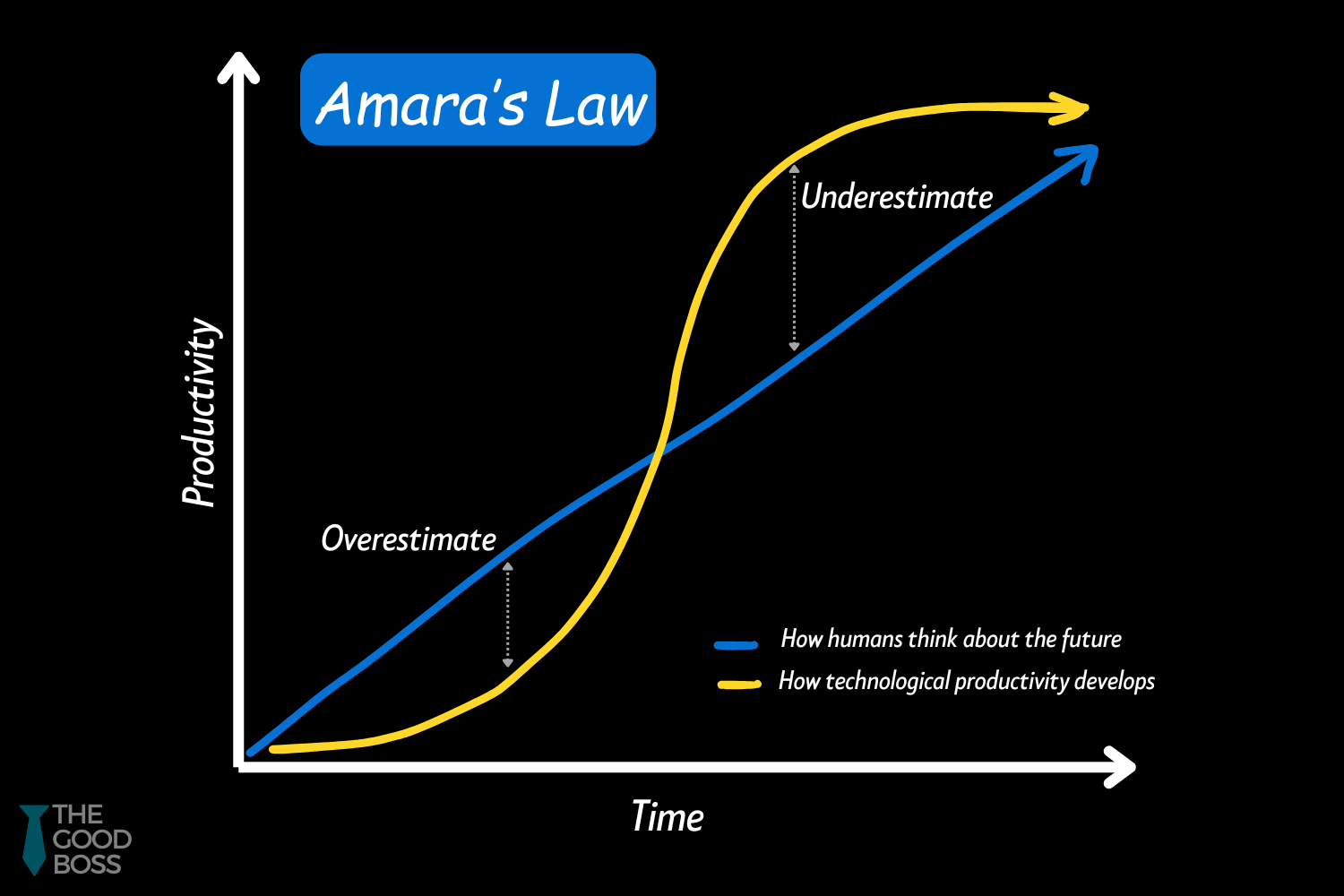
When a new technology is introduced, expectations are high at first. I remember feeling the same when I first got my hands on an iPod (for those of you old enough to remember that!) in the 2000s. I thought I could carry my whole music collection everywhere and never touch a CD again!
That was the hype phase, or the “this changes everything right now” phase.
Then, as I started using my brand new iPod, I faced the reality behind the hype. My iPod skipped exactly when I didn’t want it to, and the battery died too quickly for my tolerance. I remember thinking that I should just switch back to the good old Sony Walkman.
That’s the trough, or the point where expectations drop, and people start writing the technology off.
But behind the scenes, the tech kept getting better. I upgraded to the next generation of iPods over the course of the following years. The storage was bigger, synching got faster, and the battery life improved. Most people, including myself, had already stopped paying attention by then. And then one day, nobody was talking about it anymore - we just had our whole music library in our pocket.
The iPod wasn’t a gadget anymore. It was just how you listened to music.
Two years ago, I’d say my team was somewhere between those two points with AI tools… past the hype phase, but still in the trough. If you’re driving AI adoption in your team right now, you’re probably in that same spot.
The Two Mistakes
I’ve found that most leaders make one of two mistakes when something new comes up, like a new technology or a new capability.
The Hype Mistake. This is when you are overexcited about something, too soon. For example, if you’re excited about the impact of AI, you tell your VP that AI will cut delivery time in half by next quarter. But when actually executed, it doesn’t happen. Now every claim you make is seen with more skepticism.
The Dismissal Mistake. This is when you’re over-cautious or skeptical. For example, if you’re skeptical about AI and see it as a ‘fancy autocomplete’, you decide just to sit it out and not introduce it into your team. Then, a few months in, it gets a lot better and hard to ignore.
I’m sure you’ve noticed that both of these mistakes are nothing but two sides of the same coin.
The common theme is this: You looked at the technology once, at one point in time, and used that single look to decide where it’s going.
Applying Amara’s Law in Practice
For the rest of this article, we will focus our attention on putting Amara’s Law into practice in your own organization. As we do that, don’t forget to download Amara’s Law Worksheet.
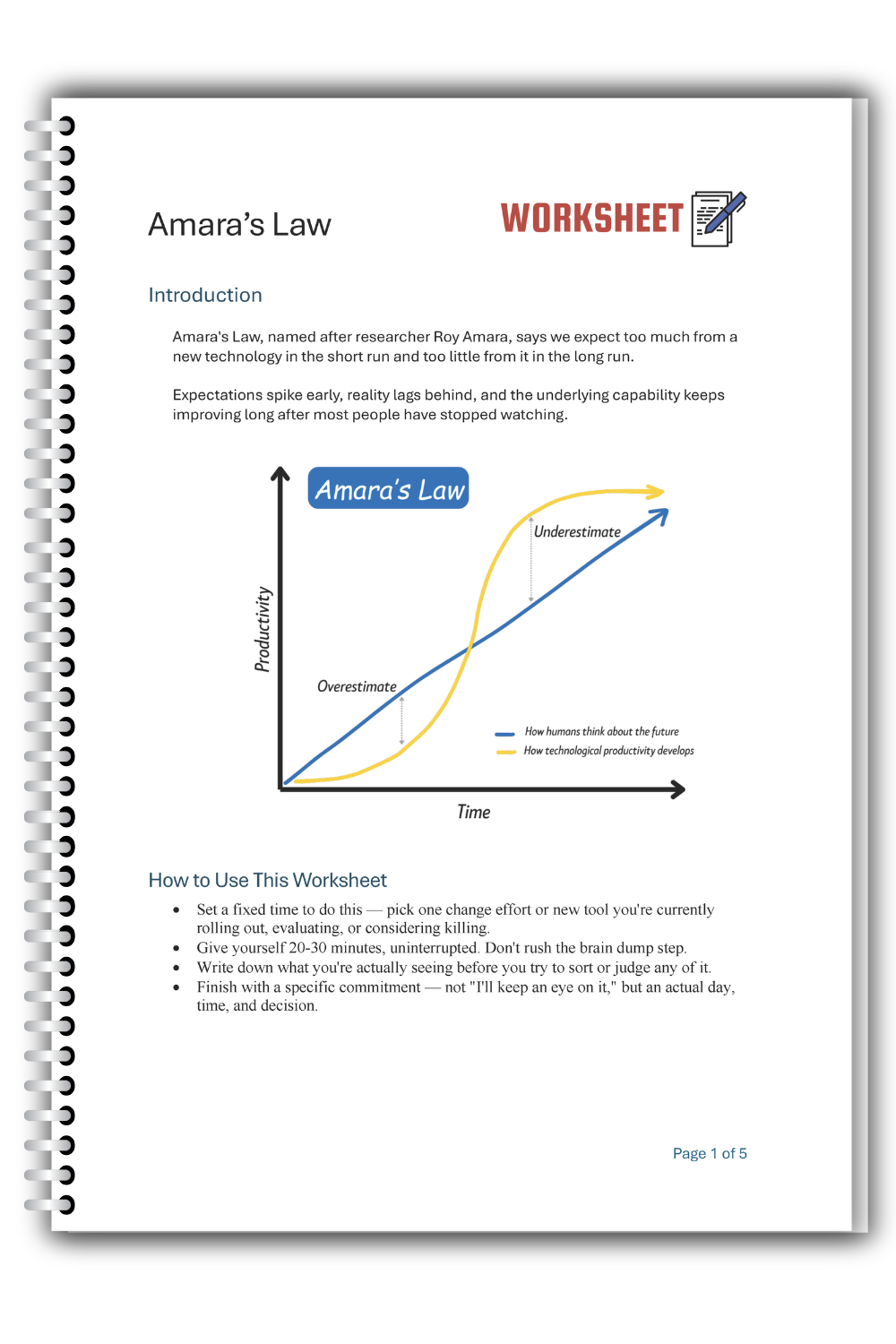
Use this worksheet to:
Decide whether a stalled tool or change effort is actually failing, or just in the trough before it takes off
Catch yourself before you promise a timeline you can’t back up
Get honest about whether your team’s pushback is about today’s version or an old, weaker one
How to download the worksheet
This worksheet is part of the Worksheets Collection, available to all paid subscribers to The Good Boss.
👉🏻 Upgrade to paid now and get instant access to the entire collection, including this worksheet.
If you prefer the standalone worksheet, you can purchase it from here.
The Two-Horizon Check
Use this simple technique to catch yourself making the Hype or Dismissal mistake, and to move towards the more practical decision whenever you see something new.