

I almost didn’t finish this book the first time.
The title and cover told me it was a communication skills manual, the kind of thing HR hands you in a binder you never open again.
Then I hit the chapter on the “Path to Action” and had to put the book down for a minute, because it described, almost exactly, a conversation I’d botched with a direct report just a few months earlier.
It wasn’t the words I said, but the thinking that led me to say them. That’s the thing about Crucial Conversations by Joseph Grenny et al.
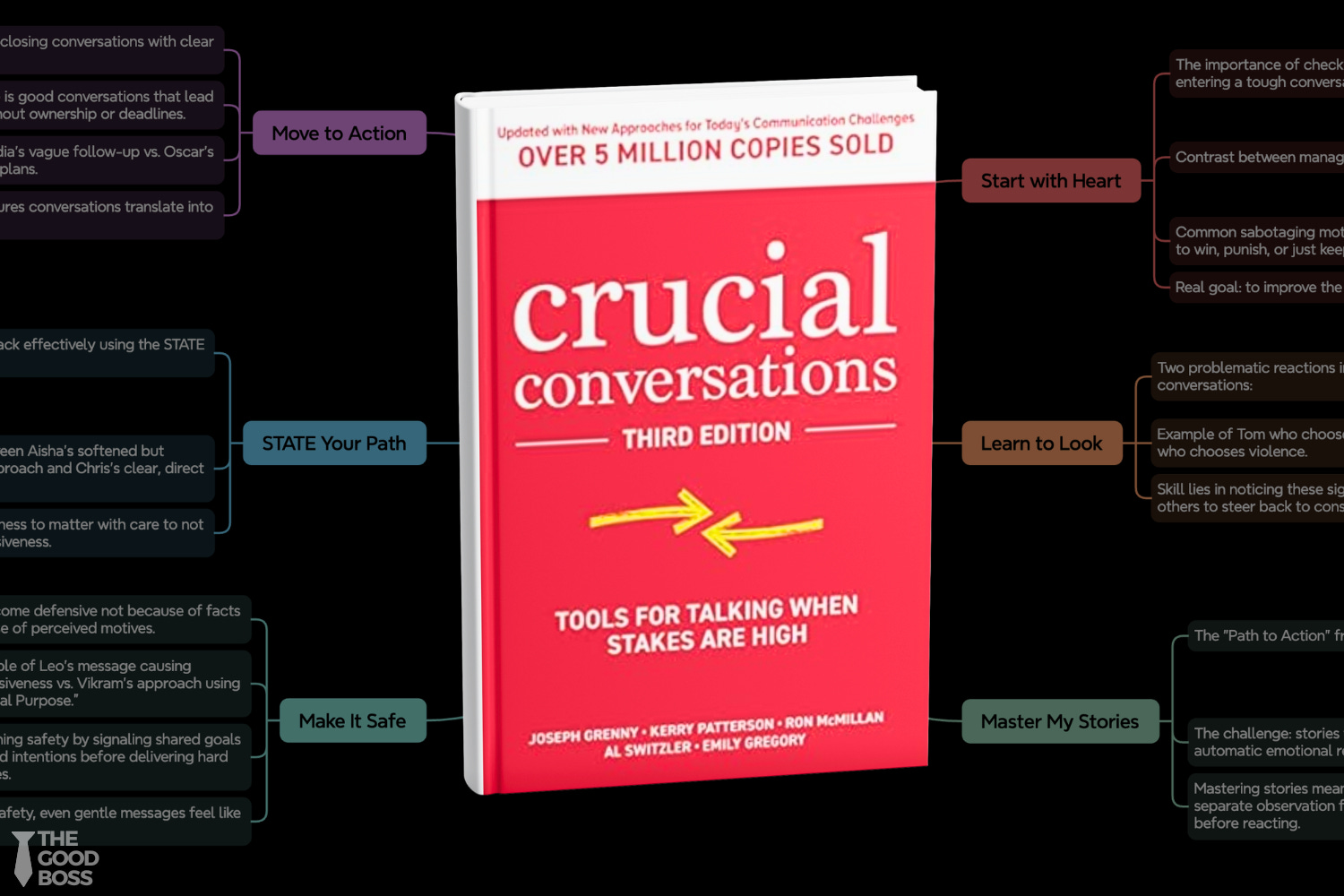
It’s not really a book about talking.
It’s a book about the half-second before you talk - the story you tell yourself about what’s happening, and how that half-second decides whether the conversation goes well or badly before a single word leaves your mouth.
This is the second post in the book-summary format I started with The 7 Habits last week. Same idea: I’m not recapping the book, I’m translating it into what you can actually use the next time a conversation at work gets tense. If you like this format, I’d love to know if there are any books you would recommend I read and distill like this.
When a Conversation Turns “Crucial”
Imagine two managers, Diego and Hannah, get blindsided in the same way: a peer of theirs - Martin - takes credit for their team’s work in front of the leadership group.
Diego, the first manager, feels his face go hot, says nothing in the room, and spends the next three days building a case in his head. He replays the moment dozens of times, drafts the email he’ll never send, and convinces himself that Martin “always does this.” By the end of the week, he’s cold in every meeting they’re both in, and nobody knows why.
Hannah, the other manager, feels the same heat as Diego. But she does something Diego didn’t: she tells herself that this is now a crucial conversation. She recognizes the high stakes, the differing opinions about what actually happened, and the real emotion in the room. She doesn’t say anything in the meeting either, just like Diego, but she books fifteen minutes with Martin that same afternoon, before the story in her head has time to harden into a verdict.
The book’s core distinction is simple: most conversations are just conversations.
A crucial conversation is one where the stakes are high, opinions differ, and emotions run strong, and the moment you notice all three, the normal rules stop working.
You can’t wing a crucial conversation the way you’d wing a status update.
Start with Heart
Here’s a scenario every manager has lived: a 1:1 conversation with someone underperforming, where you walk in already right.
Marcus, a manager at a tech company, has been dreading this one for two weeks. He walks into the 1:1 with Pooja, having mentally rehearsed exactly how he’ll prove that her performance gap is real, with key numbers loaded and ready to spill out, and ready to win the argument. Fifteen minutes in the 1:1, Pooja is defensive, and the meeting is unidirectional. At the end, Marcus leaves the meeting thinking “I said everything I meant to say” as if that’s the win condition, even though it left Pooja feeling misunderstood and miserable.
Elena, another manager at the same company but a different division, has a similar conversation the following week with her direct report, Chris. Before she walks in, she asks herself the question the book calls Start with Heart: what do I actually want here for myself, for Chris, and what do I not want? She realizes that what she really wants is for Chris to actually improve, not for herself to be “right”. That reframes the entire 30 minutes of the 1:1 that follows.
Start with Heart means checking your own motive before you open your mouth.
Most managers walk into hard conversations wanting to win, to punish, or to keep the peace, and each of those motives ultimately sabotages the actual goal, which is almost always some version of “I want this to get better.”
Learn to Look
The book has a phrase for the two ways crucial conversations go wrong, and once you learn it, you start seeing it everywhere:
People turn to silence, or
People resort to violence.
Tom, an Engineering Director at a fast-growing startup, is in a planning meeting where the roadmap he built gets quietly gutted by a VP two levels up. What does Tim do? He nods, says “makes sense,” and goes silent for the rest of the meeting with no pushback, no questions, nothing. Everyone reads this as agreement, but it’s actually withdrawal.
Renu, another Director at the same company, is in a different meeting with the same VP, and her proposal is torn apart by the VP. What does Renu do? She doesn’t go quiet. Instead, she goes sharp: she starts pulling up her “backup slides” with hard data and numbers, stacking her arguments, and waits for the VP to respond to them. She maintains eye contact, and stays visibly engaged and alert. Everyone reads this as confidence.
Learn to Look is the skill of noticing these two patterns (in others and in yourself) the moment they show up.
Silence shows up as sarcasm, masking, or just going quiet.
Violence shows up as controlling, labeling, or attacking.
Neither one is the right path forward.
Master My Stories
This is the section that stopped me cold the first time I read it, because it names something I do constantly and rarely catch myself doing.
Ben, an engineer on a scrum team, notices Farah, his peer, hasn’t responded to his Slack message in four hours. By hour two, he’s decided she’s ignoring him on purpose. By hour three, he’s decided this is part of a pattern: she doesn’t respect his time. By hour four, he’s cold with her in the team standup, and she has no idea why, because she was in back-to-back interviews all afternoon.
The book calls this the Path to Action:
You see and hear something (no response),
You tell yourself a story about what it means (she’s ignoring me),
You feel an emotion that matches the story (disrespected), and
You act on the feeling (going cold).
The trap is that steps two and three happen so fast that you experience them as just facts. Ben didn’t feel like he was making up a story. He felt like he was just reacting to reality.
The book proposes the idea of Master My Stories, which means slowing down that gap by asking what you actually saw versus what you’re telling yourself about it, before the feeling takes the wheel.
Make It Safe
Every manager has a version of this (myself included): a conversation where the content of what you’re saying is completely reasonable, but somehow the other person shuts down anyway.
Leo, an engineering manager, tells Kelly, an engineer on his team, that a client complaint came in about a missed deadline. He does this calmly and factually, with nothing accusatory in his wording. Kelly, however, immediately becomes defensive, starts explaining, and then goes quiet mid-sentence and disengages for the rest of the conversation. When Leo leaves the meeting, he wonders, “I didn’t even say anything harsh… why did that go so badly?”
Vikram, another engineering manager, has almost the same conversation with his own report, Pat, a month later. Before he gets to the complaint, however, he opens with something the book calls Mutual Purpose: a quick, genuine signal that she’s on this person’s side, not against them: “I want to figure this out together, not build a case against you.” The message is still hard, but the reaction is very different because the safety was established before the content landed.
Make It Safe is the finding that people don’t get defensive because of what you tell them. They get defensive when they sense that your motives are working against them, not with them.
Once safety is restored, you can say almost anything. Without it, even a gentle sentence feels like an attack.
STATE Your Path
Delivering hard feedback is where most managers either go too soft to matter or too hard to land.
Aisha, a marketing manager, needs to tell a peer that his part of a joint project is consistently late, and it’s making her look bad to their shared stakeholder. She opens with three minutes of cushioning: “this might be nothing, I’m probably overthinking it, feel free to ignore this”, and, unsurprisingly, by the time she gets to the actual point, it’s so buried the peer doesn’t register it as a real issue. Nothing changes.
Chris, another marketing manager, has a similar conversation with his peer. He uses what the book calls STATE: he (s)hares the facts first (not the story): “the last three deliverables came in after the agreed date”. Then, he (t)ells the story he’s drawn from those facts: “I’m starting to worry this will affect how the stakeholder sees the whole project”. Then, he (a)sks for the other person’s view, and (t)alks with genuine concern to invite pushback rather than shut it down. The message lands as direct but not as an attack, because the facts came before the judgment.
STATE is the difference between softening a message until it disappears, and delivering it hard enough that it registers without triggering defensiveness.
Fact first, story second, invitation to respond always.
Move to Action
The most common failure mode in leadership isn’t a bad conversation. It’s a good conversation that goes nowhere, because nobody closed the loop. Sound familiar?
Nadia, an engineering manager, runs a retrospective session with her team. There’s good energy in the room, real insight popping up, and everyone agreeing to a plan to fix the handoff process between two teams. However, two weeks later, nothing has changed because the meeting ended with a vague “let’s all be better about this” with no owner, date, or follow-up.
Oscar, also an engineering manager, runs a similar retro the following sprint with his team. The discussion is productive, just like with Nadia, but he ends it the way the book insists every crucial conversation should end: who does what, by when, and how will we follow up.
Move to Action is the unglamorous final step that most leaders skip because the hard emotional work already feels “done” once the conversation goes well.
It isn’t done.
A crucial conversation that doesn’t end in a clear decision is just a really good vent session.
If this format of book insights for modern leaders resonates with you, please hit reply and tell me. I would love your feedback and suggestions.
Putting It Together
The ideas from Crucial Conversations stack into three simpler questions you can actually hold in your head:
Before the conversation: is this actually crucial (high stakes, differing views, real emotion), and what do I really want here? That’s Learn to Look and Start with Heart, your prep work, done before you walk in.
During the conversation: am I noticing when I or the other person shift toward silence or violence, am I checking my story against the facts, and is this still safe for both of us? That’s Learn to Look again, Master My Stories, and Make It Safe, your real-time diagnostics.
Delivering the message: say the hard thing using STATE, and don’t leave without a decision. That’s the closing pair of STATE Your Path and Move to Action.
Found this post insightful? Do restack and share with your network so it can reach more managers. Also, if you haven’t already, join The Good Boss community on Skool for a lively discussion on topics like this and more!
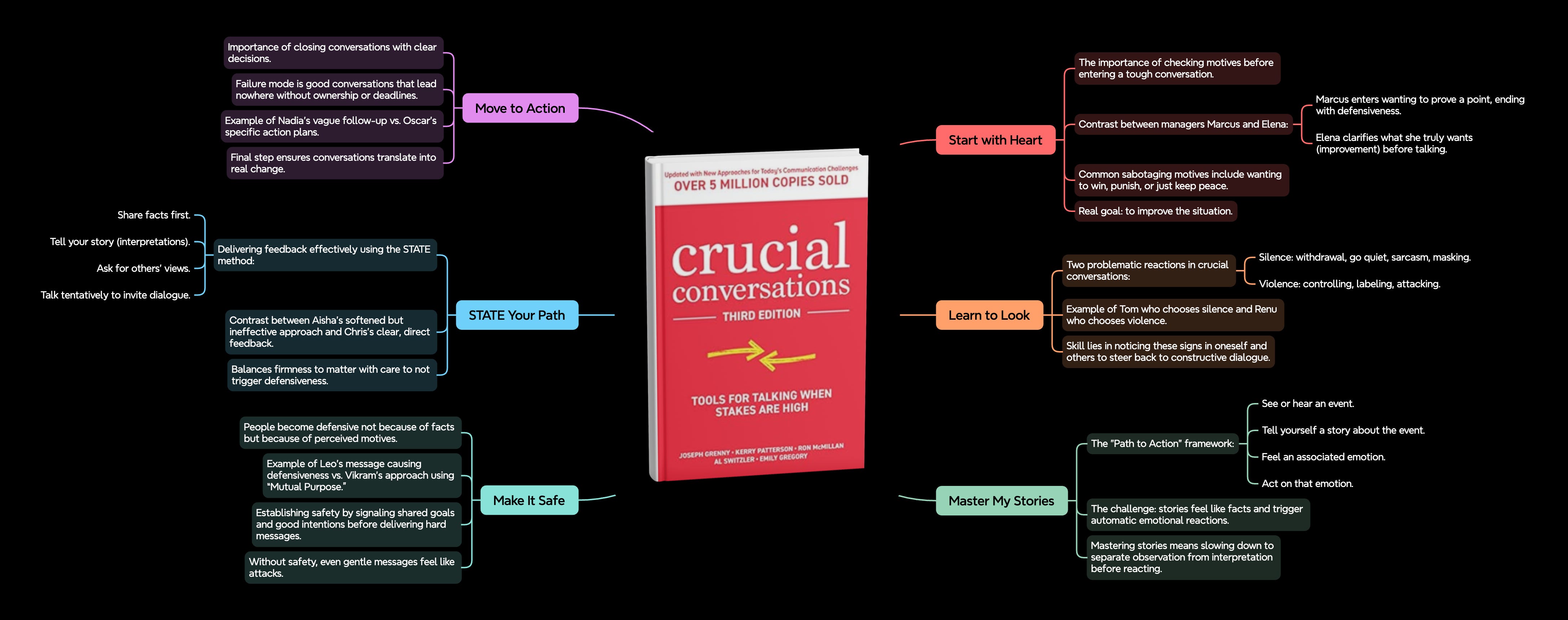
🧠 Download the Mind-map
If you are a visual person, like I am, you may want to check out the mind map that I created as a visual summary of the insights from the book.
❤️ Liked the post?
If you found this post helpful, please like and share it with other managers who can benefit from it, including your boss :)

Thanks for sharing your review. I found it very helpful ☺