

A few years ago, I was talking to a manager from another division, and he was telling me about his experience with a recent reorg that he was managing.
It wasn’t the first time he had managed a reorg. In fact, it was his third time, and he had actually developed a 3-step ‘playbook’ that he was planning to execute this time:
Have a clear checklist of tasks
Assign owners for each task
Set a two-week deadline for the alignment
This playbook had worked very well the last time when he had restructured his own team, and the entire change was completed in less than two weeks.
That wasn’t to be this time, though. This time, it took him six weeks to even notice that the plan wasn’t working. He later reflected that he was probably trying to solve this problem with a solution that was meant for a different kind of problem.
In this post, we will deep-dive into the Cynefin Framework, which is a powerful technique you can use to close that gap between the problem you think you’re solving and the problem you’re actually in.
I also have a whole chapter on this framework in my book, The Leader’s Playbook. If you’re interested, feel free to explore the book here.
Here’s what we will cover:
Where Cynefin Came From
The Four Domains
Why Cynefin Matters for Leaders
Applying Cynefin in Practice
The Domain Check Technique
Three Scenarios and how Cynefin plays out in them
Common Pitfalls (and How to Avoid Them)
Recommended Resources
Final Thoughts
Ready to dive in? Let’s go!

Where Cynefin Came From
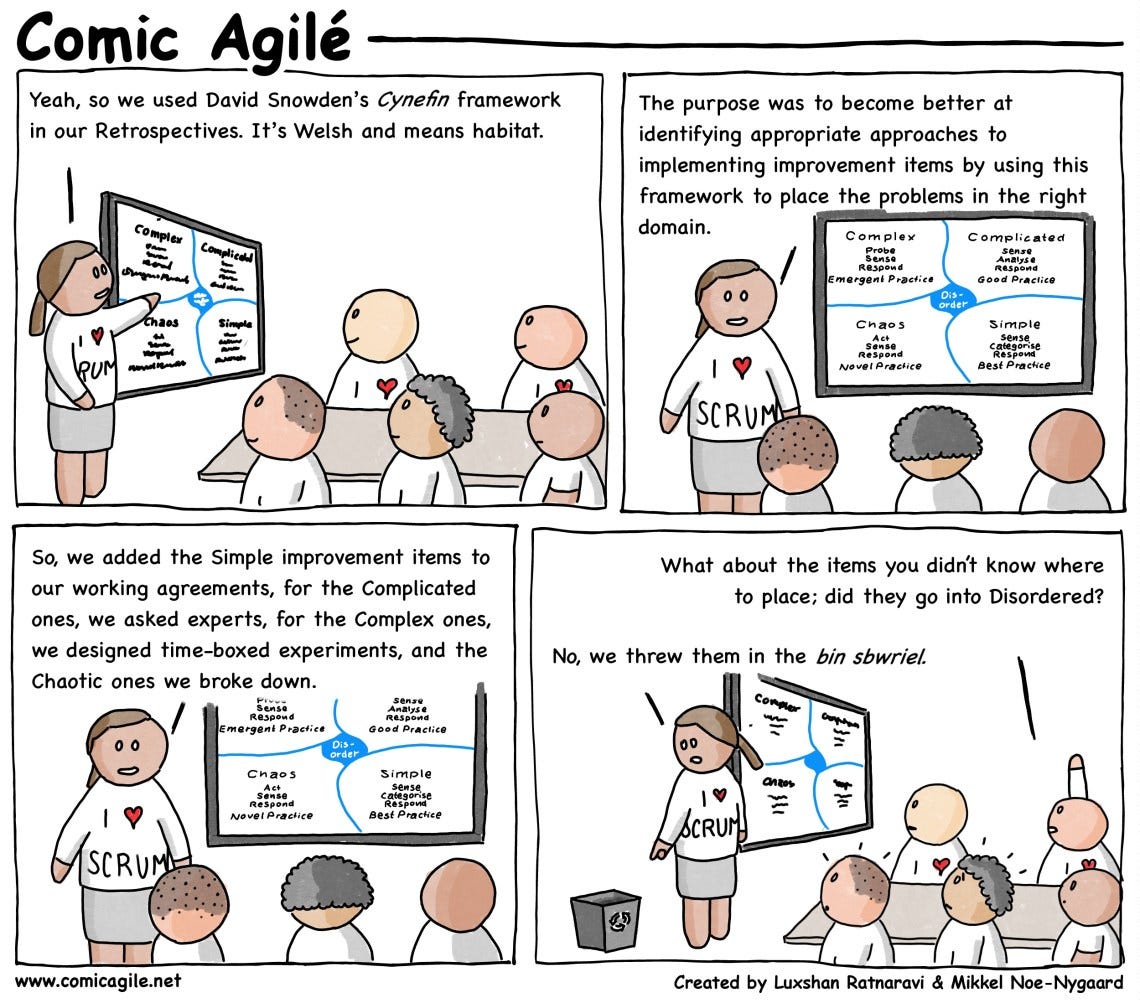
Cynefin was developed by Dave Snowden in the late 1990s while he was working at IBM. The name comes from a Welsh word roughly meaning “habitat” or “place of belonging”.
The core idea behind the framework is that the right response to a problem depends entirely on the habitat that problem lives in, not on how confident or experienced you are.
The Four Domains
Cynefin sorts problems into four domains, and the whole framework stems from one idea: each domain represents a different way of thinking, not just a different level of effort.
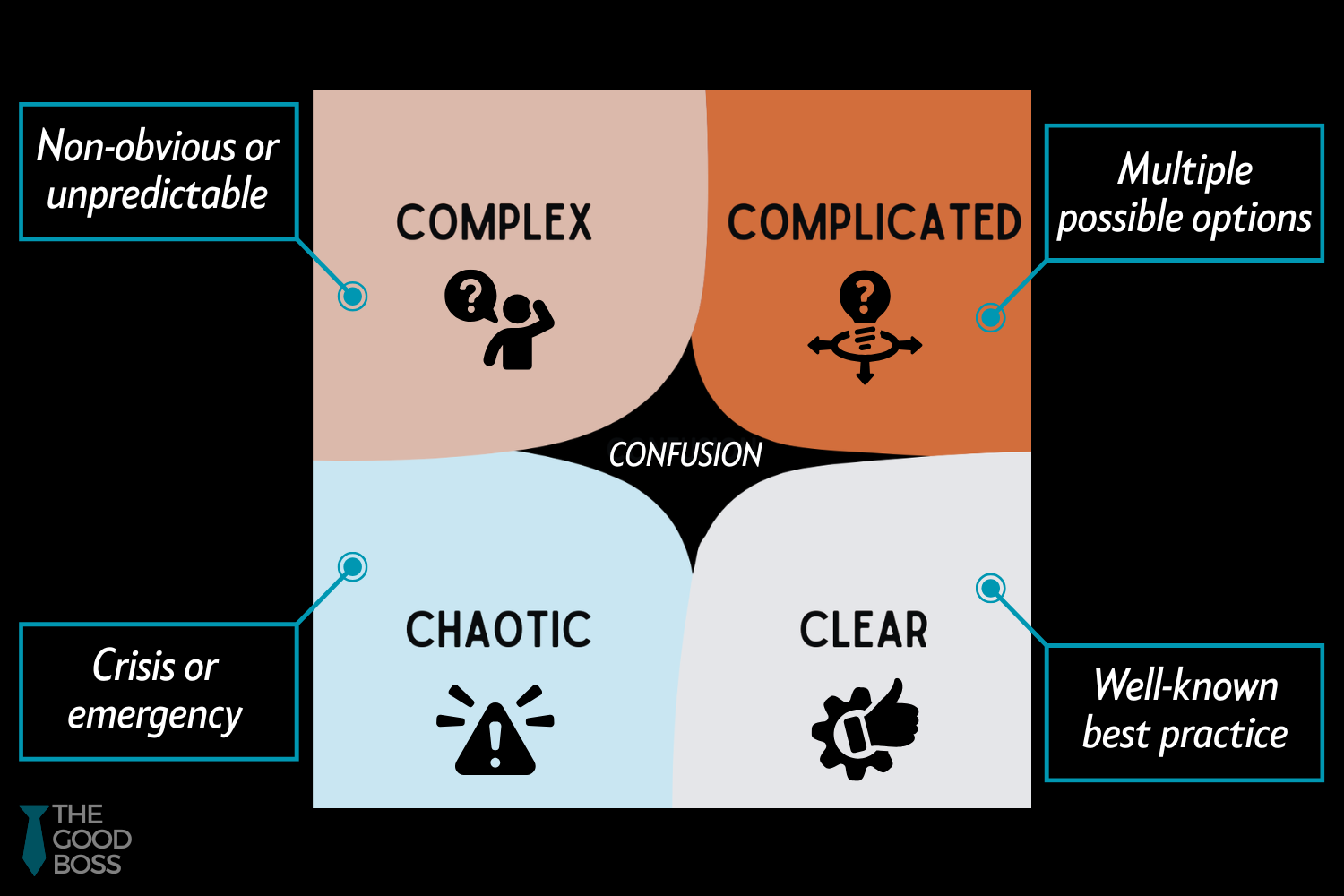
Clear. In this domain, the cause and the effect are obvious and known. There’s also a well-known “best practice”, and you just need to apply it. It could be as simple as an onboarding documentation, or a standardized deployment process, or in current AI times, a spec file that runs the SDD (spec-driven development) workflow.
Complicated. In this domain, the cause and the effect exist, but you don’t see them easily. You need a certain level of expertise to see them. Also, there isn’t one obvious answer, but there is a knowable range of good answers, and an expert can find one. Examples could be a complex architectural decision, or a legal question.
Complex. In this domain, the cause and the effect are only obvious later, in hindsight. You don’t have an expert who can tell you the right answer up front, because the system itself changes as you act on it. Examples of problems in this domain are people-related, such as team morale, cross-org dynamics, or the reorg example that I shared at the beginning of this post.
Chaotic. In this domain, there is no time to figure out the cause and the effect at all. You are time-pressured, and you don’t have the time to analyze it. Examples of problems in this domain could be a production outage, a safety incident, or a PR crisis.
Why Cynefin Matters for Leaders
I’m sure you’ve heard this many times from leadership gurus: if you want to be a good leader, you should be decisive, collaborative, and trust your gut.
However, Cynefin says that all of that advice is situational, and may not work in all situations.
For example:
A leader who is great in a crisis situation because he is fast, decisive, and directive, may be a poor leader if thrown into a Complex people problem because there the agility and decisiveness will likely backfire.
On the other hand, a leader who is careful and builds buy-in before every move, can literally freeze if thrown into a Chaotic situation because he doesn’t have the time to ask anyone what they think.
Have you noticed how the same manager can look like he’s doing a brilliant job with one problem, while being completely clueless with another problem? Or maybe found yourself in that situation?
That’s exactly why Cynefin matters for leaders, because it encourages us to act based on the situation or the domain, not just out of our expertise.
Applying Cynefin in Practice
So, how do you apply this framework in practice in your own leadership role?
I’ve put together a Cynefin Framework worksheet which walks you through step-by-step in applying this in your role.
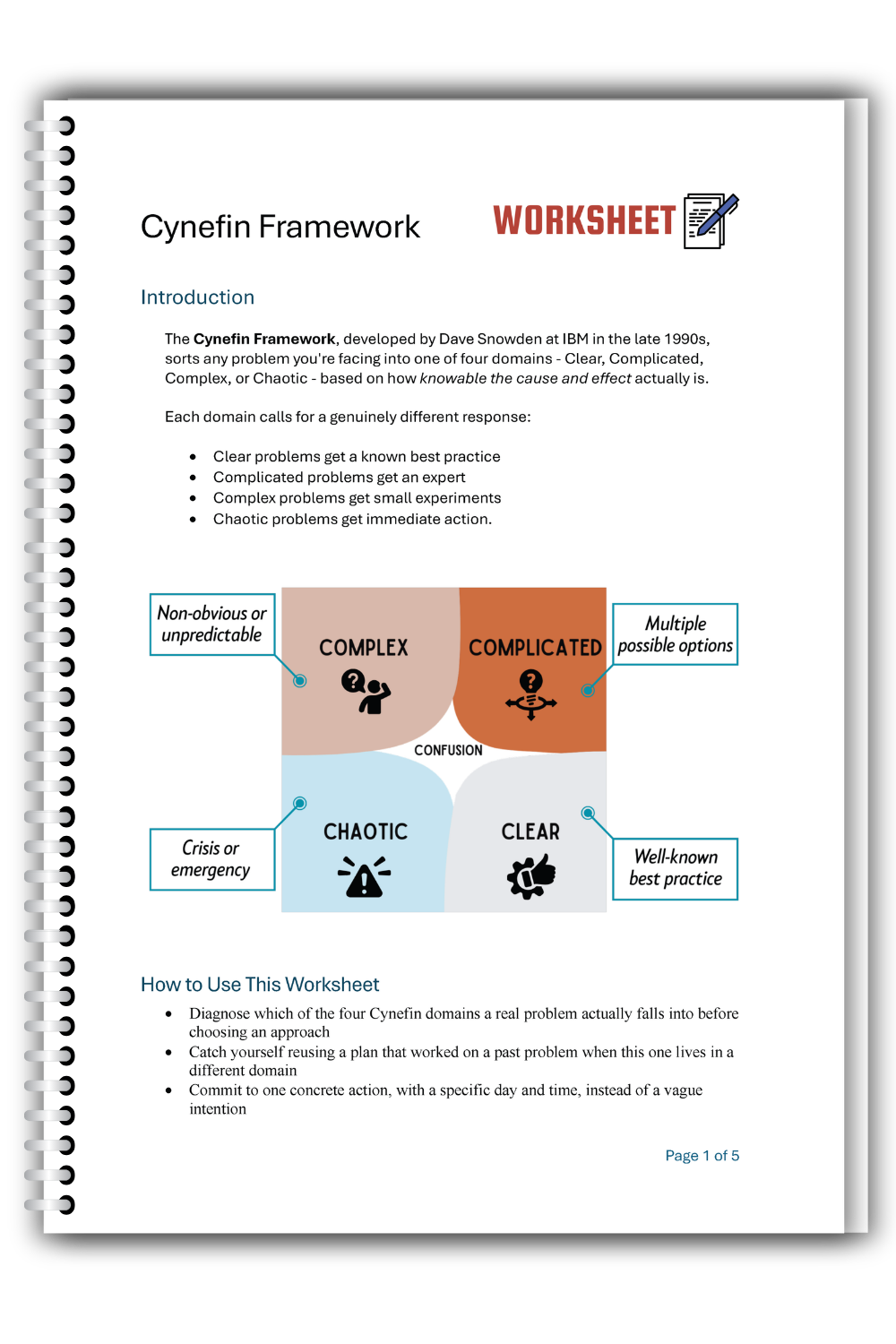
Use this worksheet to:
Diagnose which of the four Cynefin domains a real problem actually falls into
Force a fast, honest gut-check (via the Domain Check)
Commit to one concrete action, with a specific day and time, instead of a vague intention
How to download the worksheet
This worksheet is part of the Worksheets Collection, available to all paid subscribers to The Good Boss.
👉🏻 Upgrade to paid now and get instant access to the entire collection, including this worksheet.
If you prefer the standalone worksheet, you can purchase it from here.
The Domain Check Technique
Here’s the technique I actually use, and I’m calling it the Domain Check. It takes about two minutes, and I run it before any decision that feels bigger than a routine one.