

In this issue:
The Traditional Iron Triangle: Cost, Time, and Scope
Interpretation of The Iron Triangle
The Mind-Shift: Constraints to Opportunities
Bringing it together: The Value Triangle
Test Your Understanding
Practice This Framework
Download the worksheet
Create a Situation
How You Can Apply The Value Triangle
Common Mistakes To Avoid
Recommended Resources
Final Thoughts
It was the summer of 2015, and I had just taken on a new role as an engineering manager for a high-stakes project. The project came with the trifecta (“the necessary gifts”): tight deadlines, a rigid budget, and a scope that seemed to grow by the day.
Sound familiar? I thought so.
I can still remember one of the project meetings where we were trying to figure out how we can “optimize” so we can stay on track. I felt trapped by the constraints in cost, time, and scope, constantly juggling trade-offs, hoping something would help my team.
But none did.
That’s when I realized something had to change. What if instead of letting these limitations define our strategy, we could shift the conversation to what was possible?
What if we could shift our mindset from constraints to opportunities?
That moment sparked a shift in my thinking—one that transformed my approach to leadership and project management forever. Today, I call it the Value Triangle, a framework that helps leaders turn challenges into opportunities.
And in this article, I’ll show you how it works.
The Traditional Iron Triangle: Cost, Time, and Scope
Before we get into the Value Triangle, let’s take a moment to revisit the traditional Iron Triangle.
“The success of a project is impacted by its costs, time, and scope. As a manager, you can ensure successful projects by balancing these three constraints through trade-offs.” — Project Management Lore

But what are these constraints, and why do they matter?
Constraint #1: Cost
There’s no such thing as a free lunch.
The financial expenses form the central pillar of the iron triangle. You need to manage costs, budget resources, allocate funds, and make sure you don’t overspend beyond what was allocated to the project.
You need to hold on to the purse strings. And hold them tight.
Constraint #2: Time
Dates and deadlines are an essential aspect of running a project.
You have customer deadlines, delivery deadlines, and marketing deadlines. You need to meet those deadlines to ensure your project succeeds. You need to constantly manage stakeholder and customer expectations by sticking to the timeline and ensuring you are tracking to it.
If you miss a deadline, that can have a cascading impact on both cost and scope.
And nobody likes that. Not even your boss (pun intended).
Constraint #3: Scope
What is being delivered?
The scope captures the project’s deliverables — the objectives, the features, the boundaries. As a leader, you need to pay attention to the scope and make sure what was promised is being delivered.
You cannot promise a horse but deliver a donkey.
Changes in scope can be a nightmare for managers. An increase in scope can affect both the cost, and the time, and throw the entire project off its trajectory if not managed properly.
The Interplay of Constraints
Cost, time, and scope are the constraints.
These are the levers that you can play with. Adjusting one constraint will invariably affect the others.
For example, if you expand the scope of a project, you may need more time to deliver it with the same resources. Or, you may hire more resources to deliver it at the same time. Another example: if you need to cut costs, you may need to either reduce the scope of the project, or extend the timeline.
Interpretation of The Iron Triangle
The iron triangle may be a valuable theoretical concept. But just how relevant is it in today’s landscape?

The iron triangle maps the three constraints as follows:
Cost is treated purely as the “Expense” of executing the project.
Time is treated as the “Deadline” by which the project should be delivered
Scope is treated as the “Quantity” of the output
So the triangle is primarily focused on the “quality” of the project, while managing the expense, the deadline, and the quantity of the deliverable.
This framework was originally introduced in 1969 in the context of Contract Costing, and was used to plan and execute traditional projects.
In today’s age, this traditional method is being challenged by new, smarter approaches that emphasize continuous improvement, iterative development, collaboration and rapid execution.
We live in the age of AI, of Self-driving cars, and Virtual Experiences, which are all pushing the boundaries of what was once only imagined.
We are no longer limited by the traditional Constraints, and we need to shift our mindset and look at these as Opportunities.
The Mind-Shift: Constraints to Opportunities
The world is a completely different place today.
There are continuous technological advances (AI, VR, to name a few), and massive collaboration due to the widespread availability and adoption of the internet, resulting in the blurring of traditional market boundaries.
There is cut-throat competition, and everyone is trying to capture a piece of the large pie that is now available.
Human behaviors have adapted to technology. People have less patience, they are spoilt with options, and they expect fast results. They are looking for value, and specifically, value that is contextual to them.
Our attention spans have also reduced. Companies have a matter of seconds to catch our attention, especially when it comes to online media.
Also, people are more open to trying different solutions and products as long as they offer them the value they’re looking for. The entire freemium and trial business models are based on this shift in mindset.
This is driving business leaders like you to shift the three levers from constraints to opportunities.

Mind-shift #1. Cost: Expense → Investment
Cost, which was traditionally seen as an expense, is now seen as an investment.
“I’m here to build something for the long-term. Anything else is a distraction.” — Mark Zuckerberg
This is a major shift, and you need to invest in the future, not just the present. You need to think strategically about their opportunities and threats, and invest your resources so you are not left behind. This includes investments in research and development, even if those investments are not being directly applied to current projects.
Mind-shift #2. Time: Deadline → Frequency
Time, which was traditionally seen as the lever to manage deadlines, is now seen in the context of frequency.
“Speed, agility and responsiveness are the keys to future success.” — Anita Roddick
In many ways, this has put a spotlight on internal operations and efficiency of execution. How quickly and efficiently you can release new capabilities, fix issues, and respond to customer escalations is now the key driver of time.
Agility is the new clock.
Mind-shift #3. Scope: Quantity → Incremental Value
Scope, which was traditionally used to capture the quantity of work being delivered, is now used to capture the incremental value.
“You can create value with breakthrough innovation, incremental refinement, or complex coordination. The very best companies do all three.” — Sam Altman
There is no point in delivering a large feature that nobody will use.
Instead, you should be able to deliver incremental value fast, get feedback, and iterate on that. Thus the idea of frequency and incremental value go hand in hand and complement each other.
Bringing it together: The Value Triangle
In today’s era, it is the value that you deliver that defines your success.
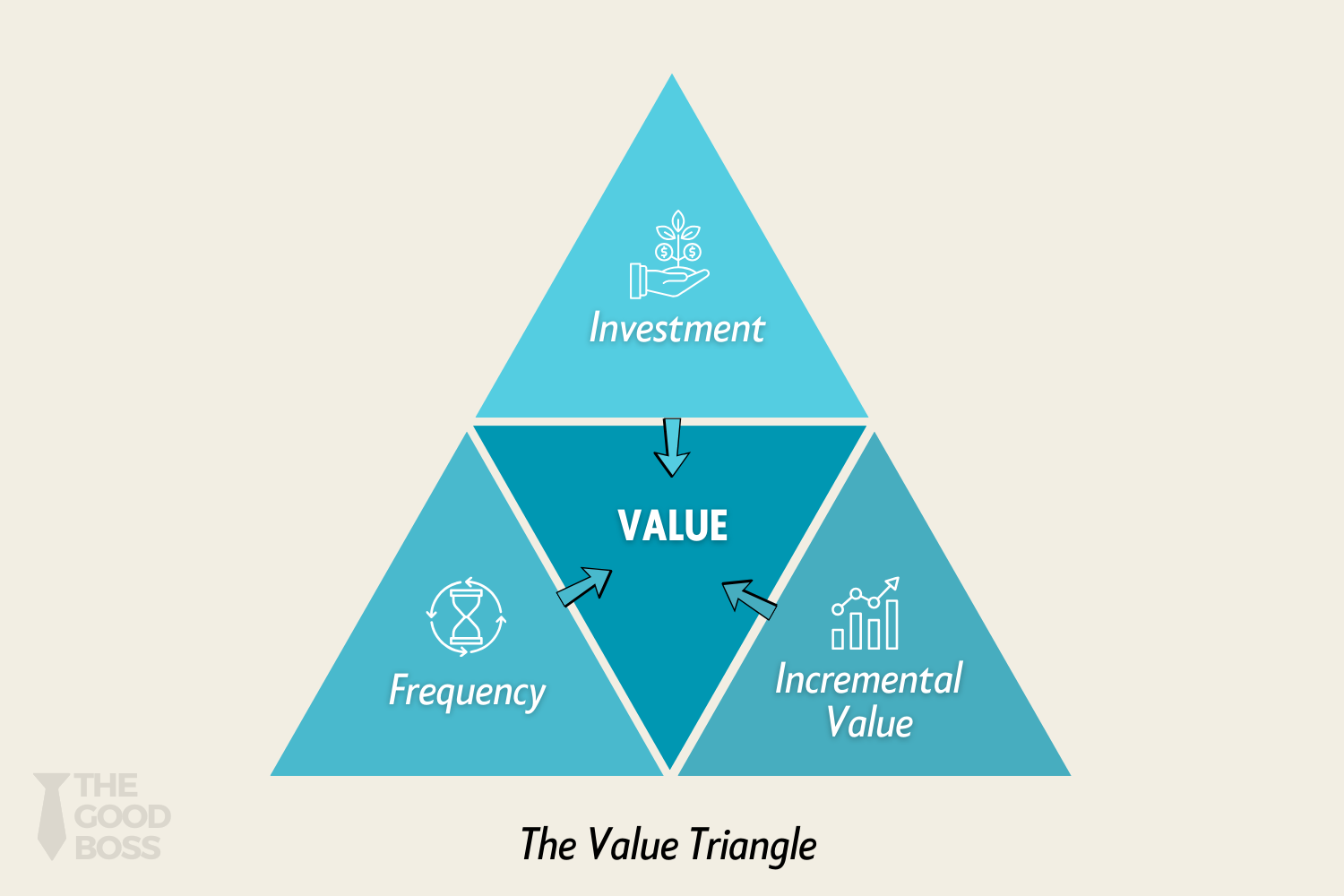
Customers are less concerned with meeting arbitrary deadlines or staying within a fixed budget if the resulting product or service fails to meet their needs or expectations. They are open to trying and testing incremental enhancements, and participating in trials and betas to help improve the quality.
In today’s landscape, you need to focus on delivering value by adopting the modern levers available to you as a leader:
You need to think strategically and invest in research and development to stay ahead of the curve. You need to be aware of the opportunities and threats ahead, and have a game plan to tackle that.
You need to optimize, modernize, and automate your internal operations and delivery mechanisms so you can deliver value at a high frequency, and respond to customer issues quickly
You need to focus on delivering incremental value, and iterate on the shape and direction that the product takes based on the feedback you receive

It’s a mind-shift: from constraints to opportunities.
Test Your Understanding
Before you move on, take a couple of minutes to check your understanding with a quick quiz.
Are you up for it? Let’s do this!

(If you’re new to Kyoshi: It’s the systems-first leadership coach, built on the same Leadership OS I’ve been writing about in this newsletter for years. Go ahead and sign up for free and try out the quiz now.)
Practice This Framework
Just like you build your physical muscles in the gym, you build your leadership muscle by practice.
🎯 Practice a drill
Got five minutes? Drills are short, focused reps. Kyoshi gives you a situation, and you rework it so it informs, inspires, and influences.
Go ahead and start the drill now!

📝 Download the worksheet
If you like step-by-step prompts, download and use the Value Triangle worksheet and apply it in your own team or work situation.
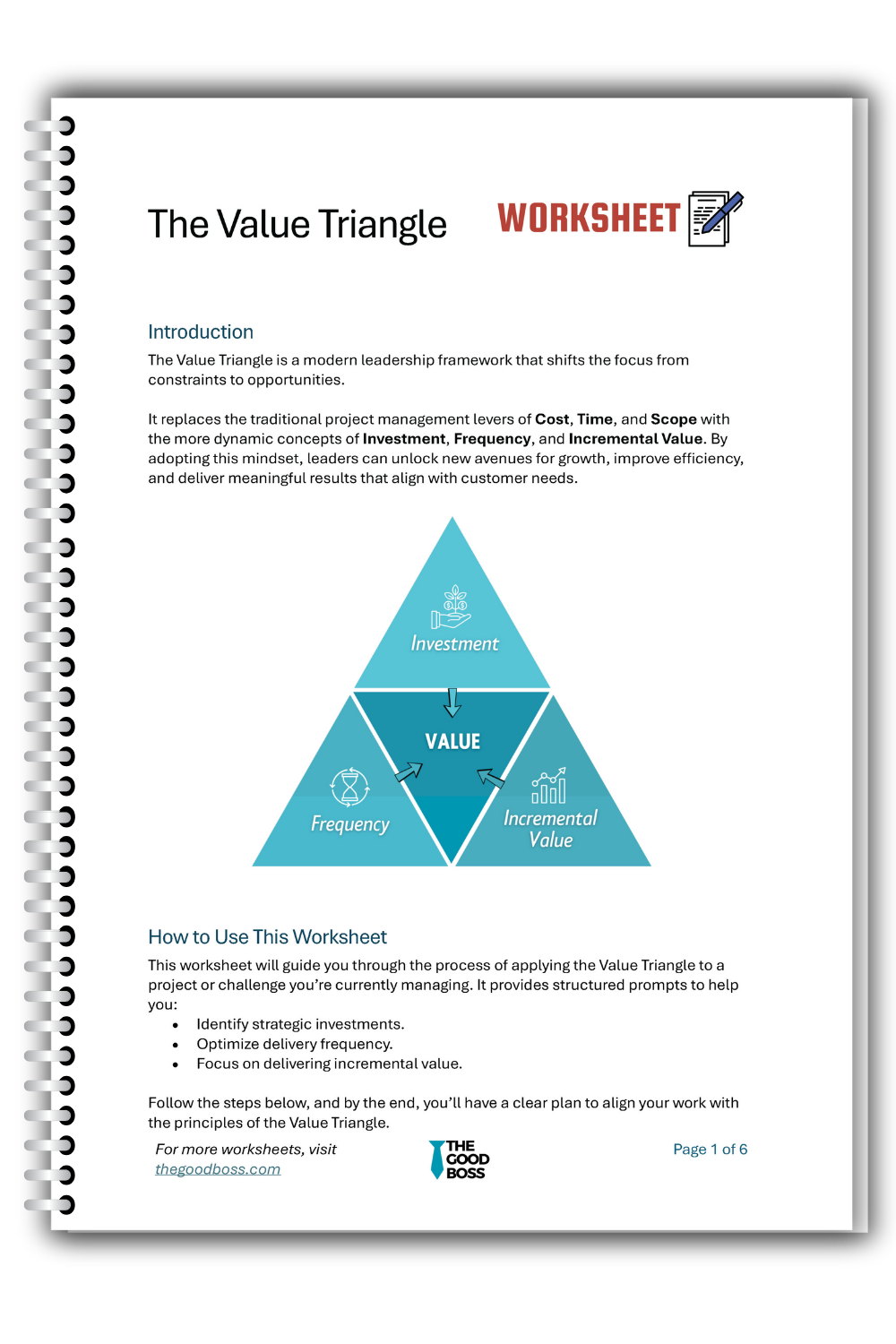
This worksheet is part of the Worksheets Collection, available to all paid subscribers to The Good Boss.
👉🏻 Upgrade to paid now and get instant access to the entire collection, including this worksheet.
If you prefer the standalone worksheet, you can purchase it from here.
🧭 Create a Situation
If you’re looking for a trusted partner to help you create and manage a situation, and actively coach you as you solve it for real, then Kyoshi can help you with all that.
Pick one real situation coming up in the next week or two. Then work with Kyoshi to apply this framework in that situation.
