In this issue:
The Strategy Meeting That Went Nowhere
The Hedgehog Concept: What It Is
The Three Circles
Why This Matters for Leaders
Putting the Hedgehog Concept Into Practice
The One Question That Changes Everything
How This Plays Out in Real Teams
Common Pitfalls (and How to Avoid Them)
Final Thoughts
The Strategy Meeting That Went Nowhere
A few years ago, I sat in one of the most exhausting planning meetings of my career.
We had eight initiatives on the table. Each one had a sponsor, a slide deck, and a compelling argument for why it was critical. By the end of the session, we had agreed to pursue all eight. And predictably, everyone left the room feeling excited.
Six months later, we had made meaningful progress on exactly two of them. The rest had slowed, stalled, or just deprioritized. And the teams that were working on those initiatives were tired, exhausted, and frustrated. When I asked team leads what we were actually focused on, nobody could give me a clean answer.
And here’s what struck me: We had a bunch of smart managers and engineers, and we hadn’t failed because of a lack of effort, or talent, or even resources. We had never honestly asked ourselves: what are we actually best at?
That question, simple as it sounds, is one of the hardest things for a leader to answer with real honesty. And it’s at the heart of a framework that I wish I had known earlier in my leadership journey.
It’s called the Hedgehog Concept.
Ready to dive in? Let’s go!
The Hedgehog Concept: What It Is
The Hedgehog Concept comes from Jim Collins’ landmark book Good to Great, published in 2001. (and one of my all-time favorite leadership books, if I may add).
Collins and his research team spent years studying companies that had made a sustained leap from good performance to truly exceptional results, and trying to understand why. One of the clearest patterns they found was this:
The great companies behaved like hedgehogs, while the merely good ones behaved like foxes.
The distinction comes from an ancient Greek parable, attributed to the poet Archilochus: “The fox knows many things, but the hedgehog knows one big thing.”
A fox is clever, fast, and always trying new approaches. It chases multiple strategies, adapts constantly, and is never short of ideas. A hedgehog, on the other hand, does one thing: It rolls into a ball, every time, and… it works.
Collins found that leaders and organizations that tried to be foxes, pursuing multiple strategies, chasing every opportunity, pivoting when things got hard, consistently underperformed. The ones that identified their one big thing and pursued it with sharp, disciplined focus were the ones that won.
The uncomfortable truth for most leaders, including myself, is that we are trained to think that more is better. More initiatives, more bets, more growth vectors.
The Hedgehog Concept pushes back hard on that instinct.
The Three Circles
So how do you find your one big thing?
Collins describes it as the intersection of three questions — what he calls the Three Circles.
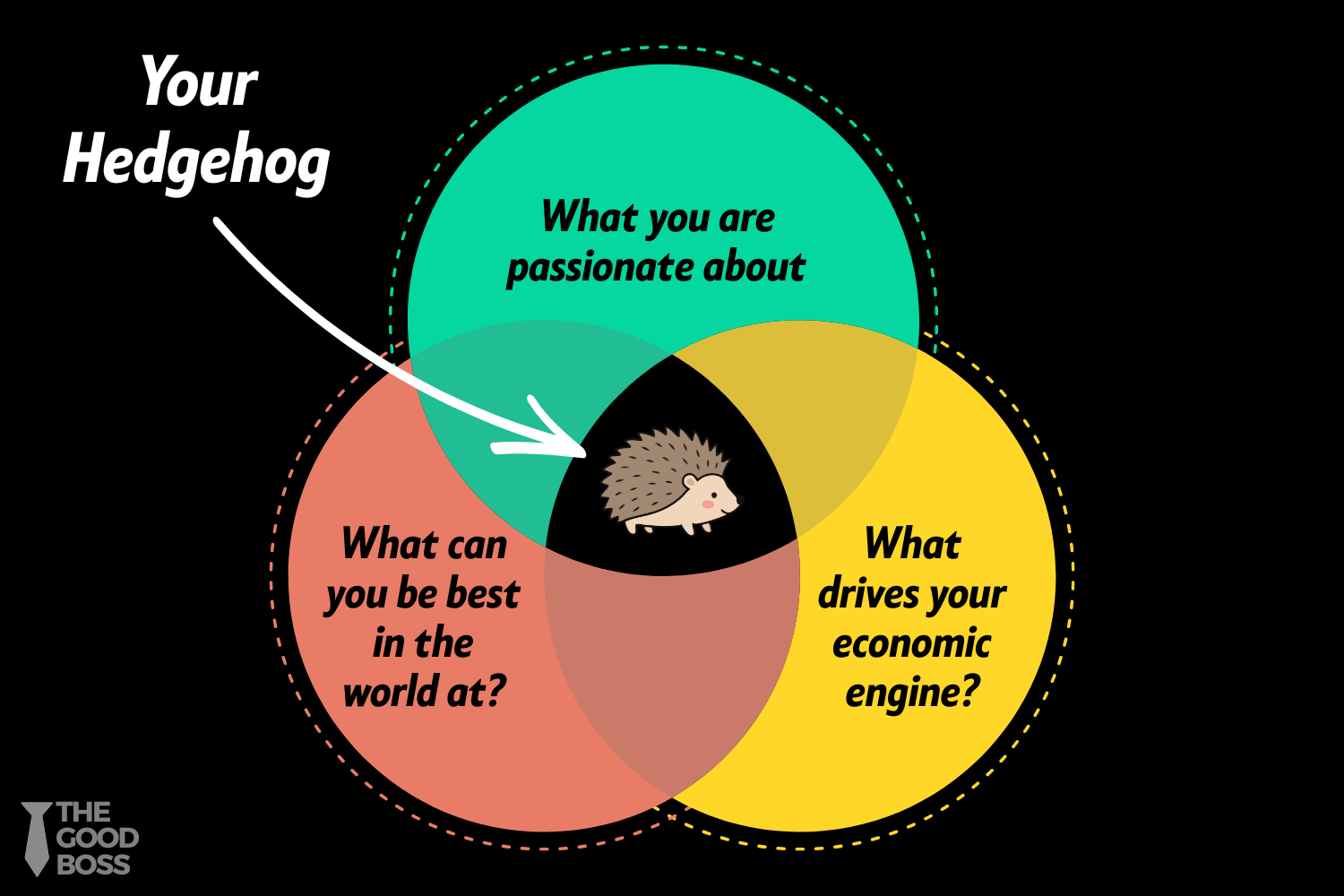
Circle 1: What are you deeply passionate about?
This isn’t what you think you should be passionate about, or what looks good in a strategy deck.
It is what genuinely energises your team. What kind of work creates real enthusiasm, not just compliance?
This is important because passion is fuel. Without it, even the most talented teams eventually lose momentum.
Circle 2: What can you be the best in the world at?
This isn’t what you do today, or what you’re pretty good at, and what you have the genuine potential to be exceptional at.
Collins is deliberate about the standard here: not best in your industry, not better than last year. Best in the world.
Most teams, if they’re honest, will find that the list of things they could truly be the best at is much shorter than the list of things they’re currently doing.
Circle 3: What drives your economic engine?
For businesses, this is about profitability. For leaders and managers, the translation is broader: what creates the most value: for your customers, your organisation, your team?
You need to ask yourself the question: Where does the real impact come from?
The Intersection
The Hedgehog Concept is not any one of these circles. It lives only where all three overlap.
That intersection is your sweet spot, because it represents the place where your passion, your unique capability, and your real impact converge.
And here’s the harder part: anything that sits outside that overlap deserves serious scrutiny.
Why This Matters for Leaders
You might be thinking: this sounds like a concept for CEOs and executive teams, not for day-to-day managers.
But I’d push back on that.
The Hedgehog Concept is just as powerful, maybe more so, at the team level. In my decades of experience leading teams, I’ve seen the fox-like behaviour that Collins describes show up just as clearly in my and other teams in the organization.
Think about the last time your team’s roadmap got reviewed. How many items were added, and more importantly, how many were removed?
Most teams are much better at addition than subtraction. A new opportunity comes along, and it gets added. A PM asks for something, and it gets added. And before long, the team is stretched working on an endless backlog of work items, and nobody can articulate what the team is truly great at.
The Hedgehog Concept gives you a framework to push back on that behavior to seek clarity, not out of stubbornness. It helps you have the honest conversation that most leaders avoid:
We can’t be great at everything, so what should we be great at?
There’s also another subtle benefit, and I’ve seen this play out in my teams many times. When your team knows their “hedgehog” (i.e, their one clear area of excellence), it builds their identity.
They know what they stand for, what kinds of work to lean into, and what to push back on.
That clarity is a key attribute of a high-performing team.
Putting the Hedgehog Concept Into Practice
For the rest of this article, we will focus our attention on putting the Hedgehog Concept into practice in your own organization. As we do that, don’t forget to download the Hedgehog Concept Worksheet.
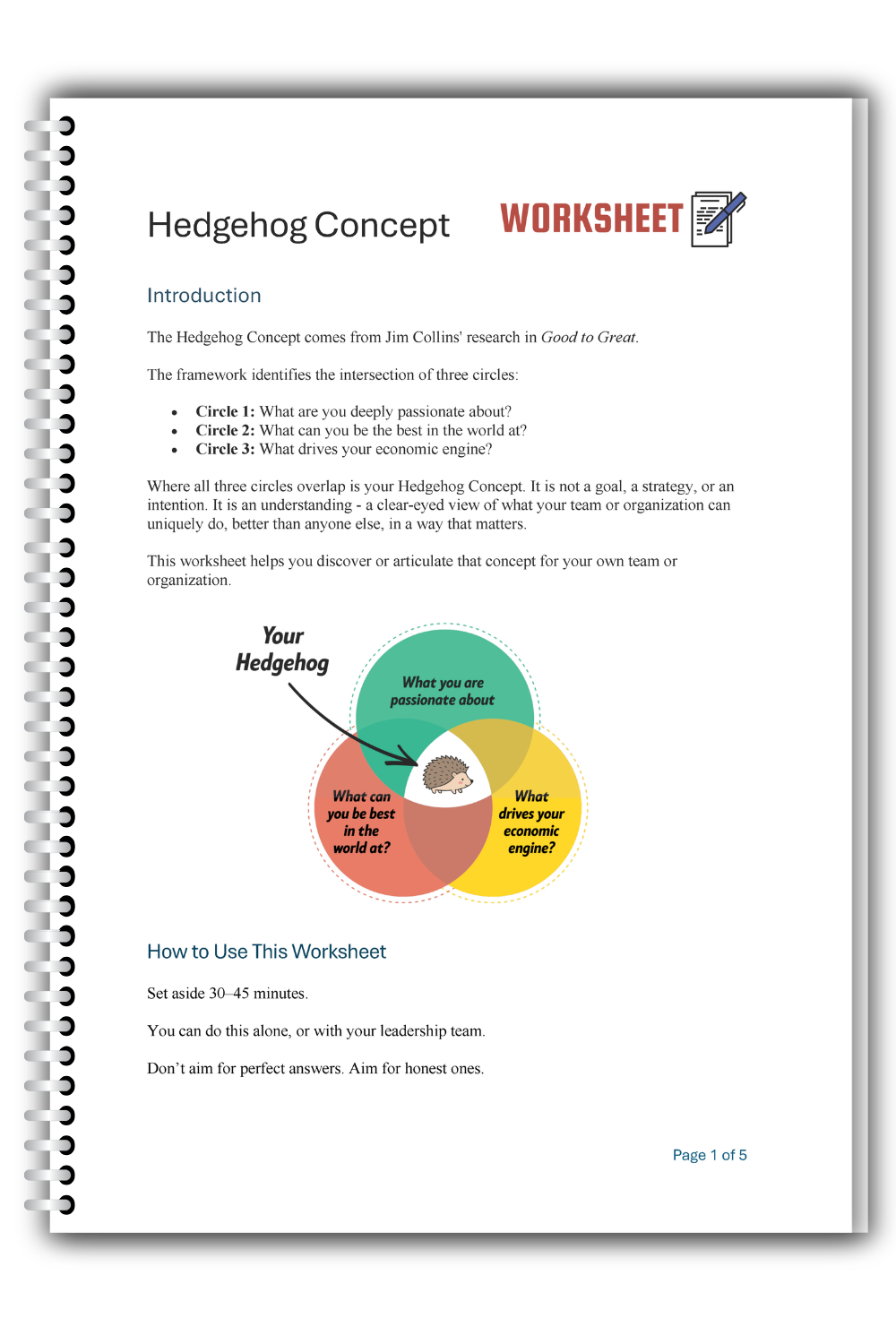
Use this worksheet to:
Get clarity on what your team can uniquely do better than anyone else
Pressure-test your Hedgehog Concept before you build a strategy around it
Turn a vague sense of “our strengths” into a decision-making filter
How to download the worksheet
This worksheet is part of the Worksheets Collection, available to all paid subscribers to The Good Boss.
👉🏻 Upgrade to paid now and get instant access to the entire collection, including this worksheet.
If you prefer the standalone worksheet, you can purchase it from here.
The One Question That Changes Everything
Here’s the shift that changed how I evaluate my team’s work.