

When I was young, my two (elder) sisters would make fun of me for keeping my room tidy, and my classmates found it funny that I would add a “table of contents” to my class notebooks!
I know… those things may sound a bit weird to some, but the point I want to make is: I love to keep things organized. That’s probably just who I am as a person. No wonder I love writing about frameworks! My wife sometimes jokes that I remind her of Monica from F.R.I.E.N.D.S., but I’d like to believe I’m nowhere close to that :)
Anywa, early in my career as a manager, I loved adding process to everything I touched. A weekly sync here, a new ceremony there, a tracking spreadsheet, and a status update format everyone in the team had to follow.
To me, every new process felt like we were making progress and were in control, and frankly, I thought I was making the team more “productive”.
But it was far from it.
In fact, objectively speaking, my team was slowing down, and a lot of it was because of me.
Each process I added took a little time away from every person on the team, every single week. One extra meeting didn’t look like much on our calendars, but when you multiply it by eight engineers and fifty weeks, it’s a lot of days wasted by the end of the year.
I was busy and felt organized, while my team was busy filling in my spreadsheets.
It took me a while, and a read of High Output Management, to see what was going on. Andy Grove has a simple idea in that book that changed how I look at my calendar.

Your output as a manager isn’t what you do. It’s what your team does.
In this post, we will look at Managerial Leverage, which is the core idea from the book, and how you can use it to multiply the output, and impact, of your organization.
☑️ In this issue:
Part 1: Understanding Managerial Leverage
What is Managerial Leverage?
The Leverage Map
Negative Leverage: When Managers Subtract
Test Your Understanding
Practice this Framework
Part 2: Applying Managerial Leverage
The Leverage Audit
Apply to Your Situation
Download the worksheet
Part 3: Going from Here
Common Pitfalls and How to Avoid Them
Final Takeaway
Part 1: Understanding Managerial Leverage
What is Managerial Leverage?
Managerial Leverage comes from High Output Management, the book Andy Grove wrote in 1983 while he was running Intel.
What I loved about it was that Grove treated management like a production problem. He argued that if a factory has output, so does a manager. The question is what that output is.
And his answer is one simple equation:
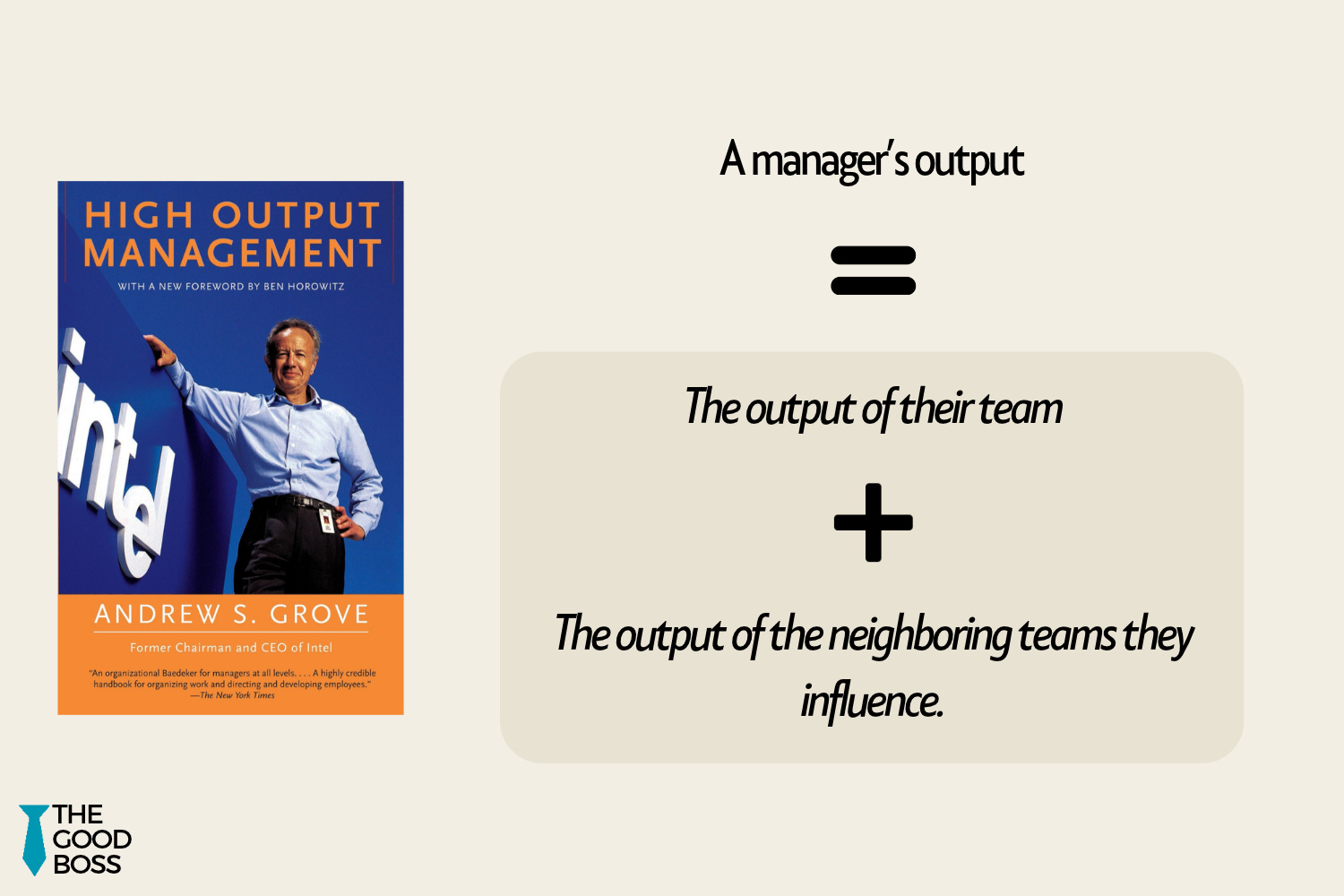
Notice what’s missing. Your own tasks as a manager don’t appear anywhere in that equation. The code you reviewed, the deck you built, the fire you put out, the decisions you made… none of them count on their own, but only if they moved the team’s output.
From there, Grove defines “leverage” as the output your team produces per activity you do. For example: every meeting you attend, decision you make, feedback you share, etc. has a leverage value. Some of it could be high, some low, and some even negative.
Understanding Managerial Leverage is especially hard for someone who is promoted from an IC role because, as an IC, you’re rewarded for what you shipped. But as a manager, the scoreboard is measuring something completely different.
The Leverage Map
So how do you know if what you’re doing has high or low leverage?
Here’s what Grove says in the book: the activit you’re doing has high leverage when at least one of three things is true:
It affects many people at once. For example, explaining a decision to the whole team in one go has higher leverage than answering the same question eight times in Slack or in 1:1s.
It affects someone’s work for a long time. For example, a good hire who stays and contributes to the company over a period of time, vs a hire who leaves within a few months. Or a clear piece of feedback (leveraging Radical Candor) that changes how someone approaches their work for months or even years, vs something they forget within a week. etc.
It provides a key insight only you have. For example, providing context from the leadership meeting or offsite that changes what the team builds next, or how they operate going forward.
And on top of that, there’s a multiplier: timing.
We all know well that, as with many things in life, that “timing is everything”.
When it comes to managerial leverage, the same action can be worth a lot more if taken early rather than later. For example, when you flag a design concern in the first review, it may cost your team 10 minutes, but if you do it after launch, it may cost you half a year.
Here’s a visual way to represent this idea. We plot the first two conditions (duration of impact vs scope of impact) into a 2x2 matrix, and we get a simple map of where your time goes.
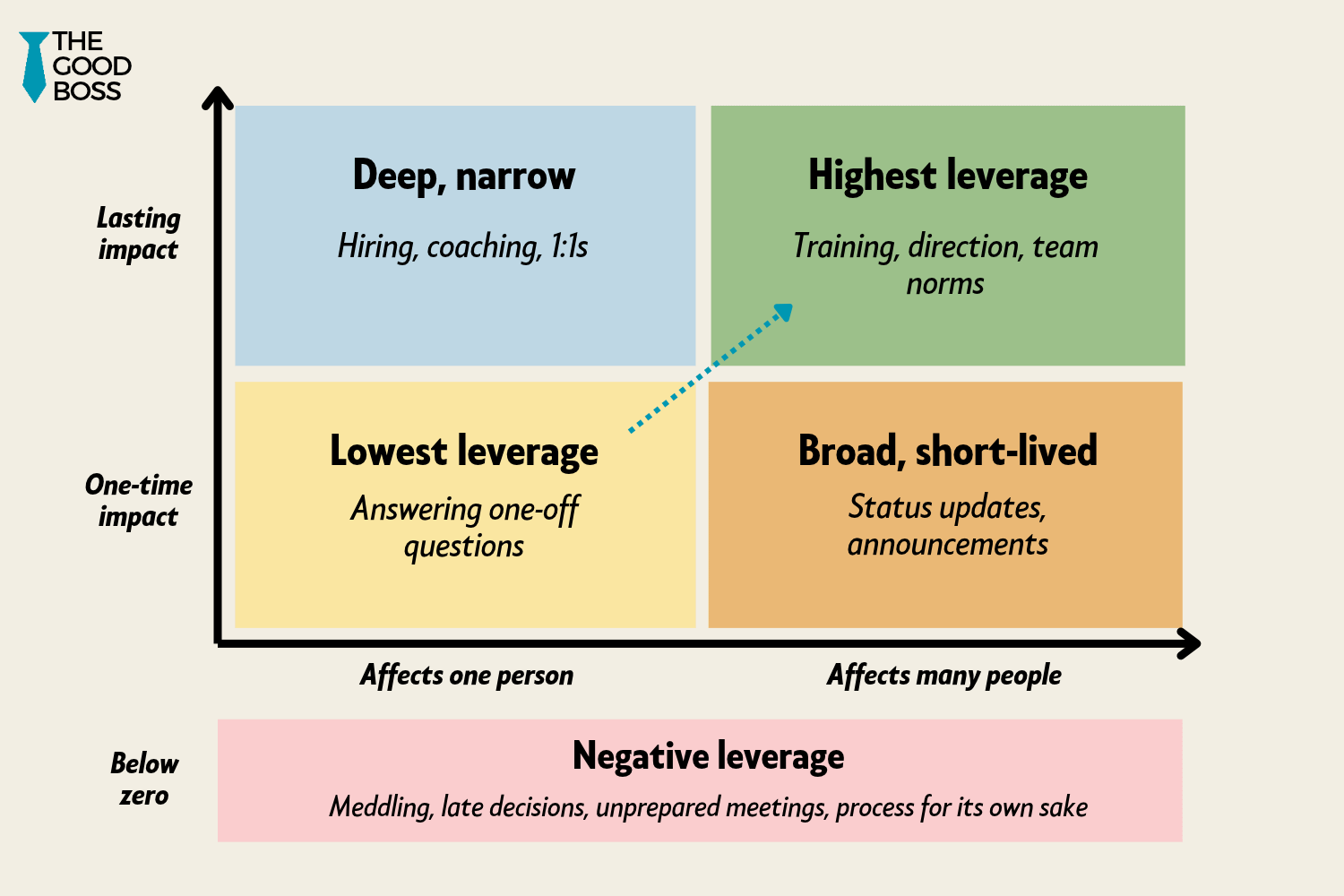
Most managers I’ve worked with spend a lot of time in the bottom-left box, and think that’s their actual job. The goal is to keep moving your time up and to the right for maximum leverage.
Negative Leverage: When Managers Subtract
You may be wondering what the horizontal box at the bottom of the image represents, and frankly, this is the part of Grove’s idea that surprised me the most.
He argues that some manager activities don’t just have “low” leverage, but they actively reduce the team’s output. He calls this “negative leverage”.
The tricky part is that the activities that lead to negative leverage may feel helpful or productive in the moment. Examples:
Meddling. Sometimes, you are tempted to “take over” a task because you know you can do it faster, and it feels like you’re “helping”. But the longer-term implications of this are usually negative: your team loses ownership, they stop learning, and start waiting for you to jump in every time.
Late decisions. Sometimes, you want to wait for “more data” before you decide, and it feels like you’re being careful and just avoiding rash decisions. But this can lead to your team becoming overcautious and slow every time they need to move forward.
Unprepared meetings. Sometimes, you don’t set any agenda for the meeting because you think that creates “flexibility”. But in the end, every person in the meeting just lost an hour of their time.
Process for its own sake. You add a new process to “feel in control”, and it makes you feel more organized (just like I did in the example I shared at the beginning of this post). But many processes eventually become speedbreakers, not accelerators.
One thing I’ve learnt is this: when your reach is broader (more people impacted), be extra careful about the process you’re introducing, because the negative impact can be just as destructive.
Test Your Understanding
Before you move on, check how well the idea of Managerial Leverage has landed.
This short quiz gives you a set of everyday manager activities and asks you to place each one on the Leverage Map.

Practice this Framework
Knowing the map is easy. Using it in the moment, when someone is waiting on you, is harder.
Practice a role-play
Let’s say one of your team members asks you to “just make the call” on a design decision. Practice choosing between deciding, coaching, and setting a rule so they don’t need to ask next time.
Go ahead and practice the role play now!

Practice a drill
Got five minutes? Drills are short, focused reps. Start a drill to practice the Managerial Leverage and how it applies in a realistic situation.

Part 2: Applying Managerial Leverage
Practice makes you better, but you only really grow when you use a framework on your own problems.
Your situation has its own people, its own history, and, frankly, its own politics.
So here are a few ways in which you can actually apply Managerial Leverage in your own leadership role today.