
“There is nothing, absolutely nothing, more important than meeting our basic human needs.” — Simon Cohen
As a manager, you want a team that owns its work.
You want people who care, who speak up, who go beyond the job description.
Right? But sometimes, it feels like you’re pushing a heavy rock uphill. I’ve felt that many times during my leadership career.
And it can feel crushing as a manager when the deadlines keep slipping, and the team’s motivation seems to fall, while we have no idea what’s really going on.
What I’ve realized over the past two decades in the corporate leadership roles is this: most performance problems are not “skill” problems. They usually go much deeper than that - often linked to the unmet needs of your team.
In today’s issue, we will discuss a classic idea from the lens of modern leadership. We will discuss the impact of Maslow’s Hierarchy of Needs in Leadership, and how you can use that to build the right culture, drive, and lead a high-performing team.

Part 1: Understanding Maslow’s Hierarchy of Needs in Leadership
In this section, we’ll understand the original model and how it applies directly to your role as a leader.
What Is Maslow’s Hierarchy of Needs?
In 1943, psychologist Abraham Maslow introduced the idea of the Hierarchy of Human Needs. He argued that human behavior is driven by layered needs. We move up only after the lower ones are met.
Maslow described five levels:
Physiological needs
Safety needs
Social needs
Esteem needs
Self-actualization
The key idea is simple: you can only meet the higher-level needs of a person after meeting their lower-level needs. For example:
If someone feels unsafe, they won’t care about purpose.
If someone feels excluded, recognition won’t matter.
The order matters, and as I studied this, I realized that the same principles apply to leadership.
How Maslow’s Hierarchy Works in Leadership
As a leader, you are responsible for creating the conditions that meet these needs for your team.
Here’s how the pyramid translates for leadership.
1. Personal Mastery

“One can have no smaller or greater mastery than the mastery of oneself.” — Leonardo da Vinci
As a leader, at the foundational level, you must meet the basic needs for personal mastery.
These form your physiological needs, and include the necessary skills and knowledge to get your job done. You must know your job, your domain, and your industry.
You must build your expertise, and continue to invest in self-improvement, skill development, and growth.
Depending on your level and role, you may need to focus on technical leadership, tactical execution, or strategic planning.
Personal mastery also includes self-awareness, and the recognition and appreciation of your strengths, weaknesses, and motivations.
👉🏼 To gain personal mastery for yourself and your teams, you should:
Build your expertise in your field, domain, industry
Continue to develop your skills and deepen your expertise
Be self-aware and recognize your strengths and weaknesses
Provide comprehensive onboarding and training programs.
Ensure employees have the necessary resources (hardware, software, workspace).
Regularly review workloads to avoid burnout and ensure work-life balance.
2. Trust

“You build trust with others each time you choose integrity over image, truth over convenience, or honor over personal gain.” — John C. Maxwell
Once you have acquired personal mastery, you move up to the next level of needs for any leader: fostering trust.
Just as individuals seek safety and security in their lives, leaders must create a sense of security and stability in their teams.
In The Five Dysfunctions of a Team, Patrick Lencioni talks about how the Absence of Trust sits at the core of a dysfunctional team.
As a leader, you must create a supportive environment by fostering trust so your team members feel valued and respected. You must actively mine for hidden conflicts, and ensure your teams trust each other and hold each other accountable.
You need to create an environment of psychological safety, where your team members feel safe to voice their thoughts and opinions, and are willing to take risks.
👉🏼 To foster trust, you should:
Create an environment of trust and psychological safety
Encourage thoughtful and objective disagreements
Be authentic and transparent in your communication
Implement clear policies for conflict resolution and career development.
Regularly check in on team morale and mental health.
3. Belonging

“A sense of belonging is one of humanity’s deepest longing.” -Brené Brown
As humans, we are social beings, and the next level in the hierarchy of needs for a leader is belonging.
As a leader, you need to cultivate a sense of belonging in your team, which includes fostering a sense of community, collaboration, and inclusivity.
You need to value each individual in your team as they are, and celebrate the diversity of thoughts and ideas. You need to make sure they feel part of a team, and that they feel comfortable working together towards the common business goals.
You can do this with intentional gatherings, celebrating successes, and creating opportunities for the team members to bond and get to know each other.
Creating a sense of belonging will not only lift the engagement level for your team, but also improve the business results and impact.
👉🏼 To foster a sense of community, you should:
Promote inclusivity and celebrate diversity of thoughts and ideas
Encourage collaboration and team bonding through intentional gatherings
Work towards a one-team mindset
Organize regular team-building activities and offsites.
Celebrate personal milestones and professional achievements.
Create mentorship programs to foster connection and collaboration.
4. Recognition

“People work for money, but go the extra mile for recognition, praise, and rewards.” — Dale Carnegie
The next level in the hierarchy of needs for leaders is recognition, which satisfies the self-esteem needs of their teams.
Who doesn’t like to be recognized and rewarded for their work? Well, I certainly do.
As a leader, you need to acknowledge and celebrate individual and team accomplishments. This not only motivates them, but energizes them to do even more and aim higher.
You need to cultivate a culture of recognition, where efforts are noticed and contributions are valued.
👉🏼 To promote a culture of recognition, you should:
Publicly celebrate successes during team meetings or company-wide calls.
Encourage team members to take on bigger challenges
Provide regular feedback to your team members
Offer promotions and new responsibilities to high-performing employees.
Encourage employees to take on stretch projects and new challenges.
5. Vision
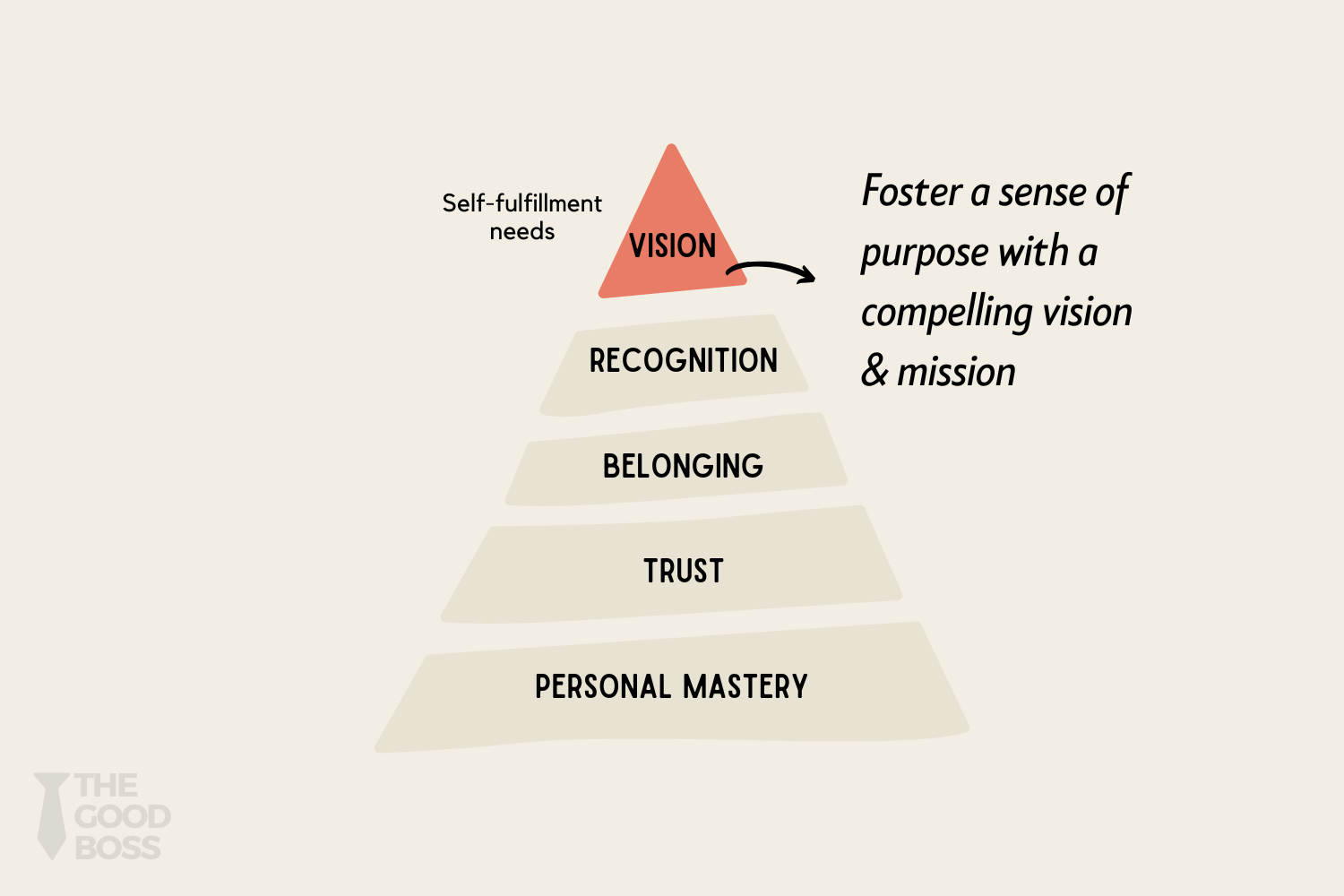
“A vision is not just a picture of what could be; it is an appeal to our better selves, a call to become something more.” — Rosabeth Moss Kanter
You have achieved personal mastery, and have built a culture of trust, belonging, and recognition in your team.
What next?
At the very top of the hierarchy of needs lies the need for self-fulfillment and self-actualization, and leaders can fulfill that with a compelling vision and purpose.
You need to challenge the status quo, and provide opportunities for your team members to use their creative energies to drive innovation.
You need to empower your team members to take on challenging tasks, nurture potential future leaders, and prepare your organization to counter external threats and competition.
At the highest level, you need to foster a sense of meaning and purpose, and inspire your team members to realize their full potential.
👉🏼 To foster a sense of purpose, you should:
Clearly articulate the company’s vision and align team goals with it.
Drive innovation by challenging the status quo and encouraging risk-taking
Keep an eye on the competitive environment, and take steps to stay ahead of the curve
Involve employees in goal-setting and innovation initiatives.
Assign projects that allow employees to explore their passions.
Create innovation labs or task forces to encourage creative contributions.
In Summary: Maslow’s Hierarchy of Needs in Leadership
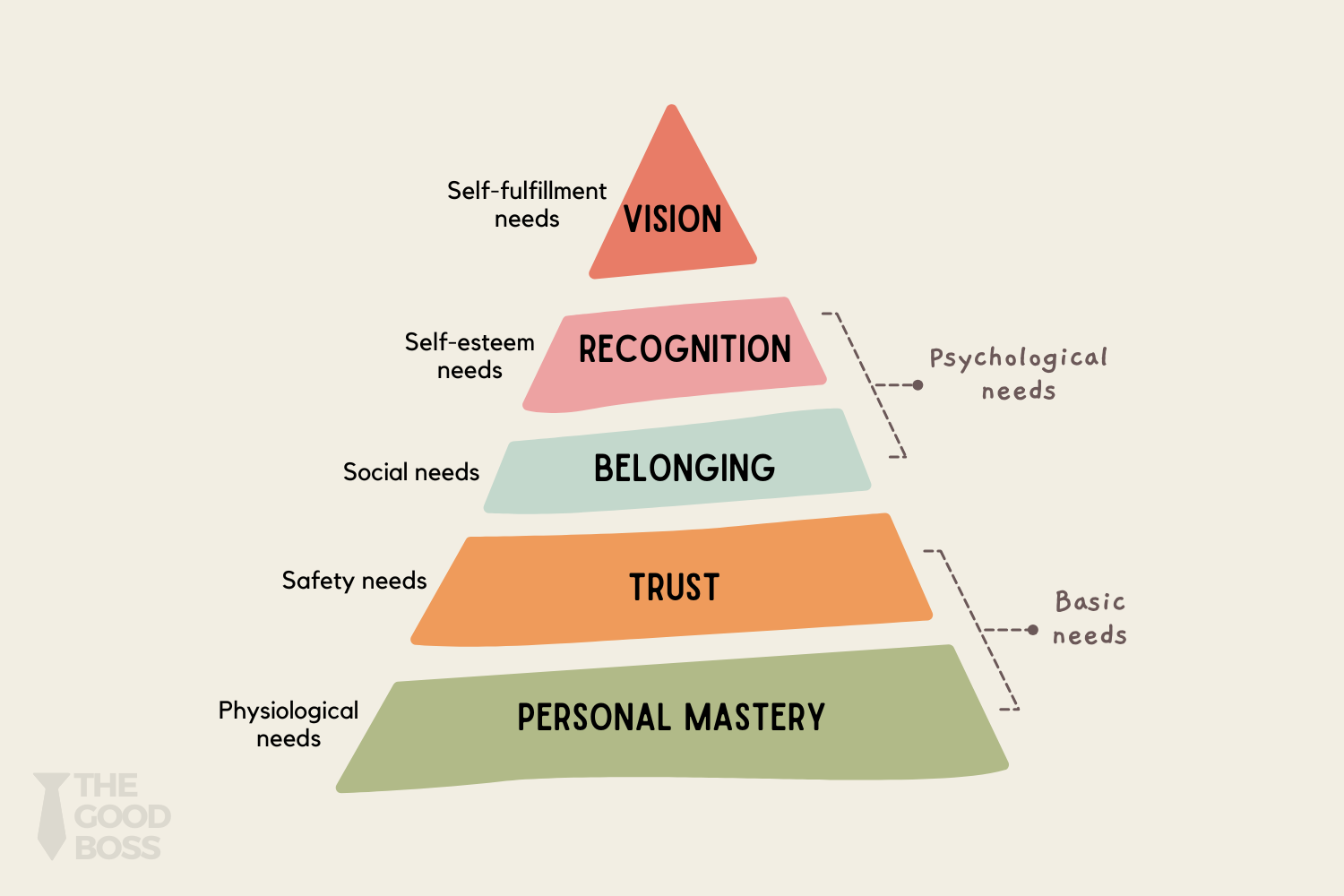
In this issue, we reviewed Maslow’s Hierarchy of Needs in Leadership:
Physiological needs: Personal Mastery. At the most basic level, leaders must meet the need for Personal Mastery. This includes building the knowledge and skills to get the job done, and continuously learning and gaining expertise in the field.
Safety needs: Trust. To provide for a safe and secure environment, leaders must foster trust and psychological safety in their organization to promote open dialogue and risk-taking.
Social needs: Belonging. Leaders must foster a sense of belonging by providing opportunities for their teams to bond and work together towards common goals.
Self-esteem needs: Recognition. Leaders must create a culture of recognition where great work is valued and promoted.
Self-fulfillment needs: Vision. At the highest level, leaders must rally their teams towards a compelling vision, and provide opportunities for them to reach their full potential.
Part 2: Applying Maslow’s Hierarchy in Your Leadership
For the rest of this article, we will focus our attention on applying Maslow’s Hierarchy of Needs in your own organization. As we do that, don’t forget to download the worksheet.
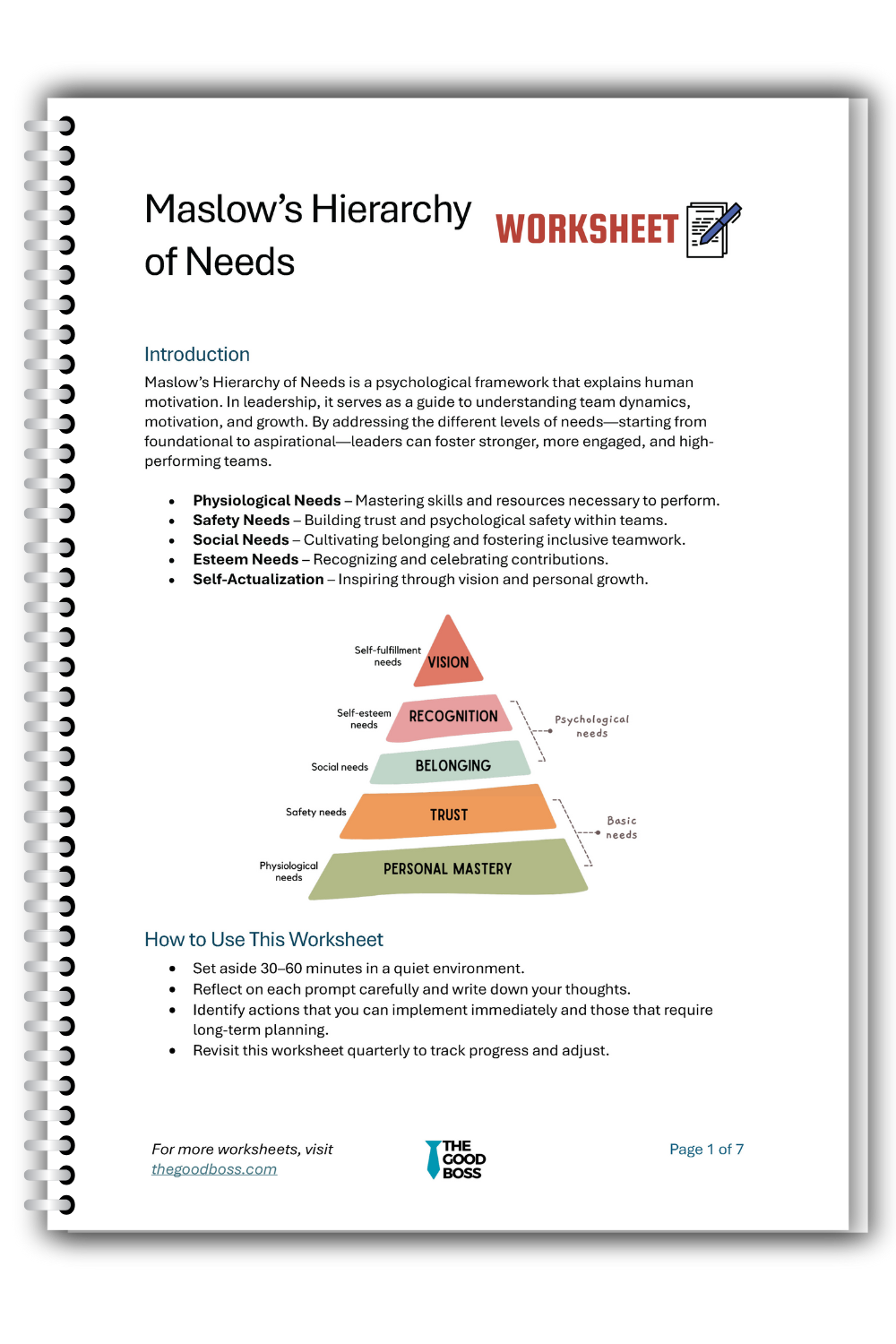
Use this worksheet to:
Assess how well you’re meeting your team’s needs, from safety to growth
Spot the level that’s holding your team back right now
Walk away with one concrete action to take this week
How to download the worksheet
This worksheet is part of the Worksheets Collection, available to all paid subscribers to The Good Boss.
👉🏻 Upgrade to paid now and get instant access to the entire collection, including this worksheet.
If you prefer the standalone worksheet, you can purchase it from here.
The 5-Step Leadership Diagnostic
Here’s a simple 5-step diagnostic I use.