

In this issue:
Part 1: Understanding Probabilistic Thinking
What is Probabilistic Thinking?
How Probabilistic Thinking Works
Part 2: Applying Probabilistic Thinking in Leadership
Real-Life Leadership Scenarios
The Probabilistic Thinking Application Worksheet
Part 3: Going from here
Recommended Resources
Final Takeaway
⛱
I live in tropical Singapore, and frequently face rainy weather on my way to work.
Imagine this: I wake up, check the weather forecast for the day, and see a 60% chance of rain, and a 15% chance of thunderstorms (with the remaining 25% chance of it being a sunny day).
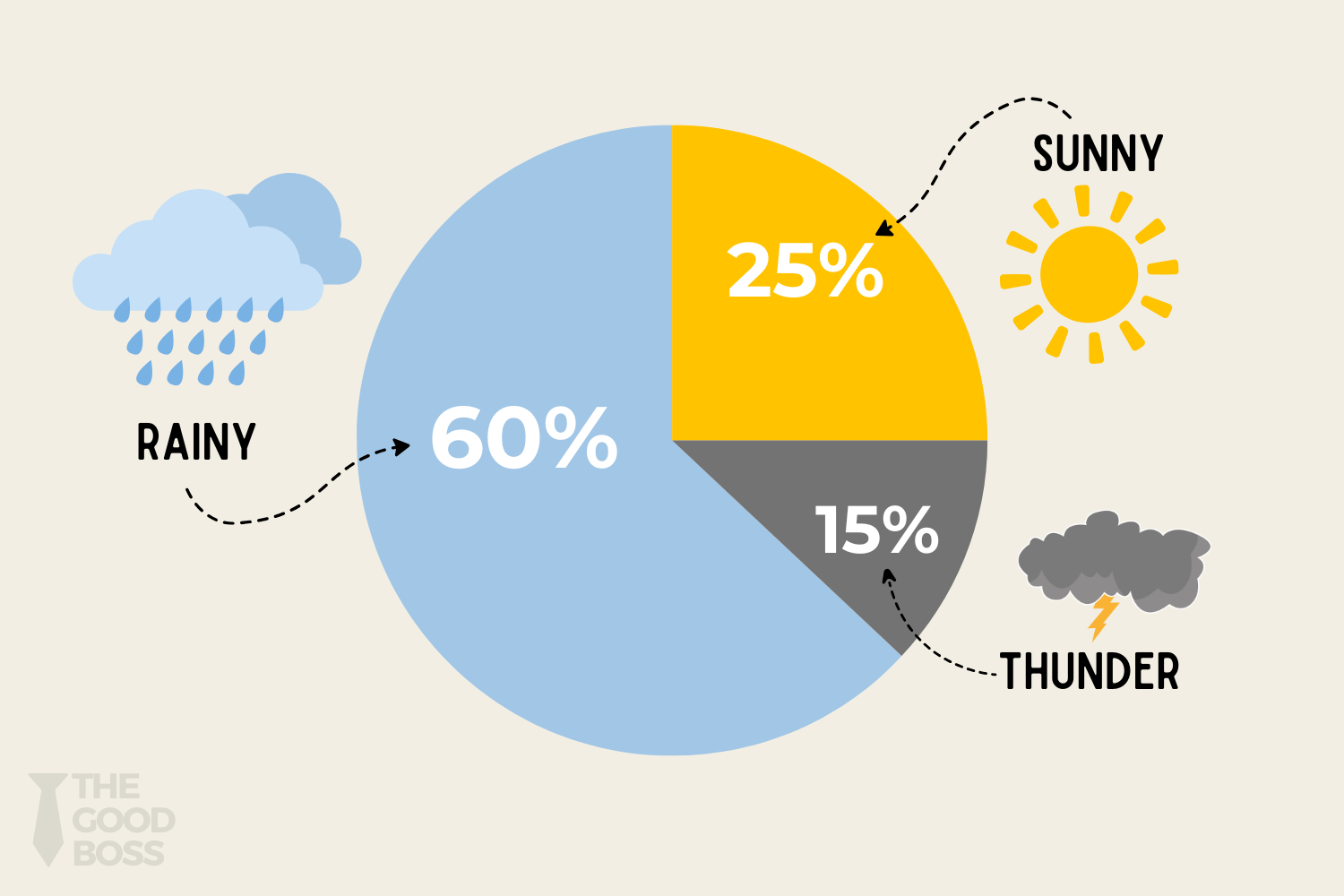
Do I take an umbrella to work?
Most people instinctively react in one of two ways:
Deterministic Thinking: "60% is high—I won’t take my chances and carry one."
All-Or-Nothing Thinking: "There's any chance of rain? Better carry an umbrella just in case!"
But neither of these approaches is optimal. As a probabilistic thinker, I would approach it differently:
If carrying an umbrella has little downside (it’s light and easily fits in my bag) and could prevent discomfort (I don’t like to get drenched, or soaked in the hot sun!), it’s a smart choice.
If the downside of carrying it is high (e.g., it's bulky, I’m biking to work, or I’m only outdoors for a mere 10 mins on my way to work), I might accept the small risk and go without it.
Now, imagine applying this kind of probabilistic reasoning to major business decisions—launching a product, hiring an executive, or investing in innovation.
This is where probabilistic thinking becomes a powerful framework for leaders. It helps you avoid gut-driven decisions and instead make calculated, high-quality choices in an uncertain world.
Part 1: Understanding Probabilistic Thinking
Probabilistic thinking has its roots in the theory of probability from the 17th century, when mathematicians Blaise Pascal and Pierre de Fermat laid the foundation of of the theory through problems in gambling. It was later expanded by Jacob Bernoulli, whose work showed how to reason about uncertainty using likelihoods.
What is Probabilistic Thinking?
Probabilistic thinking is about assigning likelihoods to different possible outcomes and making decisions based on their probabilities and impact.
Think of it like this:
A deterministic thinker says, “Our product will succeed.”
A probabilistic thinker says, “There’s a 70% chance of success, 20% chance of moderate performance, and 10% chance of failure.”
Going back to the weather example:
Binary thinking: “It will be either rainy, or sunny.”
Probabilistic thinking: “There is a 70% chance of rain.”
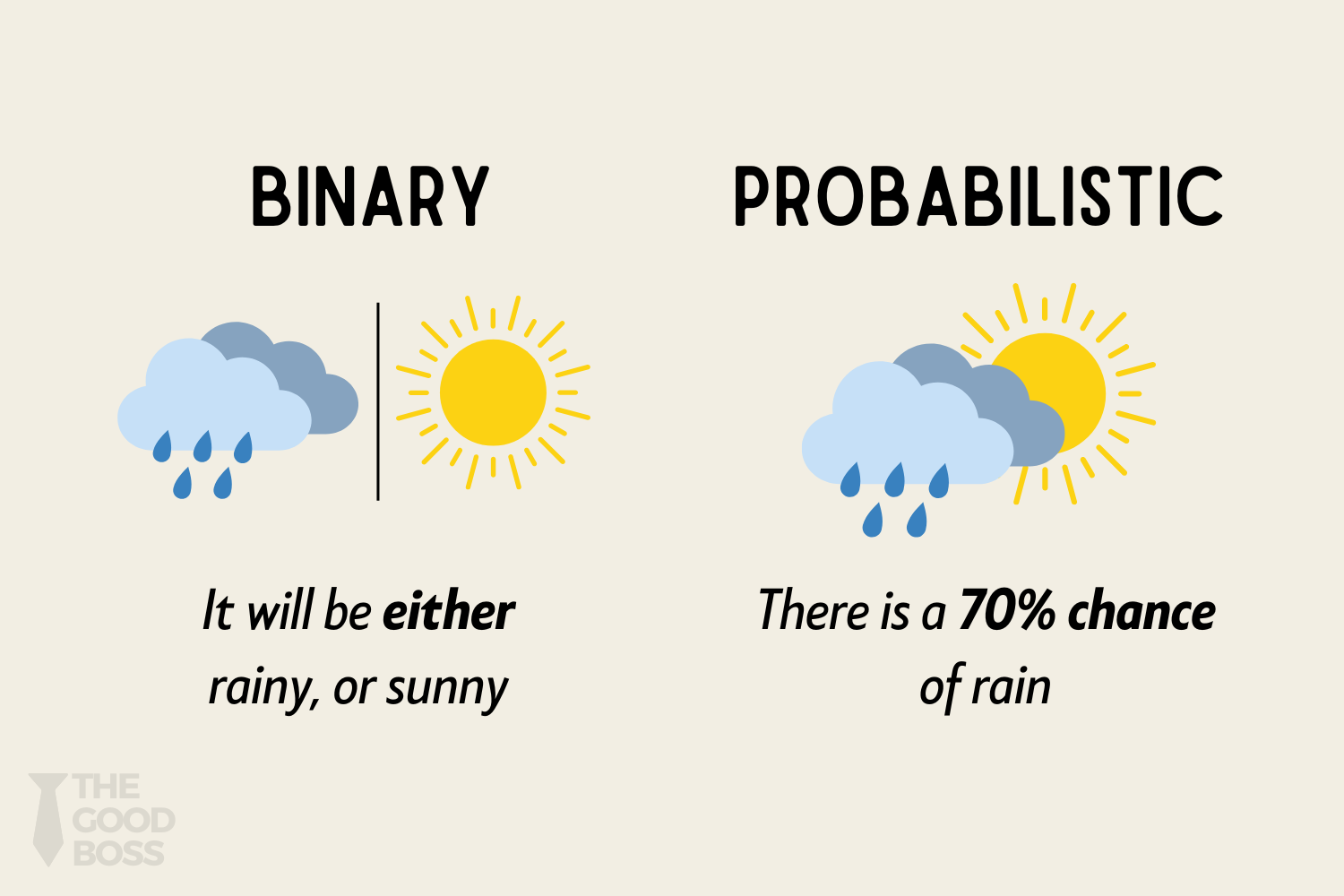
Rather than treating decisions as black or white, probabilistic thinkers evaluate a range of possible futures, weigh the risks, and make informed choices.
Poker players, hedge fund managers, and military strategists use probabilistic thinking daily.
As a leader, you should too.
How Probabilistic Thinking Works
Probabilistic thinking involves four key steps:
1. Recognize Uncertainty
Accept that no decision has a 100% guaranteed outcome.
Identify multiple possible results and what influences them.
2. Assign Probabilities to Different Outcomes
Estimate the likelihood of success, moderate success, and failure based on available data.
3. Calculate Expected Value (EV)
Weigh potential benefits and risks against their probabilities.
Use this formula:
EV = (Probability of Success × Reward) + (Probability of Moderate Success × Reward) + (Probability of Failure × Loss)
4. Update Probabilities as New Data Emerges (Bayesian Thinking)
Probabilities and outcomes may change over time.
Adjust probabilities based on customer feedback, market trends, and test results.
Enjoying the read? Hit the ❤️ button and share/restack 🔁 it with others who might find it helpful.
Part 2: Applying Probabilistic Thinking in Leadership
In this section, you will learn how to apply Probabilistic Thinking in your role as a leader.
We will make it real with the Probabilistic Thinking Application Worksheet, which will help you build your muscle in applying and using this framework in your leadership role.
We will discuss some common real-life leadership scenarios, and how you would apply probabilistic thinking in each of those scenarios.
The Probabilistic Thinking Application Worksheet
Now that we have a good understanding of the framework, it’s time to put this learning into practice!
Download the Probabilistic Thinking Application Worksheet and use it to:
Make Smarter Decisions – Assess risks and rewards using probabilities instead of relying on gut feelings.
Minimize Risk, Maximize Gain – Use Expected Value (EV) to prioritize high-impact decisions and avoid costly mistakes.
Stay Agile & Adapt – Continuously update your estimates as new data emerges to improve decision accuracy.

The worksheet includes step-by-step prompts to guide you through the entire application process.
How to download the worksheet
This worksheet is part of the Worksheets Collection, available to all paid subscribers to The Good Boss.
👉🏻 Upgrade to paid now and get instant access to the entire collection, including this worksheet.
If you prefer the standalone worksheet, you can purchase it from here.