In this issue:
The Promotion That Backfired
What the Peter Principle Really Says
The Competence Cliff: Why Promotions Create New Incompetence
Why This Matters for Leaders
Putting the Peter Principle Into Practice
The One Shift: Promote for the Next Role, Not the Last One
How This Plays Out in Real Teams
Common Pitfalls (and How to Avoid Them)
Final Thoughts
The Promotion That Backfired
A few years ago, I made a promotion decision I was completely convinced was the right one.
Arjun had been on my team for three years. He was the kind of engineer every manager wants: technically sharp, always delivered on time, and the person others came to when they were stuck. When a senior engineering role opened up, his name was the first one that came to my mind. It felt like a no-brainer. So, I promoted him to that role.
Six months later, Arjun was struggling.
The new role required him to lead a small sub-team, drive cross-functional alignment, and make architectural decisions that involved trade-offs he’d never had to navigate before.
He was no longer being asked to execute. He was being asked to lead.
And the skills that had made him exceptional at the first thing weren’t the same skills the second thing demanded.
To be clear, he wasn’t failing because he wasn’t talented. He was smart, talented, and motivated. He was failing because I had promoted him into a role he wasn’t ready for, and I hadn’t done enough to prepare him for it.
What I experienced wasn’t just bad luck. I’ve seen countless managers repeat this over and over again. There’s a pattern behind it, and once you see it, you’ll start noticing it everywhere.
It’s called the Peter Principle.
What the Peter Principle Really Says
The Peter Principle was introduced by Dr. Laurence J. Peter and Raymond Hull in their 1969 book of the same name. The idea is deceptively simple:
In a hierarchy, every employee tends to rise to their level of incompetence.
Here’s what that means in practice. When someone does their job well, they get promoted. When they do the new job well, they get promoted again. This continues until they reach a role where they can no longer perform effectively. And there, they stay.
The uncomfortable implication is this: over time, most roles in most organizations end up being filled by people who are not quite right for them. And this isn’t because of bad intentions, but because of how the system works.
But here’s what often gets missed. The Peter Principle isn’t really about the people. It’s about the logic of promotion itself.
We promote people based on what they’ve already done, i.e., their past performance in their current role. But the next role is fundamentally different. It demands different skills, different thinking, and different behavior.
Past performance is a signal of what someone has done. It says very little about what they’re ready to do next. The problem is that most organizations use past performance as a leading indicator for future performance, which can be highly misleading.
The Competence Cliff: Why Promotions Create New Incompetence
Think of it as a cliff.
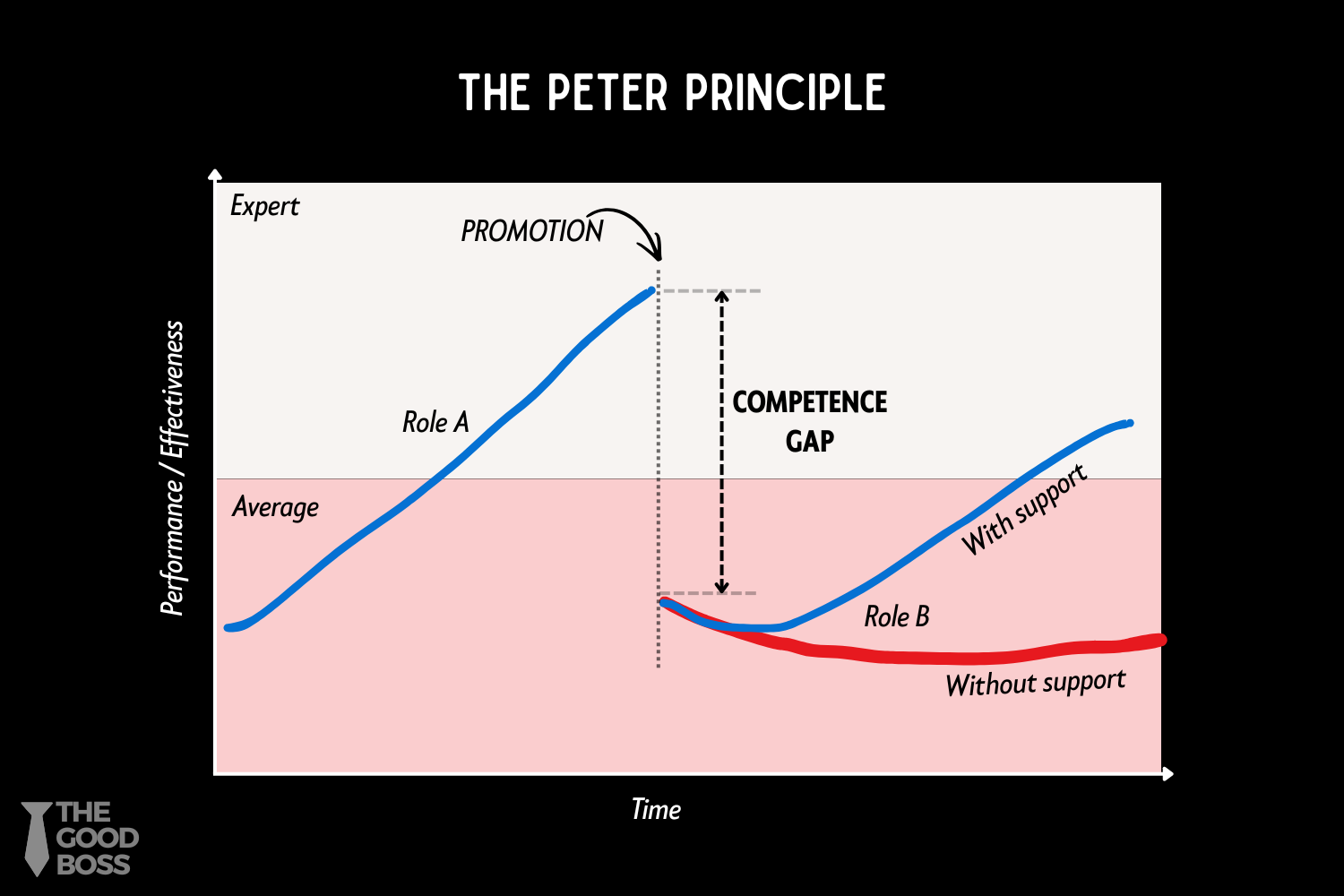
On one side, your best individual contributor: someone who has mastered their craft, earned the trust of the team, and consistently delivered results.
On the other side, the new role they’ve just stepped into: one that looks similar on the org chart, but requires an entirely different set of capabilities.
What got them to the promotion is rarely what they need after it.
The reality is that the skills that drive individual performance, such as deep technical expertise, focused execution, and personal accountability, are often the opposite of what’s needed in a leadership role: delegation, tolerating ambiguity, influencing without authority, and thinking in systems rather than tasks.
This gap is what I call the Competence Cliff. And the bigger the jump between roles, the steeper the cliff.
The problem isn’t that people can’t develop these new skills. Most smart individuals can, and most eventually do. The problem is that we rarely prepare them for the cliff before they have to jump off it.
Why This Matters for Leaders
If you’re a manager or a leader, the Peter Principle isn’t just an interesting observation. You should think of it as a mirror.
Every time you make a promotion decision, you are either setting someone up to grow, or (unintentionally) setting them up to fail.
And most of the time, when someone struggles after a promotion, the blame lands on them. We say that they weren’t ready, or they couldn’t handle it, etc.
But the real question to ask is:
Who decided they were ready?
Who prepared them for it?
Who supported them through the transition?
The cost of getting this wrong is real, and it shows up slowly, but surely.
The individual loses confidence. Someone who was once a star performer now feels like they’re in over their head, every single day. That creates a persistent self-doubt that leaves a mark in their confidence and motivation.
The team loses stability. A struggling leader creates confusion and instability. Team members start going around them, or disengaging, or leaving altogether.
And the organization loses twice. Once when the high performer stops doing what they were great at, and again when the new role they’ve stepped into isn’t being led well.
The Peter Principle is a leadership problem, not a people problem. And that means it’s yours to solve.
Putting the Peter Principle Into Practice
For the rest of this article, we will focus our attention on putting the Peter Principle into practice in your own organization.
As we do that, don’t forget to download the Peter Principle Worksheet.
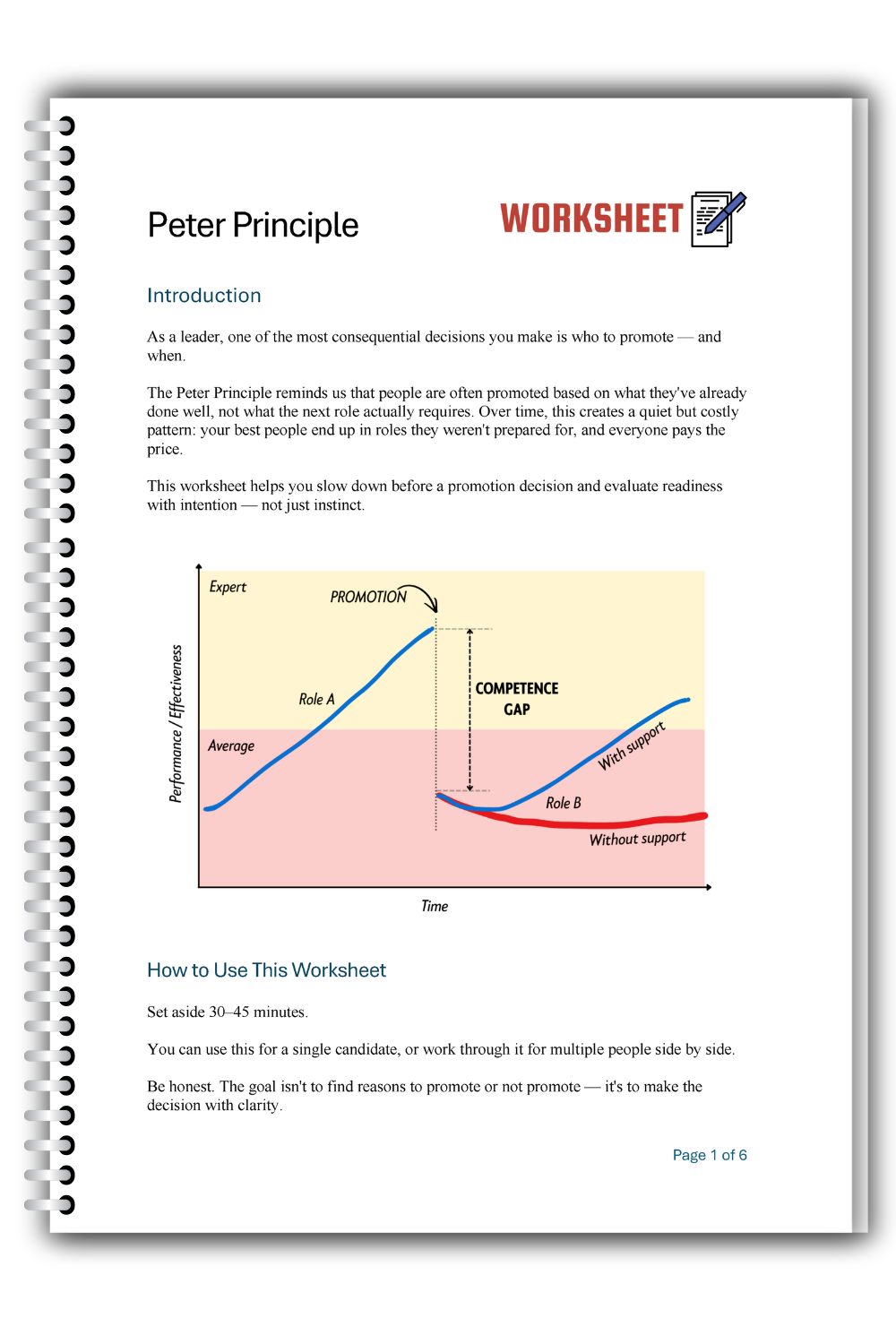
Use this worksheet to:
Evaluate readiness with clarity, not just gut instinct
Find the gap between what got someone here and what the next role requires
Turn a “yes” into a real transition plan, not just an announcement
How to download the worksheet
This worksheet is part of the Worksheets Collection, available to all paid subscribers to The Good Boss.
👉🏻 Upgrade to paid now and get instant access to the entire collection, including this worksheet.
If you prefer the standalone worksheet, you can purchase it from here.
The One Shift: Promote for the Next Role, Not the Last One
Here’s the shift that changed how I make promotion decisions.