Consider this:
You’re leading a team of smart engineers. You’ve set the goals for the year, and explained the ‘why’.
You have even reinforced the message in your 1:1s, All Hands, and even hallway chats with your team.
But despite all that, something doesn’t seem to work.
You find that for some of your team members, the message seems to land - they are aligned with the goals, and jump on board.
However, for others, it doesn’t seem to work. You notice that they smile and nod during the team meetings, but then they go back to their old ways.
So, you naturally start to wonder:
“Am I not being clear? Do they not care? What am I missing?”
Here’s what most leaders miss:
Not everyone sees the world the same way.
Not everyone is driven by growth, or impact, or freedom.
Some people want structure. Others want meaning. Some just want stability.
So, what you’re really facing is a values mismatch, not a motivation problem.
In this issue, we will discuss Spiral Dynamics, a leadership framework you can use to tackle exactly that, and align your own values with your team’s.
Here’s what we will cover:
Part 1: Understanding Spiral Dynamics
What is Spiral Dynamics?
How Spiral Dynamics Works
Why Spiral Dynamics Matters for Leaders
Part 2: Applying Spiral Dynamics
The Team Value Mapping Method
The Spiral Dynamics Worksheet
Part 3: Going from Here
Common Pitfalls (and How to Avoid Them)
Recommended Resources
Final Thoughts
Let’s begin by understanding what Spiral Dynamics is.
Part 1: Understanding Spiral Dynamics
What is Spiral Dynamics?
Spiral Dynamics is a model that helps you understand the underlying values that drive people, and how those values evolve over time.
It was originally developed by psychologist Clare Graves, and later expanded by Don Beck and Christopher Cowan.
At its core, Spiral Dynamics says this:
People (and teams) operate from different value systems. These value systems shape how they think, what they care about, and how they respond to leadership.
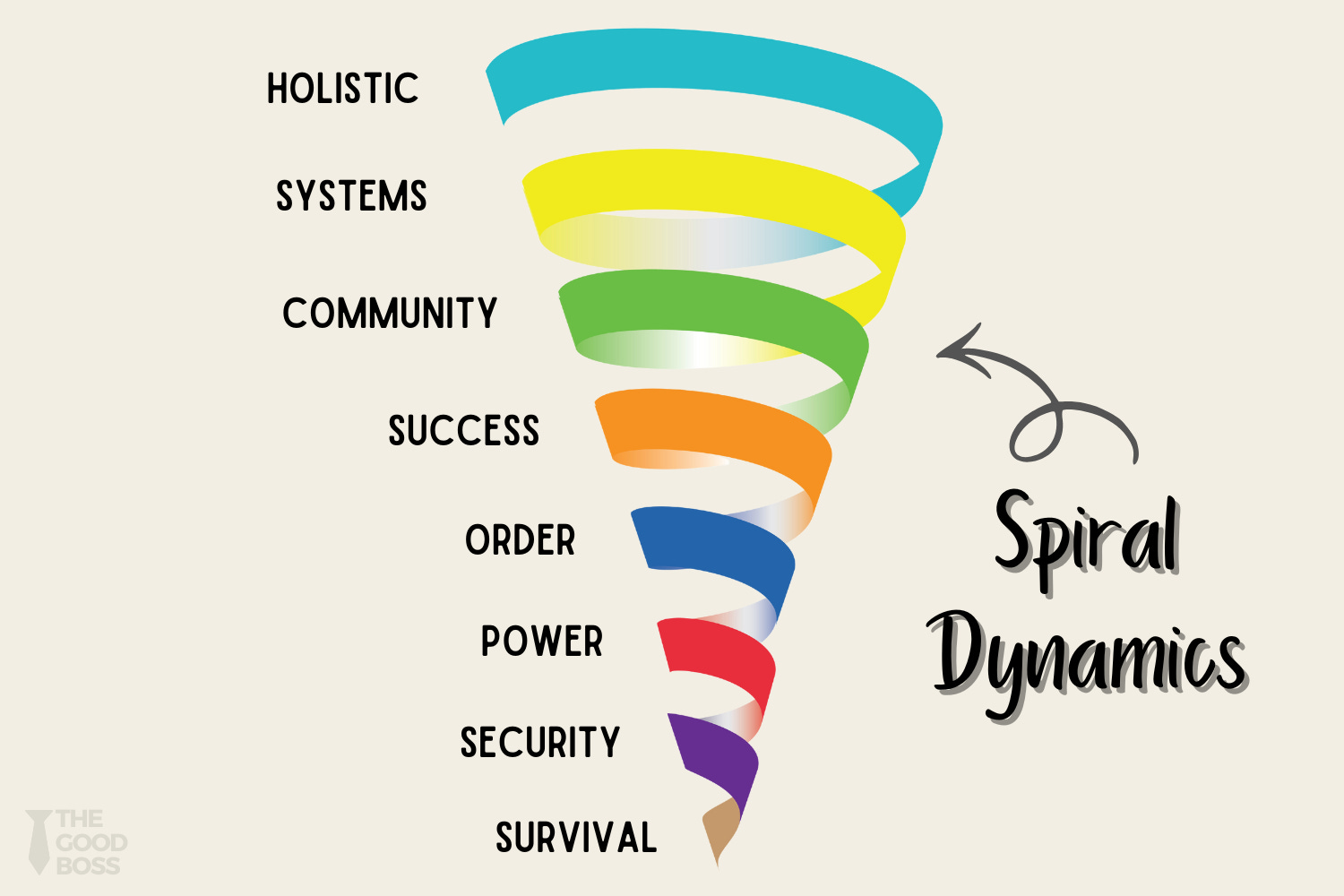
The model organizes these value systems into a “spiral” of stages. Each stage represents a different “worldview”: a way of thinking about work, purpose, success, and relationships.
And while we tend to grow through these stages over time, people and teams don’t all operate from the same level:
Some are focused on rules and structure.
Others care about collaboration and shared purpose.
Some are just trying to keep things from falling apart.
That’s why one leadership style doesn’t work for everyone.
If someone on your team is in the ‘stability and safety’ mode, and you start talking to them about ‘growth and purpose’, you’re likely to lose them
Spiral Dynamics gives you a way to see that mismatch, and fix it.
How Spiral Dynamics Works
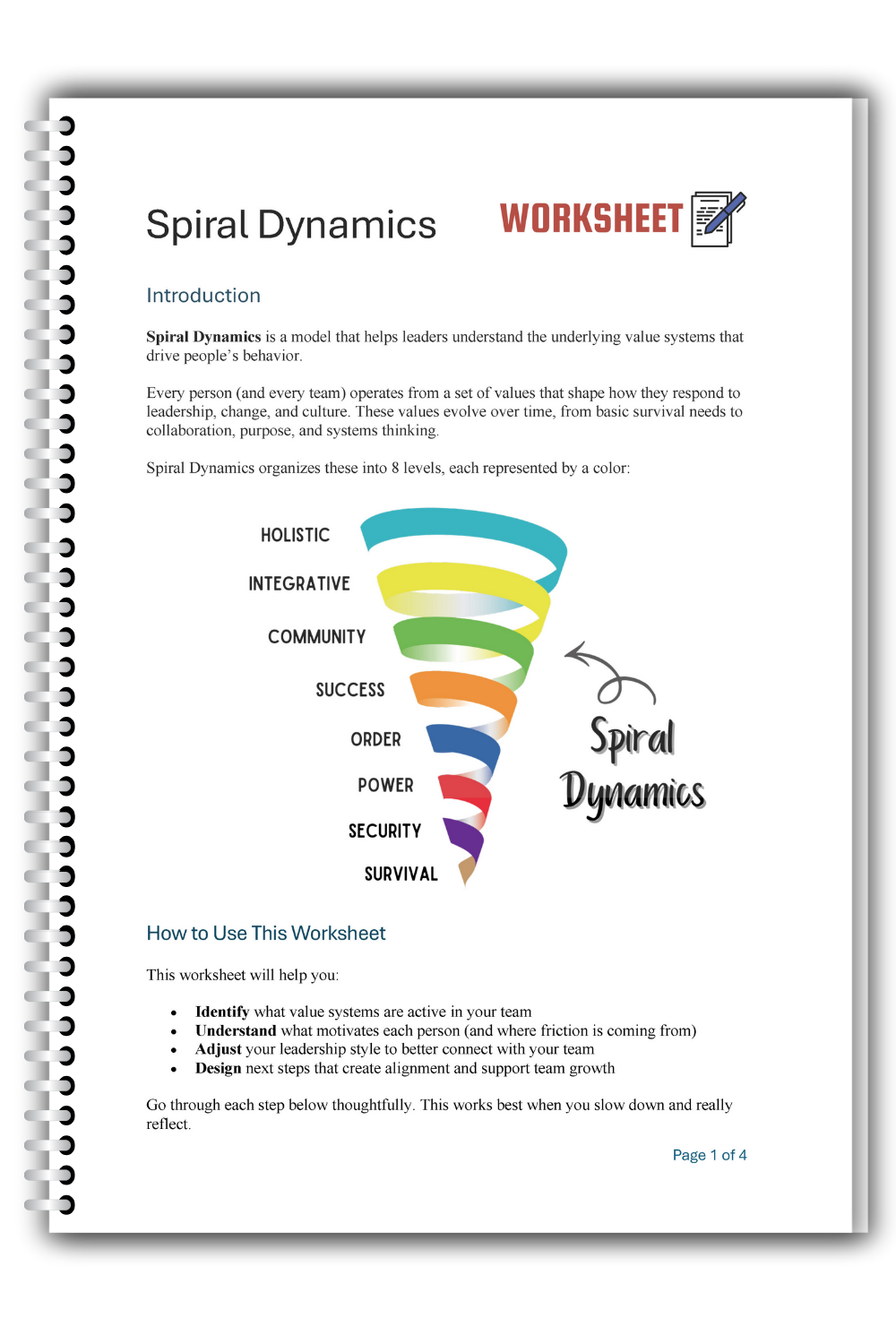
The Spiral Dynamics model maps human development into eight core value systems, each one represented by a different color.
Each color stands for a stage in how people think, what they value, and how they behave in groups or organizations. To be clear, though, these aren’t ‘personality traits’. They’re evolving ‘mindsets’.
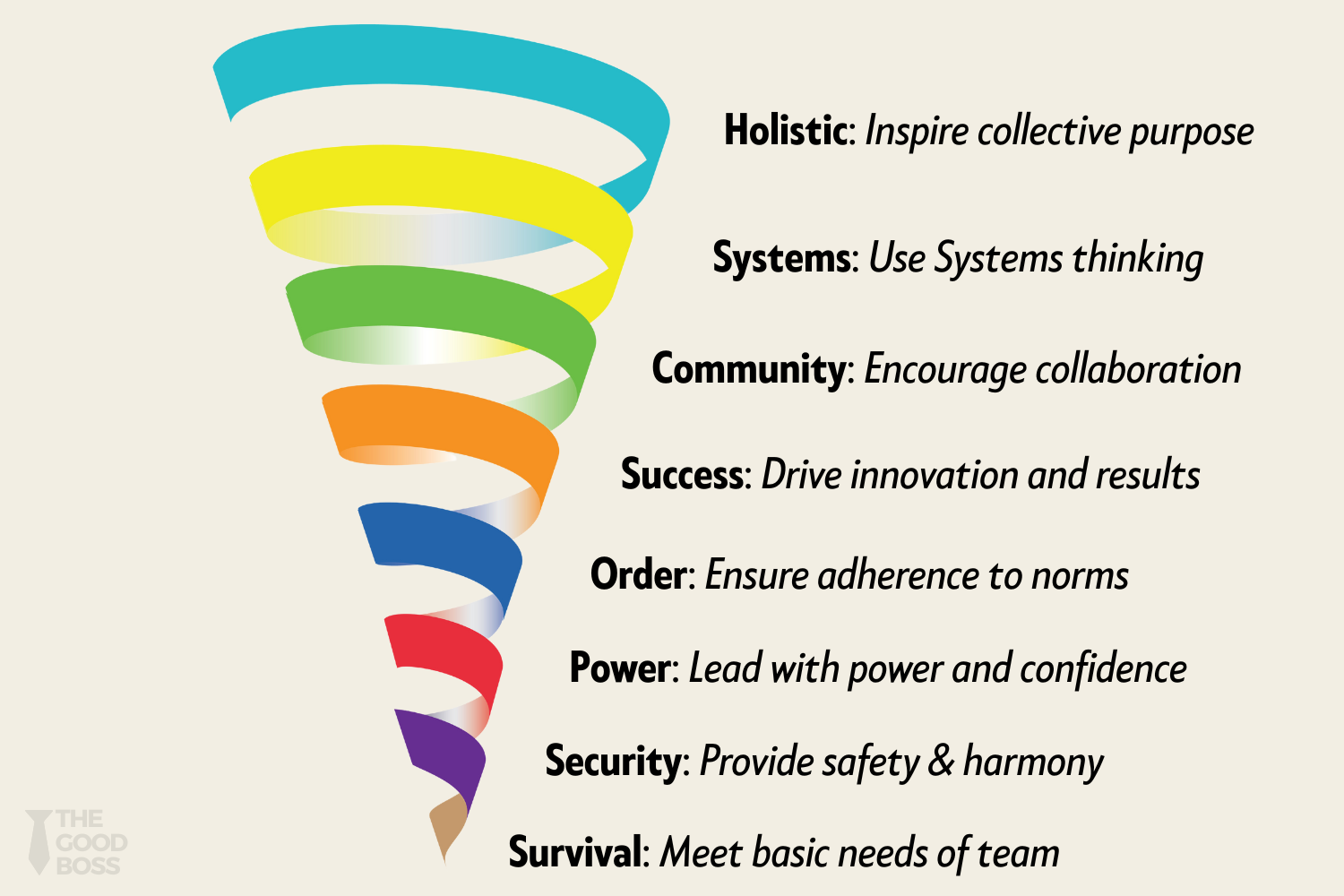
Here’s a quick overview of the eight stages:
Beige (Survival): Driven by basic needs such as food, safety, shelter. Rare in organizations, unless under crisis.
Purple (Security): Loyalty, rituals, group safety. Think tight-knit families or founding teams.
Red (Power): Control, strength, action. Think early-stage startups or strong-willed individuals.
Blue (Order): Structure, discipline, rules. You’ll find this in traditional companies, schools, or military-style cultures.
Orange (Success): Achievement, autonomy, measurable goals. This is where most modern companies operate.
Green (Community): Collaboration, equality, community. Think mission-driven teams or inclusive cultures.
Yellow (Systems): Complexity, integration, adaptability. Values the bigger picture and long-term thinking.
Turquoise (Holistic): Global awareness, interconnectedness. Rare in business, and more common in philosophy or social leadership.
A few key things to note:
These stages build on each other. You don’t skip from Red to Yellow. You evolve gradually as your worldview expands.
Teams and organizations often have a dominant value system, but individuals within them can operate at different levels.
You don’t “graduate” from one stage and never look back. People often shift between levels depending on the situation.
Why Spiral Dynamics Matters for Leaders
What makes Spiral Dynamics powerful is that it helps you see the invisible: the underlying logic behind someone’s choices, motivations, and resistance.
What I like most about this model is that it turns culture from something fuzzy and abstract into something you can observe, name, and work with.
And for leaders, that changes everything.
As a leader, you’re not just managing projects. You’re managing people with different motivations, mindsets, and values.
Spiral Dynamics helps you to:
Understand where your team is coming from
Adjust your leadership style to match what they actually care about
Create a team culture that meets people where they are, and helps them grow
Think of it as a map 🗺️.
Without it, you’re guessing. With it, you’re leading with confidence and precision.
And once you see your team through this lens, you’ll start to notice things you missed before: the invisible patterns that shape your culture, your team dynamics, and even your biggest challenges.
In the next section, we’ll see how to apply this model to real teams, real problems, and your day-to-day leadership.
Part 2: Applying Spiral Dynamics
So far, we’ve explored what Spiral Dynamics is, how it works, and why it matters.
Now let’s bring it down to the ground.
In this section, you’ll learn how to apply the Spiral Dynamics model in your role as a leader. This is where it gets real, because once you start seeing your team through this lens, you’ll start leading very differently.
Here’s what to expect:
You will get the chance to practice this in your own situation with the Spiral Dynamics Worksheet, a practical tool to help you assess your team and adjust your leadership style with clarity.
We’ll then look at the Team Value Mapping method, a simple way to identify the dominant value systems within your team.
The Spiral Dynamics Worksheet
Ready to put Spiral Dynamics into practice? Download the Spiral Dynamics Worksheet and use it to:
Decode what drives each person on your team
Match your leadership style to what actually motivates them
Surface hidden value clashes that block progress
Design 1:1s, feedback, and culture shifts that land better
How to download the worksheet
This worksheet is part of the Worksheets Collection, available to all paid subscribers to The Good Boss.
👉🏻 Upgrade to paid now and get instant access to the entire collection, including this worksheet.
If you prefer the standalone worksheet, you can purchase it from here.
The Team Value Mapping Method