

A couple of years ago, I wasn’t sure if I should pursue formal coach training. I thought I was already a decent coach and didn’t really need this. After all, I had been running 1:1s for more than 20 years in my leadership role, and those 1:1s felt like coaching.
When I finally went into the Associate Certified Coach (ACC) training program, I remember doing my first recorded practice session, and later playing it back.
I counted asking exactly eight questions in 30 minutes. And guess what - six of those questions were nothing but advice with a question mark at the end.
Something like: “Have you thought about talking to the PM first?”
That’s what coach trainers call a leading question, which is a big no-no for real coaches.
At the end of that session, I went back and looked at my own work calendar. I had seven 1:1s a week, every week, and most of them followed the same script. I asked my team member what they worked on, what the blockers were, and what I would do.
Since getting formally certified and having coached several managers and leaders as part of my training and at work, I kept leaning on one simple structure to break that habit.
It’s called T-GROW, and, quite honestly, this simple framework turned the most wasted 30 minutes of my week into the most impactful. In this post, I will share how this model works, and how you can leverage it with your teams to turn your 1:1s from status updates to real coaching conversations.
Here’s what we will cover:
From Tennis Courts to Team Meetings
The T-GROW Coaching Model
Why Managers Need a Structure
Applying T-GROW in Your Next 1:1
The Flipped 1:1
Common Pitfalls (and How to Avoid Them)
Final Thoughts
Ready? Let’s dive in.
📣 Introducing: Kyoshi
If you’ve been following me here for a bit, you’re probably familiar with the Leadership OS: the system of skills and frameworks behind great leadership.
For the past several months, I’ve been turning that system into an AI-powered app for leaders like you and me, and I’m excited to say that it’s almost ready to launch! 🚀
Kyoshi is a system-first leadership coach, powered by the Leadership OS, available whenever you need it. Use it to learn the skills, practice the drills, and actually apply your learning to real situations you face every day as a leader.
And yes, it coaches you the way this post describes following the TGROW model: questions first, advice second.
Stay tuned for the full reveal on Friday. 🔥
From Tennis Courts to Team Meetings
T-GROW actually started as GROW back in the 1980s in the UK. It was originally developed by Graham Alexander, Alan Fine and Sir John Whitmore.
Whitmore made it famous in his 1992 book Coaching for Performance, which is still a popular book amongst the coaching and executive leadership fraternity today.
And like with many things, the root of the GROW framework lies in sports.
Whitmore drew a lot of inspiration from Timothy Gallwey’s The Inner Game of Tennis, another great book, in which Gallwey argued that players improve faster when a coach helps them notice what’s happening (and take ownership) rather than when the coach tells them what to fix.
The fundamental idea applies to the corporate world as much as it does to sports: People act on what they ‘figure out’. They forget what they’re ‘told’.
So where did the ‘T’ come from? Great question.
Myles Downey, a coach who ran the School of Coaching in London, added Topic at the front in his book Effective Modern Coaching. His point was that you can’t set a good goal for a conversation until you know what the conversation is actually about.
And that’s how the T-GROW model came to be.
The T-GROW Coaching Model
T-GROW has five specific stages, and should be run in that order. Let’s look at each of the stages.
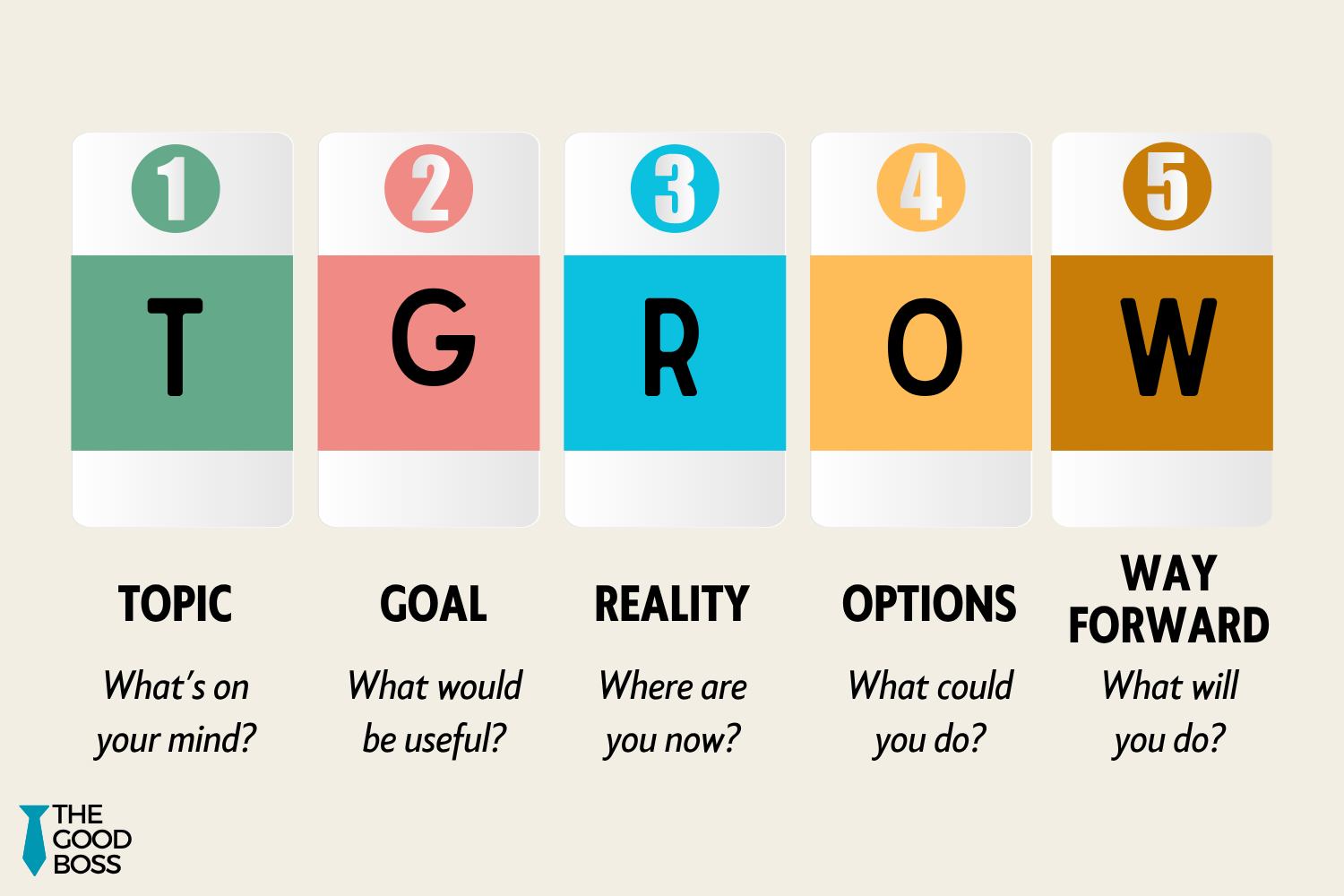
T: Topic. The topic is simply what the person wants to talk about, or what’s on their mind. If you’re going into a coaching conversation as a coach, you can ask something like “What’s the topic you would like to discuss today?”. This sets the frame and context for the coaching conversation.
G: Goal. The goal tries to identify what they want to walk away with from this conversation. Another way to put it is: what tangible outcomes do they want to achieve by the end of this conversation so they know it was time well spent. As a coach, a question you can ask is: “By the end of our 30 minutes, what would be useful for you?”
R: Reality. The reality is where the details lie - what’s actually going on, the facts of the matter, what they’ve tried, and what they observed, etc. It’s the current state of affairs. This is where you would want to spend the majority of the conversation, as you want to make sure you get to the bottom of the issue, not just the surface level.
O: Options. The options are the possible things or actions they can take to address the issue. Your job is to get them to generate at least 2-3 options, and avoid suggesting options even if you are an expert in that field.
W: Way Forward. This is the final step where you help them figure out which option they would go with, and what the next step would be. This step helps to ground the entire discussion and end with a concrete committment that is actionable.
Why Managers Need a Structure
I know what you might be wondering: why do managers need a coaching framework? Aren’t coaching frameworks for professional coaches?
It’s a good question, so let me try to address it.
A fundamental principle of coaching, as you would be able to tell by now, is to encourage the person to identify the solutions on their own rather than handing out answers or suggestions.
Coaching is not the same as mentoring or consulting. Refer to my other post where I discuss the distinction between the four leadership support roles:

In fact, I would argue that managers and leaders need the structured coaching frameowrk more so than professional coaches.
Why? Because a profesional coach typically has one big advantage over you. They are typically not from the same domain or industry and so they tyipcally don’t know the answer. They don’t know your codebase, your stakeholders, or your org’s history. So, they have nothing to offer, and no temptation to resist.
On the other hand, as a manager, you do have all the context. You probably know the codebase better than your team member, or the stakeholders, or the domain. So, you have that urge to offer solutions, to mentor rather than coach, and that’s what makes coaching your team members hard.
When you hand over the answers to your team, they carry a hidden cost, which compounds over time. If you consistently do this, your team eventually can’t decide anythign without you in the room, and then you will wonder why you are suddently the bottleneck.
T-GROW works because it gives you guardrails for the moment you most want to jump in. You can still be the expert, but you need to hold your expertise untl the person has done their own thinking first. In my experience coaching leaders and individual contributors, most of the time, they get to an answer as good as mine. Sometimes even better, because they know details I don’t.
Applying T-GROW in Your Next 1:1
For the rest of this article, we will focus our attention on putting the T-GROW coaching model into practice in your own team. As we do that, don’t forget to download the T-GROW Coaching Worksheet.
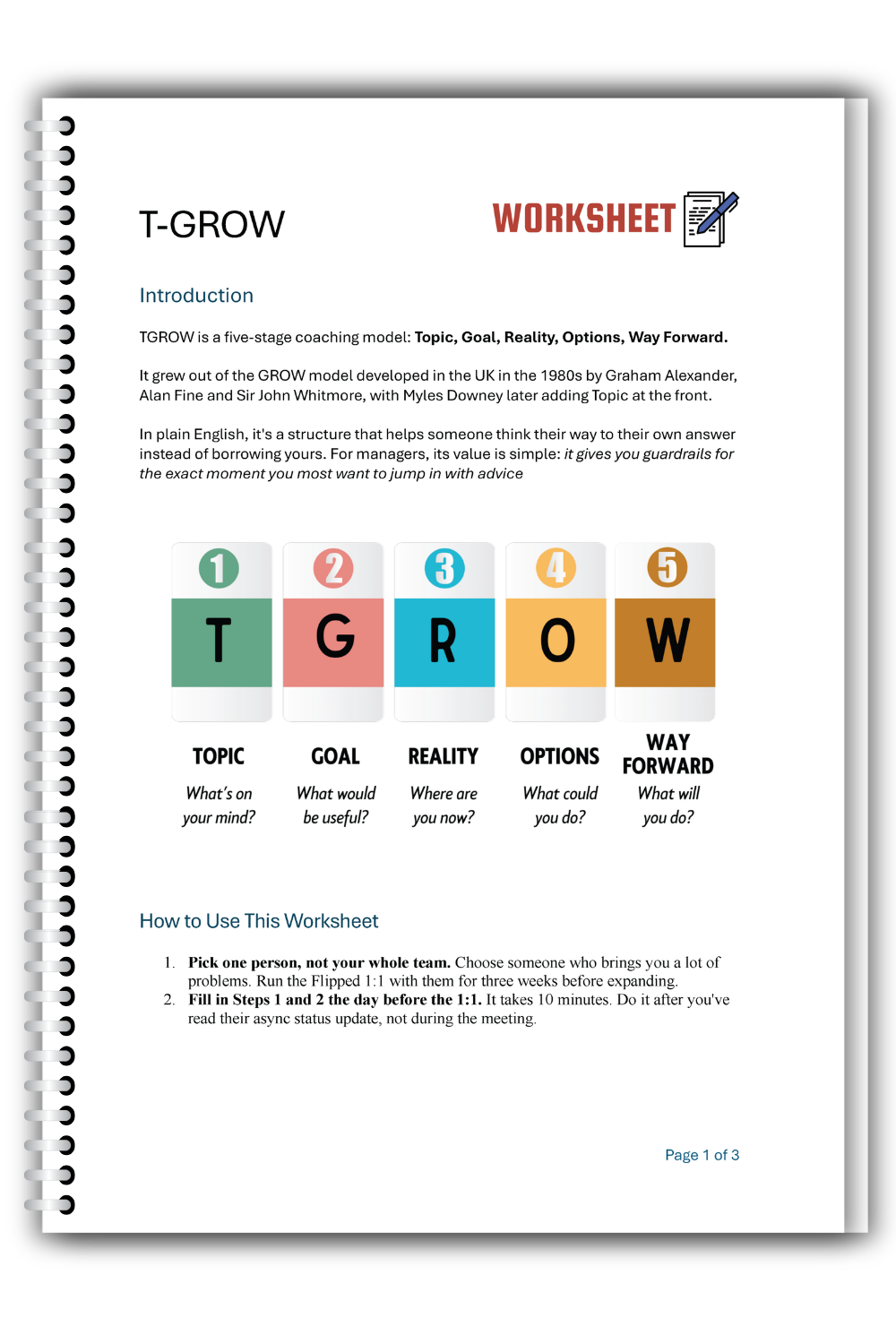
Use this worksheet to:
Prepare for your next 1:1 in 10 minutes
Plan your coaching questions for each T-GROW stage
Hold back advice until your team member has done their own thinking
Spot where you still rush to give answers
Turn every 1:1 into a clear commitment and follow-up
How to download the worksheet
This worksheet is part of the Worksheets Collection, available to all paid subscribers to The Good Boss.
👉🏻 Upgrade to paid now and get instant access to the entire collection, including this worksheet.
If you prefer the standalone worksheet, you can purchase it from here.
The Flipped 1:1
So, here’s a simple technique I use to apply the T-GROW model to a 1:1. I call it the Flipped 1:1.