

In this issue:
Why Smart Leaders Still Misread People
Why Behaviour Is Usually a Symptom
The 6 Human Needs, Explained Simply
Applying the 6 Human Needs in Practice
How to Start Using This With Your Team
Real-World Leadership Scenarios
Common Pitfalls and How to Avoid Them
Final Thoughts
Why Smart Leaders Still Misread People
I find this one of the strangest parts of leadership: I can work with smart, capable, well-intentioned people, and still feel confused by their behaviour.
For example:
One engineer on my team needs constant clarity before she acts, while another gets frustrated the moment things become too structured.
One technical lead keeps pushing for visibility and recognition, while another seems far more energized working in the background, as long as he is working on meaningful work.
One manager resists change and prefers stability, while another gets bored if things don’t change fast enough.
I used to observe this behavior, but misread what was underneath it. Most leaders I speak to tell me they are in the same boat.
As leaders, we tell ourselves simple stories, and often attach “labels” to individuals:
This team member is insecure.
That one is difficult.
This manager is ambitious.
That one is disengaged.
Sometimes those labels are not completely wrong, but they are usually incomplete. They describe the “surface”, not the engine underneath it.
I find that a lot of leadership gets easier when you stop reacting only to behaviour, and start asking what might be driving it.
Why Behavior Is Usually a Symptom
At work, behaviour is what we see first. In the examples I shared earlier, behavior is what is visible: resistance, defensiveness, restlessness, neediness, etc.
But behaviour is often just the visible expression of something deeper.
I remember having a team member who would push back on every change, and I thought he was just ‘negative’. But it turned out that he was protecting his need for stability. I had another, a high performer, who suddenly seemed restless, and I thought he was being ungrateful and impatient. Turned out, he was starving for growth, and needed more.
I’m not saying that every behavior should be ‘excused’. Absolutely not. All I’m saying is that we should be more careful when we interpret behavior.
The reality is, most leaders in the corporate world are trained to ‘drive outcomes’ and ‘address performance’. And that does matter, of course. But I strongly feel that you can be more effective as a leader when you also get better at reading the emotional logic underneath what people do. When you learn to do that, you will further amplify the business results, not hurt them.
One of the simplest ways I’ve found to do that is through a model popularized by Tony Robbins called the 6 Human Needs.
Let’s now look at how that works.
The 6 Human Needs, Explained Simply
The model suggests that all human beings are driven, in different degrees, by six core needs:
Certainty
Variety
Significance
Love & Connection
Growth
Contribution
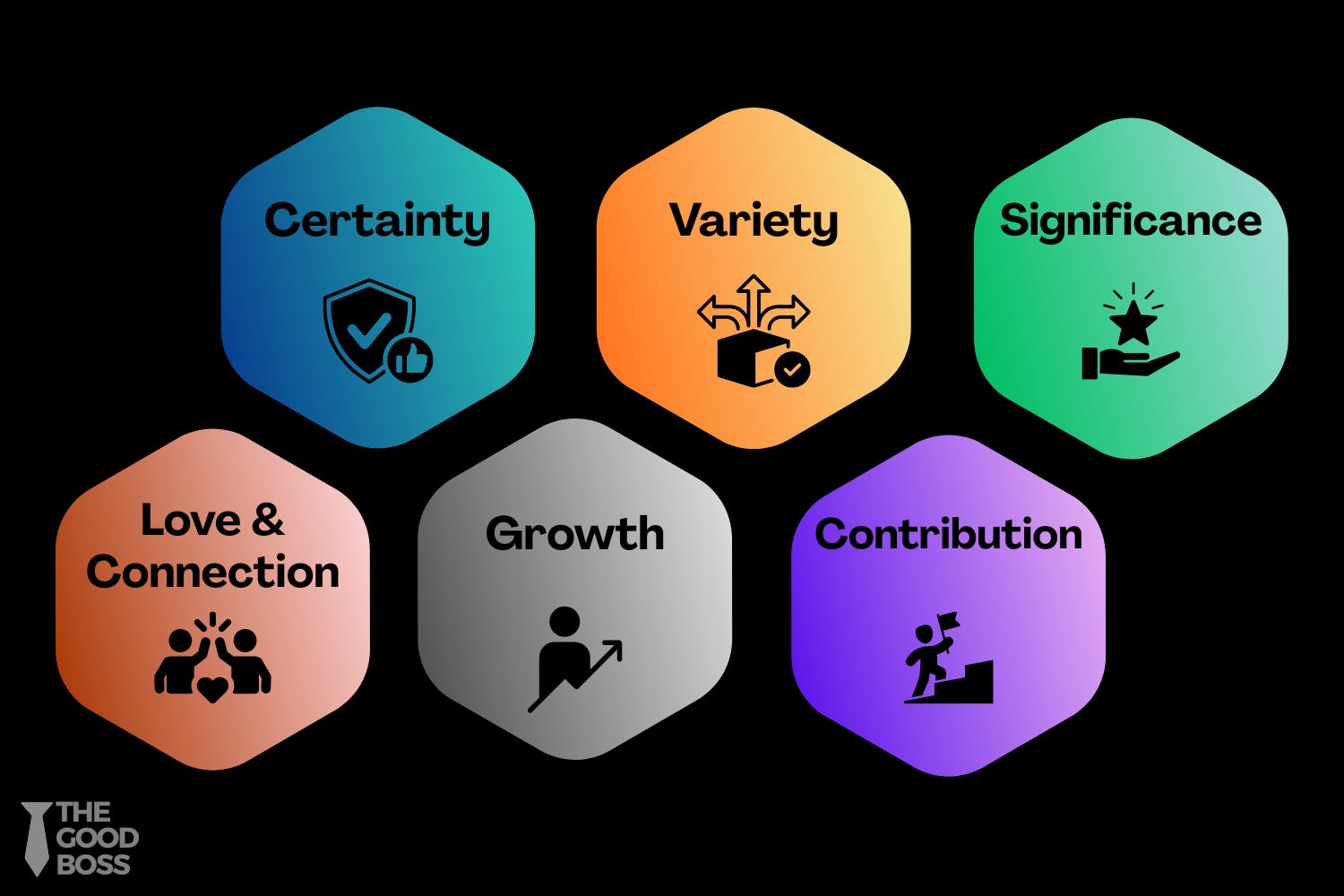
Certainty is the need for stability, predictability, and a sense of control. At work, this often shows up as a desire for clarity, structure, process, and low ambiguity. Many team members prefer working in stable and predictable environments.
Variety is the need for novelty, change, challenge, and stimulation. At work, it often shows up as a hunger for fresh problems, movement, experimentation, and less routine. I’ve seen many team members crave for variety, taking on challenging assignments related to areas they haven’t worked on before.
Significance is the need to feel important, valued, respected, or uniquely seen. At work, this can show up as a desire for ownership, recognition, influence, or visible impact. Many, if not most, team members want to be seen, and recognized for the impact they are making.
Love & Connection is the need for trust, belonging, closeness, and emotional connection. At work, this often shows up as a desire for team bond, support, trust, and a sense of belonging. This keeps team members engaged and feel a sense of shared ‘care’ for their wellbeing.
Growth is the need to learn, improve, stretch, and become better. At work, it shows up as a hunger for challenge, development, feedback, and progress. High performing team members who are studious often seek fast growth and progress in their career.
Contribution is the need to help, serve, support, or make a meaningful difference. At work, this often shows up as a desire for purpose, impact, service, and the feeling that one’s work matters to others. This helps to connect the dots between what a team member does, and why that matters to the organization as a whole.
For me, the biggest realization with this model is that as humans, we are not simply reacting to the task in front of us. We are (often unconsciously) trying to protect or satisfy one of those deeper needs within us.
One more thing to keep in mind is that the needs themselves aren’t inherently ‘good’ or ‘bad’. What matters is how they are being met by the individual, or by the organizational culture itself:
Need for certainty. One team member may meet that need by being reliable or calm, while the other may meet that same need by being rigid or resistant to change.
Need for significance: One team member can show up as confident with a sense of ownership, while another may become defensive or performative.
Need for connection: In some teams, this can show up as trust and belonging, while in others, it can show up as toxic positivity.
Ultimately, the context matters.
So, how do you start using this framework with your team? The good news is that you don’t need to be a psychologist or a psychoanalyst to use it.
There’s a much simpler way, which we will look at next.
Applying The Six Human Needs in Practice
For the rest of this article, we will focus our attention on putting the Six Human Needs into practice in your own organization. As we do that, don’t forget to download the Six Human Needs Worksheet.
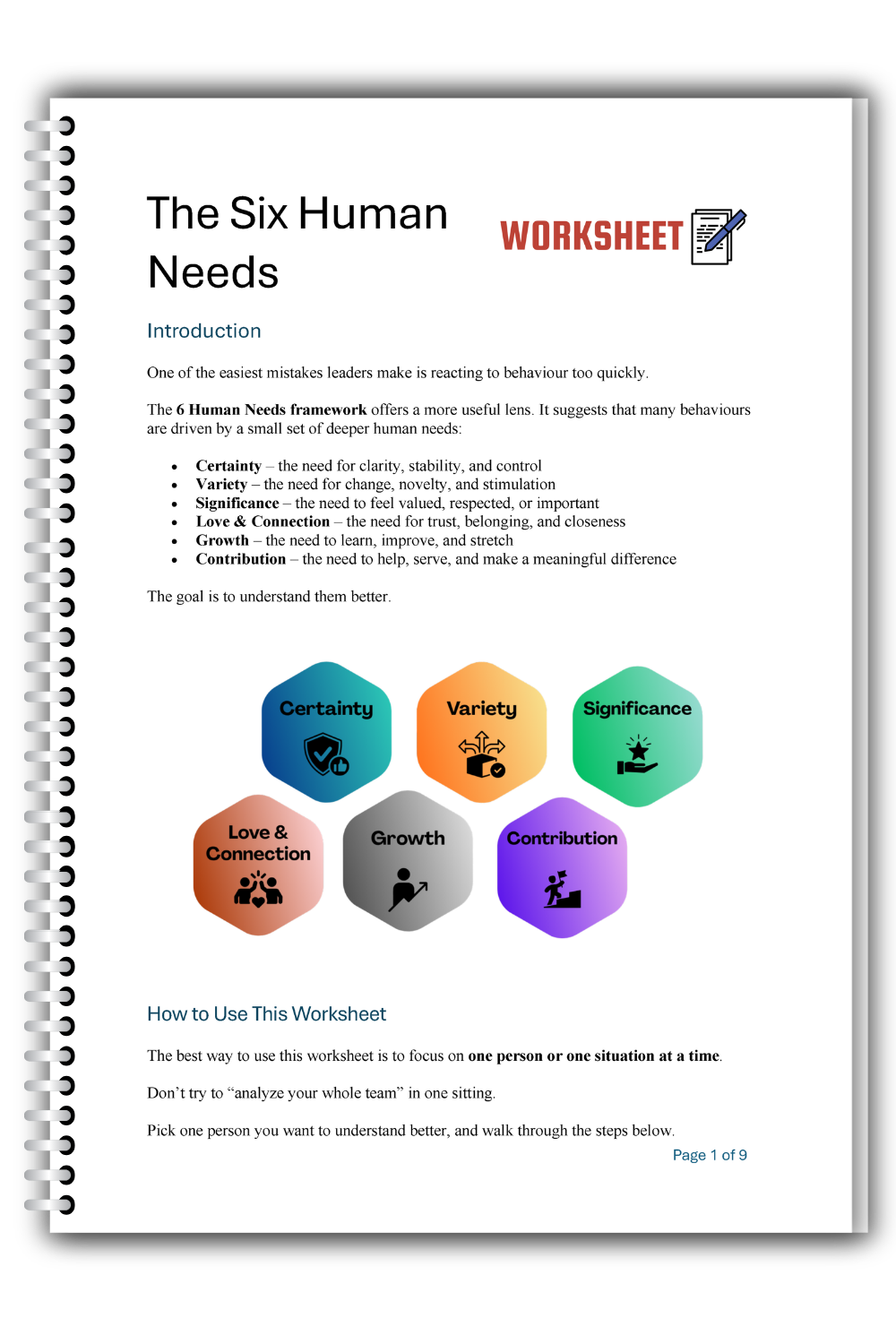
Use this worksheet to:
Understand the need behind a behavior before you judge or react to it
Get a specific, better way to respond to one person you’re trying to understand
Turn the framework into your next 1:1 conversation, not just a reflection exercise
How to download the worksheet
This worksheet is part of the Worksheets Collection, available to all paid subscribers to The Good Boss.
👉🏻 Upgrade to paid now and get instant access to the entire collection, including this worksheet.
If you prefer the standalone worksheet, you can purchase it from here.
How to Start Using This With Your Team
In order to apply this model in your own team, you just need to take a step back, analyze the need, and then craft your response accordingly.
I like to think of it as the three-step process: