

The 7 Habits of Highly Effective People is one of the most-read non-fiction books on the planet.
I first read it in my twenties, and at that time, the ideas felt abstract as I was just getting started with my first job at a tech company as a software engineer.
I’ve re-read it a few times since, and I picked it up again last month, mostly out of nostalgia. This time, I expected to skim it and drop it back on the shelf.
But as I started going through the pages, I found myself dog-earing pages, because the ideas started jumping out at me. I realized that many of the ideas I now teach as “modern” leadership frameworks and strategies were captured by Convey in this classic.
So I decided to try a different format this week: I’m going to deep-dive into the key ideas from the book through the lens of modern leaders, with a focus on the frameworks and strategies that still hold up.
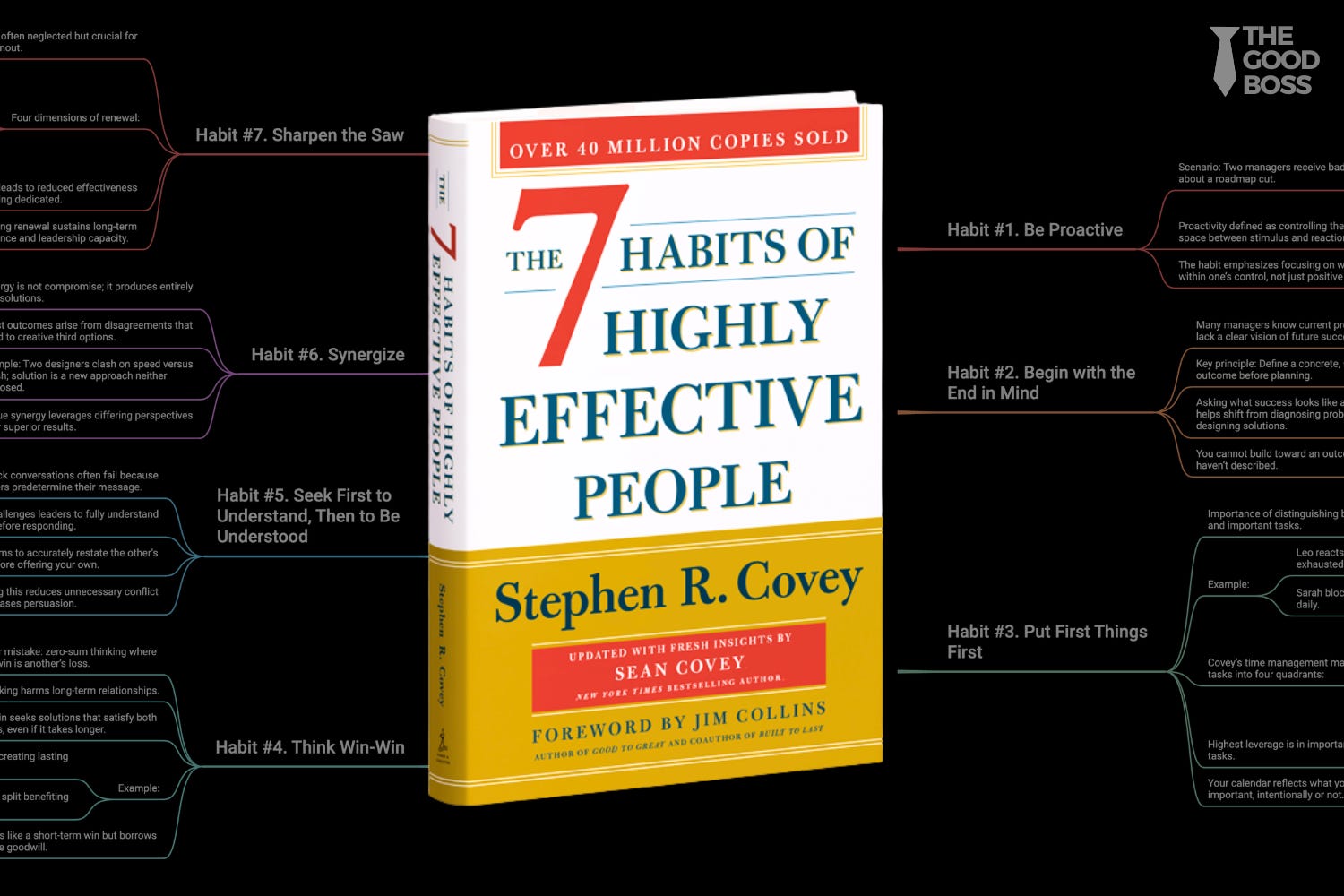
Here’s what I pulled out, habit by habit.
Habit #1. Be Proactive
Imagine two engineering managers, Martin and Grace, get the same bad news: the roadmap just got cut by 30%.
Martin spends the day venting in Slack about “leadership”, about “the business,” about how nobody tells engineering anything.
Grace spends ten minutes annoyed, then asks: “Okay, given this, what’s still in my control?” She re-scopes the quarter by the end of the day.
Both are allowed to be upset, but only one of them is being proactive.
Proactivity, in Covey’s language, isn’t optimism. It’s the gap between stimulus and response, and the discipline to act inside that gap instead of just reacting.
Martin isn’t wrong to be frustrated. He’s just spending his only leverage, his response, on something that changes nothing.
👉🏻 The habit isn’t “stay positive.” It’s: control what’s yours, and stop performing outrage over what isn’t.
Habit #2. Begin with the End in Mind
Most managers I work with can tell me, in detail, what’s broken about their team right now. Almost none of them can tell me what “great” looks like six months from now.
That’s backwards.
Covey’s second habit says: define the destination before you plan the route.
Not a vague vision statement, but a real, specific picture of the outcome you’re building toward.
I’ve started asking managers one blunt question: “If this team were working perfectly a year from now, what would be different?” The answer is almost always more useful than any retro they’ve ever run, because it forces them to stop diagnosing and start designing.
👉🏻 You can’t build toward an outcome you’ve never actually described.
Habit #3. Put First Things First
Here’s the trap: “important” work and “urgent” work can look deceptively similar.
Leo runs his week from his inbox. The loudest email or Slack message wins his attention. He’s exhausted by Friday and can’t tell you what he actually accomplished by the end of the week.
Sarah, on the other hand, blocks 90 minutes every morning before opening the Inbox or Slack. She focuses on the one or two things that matter most that week, urgent or not.
This is Covey’s time management matrix: sort everything into four quadrants:
urgent/important,
not-urgent/important,
urgent/not-important,
not-urgent/not-important.
Most of your actual leverage lives in quadrant two: important, but not urgent. Nobody’s forcing you into it. You have to choose it, daily, or it never happens.
👉🏻 Your calendar isn’t a record of your priorities. It’s a record of what you decide is important, whether you do it intentionally or not.
❤️ Enjoying the read?
If you are finding this post helpful, please like and share it with other managers who can benefit from it, including your boss :)
Habit #4. Think Win-Win
Early in my career, I believed in the zero-sum game: if my team got a new project, if I pushed back on a peer’s ask, I “won.”
Covey calls this win-lose thinking, and it quietly wrecks more working relationships than any single bad decision does.
The alternative is win-win thinking, which is to genuinely look for the version of the outcome that works for both sides, even if it takes longer to find.
I’ve watched two people negotiate the same headcount freeze.
Richa fought to protect her team’s number at the expense of a peer’s team, and won a bitter ally for the rest of the year.
Malcolm proposed a split neither had asked for, one that let both teams hit their real goals. Guess who built longer-lasting trust and rapport with their team and peers?
👉🏻 Win-lose in the workplace can feel like winning in the moment, but it’s actually just borrowing against next month or quarter.
Habit #5. Seek First to Understand, Then to Be Understood
Most feedback conversations fail before a word is said, because the manager walks in already knowing what they’re going to say.
Covey’s fifth habit is uncomfortable because it asks you to do the opposite:
Understand fully before you respond at all.
To be clear, it’s not about listening so you can respond. It’s listening so you can accurately restate the other person’s position before you offer yours.
I try this test now in hard conversations: could I explain their side back to them well enough that they’d say “yes, that’s exactly it”? Most of the time, the answer is no, and once I actually get to that understanding, half of what I planned to say originally turns out to be unnecessary.
👉🏻 You’re not persuasive because you talk well. You’re persuasive because you understood first.
Habit #6. Synergize
“Synergy” has become a buzzword and gets thrown around so loosely in corporate life that it’s become a punchline.
Covey’s actual point is sharper: the best outcome usually isn’t your idea or their idea, it’s a third option that only exists because you disagreed first.
I remember several years ago working with two user experience designers who used to clash constantly on a product decision. One wanted speed, while the other wanted polish.
Their manager stopped mediating between the two positions and instead asked: “What would a version look like that neither of you has proposed yet?” Within twenty minutes they’d built something better than either original pitch.
👉🏻 Synergy isn’t compromise, because compromise implies both sides lose a little. Synergy means the disagreement itself produced something neither side had.
Habit #7. Sharpen the Saw
The seventh habit is the one every burned-out manager skips first and needs most: renewal.
Covey breaks it into four dimensions: physical, mental, social/emotional, and what he calls “spiritual,” meaning the sense that your work connects to something you actually value.
Many managers I work with only notice the physical dimension, and only once it’s already failing. They clock that they’re not sleeping, not the three months before that when they stopped reading anything longer than a Slack message, stopped seeing friends outside of work, and started wearing “busy” like a personality trait instead of a warning sign.
I know the mental and social dimensions personally, because I ignored both for almost two years, telling myself the team needed me too much for me to step back. What actually happened: my patience shortened, and my judgment got worse. And that’s exactly when the team needed me more, not less, because I was operating at maybe 60%.
👉🏻 You don’t get credit for the saw that never gets sharpened. You just cut slower, with more effort, and call it “dedication”.
Putting it together
Covey’s seven habits build in order:
Habits 1–3 are about mastering yourself (Be Proactive, Begin with the End in Mind, Put First Things First).
Habits 4–6 are about working with others (Win-Win, Understand First, Synergize).
Habit 7 renews all six.
Effectiveness, in leadership or in general, was never about “doing more”. Covey’s whole argument, 35 years on, is still just this: know what matters, and stop pretending you don’t.
If this book-review format is one you’d want more of, tell me in the comments or hit reply. And if it was useful, a restack helps more managers find this. ❤️
❤️ Found this helpful?
If you found this post helpful, please like and share it with other managers who can benefit from it, including your boss :) If you have any feedback, please drop your comment below - it helps me to keep improving the content. Thank you!

Thanks for the reminder.
“The Seven Habits of Highly Effective People” by Stephen Covey, “The Leadership Challenge” by James Kouzes and Barry Posner, and “Leadership is an Art” by Max DePree are all classics worthy of rereading often. “A Failure of Nerve” by Edwin Friedman could also be on that list.
Gaurav, This is a great approach and helped me a lot.