

A few years ago, I was in a planning meeting with my team to align on the release date for a high-visibility product feature. Halfway through the meeting, we converged on 8 weeks as a reasonable time to ship the feature.
As the meeting was coming to a close, one of the team members floated the idea that “we should ship it two weeks ahead, in 6 weeks”, and a couple of others supported that with “sure”. I watched everyone around the room, and didn’t see any disagreements, so I piled on with “let’s try it”. And that was it. The decision was made, and the meeting was over.
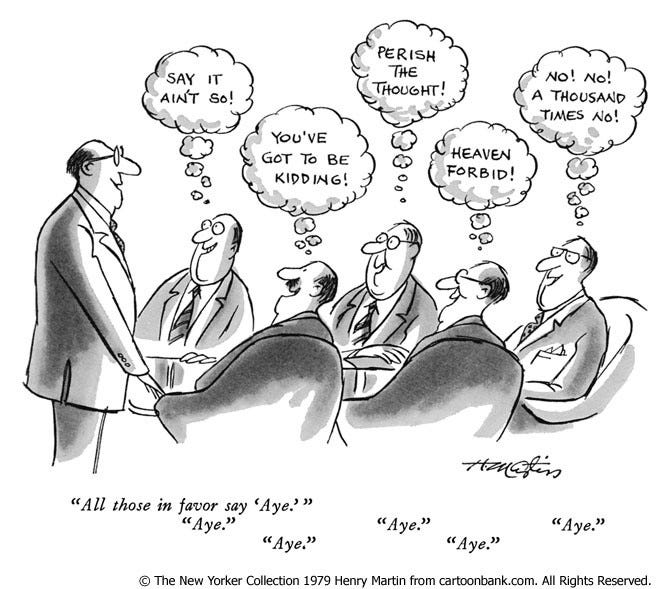
Over the next few days after that decision, in separate 1:1s, three different people on my team told me that they weren’t quite sure about the timeline. All of them were in the meeting, but not one of them had said a word in the room. Each one told me a similar story.
In the meeting, they assumed that everyone else was on board, so they didn’t want to be the one who slowed things down.
What was interesting for me was that none of them “lied” in the meeting, or got pressured by someone else’s loud voice. Each of them privately assumed that they were the only one with a different opinion, so they chose to keep quiet.
And that’s how a team of smart, honest people ends up committing to a plan that, individually, none of them wanted.
This was an example of the Abilene Paradox in action.
In this issue:
Understanding the Abilene Paradox
How the Abilene Paradox Works
How This Is Different From Groupthink
Applying the Abilene Paradox in Practice
The Reluctance Check
The Reluctance Check in Action
Common Pitfalls (and How to Avoid Them)
Final Thoughts

Understanding the Abilene Paradox
The Abilene Paradox was introduced by management expert Jerry Harvey, who told a story about his own family, as illustrated below:
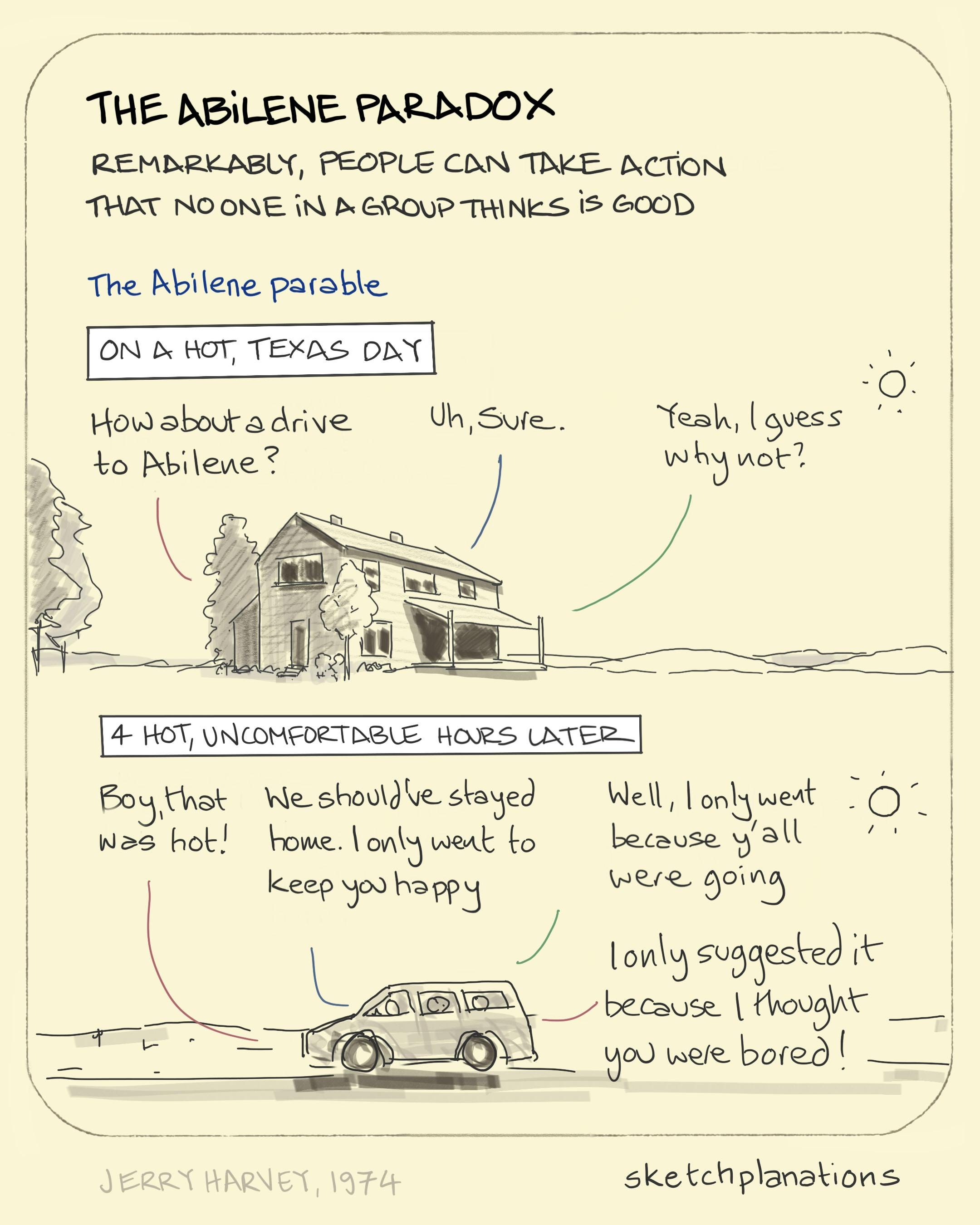
On a hot afternoon in 1974 in Coleman, Texas, a family member suggested an idea: let’s drive to Abilene for dinner. The rest of the family members agreed, and they went ahead with the 50-mile-long drive to Abilene.
The drive turned out to be hot, dusty, and the meal was nothing more than mediocre. On the drive back, when the family started discussing how horrible this idea was, it came out that nobody had actually wanted to go. Each person assumed the others were excited about it, so they went along wanting not to be the spoil-sport.
The Abilene Paradox:
When a group agrees to do something that nobody in the group actually wants, because everyone assumes they're the only one who is not into it.
How the Abilene Paradox Works
The Abilene Paradox breaks down into three steps, and they happen almost at the same time:
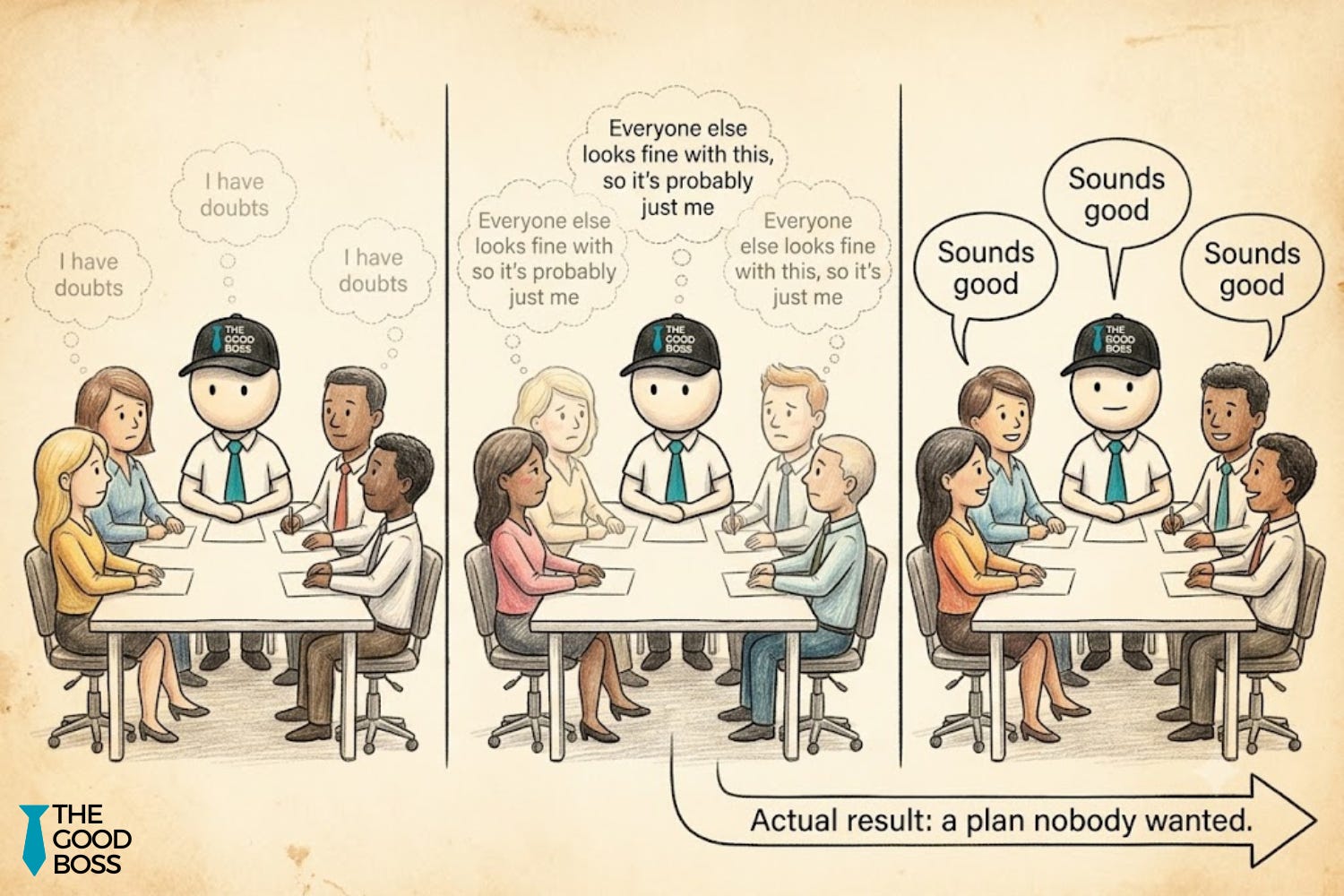
Private doubt. Someone in the group has a real hesitation about the idea on the table. It’s not a strong objection, just a “hmm, not sure about this.”
A wrong read on the room. That same person looks around, sees everyone else looking calm or nodding along, and concludes that they’re the only one who feels this way. What’s actually happening is that everyone else is making the same wrong read, at the same time, about each other.
A rational choice to stay quiet. Given that they believe that they’re the only one in doubt, they decide not to raise any concerns, and stay quiet. After all, why be the one person who blocks something everyone else clearly wants? So they say yes, the next person does the same calculation and says yes, and before you know it, the group arrives at a decision that nobody actually agrees with.
The most subtle, and dangerous, part of the Abilene Paradox is this: nobody in the room is being dishonest or spineless. Each person is making a reasonable decision based on the wrong assumption about what everyone else believes.
How This Is Different From Groupthink
I’ve seen managers confuse the Abilene Paradox with Groupthink, which is another common trap, so I want to draw the distinction.
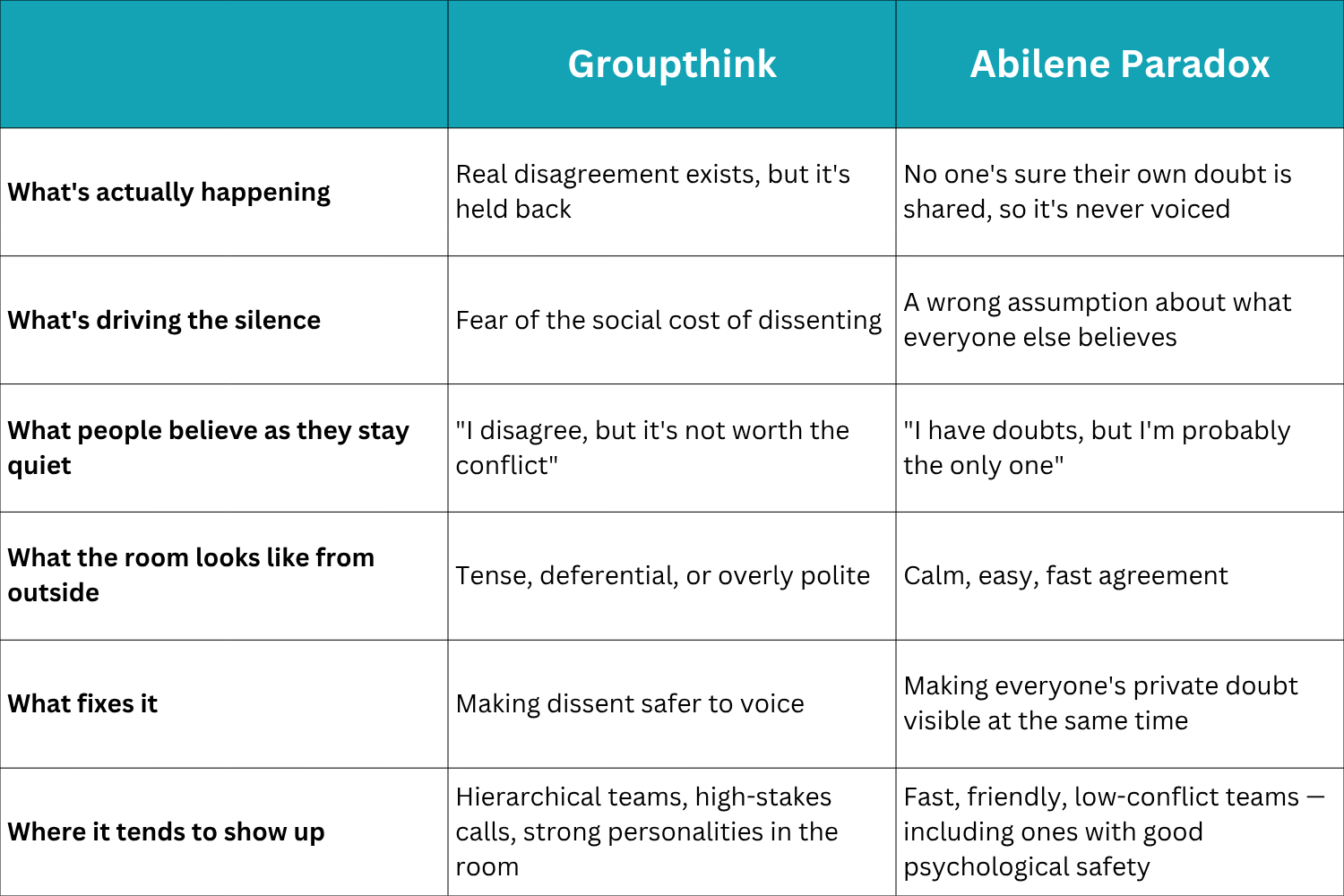
Groupthink is what happens when a group actively suppresses real dissent to protect harmony. Someone in the room has a real, strong objection. They can point to exactly why they disagree, but they choose not to raise it because they’re afraid of the repercussions. There is real disagreement in the room, but it’s just being held back by pressure, or a desire to avoid conflict. The fix for groupthink is mostly about psychological safety: making it safe for people to voice their objection.
The Abilene Paradox is different because nobody is holding anything back out of “fear” or a lack of psychological safety. Each person holds a doubt, but it’s not a strong objection. It’s not “I disagree, but I’m scared to say so.” (That’s groupthink) It’s closer to “I have a nagging feeling, but everyone else looks fine, so it’s probably just me.” The fix in this case is making everyone’s private hesitation visible to everyone else at the same time, before the group locks in on the wrong direction.
This is what makes the Abilene Paradox dangerous. A team can have excellent psychological safety, yet still run into the trap of the paradox.
Applying the Abilene Paradox in Practice
For the rest of this article, we will focus our attention on putting the Abilene Paradox into practice in your own organization. As we do that, don’t forget to download the Abilene Paradox worksheet.
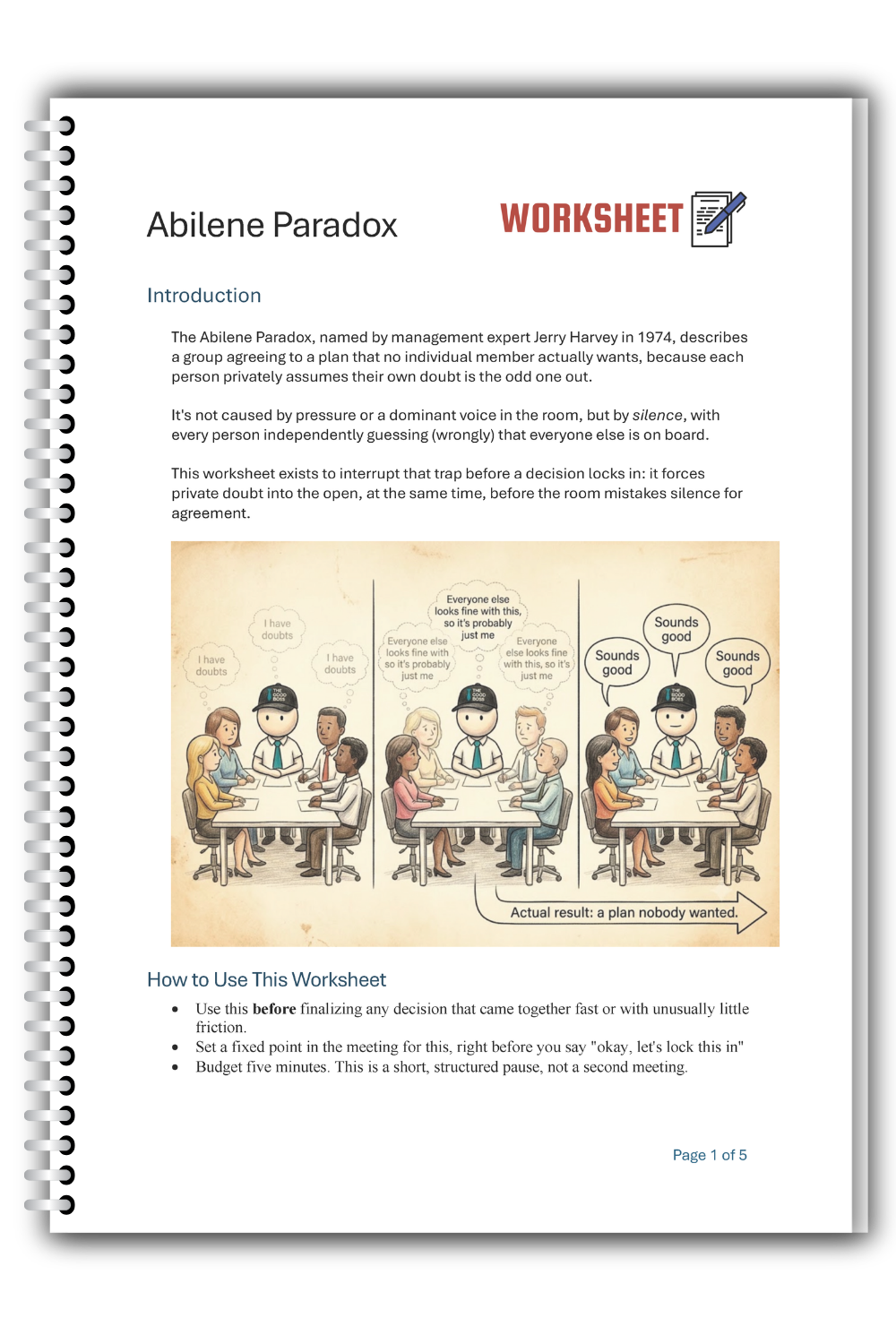
Use this worksheet to:
Turn a fast, easy “yes” into a real check instead of an assumption
Surface the one hesitation everyone is privately holding but not saying
How to download the worksheet
This worksheet is part of the Worksheets Collection, available to all paid subscribers to The Good Boss.
👉🏻 Upgrade to paid now and get instant access to the entire collection, including this worksheet.
If you prefer the standalone worksheet, you can purchase it from here.
The Reluctance Check
Here’s a simple technique that you can apply to counter the Abilene Paradox in your team: