In this issue:
A Meeting That Made Me Uncomfortable
What We Were Taught Good Leadership Looks Like
What AI Just Changed
The Three Layers of Leadership
Why This Matters for You as a Manager
The One Shift: Audit Your Last Five Days
How This Plays Out in Real Teams
Common Pitfalls (and How to Avoid Them)
Final Thoughts
A Meeting That Made Me Uncomfortable
A few weeks ago, I was in a leadership team meeting.
A senior manager was presenting his team’s quarterly review. He had prepared slides and talking points and done a great job summarizing the key wins and misses. Clearly, he had put a lot of hard work on it.
But as he wrapped his presentation, I started thinking…
I had done something similar the week before. I had prepared performance reviews, planned our team priorities, and summarized key takeaways from the past quarter. Except I hadn’t spent days on it. I had used AI, and what used to take me days took a couple of hours, max.
It was a similar output, but in a fraction of the time.
I looked around the room. These were smart, experienced leaders who had been in the industry for several years and in these leadership roles. And yet, so much of what they were doing, like the synthesis, the summaries, the decks, the documentation, was exactly the kind of work that AI now handles faster and better than any of us.
And what’s more, AI can arguably do these tasks better, with higher quality, and in minutes.
So if those things used to define what great leadership looked like, and AI can now do them on demand, what does great leadership look like today?
That question made me uncomfortable…
What We Were Taught Good Leadership Looks Like
For most of us, the mental model of a “good leader” was shaped by what got us promoted.
You were sharp, had answers, and could walk into a room, absorb a complex situation quickly, cut through the noise and make a confident call. You remembered things, connected dots others missed, and were typically the most informed person in the room.
These weren’t just your skills… they became your identity.
And for a long time, this model defined great leadership. In the pre-AI era, information was scarce, or harder to process, and analysis took time and effort. In that era, the leader who could synthesize complexity the fastest created real value.
While that era may not be over just yet, it is changing faster than most leaders want to admit.
What AI Just Changed
Many leaders I speak to think of AI as the ‘new tool on the block’.
I think that’s a very narrow way to look at it. AI is more than just a tool. AI is rapidly commoditizing the skills that used to define leadership competence, and that’s a big deal.
Need to remember key information? AI can pull it up from its memory in seconds.
Need to identify patterns across pieces of data? AI can do that better and faster than humans.
Need to summarize last quarter’s decisions for a new stakeholder? A two-line prompt.
Need to write a professional, impactful email to key stakeholders? Straightforward.
All these tasks are now table stakes, thanks to the power of AI.
And this has created a crisis for a specific kind of leader - the one who builds their confidence and credibility in being the most informed, analytical person in the room.
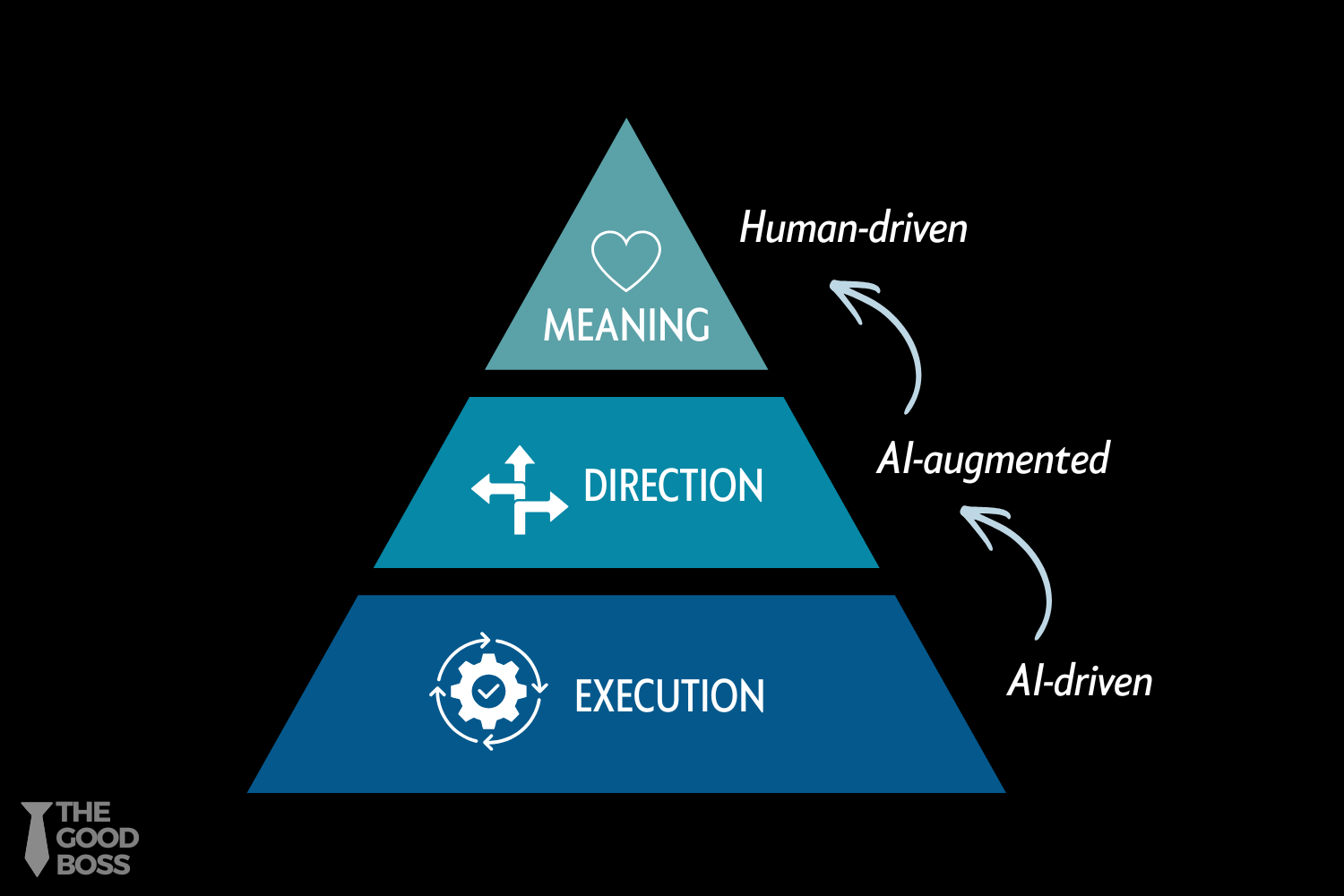
The Three Layers of Leadership
Here’s the framework I’ve been thinking about to make sense of this shift.
Think of leadership as a pyramid with three layers.