

In this post:
Part 1: Understanding the AI Fluency Framework
What Is the AI Fluency Framework?
The Four Competencies (4Ds)
The Three Modes (3As)
Why This Matters to Managers
Test Your Understanding
Practice This Framework
Part 2: Applying the AI Fluency Framework
Download the Worksheet
Apply to Your Situation
The 4D Handoff
Part 3: Going from Here
Common Pitfalls and How to Avoid Them
Final Takeaway
Over the past two years or so in my company, we’ve rolled out AI coding tools, starting with Co-pilot, then Cursor, and now Claude Code. Most software companies have done the same.
Within a few weeks of the rollout of each tool, the usage shot up, and the number of PRs (pull requests) also increased by a factor of 3x.
The climbing number of PRs looked great until we realized that the review queue had started to fill up. And then the CI got blocked. And then the incidents started pouring in…
There’s no doubt that AI is helping us to become more efficient, more productive, and release faster. But when I speak with leaders, I still hear them talk about “better prompts”, which misses the whole point.
I decided to closely watch what was going on as we moved to the AI-native ways of working, and what the real bottleneck was, and I had a big realization:
The people who were struggling most with AI were mostly the same people who already struggled to delegate, write a clear brief, or properly review someone else’s work. AI didn’t create a new skill gap on that team. It exposed an old one.
That’s the part most AI training ignores, and frankly, most leaders miss.
Getting real results from AI has much less to do with ‘clever prompts’ and much more to do with the skills that make someone a good manager.
In this post, I’ll be breaking down what I mean by that, and what you can do as a leader to make the most of AI in your team.
Part 1: Understanding the AI Fluency Framework
What Is the AI Fluency Framework?
The AI Fluency Framework comes from Anthropic’s free AI Fluency course on Claude Academy. You’ll also hear it called the 4D Framework, because it’s built on four competencies that all start with ‘D’. (Boy, do I love these acronyms!)
So what does ‘AI Fluency’ mean?
AI fluency means being able to work with AI effectively, efficiently, ethically, and safely.
That’s a much bigger goal than “write better prompts,” and it’s why I think the framework is so useful for leaders.
When I first went through it, what stood out to me was how familiar it felt. I’ve been coaching managers on every one of the four Ds for years. The only thing that’s new is who’s on the other side - a human or AI.
Let’s take a deeper look at the 4Ds next.
The Four Competencies (4Ds)
Here are the four Ds, along with the management skill each one mirrors.
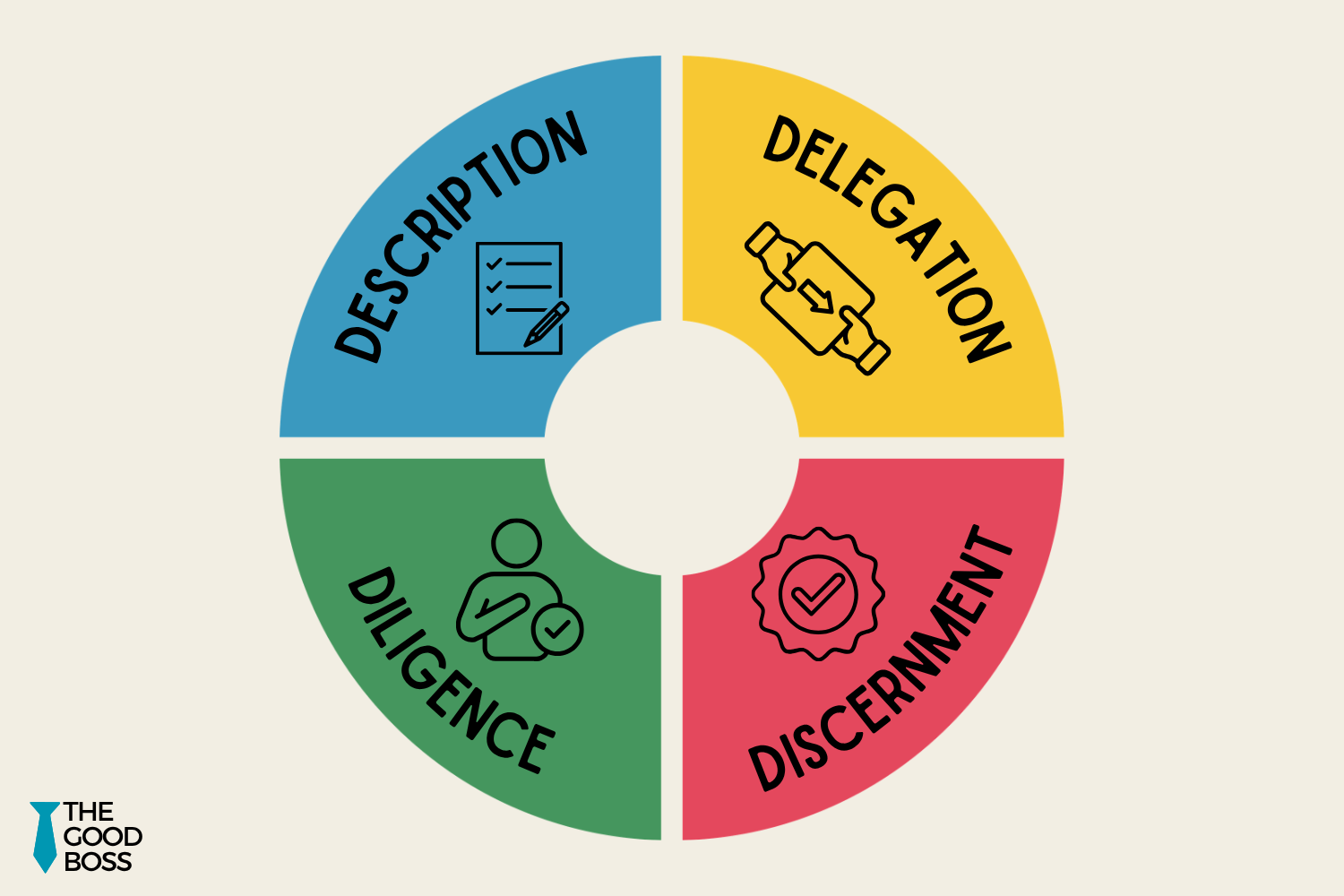
1. Delegation: deciding what to hand off
Delegation is about deciding what work you do yourself, what you do together with AI, and what you let AI handle on its own.
This can further be broken down into three parts:
Problem awareness: knowing your goal and the work that’s involved
Platform awareness: knowing what different AI tools can and can’t do
Task delegation: splitting the work between the two so each side does what it’s good at
You’re probably thinking - that sounds like management already, and you’re 100% right.
Think about it:
A good manager knows the work well enough to break it down, and knows his team well enough to match the right task to the right member of the team.
That’s exactly how Delegation works with AI in this framework.
And an important implication of this: If you struggle to delegate to a new hire, you’ll struggle to delegate to AI for the same reasons.
2. Description: writing a good brief
Description is about how “clearly” you communicate with AI.
There are three layers involved here:
Product (what you want as the output)
Process (how you want the task to be tackled)
Performance (how you want the AI to behave while it works with you, for example, concise or detailed, challenging or supportive, etc.)
A good brief or description includes all these layers, but most managers tend to skip the process and performance layers.
They tell AI what they want it to build, and then get surprised when the result is technically correct, but not what they needed.
Again, you can see how this correlates with the manager’s role outside of AI.
Even with their human team members, managers need to be clear about their expectations for the goals and give some sense of the process and performance expectations.
And that’s exactly what Description is with AI in this framework.
3. Discernment: reviewing the work critically
Discernment is evaluating or verifying what the AI gives back to you.
It uses the same three layers we discussed above:
Is the output of good quality and what I expected? (product)
Did it follow a sensible process when executing the task? (process)
Was it helpful in how it worked with me? (performance)
In the non-AI world, good managers evaluate and assess their team’s performance based on metrics. They provide them feedback, help them get better over time, and provide the support along the way.
The same applies with AI, and that’s what Discernment is all about.
4. Diligence: owning the outcome
Diligence is about working with AI responsibly.
It means being thoughtful about what you create with it, being open about how AI was involved, and taking responsibility for the outcomes and impact of whatever you’re building.
AI isn’t accountable for what it built on your instruction. You are.
Again, for managers, this is the core of accountability. “AI wrote it” is no more acceptable an excuse than “the intern wrote it”. You own the outcomes delivered by your team. Period.
The Three Modes (3As)
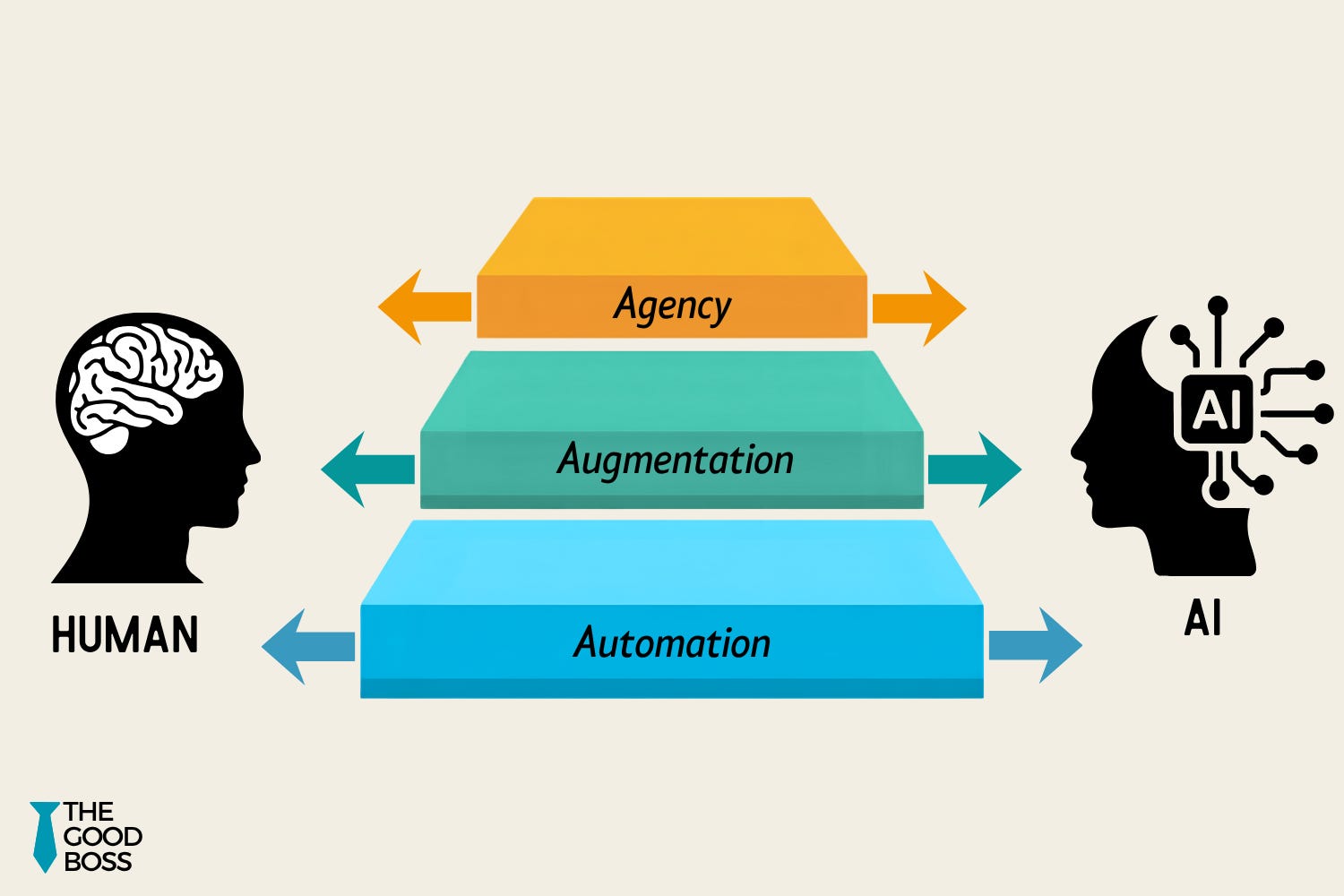
The AI Fluency Framework also describes three ways people work with AI:
Automation: You provide the instructions, and AI carries out a specific task based on those.
Augmentation: You and AI work together as thinking partners.
Agency: Instead of telling AI each step, you set it up to work on its own on your behalf.
If you know Situational Leadership, this will sound quite familiar.
Automation is similar to the directing phase, augmentation is similar to coaching, and agency correlates to delegating.
And just like with people in Situational Leadership, the “right mode” depends on the task at hand and on how much trust you’ve built up with AI.
Why This Matters to Managers
Most companies today are tracking AI adoption with usage numbers, such as seats activated, tokens burnt, or the percentage of code written with AI.
Those numbers are useful when you’re at the beginning of the adoption cycle, and want to get your teams onboarded to these tools.
But once everyone is using the tools (which pretty much everyone is today), what’s more useful is to measure what matters, i.e., whether you’re getting better results with AI.
If you’re familiar with Goodhart’s Law - once usage becomes the target, it stops telling you much.
And as AI takes on more of the “producing”, your role as a manager, and your teams’ as well, shifts from producing, to judgment. This includes:
Deciding what to hand off
Spotting mistakes and errors in what is produced
Deciding if the product is actually “ready’ to be shipped
etc.
This makes AI fluency less of a tools problem, and more so a leadership problem.
Test Your Understanding
We just went through the AI Fluency Framework, the 4Ds, and the 3As.
Before you move on, take a couple of minutes to check your understanding with a quick quiz.

(If you’re new to Kyoshi: It’s the systems-first leadership coach, built on the same Leadership OS I’ve been writing about in this newsletter for years. Go ahead and sign up for free and try out the quiz now.)
Practice This Framework
Just like you build your physical muscles in the gym, you build your leadership muscle by practice.
🎯 Practice a drill
Got five minutes? Drills are short, focused reps. Start a drill in Kyoshi to practice the AI Fluency Framework and how the 4Ds apply in a realistic situation.

Part 2: Applying the AI Fluency Framework
Practice makes you better, but you only really grow when you use a framework on your own problems.
Your situation has its own people, its own history, and, frankly, its own politics.
So here are two ways in which you can actually apply this framework in your own leadership role today.