

I first got promoted to a manager in 2008, and I remember sitting in my first calibration meeting that year as one of the decision-makers.
For most of my career until that point, I had been an individual contributor, and I had been on the other side of that door.
I would submit my self-review to my manager, and several weeks later he would share my performance rating and my compensation letter. I had heard about the “calibration process” that managers were involved in, and had always assumed that it was a careful, objective review of everyone’s work.
In that first calibration meeting, I witnessed what actually happens behind those doors.
Two names came up back to back. The first was a senior engineer (let’s call her Mei Ling) who had one of the strongest delivery records in the entire group. I had known her work from my own IC days.
Mei Ling’s manager said that she’s solid and really reliable. No other manager added anything.
The second name was Kreesh, another engineer I had worked with in the past, but his record wasn’t as solid as Mei Ling’s. Before Kreesh’s manager could even finish the first sentence, two other directors jumped in. “He saved us during the March outage.” “He’s the one the product team always asks for.”
Within five minutes, Kreesh’s name was on the promotion list, while Mei Ling got a “strong, but not yet ready”.
When I walked out of that meeting, I replayed what had happened and realized something strange.
Nobody in the room had “cheated” or “lied”, and it felt like the outcome was “fair”.
Yet, something inside me told me that there was more to it.
I realized then that “corporate success” isn’t pure meritocracy as we claim it will be. And it isn’t a rigged lottery either.
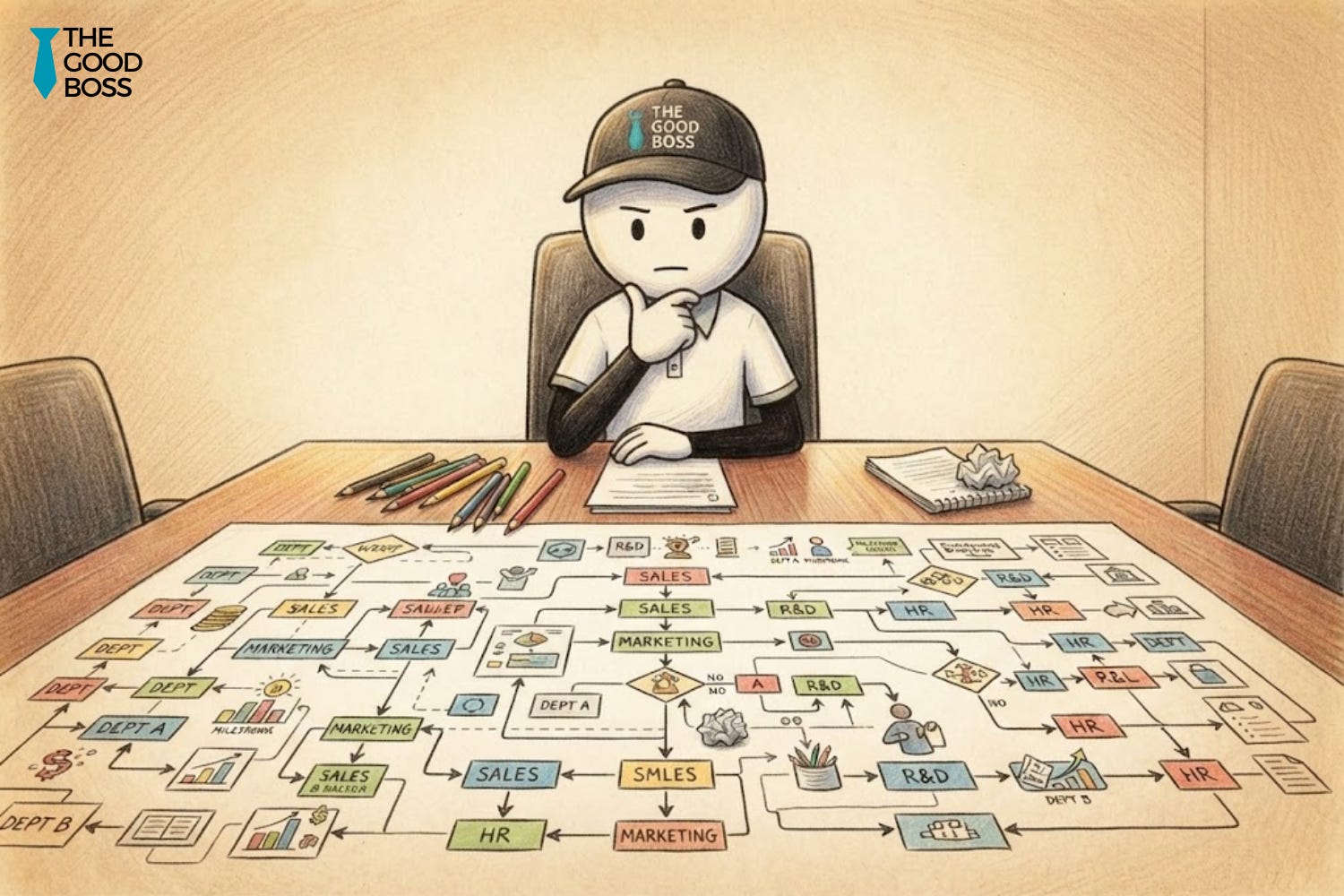
It’s a game.
Merit gets you a seat at the table, but the rules decide whether your merit counts.
And, just like me, most of us were never taught the rules.
In my earlier posts on The Hidden Rulebook of Corporate Politics and The 48 Laws of Power in Leadership, we looked at the unspoken rules of politics and the sources of power.
In this post, I want to zoom out and show you the whole game: where it's is played, who’s playing, what gets traded, and how the wins get counted.
I’ve broken the corporate game into six parts:
Chapter 1: The Board - where the game is actually played
Chapter 2: The Players - who you’re really playing with (and against)
Chapter 3: The Currency - what gets traded
Chapter 4: The Moves - the plays that actually work
Chapter 5: The Scoreboard - how wins and losses get counted
Chapter 6: The Endgame - how to win the long game without losing yourself
Across these six chapters, I’ll share 28 moves that I’ve seen play out again and again over 20+ years of leading teams in the corporate world.
Let me be clear about one thing upfront: this isn’t a post about manipulation. It’s a post about awareness.
You can’t play a game well if you don’t know you’re in one.
If that resonates, let’s roll the dice 🎲 and let the game begin! (pun intended)
Chapter 1: The Board
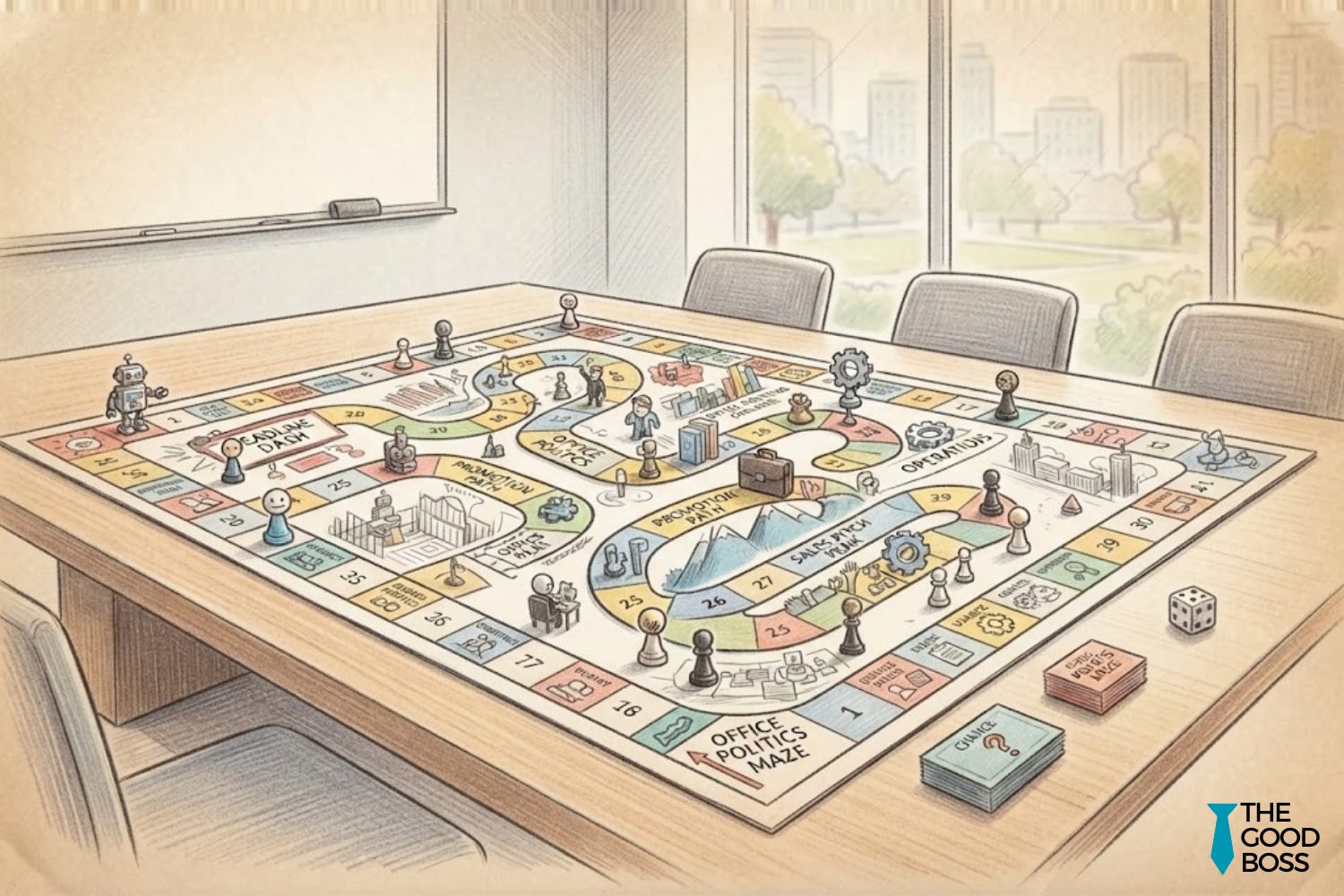
Before you make a move, know where the game is actually played.
Most people think the corporate game is played in the big meetings like the all-hands, the quarterly reviews, or the launch announcements.
But here’s what I’ve seen again and again: by the time something shows up in a big meeting, the game is usually over.
The real game is played on a board that most people never look at closely: the planning calendar, the budget, the calibration room, and the reorg.
This chapter is about learning to see that board.
Move 1: The game runs on a calendar.
Every company has a rhythm.
It could be the annual planning, the quarterly budget cycle, mid-year reviews, or the annual calibration.
Most of the important decisions get made inside those windows, often months before anyone announces them.
I remember a manager, Kenji, who had a great idea for a platform investment. He did a lot of research to collect data points and made a strong pitch to the leadership team in November.
The leadership team loved it and had a simple response: “Let’s look at this next year”.
What Kenji didn’t realize was that next year’s budget had already been locked in September.
Meanwhile, another manager, Hannah, pitched a much less revolutionary idea in July, right when planning was open. And guess what - she earned her team two additional headcounts.
Kenji had the better idea, but Hannah had the better timing.
👉🏼 Takeaway: The best idea at the wrong time loses to a decent idea at the right time. Learn your company’s calendar, and work backward from it.
Move 2: The budget is the real org chart.
Every company says that it cares about its customers, quality, innovation, and its people.
But if you want to know what it actually cares about, follow the money.
Sameer, an Engineering Manager I knew in a previous company, joined an org where the leadership kept repeating that “quality is our top priority.”
Yeah, we’ve heard that before.
So he put together a solid proposal to reduce tech debt, which directly addressed the quality problem. But when he presented that to the same leadership, they weren’t willing to invest in it.
Then he noticed that every new headcount in the last two years had gone to features for enterprise customers.
So he reframed his proposal: it was the same work on improving quality, but he positioned it as a way to “reduce churn in the top 50 enterprise accounts” with projections included.
He got funding within a month.
The work didn’t change. The alignment with the money did.
👉🏼 Takeaway: Strategy decks tell you what leaders want to believe. Budgets tell you what they actually value.
Move 3: Calibration is the final table, and you’re not at it.
During my experience at a calibration meeting as a first-time manager, I realized something that most people don’t think about:
The most important conversation about your career happens in a room you will never enter. Your manager typically has two or three minutes to argue your case, against a dozen other cases.
Divya, a manager I once coached, had a great year. She told me that her boss genuinely liked her work, and even hinted that he’ll be recommending her for a promotion.
But in the calibration meeting, when he was asked for specifics, all he could say was, “She did really great work this year.”
And that wasn’t enough.
After realizing this, Divya did something simple the following year. A few weeks before calibration, she sent her boss a one-page summary of her three biggest wins, the business impact of each, and a couple of quotes from stakeholders in other teams.
Later, she found out that he had used her lines almost word for word in the room when he needed them most.
👉🏼 Takeaway: Your manager is your lawyer in a room you’ll never see. Do them a favor, and hand them the case file.
Move 4: Every reorg resets the board.
I’ve seen dozens of reorgs through my career, and I’ve also participated in several of them myself.
Reorgs are usually chaotic.
But they’re also the moments in time when the pieces on the board get reset.
I remember living through a major reorg many years ago, and observing two managers, Ben and Nadia, react in completely different ways.
Ben decided to keep his head down “until the dust settles.” He just kept doing what he was doing and didn’t pay much attention to all the chaos around him.
Nadia, on the other hand, decided to pay attention to what’s going on. She proactively set up a one-on-one with the new VP who took over the org in the first two weeks. She asked him what problems were top of mind for him, and volunteered to take one of them on.
A couple of months later, when the dust finally did settle and the new leadership team was formed, Nadia was on it.
And Ben? He had to spend the next year re-explaining to the new leaders who he was and what his team did.
👉🏼 Takeaway: The dust settles around the people who moved first.
Move 5: Every company has house rules.
I was recently playing Uno with my kids. My daughter threw down a +2. Then my son threw his own +2 right on top of hers, and suddenly it was my turn, staring at four cards.
“You can’t stack those!” I said.
My son didn’t even blink. “That’s the rule, Papa!”
Turns out, in the version of Uno my kids play, stacking is completely normal. In the version I grew up with, it was practically cheating. Same cards, same game, yet completely different house rules.
Companies work the same way. The core game looks similar everywhere, but the house rules change.
Tomás, an engineering manager I worked with in the past, joined a large software company after years at a fast-moving startup.
If you’ve worked at a startup, you can relate to this: you win by shipping fast and asking for forgiveness later.
So Tomás did the same thing in his new company: he kicked off a new process without getting buy-in from his leadership and stakeholders. And… it backfired badly, and he had to revert the process within a few weeks.
In his new company, decisions ran on consensus, and he was quickly labeled a “cowboy.”
Tomás didn’t make a bad move. He made a good move under the wrong house rules.
These days, one of the first questions I ask any new leader I speak with is this: “How do decisions actually get made here?” Data-driven, consensus, or top-down?
👉🏼 Takeaway: The moves that made you a star in one company can get you benched in another. Learn the house rules before you play.
P.S. If you’re enjoying reading this article, I’ll appreciate it if you would take 2 seconds and hit the ❤️ button and share/restack 🔁 it with others who might find it helpful. You can also subscribe to The Good Boss for more posts like this every week. Thank you! 🙏
Chapter 2: The Players

The org chart shows you the boxes. It doesn’t show you the roles people actually play.