

A few years ago I was tasked to lead a platform migration project from a legacy technology to a new technology. I had worked hard on the migration plan, and put together a deck to showcase what the migration would look like.
I scheduled a team meeting to showcase the plan to my team. I remember being confident and hyped up about the whole strategy, and I thought the presentation would sail through.
But ten minutes into the meeting, one of the engineers on the team (who had, incidentally, just joined fresh out of college a few weeks ago) asked a question that I still remember word for word:
“Wait, why do we need to migrate this to the new platform?”
Confident as I was feeling at the time, I gave him the most predictable answer. I told him that we’re doing this for scalability and long-term maintanability of our platform.
On hearing my answer, I could notice that he didn’t fully get the logic, but he nodded slightly, and we moved on with the meeting.
Later that evening, I went back to my notes to find the real reason. Turned out, it was not about scalablity after all, but cost. If we continued with the old platform, we would run out of our infrastructure budget within a few months. Scalability was never a problem at all.
Since then, I’ve caught myself explaining something that I didn’t fully understand myself.
💬 Have you caught yourself doing this too? Let me know in the comments!
In this post, we will unpack the Feynman Technique, how it works, and how you can use it to catch the gaps in your thinking before you share them with your team and stakeholders.
Here’s what we will cover:
Where the Feynman Technique Comes From
The Four Steps
Why This Is a Management Problem
Applying the Feynman Technique in Practice
The Plain-English Pass
How This Plays Out in Real Teams
Common Pitfalls (and How to Avoid Them)
Final Thoughts
Where the Feynman Technique Comes From
The Feynman Technique is named after Richard Feynman, the Nobel Prize-winning physicist from the United States known for his many works in the areas of physics and quantum mechanics.
I had heard his name during my science classes back in school, and then again recently in the context of ‘learning’ styles.
The interesting fact that most people don’t know is that Feynman didn’t actually prescribe or create the Feynman Technique himself. The technique evolved out of the way he actually studied and worked.
From his young years, Feynman didn’t believe in “rote memorization”, which was actually the standard way of ‘teaching’ back in the early 1900s in schools (and is in fact still true today in many schools around the world).
He thought that just repeating a formula or a definition back over and over again without actually understanding it was a complete waste of his time.
So, in college, he kept notebooks where he rewrote and recaptured entire lectures from basic principles instead of copying them down word for word. That habit is also where his reputation as “The Great Explainer” came from.
He could take some of the hardest ideas in physics and break them down into plain language anyone could follow.
The Four Steps
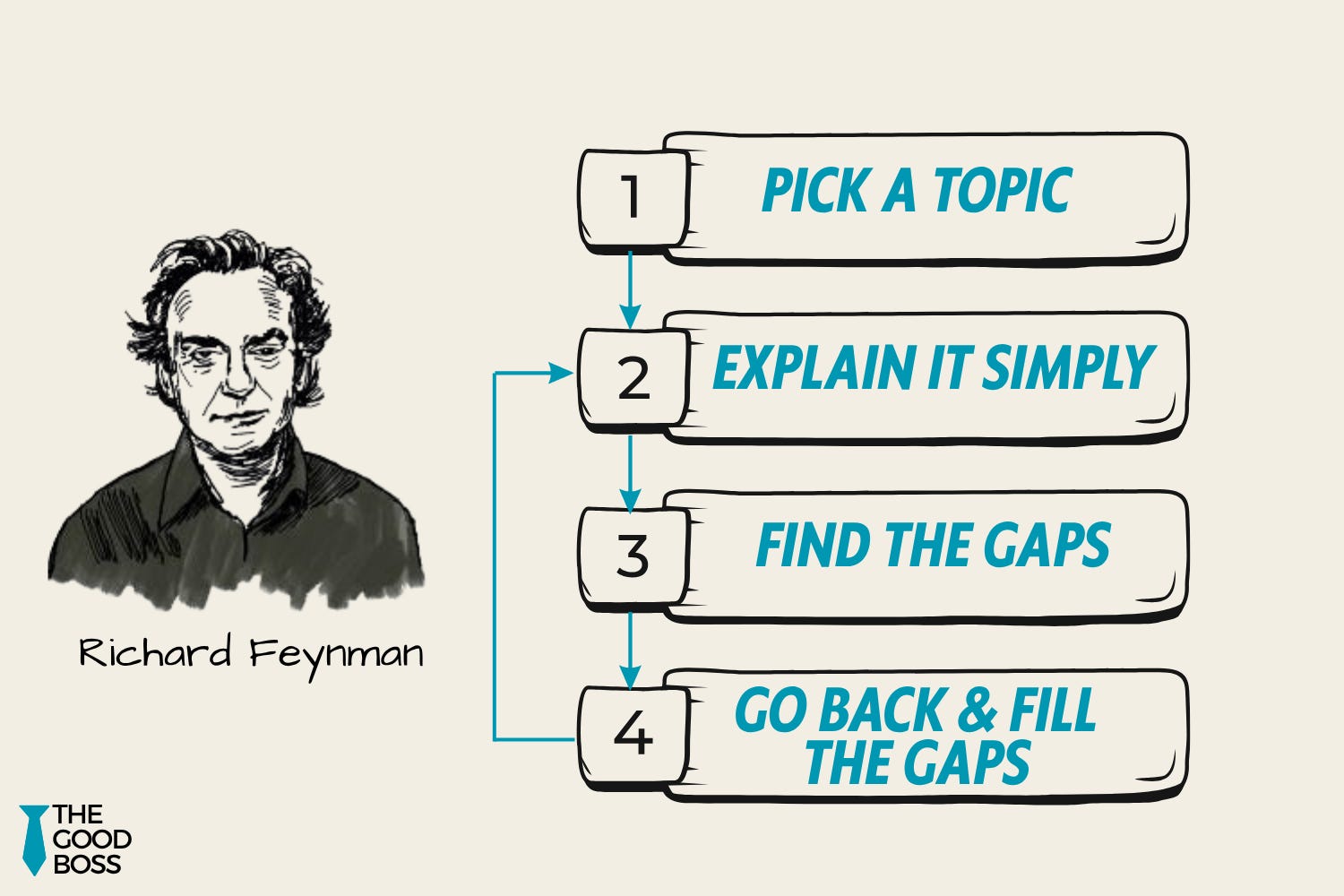
The technique itself has four steps:
Pick the topic. It could be a decision, a plan, or a team strategy.
Explain it simply. Teach it as if you’re talking to someone who is brand new to the topic (like I would do to the new engineer on my team in the situation I shared at the beginning)
Find the gaps. Notice when you get stuck. For example, when you find yourself dropping a buzzword like “strategic alignment” or “synergy” that should be a signal to you that you’re now entering the edge of your own understanding of this topic, and that’s the gap.
Go back and fill the gaps. Go back to digging into the gaps, the data and the sources, and then explain it again (go back to Step 2).
Why This Is a Management Problem
Feynman used this technique to learn and teach physics.
And as a manager, you can use it to find out if you actually understand the strategy that you’re being paid to lead in your role.
Why is this important? Here are a few reasons:
Jargon rarely helps clarify anything. I hope you’ll agree with me on this one, that most jargon and buzzwords are really there to cover gaps and hide from the real issue. “Aligning on strategic priorities” may sound like a plan, but when you dig deeper into the mechanics, more often than not, you’ll find that nobody has actually agreed on what to do first.
The clarity of your thinking is directly proportional to the quality of your team’s execution. Think about this: if you explain something to your team in a fuzzy manner, do you really expect them to execute clearly? If your decisions aren’t crystal clear, do you really expect them to move forward without running into “wait, what did you actually mean by that” hurdles?
The bottom line: as a manager, you need to be absolutely clear about the vision, the strategy, and the goals that you’re setting for your team.
If you’re not clear, don’t expect your team to be clear either.
Applying the Feynman Technique in Practice
For the rest of this article, we will focus our attention on putting the Feynman Technique into practice in your own leadership role. As we do that, don’t forget to download the Feynman Technique Worksheet.
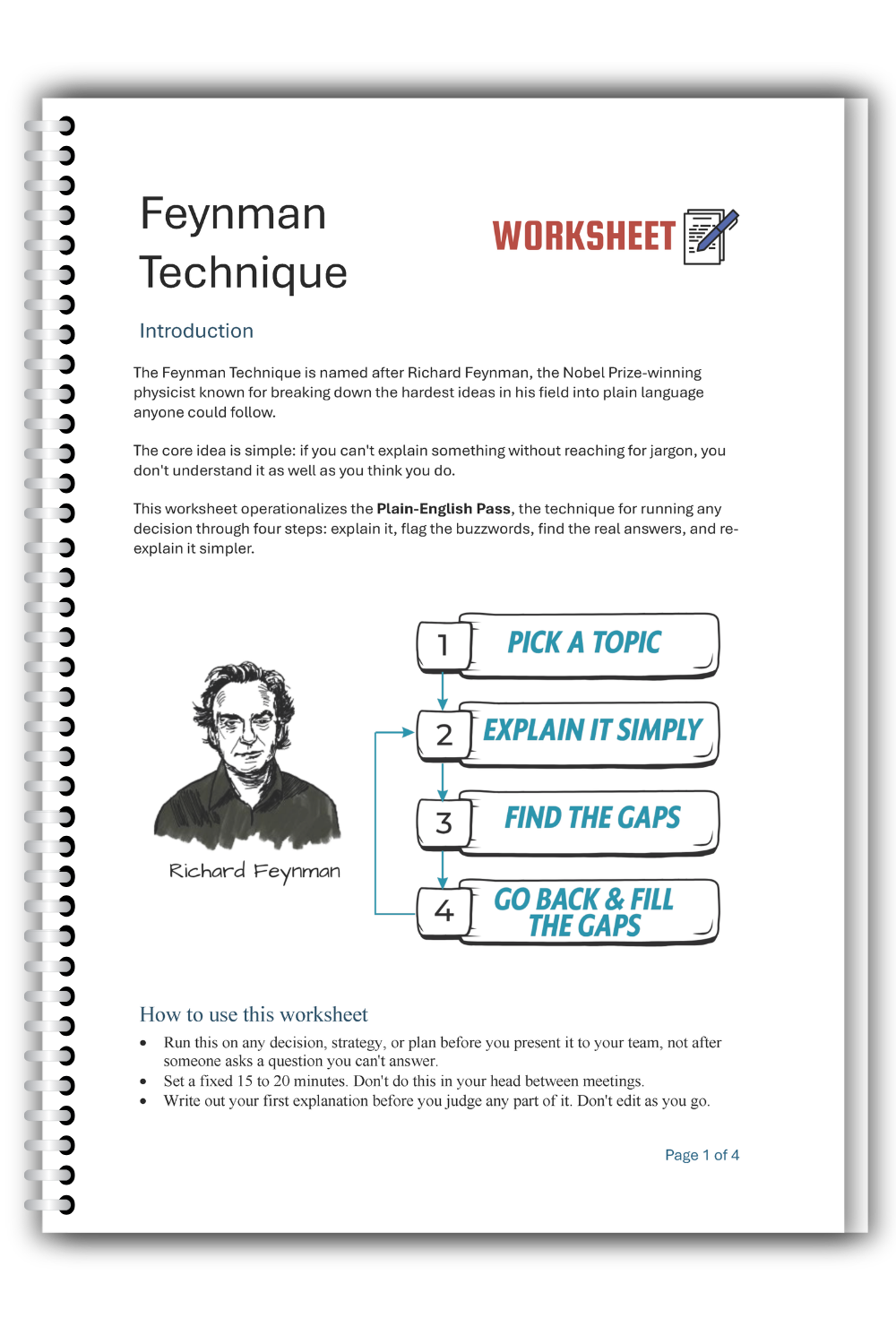
Use this worksheet to:
Run any decision through the four steps before you present it to anyone else
Spot exactly which phrase or claim is hiding a gap, instead of guessing at “communication issues”
Build a plain-language version of your explanation you can actually reuse with your team
How to download the worksheet
This worksheet is part of the Worksheets Collection, available to all paid subscribers to The Good Boss.
👉🏻 Upgrade to paid now and get instant access to the entire collection, including this worksheet.
If you prefer the standalone worksheet, you can purchase it from here.
Next, let's understand the simple technique you can use with your team to move from fuzzy to clear.