

In this issue:
Part 1: Understanding The Five Dysfunctions of a Team
The Five Dysfunctions Explained
The Pyramid of Dysfunctions
Test Your Understanding
Practice this Framework
Part 2: Overcoming The Five Dysfunctions
Download the Worksheet
Apply to a situation
Climbing the Pyramid
Real-Life Leadership Scenarios
Overcoming The Five Dysfunctions: Worksheet
Part 3: Going from here
Common Pitfalls and How to Avoid Them
Recommended Resources
Final Takeaway
✨
Picture this: you take a bite at the perfect burger, the fancy croissant, or the cake with flawless frosting. And then, first bite: it’s dry, bland, or just plain bad.
Some teams are like that.
They look healthy. Meetings are orderly, team members say “yes”, and there is no visible tension. Everyone seems aligned.
Except… they aren’t.
Decisions are stalled, feedback is a formality, and team members leave meetings confused.
You ask yourself: We’ve got smart people. What’s going wrong?
The problem isn’t obvious. It’s not a lack of skills, or misaligned strategy, or a resourcing issue. It’s something deeper.
In today’s post, we will discuss the Five Dysfunctions of a Team, which are the real spoilers in a seemingly-perfect team. We will understand each dysfunction, and also learn strategies to overcome them. We will review several real-life leadership scenarios to illustrate how these dysfunctions can creep into any team, and how you, as the leader, can counter them.
Ready? Let’s dive in.
Part 1: Understanding The Five Dysfunctions of a Team
In 2002, Patrick Lencioni published a book that changed the way thousands of leaders think about teams.
The book wasn’t a boring academic study. It was written as a leadership fable: a fictional story of a new CEO trying to turn around a dysfunctional executive team. Through the story, Lencioni introduces a simple but powerful model: The Five Dysfunctions of a Team.
During his years of working with teams of all shapes and sizes, he noticed patterns and hidden dysfunctions.
The beauty of this framework is that it doesn’t depend on your strategy or product. It depends on human behavior, which, as we know, is universal.
The Five Dysfunctions Explained
Let’s now review the five dysfunctions in a bit more detail.
Dysfunction #1. Absence of Trust
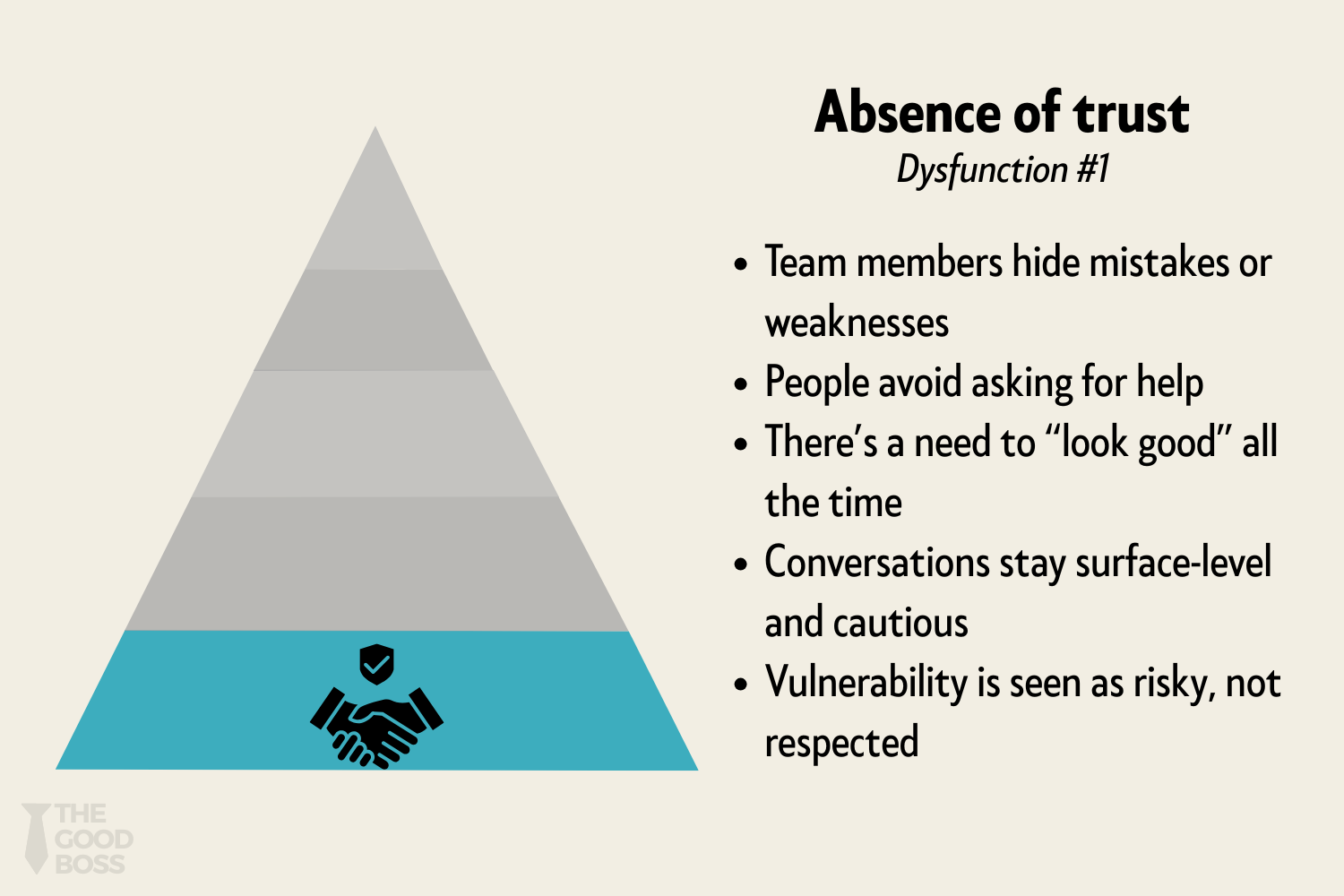
Most people think of trust as reliability: “I trust that you’ll get your work done.” But that’s predictive trust.
What Lencioni talks about is vulnerability-based trust. The kind that lets people say:
“I messed up.”
“I need help.”
“I don’t know how to solve this.”
When this kind of trust is missing, people hide their weaknesses. They put up armor. They don’t ask questions when they’re lost. They avoid sharing feedback. Everyone’s pretending to have it together when they actually don’t.
If your team never talks about mistakes, be careful. The dysfunction may already be in play.
What’s more, this is the foundation. If you don’t fix this, all the other dysfunctions will pile on.
Dysfunction #2. Fear of Conflict
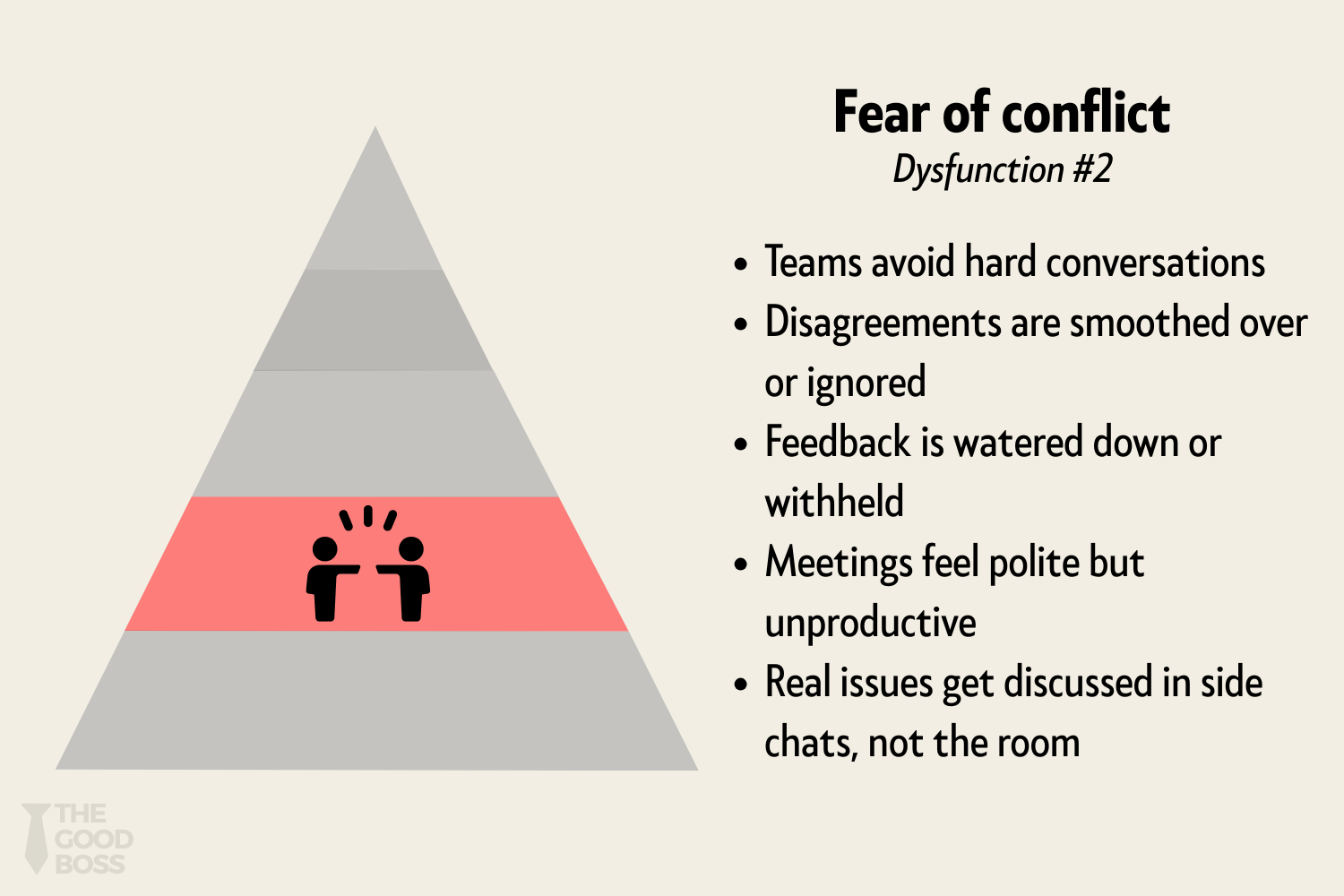
When there’s no trust, there’s no healthy conflict.
Teams that lack such trust typically have low psychological safety. They’re afraid to speak their minds and prefer to stay silent to avoid conflict. They just nod, even when they disagree.
Real stories only make their way near the watercooler, or on online forums such as Blind.
Great teams aren’t afraid to challenge each other. They engage in healthy conflict, which helps to bring the best solutions forward.
If everyone in your meetings seems too agreeable, that’s not harmony. That’s fear.
Dysfunction #3. Lack of Commitment
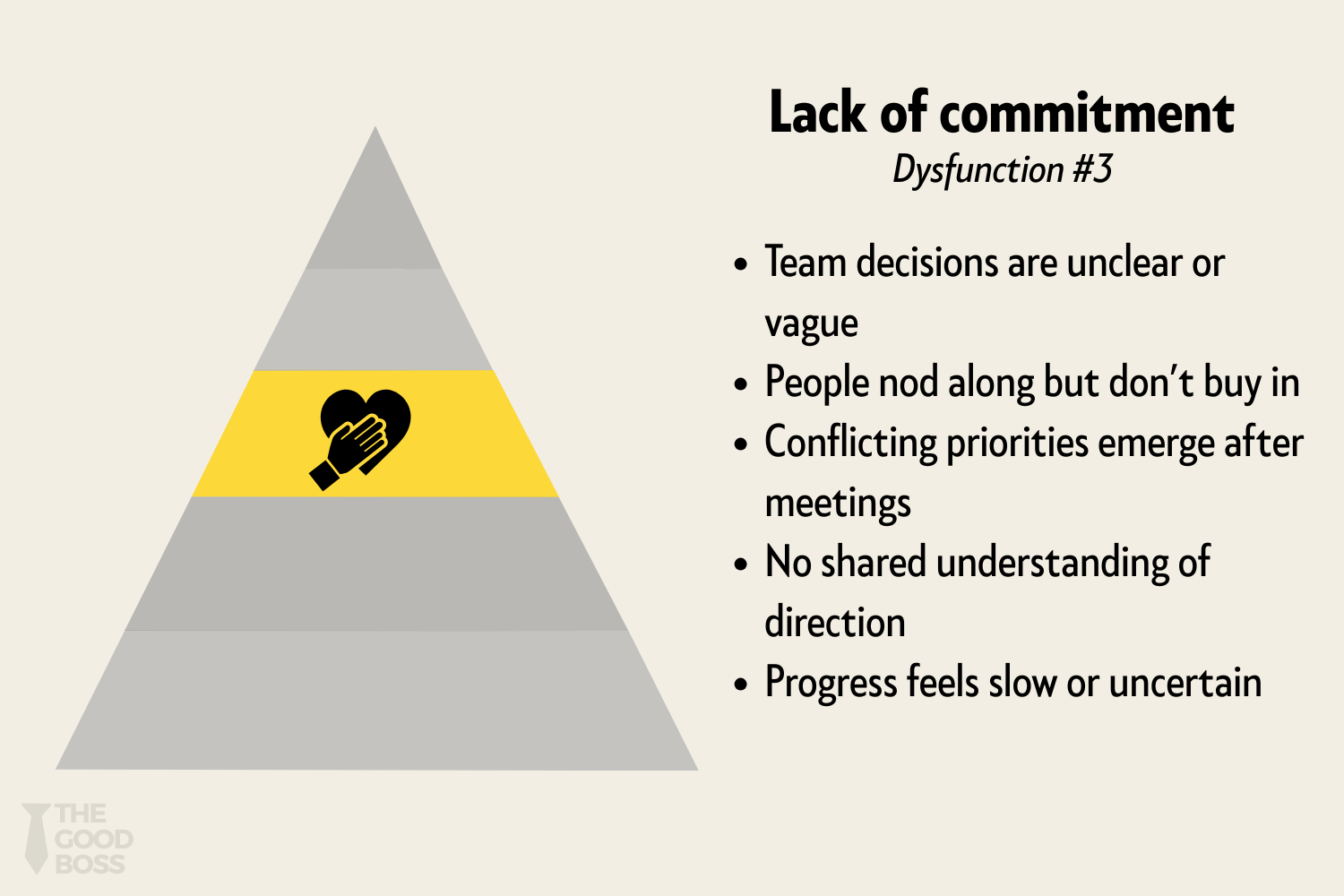
If people can’t express their opinions, then they don’t feel ownership over the outcome.
They might say “yes,” but it’s not a real yes. It’s passive compliance.
And later, when the decision gets challenged or things get hard, they’ll say:
“I never really agreed with that.”
“That wasn’t my decision.”
“I had concerns, but…”
This kind of commitment problem is subtle. You won’t see it in the meeting, but you may see it after the fact.
When your team walks out of a room with fuzzy takeaways or mixed interpretations, commitment is missing.
Dysfunction #4. Avoidance of Accountability
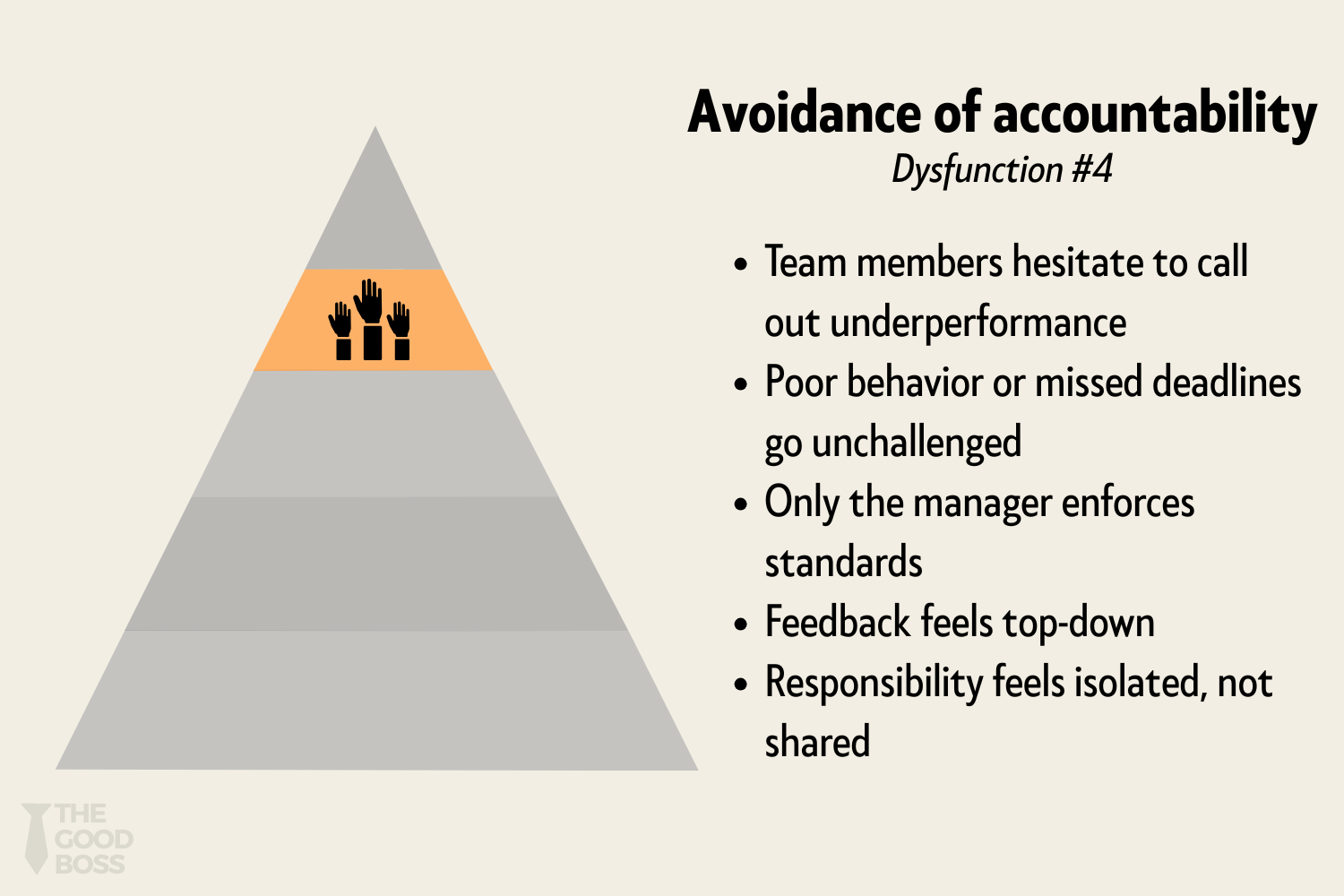
When there’s no real commitment, there’s no shared standard. And when there’s no shared standard, nobody holds each other accountable.
The team misses deadlines, the quality bar gets lowered, yet nobody seems to say anything.
Because nobody cares anymore. They don’t want to be the one who is thrown under the bus, and would rather someone else is.
Everyone just wants to stay away from the limelight for fear of being ‘called out’. They’re all running away from accountability.
Dysfunction #5. Inattention to Results
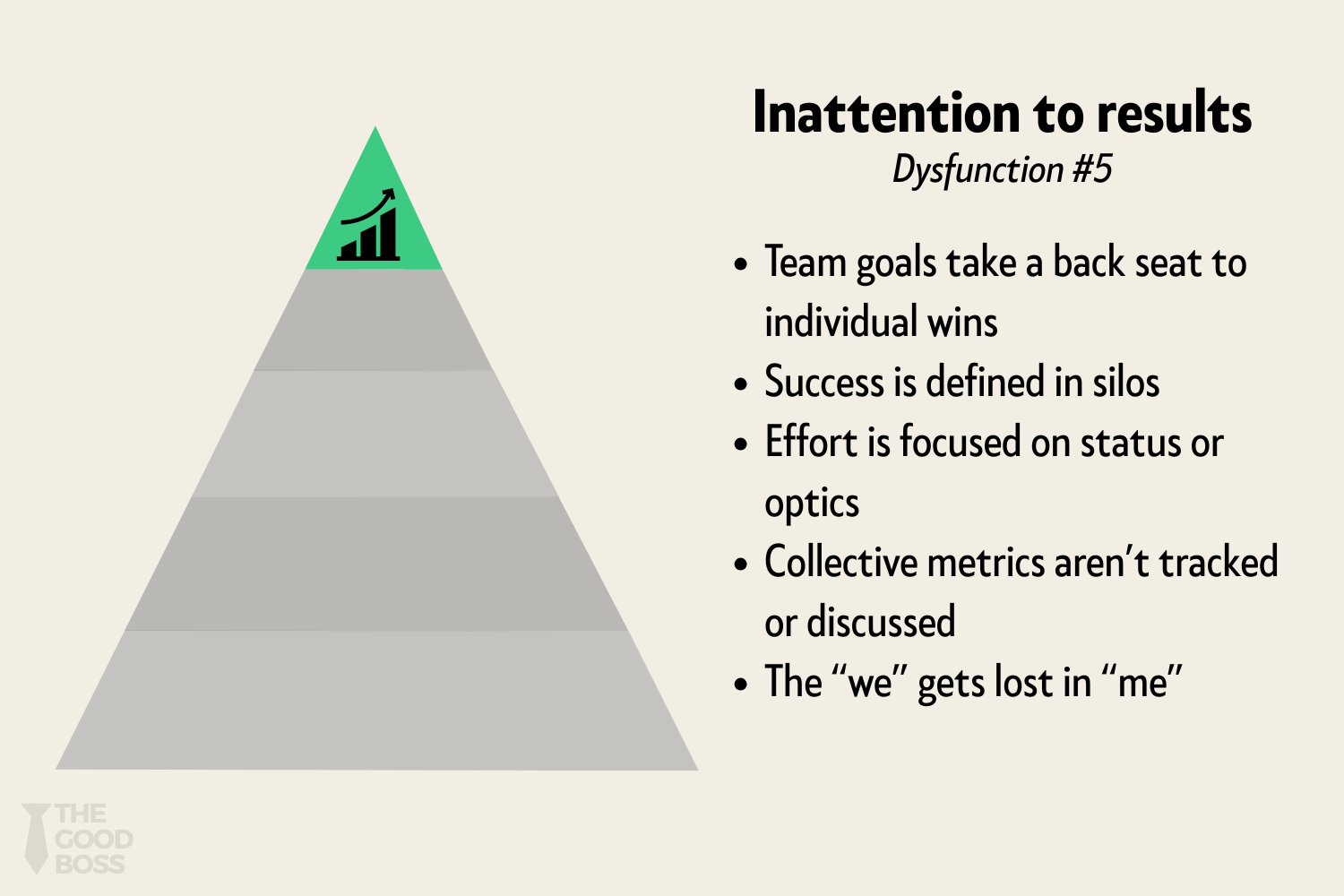
This is the final breakdown, the one you see the most, but understand the least.
When the lower dysfunctions go unchecked, people stop caring about shared results. They start chasing personal wins, and start grinding their own axes.
Have you noticed any of these behaviors? I definitely have:
PMs optimizing only for their roadmap, not what’s best for the customer.
Engineers prioritizing “cool” problems over team velocity.
Managers fighting for headcount instead of cross-team wins.
The team stops being a team. It becomes a group of individuals, working to feed their own egos.
Everone’s busy, but nothing seems to be getting delivered.
The Pyramid of Dysfunctions
You may have noticed how each dysfunction builds on the previous one. Lencioni visualizes these dysfunctions as a pyramid, where each layer supports the one above it.
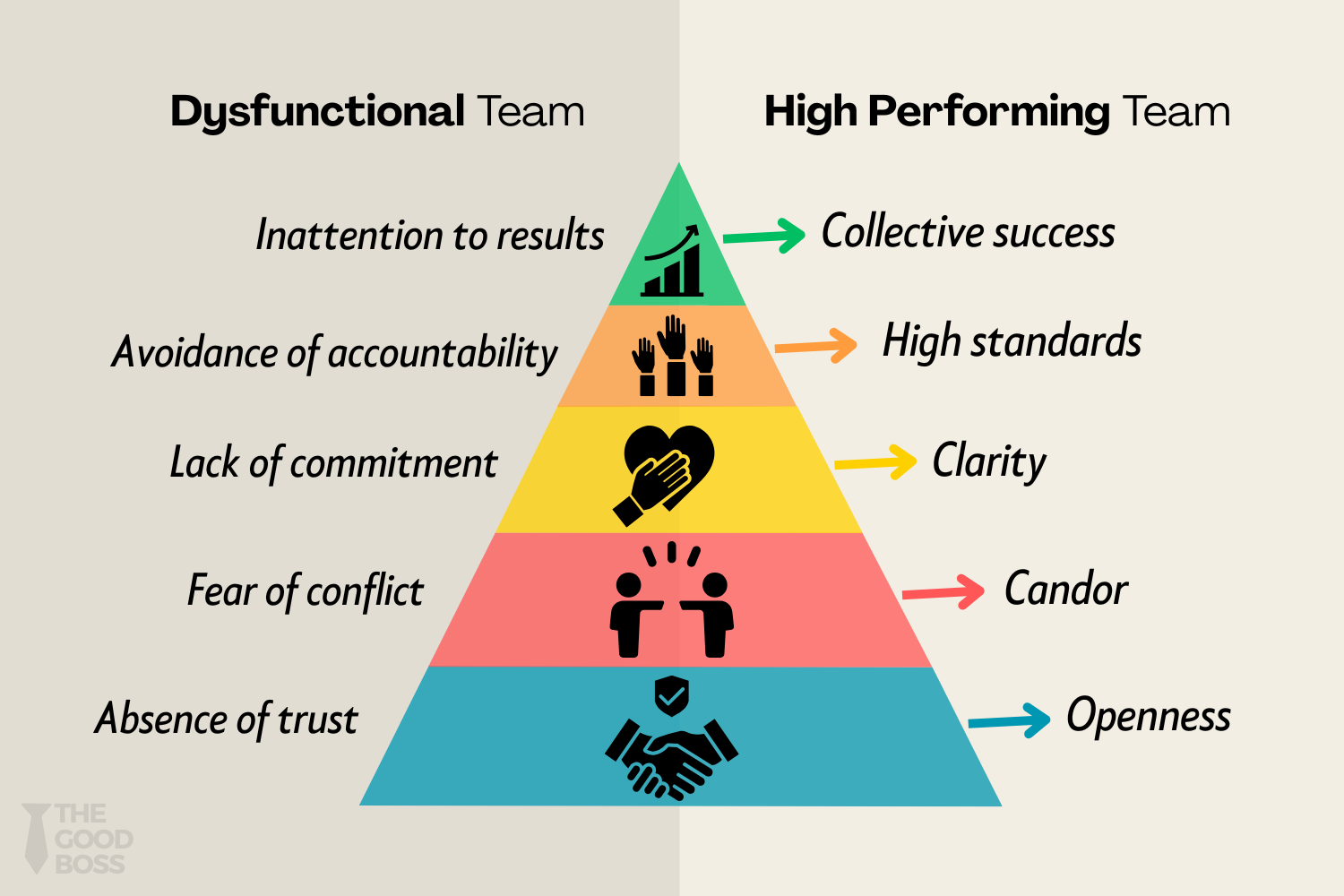
You can’t fix poor results with more pressure.
You can’t demand accountability if no one feels committed.
You can’t get real commitment without healthy conflict.
And healthy conflict won’t happen without trust.
I’ve learned this the hard way. Many managers push harder when they don’t see the results. They start micromanaging their teams, checking-in multiple times a day, and put pressure to get the outcomes.
But none of that will work, because the problem is usually at the base of the pyramid.
To truly build a high-performing team, you need to work your way up from the base. In the next section, we will discuss various strategies to overcome the five dysfunctions.
Test Your Understanding
Before you move on, take a couple of minutes to check your understanding with a quick quiz.
Are you up for it? Let’s do this!

(If you’re new to Kyoshi: It’s the systems-first leadership coach, built on the same Leadership OS I’ve been writing about in this newsletter for years. Go ahead and sign up for free and try out the quiz now.)
Practice This Framework
Just like you build your physical muscles in the gym, you build your leadership muscle by practice.
🎯 Practice a drill
Got five minutes? Drills are short, focused reps. Kyoshi gives you a situation, and you rework it so it informs, inspires, and influences.
Go ahead and start the drill now!

Part 2: Overcoming The Five Dysfunctions
📝 Download the worksheet
If you like step-by-step prompts, download and use the Radical Candor worksheet and apply it in your own team or work situation.
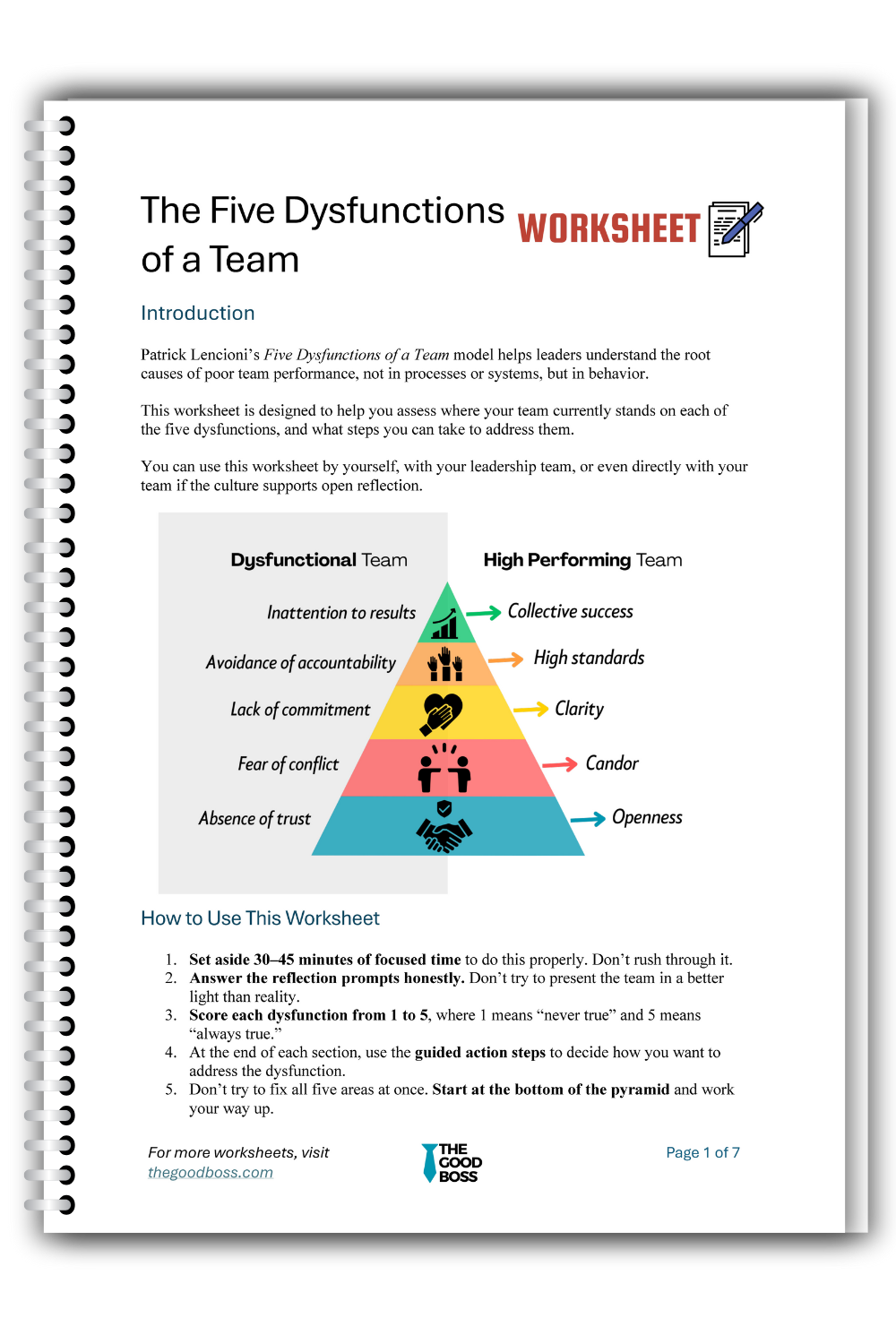
How to download the worksheet
This worksheet is part of the Worksheets Collection, available to all paid subscribers to The Good Boss.
👉🏻 Upgrade to paid now and get instant access to the entire collection, including this worksheet.
If you prefer the standalone worksheet, you can purchase it from here.
🧭 Apply to a Situation
If you’re looking for a trusted partner to help you create and manage a situation, and actively coach you as you solve it for real, then Kyoshi can help you with all that.
Pick one real situation coming up in the next week or two. Then work with Kyoshi to apply this framework in that situation.
