

Picture this: you’re in the middle of a meeting with your team, juggling several priorities.
There’s a major project that’s been delayed, small urgent tasks piling up, and a new feature request from your top client. You feel the weight of everything on your shoulders. Where should you focus? What should your team tackle first?
Now, picture being in that situation almost every day.
That was me a few years ago.
As a leader managing multiple teams of software engineers, I often found myself lost in the sea of initiatives. Everyone (no surprises there) had an opinion on what was urgent, but not everything was truly important. I needed a system to help me cut through the noise.
Do you feel the same? You’re not alone.
In fact, a survey by Gallup found that 64% of managers feel overburdened by the sheer volume of tasks on their plates.
When I stumbled upon the Impact-Effort Matrix a few years ago, it completely revolutionized how I made decisions at work and beyond. With this post, I hope to empower you to do the same.
Part 1: Understanding the Impact-Effort Matrix
In this section, we will learn what the Impact-Effort Matrix is and how it works.
What is the Impact-Effort Matrix?
The Impact-Effort Matrix is a decision tool that helps you prioritize tasks and projects. It helps you to filter out what matters and needs immediate attention, and what can wait.
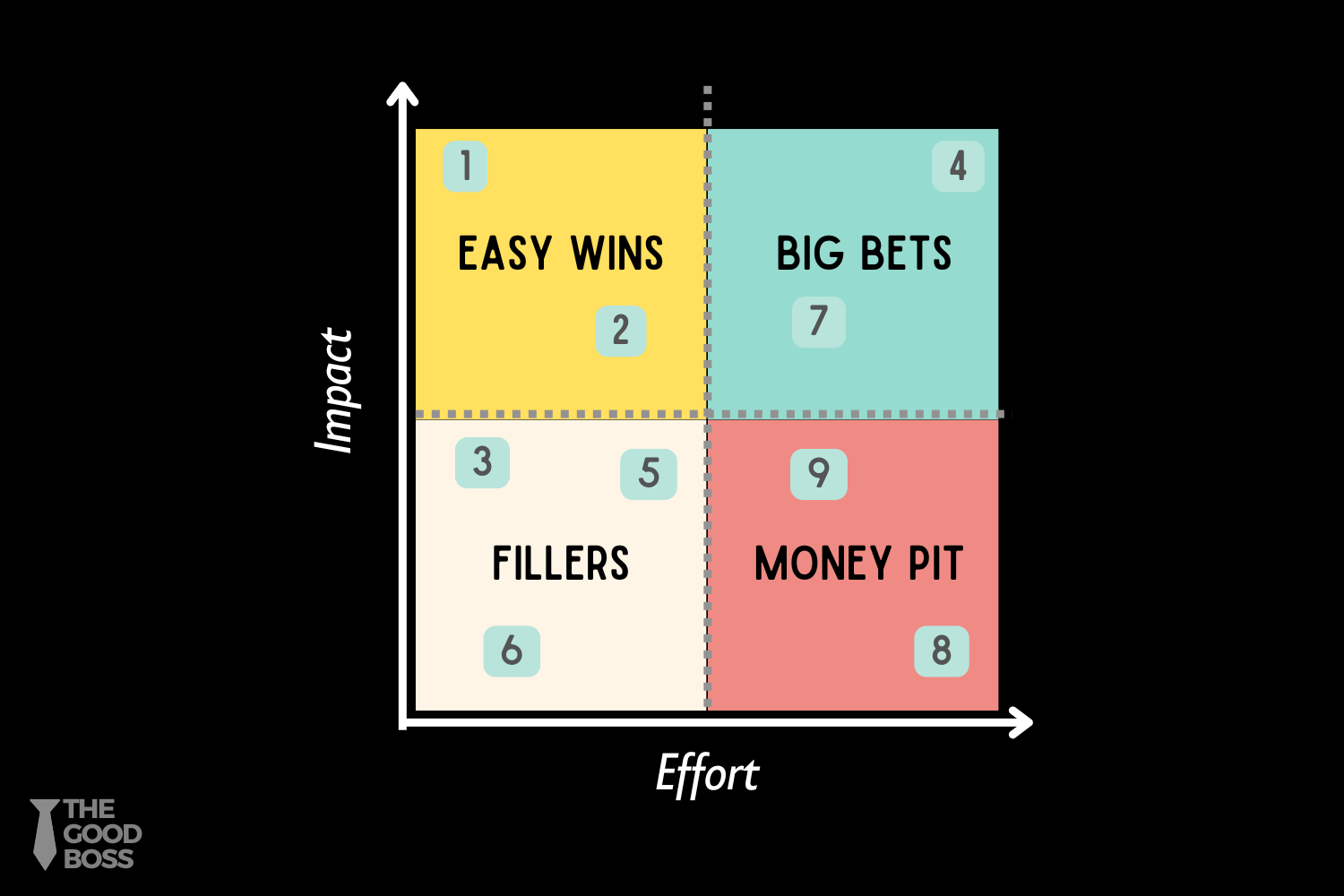
It looks at two simple factors:
Impact - the value a task creates. You can think of this as the value proposition, or the business impact.
Effort - the work needed to complete it. You can think of this as the complexity and investment needed to get the ‘value’ returns.
When you place initiatives along these two axes, you get four quadrants.
Easy Wins (High Impact, Low Effort): These are tasks that deliver big results with little work. Do these first.
Big Bets (High Impact, High Effort): These require time and resources, but the payoff is large. Plan these strategically.
Fillers (Low Impact, Low Effort): These are easy tasks that add little value. Do them only if time allows.
Money Pits (Low Impact, High Effort): These drain energy without much return. Avoid them whenever possible.
👉🏼 Once you place your work into these four boxes, priorities become obvious.
How the Impact-Effort Matrix Works
The power of this matrix is its simplicity.
Leaders often struggle because every task feels urgent. The matrix “forces” you to ask two clear questions.
How much impact will this create?
How much effort will it take?
When you step back and look at work through this lens, patterns appear quickly.
You start spotting easy wins that were hiding in plain sight.
You see which big initiatives deserve real investment.
And you catch the time sinks that quietly drain your team’s energy.
To be clear, the matrix does not make decisions for you - it’s a ‘lens’. What it does do it is it makes the right decision more obvious and easier to see.
Why the Impact-Effort Matrix Matters for Managers
As a manager, your success depends on your ability to make smart decisions quickly. With resources always limited, prioritizing effectively is critical.
Research shows that poor prioritization leads to wasted time, burnout, and missed goals. In a study by the Harvard Business Review, teams that used structured prioritization frameworks like the Impact-Effort Matrix saw a 20% boost in productivity.
By using the matrix, you can cut down on time-wasting activities and focus on what truly moves the needle for your team.
Test Your Understanding
Before you move on, take a couple of minutes to check your understanding with a quick quiz.
Are you up for it? Let’s do this!

(If you’re new to Kyoshi: It’s the systems-first leadership coach, built on the same Leadership OS I’ve been writing about in this newsletter for years. Go ahead and sign up for free and try out the quiz now.)
Practice This Framework
Just like you build your physical muscles in the gym, you build your leadership muscle by practice.
🎯 Practice a drill
Got five minutes? Drills are short, focused reps. Kyoshi gives you a situation, and you rework it so it informs, inspires, and influences.
Go ahead and start the drill now!

Part 2: Applying the Impact-Effort Matrix
Now, practice makes you better, but you only really grow when you use a framework on your own problems.
Role plays and drills are useful, but they’re not your situation.
Your situation has its own people, its own history, and, frankly, its own politics.
So here are two ways in which you can actually apply this framework in your own leadership role today.
📝 Download the worksheet
If you like step-by-step prompts, download and use the Impact-Effort Matrix worksheet and apply it in your own team or work situation.
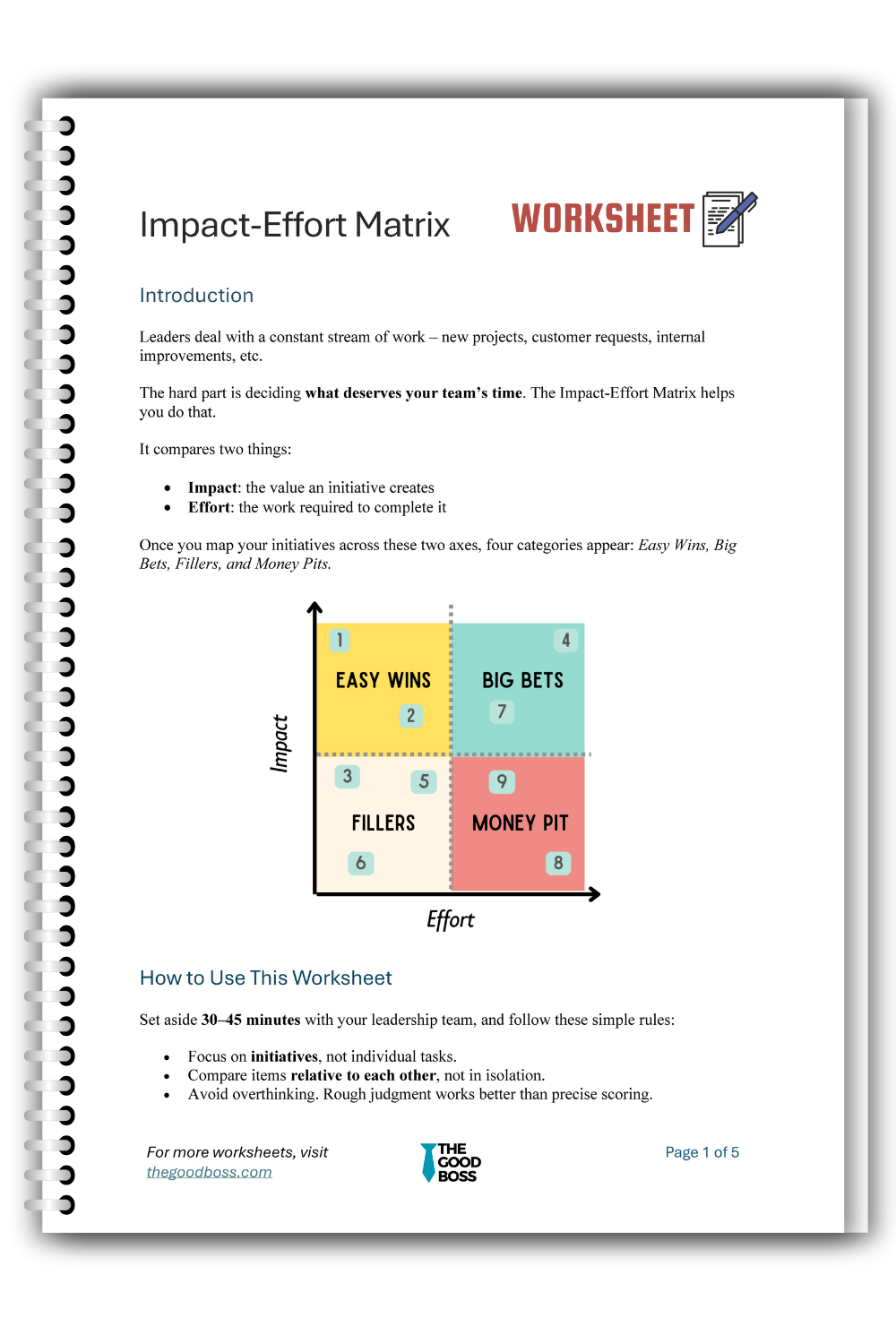
Use this worksheet to:
Turn a long list of initiatives into a clear priority map
Separate the easy wins and big bets from the time sinks
Get your leadership team aligned on what deserves focus right now
How to download the worksheet
This worksheet is part of the Worksheets Collection, available to all paid subscribers to The Good Boss.
👉🏻 Upgrade to paid now and get instant access to the entire collection, including this worksheet.
If you prefer the standalone worksheet, you can purchase it from here.
🧭 Create a Situation
If you’re looking for a trusted partner to help you create and manage a situation, and actively coach you as you solve it for real, then Kyoshi can help you with all that.
Pick one real situation coming up in the next week or two. Then work with Kyoshi to apply this framework in that situation.

The Step-by-Step Approach to Apply the Impact-Effort Matrix
Here is a simple four-step process you can use with your team.