

Many years ago, I had a manager who was, should I say, very involved.
Almost every week, he would tell me some version of “I’m the only one fighting for the team.”
He said this in our 1:1s, in the hallway on the way to get coffee, and at times even in our team meetings.
Yup, that felt awkward.
To be fair, from his perspective, when he said that, he was trying to show how much he “cared.”
But from the team’s perspective, it was a completely different story.
Every problem we raised to him quickly turned into his problem, and then somehow, into his personal mission.
I remember once raising an issue related to team burnout with him, and a few weeks later, I heard him talk about how burnt out he felt. Woot!
As you can imagine, eventually the team stopped raising any problems to him. After all, who likes their problems turned into a drama?
At that time, I wasn’t sure why he did that. I tried to convince myself that he was just a “different personality type”.
It took me years and a fair amount of leadership research to realize what was actually happening.
In this post, I’m going to deep-dive into the Karpman Drama Triangle. We will discuss how it works and how it shows up for leaders (including why it did for my boss).
Here’s what we will cover:
The Origin of the Drama Triangle
The Three Roles
Why This Matters for Leaders
Applying the Karpman Drama Triangle in Practice
The Corner Check Technique
How This Shows Up in Real Situations
Common Pitfalls (and How to Avoid Them)
Final Thoughts
The Origin of the Drama Triangle
The Drama Triangle was originally introduced by psychiatrist Stephen Karpman in 1968.
Whenever I research frameworks, I love the “origin story” behind them.
Interestingly, Karpman wasn’t studying office politics or leadership philosophies. Not at all.
He was actually studying fairy tales and stage drama. Karpman noticed that basically every story - whether Little Red Riding Hood, soap operas, or even your family’s Thanksgiving dinner - features the same three characters, or ‘roles’, showing up over and over again.
That’s what he called the Drama Triangle, which later became popular as the Karpman Drama Triangle.
Next, let’s look at how the triangle actually works.
The Three Roles
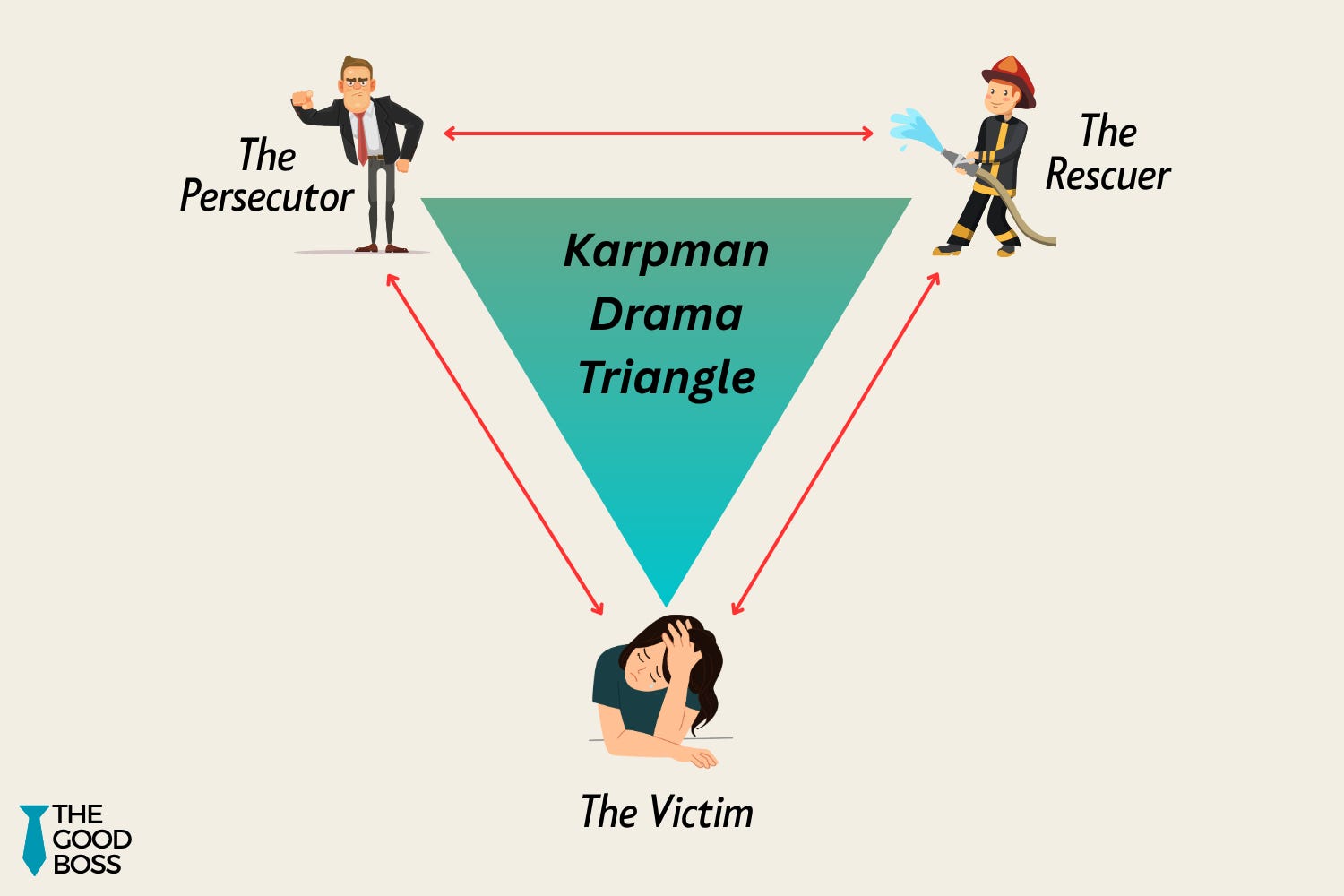
The Karpman Drama Triangle has three ‘roles’:
The Victim. This is the person who keeps pulling the “victim card”. They keep saying “poor me, nobody helps me… this always happens to me.” I bet you know many so-called ‘victims’ in your own life as well. In most cases, the ‘victim’ feels stuck and powerless, even in situations where he has more control than he wants to admit.
The Persecutor. This is the critic, or the one who sets impossible standards, and then points out how “everyone is failing to meet them.” Sometimes this is a harsh boss or the task master (I’ve seen plenty of those through my career), and sometimes it’s the boss who holds “high standards” and then holds a gun on his team to meet them.
The Rescuer. This is the one who pops in to ‘fix things’ (think Spiderman!) like it’s their problem. But in most cases, the rescuer tries to rescue a situation that doesn’t need rescuing at all. He tries to help people who didn’t really ask for help. Remember my boss from earlier - he was the rescuer for our team.
Why This Matters for Leaders
We all know the typical management advice: have the hard conversation, set the expectations, and move on.
Simple? Not quite.
In the last 20+ years leading teams, I’ve seen countless managers who follow that advice, but it leads them nowhere.
Here’s one scenario I’ve seen play out a lot:
You rescue your team by lowering the bar
They feel like victim of your low expectations
You get frustrated with that, and become the persecutor.
The team gets frustrated, disengaged, and burnt out.
Rise and repeat.
The value of learning this framework is to become more self-aware and team-aware. You want to be able to detect when you’re playing one of those roles of the drama triangle, and how you get out of that trap.
Applying the Karpman Drama Triangle in Practice
For the rest of this article, we will focus our attention on putting the Karpman Drama Triangle into practice in your own team and organization.
As we do that, don’t forget to download the Karpman Drama Triangle Worksheet.
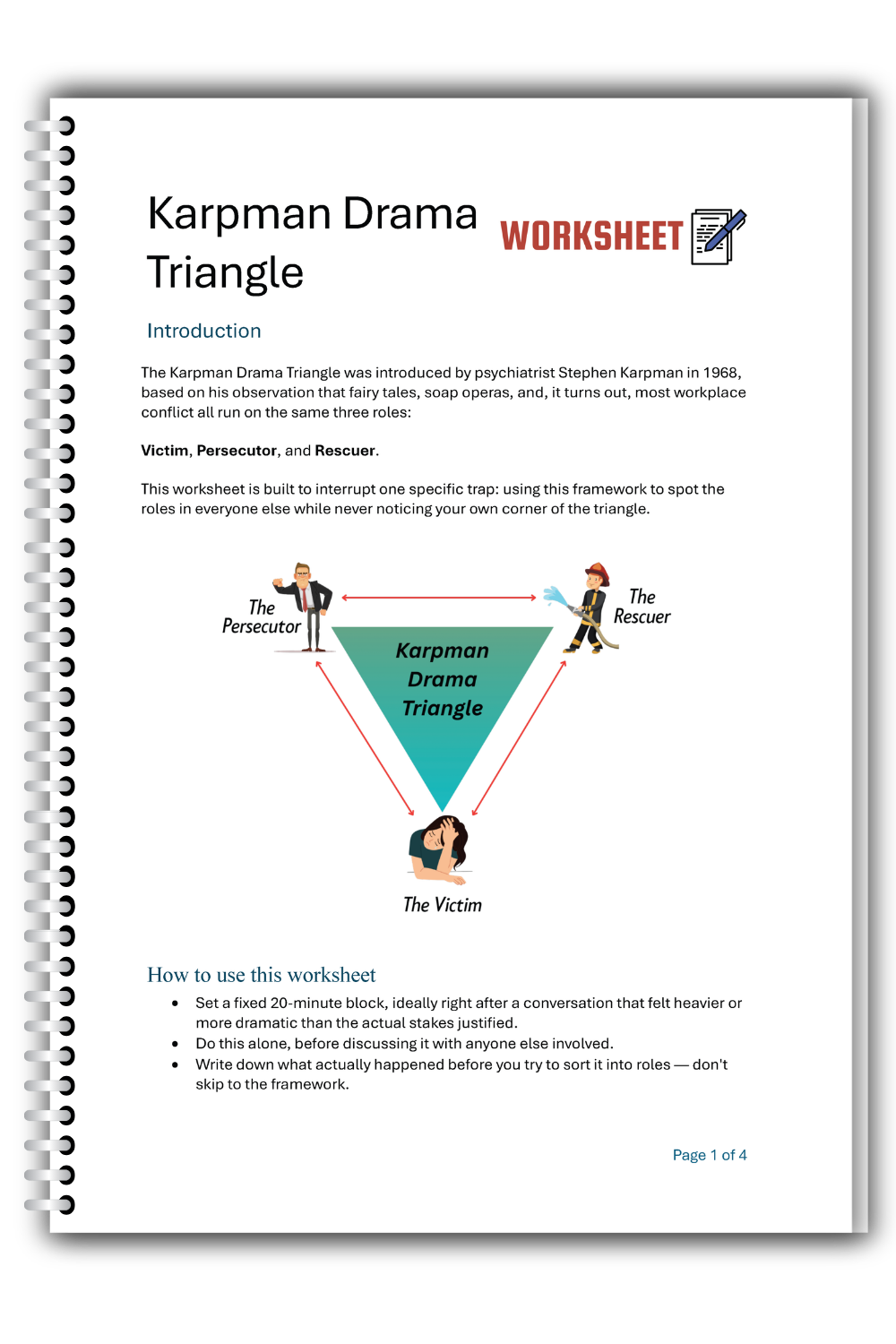
Use this worksheet to:
Catch which corner of the triangle you’re standing in, before you speak from it
Spot the specific conversation where you keep replaying Victim, Persecutor, or Rescuer
Build a habit of noticing the pattern in the moment, not three days later in the shower
How to download the worksheet
This worksheet is part of the Worksheets Collection, available to all paid subscribers to The Good Boss.
👉🏻 Upgrade to paid now and get instant access to the entire collection, including this worksheet.
If you prefer the standalone worksheet, you can purchase it from here.