In this issue:
The Email That Ruined my Afternoon
The Ladder of Inference
The Six Rungs
How This Shows Up for Managers
Putting the Ladder Into Practice
The Rung Check Technique
How This Plays Out in Real Teams
Common Pitfalls (and How to Avoid Them)
Final Thoughts
The Email That Ruined my Afternoon
A few years ago, I was putting together a proposal for a new project I felt strongly about. It was genuinely excited about it and put in real effort into building the case: why it mattered and the data to back it up.
I made sure that I was thorough enough so there was nothing left to poke holes in.
Finally, that Wednesday afternoon, after reviewing it a few times, I attached the deck to an email to my manager, and hit send, full of anticipation.
My manager’s reply came back within the hour: “Let’s discuss.”
That was it. No “great idea,” no “let’s talk logistics,” not even a question mark. Just two words and a full stop.
I spent the rest of that afternoon dismantling my own proposal in my head.
Maybe the data wasn’t as strong as I thought.
Maybe he saw a flaw I’d missed.
Maybe this was the polite version of “no.”
I then started rehearsing how I’d defend it when I do get to ‘discuss’ it with him.
The next morning, he pulled me for a quick chat in the office kitchen, and it turned out to be nothing like what I was preparing for. He said he loved the idea, and just wanted five minutes to talk through timing before he took it to his boss.
That was the entire “discussion.”
The email didn’t ruin my afternoon. The version of it I wrote in my head did.

The Ladder of Inference
Here’s the strange part: nothing about the situation actually changed between “Let’s discuss” landing in my inbox and the conversation the next morning with my boss.
The facts didn’t change, but only my reading of them had changed, from two neutral words into an entire verdict about my idea.
That gap has a name.
It’s called the Ladder of Inference, developed by organizational psychologist Chris Argyris and later popularized by Peter Senge in The Fifth Discipline.
In plain terms: your brain doesn’t respond to raw facts.
It responds to a chain of quiet “jumps” that happen so fast you rarely notice you’re climbing at all.
By the time you feel a reaction, you’re standing several rungs above the actual data, reacting to a belief you built yourself.
In my case, I didn’t react to my manager’s words “Let’s discuss.” I reacted to a belief about what those two words meant that I had constructed in about ninety seconds.
The Six Rungs
Here’s what climbing the ladder actually looks like, rung by rung, using my own email as the example:
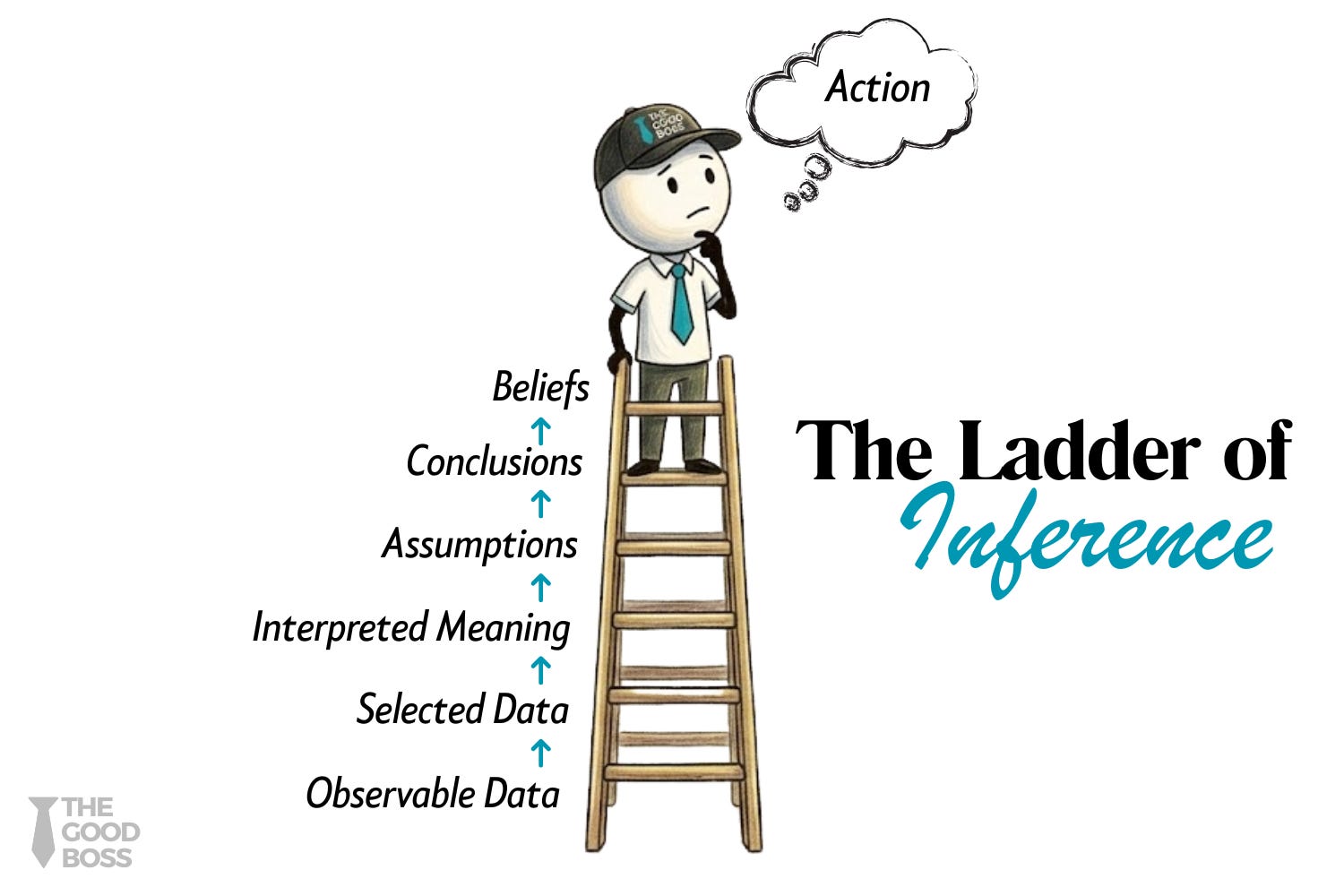
Observable Data. What actually happened? If there were a CCTV camera, what would it have captured? My manager typed “Let’s discuss.” That’s all that happened.
Selected Data. What data was selected (i.e., filtered)? I noticed the message was short and lacked enthusiasm. I didn’t notice that he’d replied within the hour, which likely meant he’d actually read the whole thing closely.
Interpreted Meaning. What’s the meaning you attach to what you selected? In my case, “No enthusiasm” became “he found a problem with it.”
Assumptions. What assumptions did you make? We generally fill gaps with beliefs we already hold. I already carried a quiet worry that my proposal was more ambitious than practical, so the gap got filled with that.
Conclusions. What was the conclusion? The assumptions harden into a verdict: “He’s going to say no, or water it down.”
Beliefs. What is the belief based on the conclusion? The verdict became a standing belief for the rest of the afternoon that this idea was probably dead on arrival.
Action. What action was taken? I acted on the belief: rehearsing my defense, bracing for pushback, without ever thinking twice.
The climb takes seconds. Coming back down takes a conscious decision to look again.
How This Shows Up for Managers
I’ve seen the Ladder of Inference show up in many forms for managers.
In feedback conversations. A flat tone in a review is inferred as resistance when it’s often just fatigue or nerves.
In cross-team friction. “They’re blocking us on purpose” is almost always an assumption based on a minor observation, usually a missed Slack message or a different set of priorities.
In remote and async work. Less context means less real data to select from, which means faster climbs to the wrong inferences. A delayed reply, a short message, a camera-off call - they all get filled in with whatever story is easiest to tell.
That’s the power of The Ladder of Inference as a model - when you consciously step down the ladder, you notice the pattern:
The less context you have, the faster you climb, and the more confident you feel doing it.
Putting the Ladder Into Practice
For the rest of this article, we will focus our attention on putting The Ladder of Inference into practice in your own team or organization. As we do that, don’t forget to download The Ladder of Inference Worksheet.
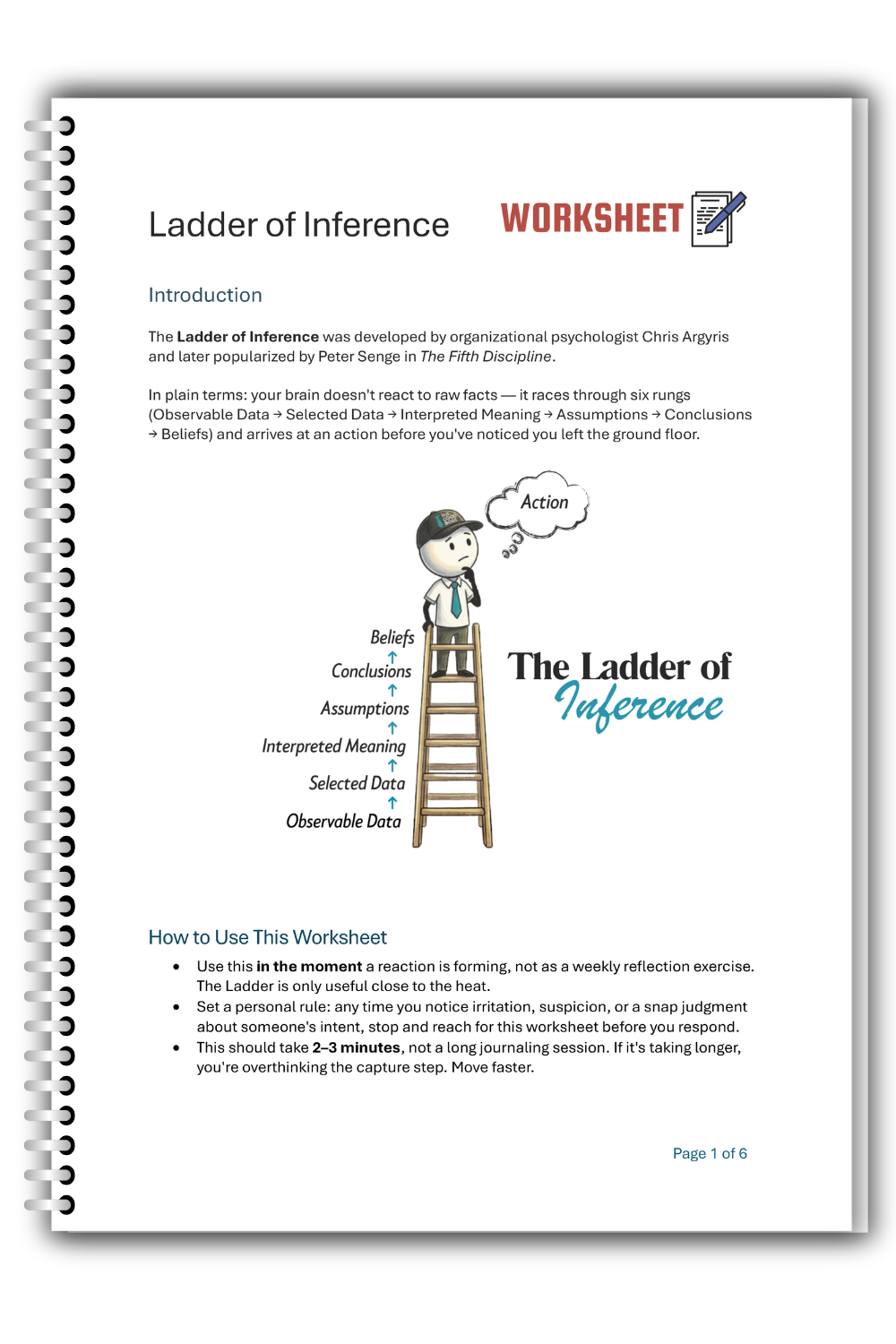
Use this worksheet to:
Pause before a tense 1:1, when a tone or short reply feels bigger than it probably is.
Slow down on a cold-sounding message, like a flat Slack reply, email, or delayed response.
Catch a snap judgment before it shapes a promotion call or performance read.
How to download the worksheet
This worksheet is part of the Worksheets Collection, available to all paid subscribers to The Good Boss.
👉🏻 Upgrade to paid now and get instant access to the entire collection, including this worksheet.
If you prefer the standalone worksheet, you can purchase it from here.
The Rung Check Technique
Here’s a simple technique I like to use: before you act on a conclusion, find the rung where you left the facts.