

In this issue:
Part 1: Understanding the Leadership Scorecard
What is the Leadership Scorecard?
How the Leadership Scorecard Works
Part 2: Applying the Leadership Scorecard
The Leadership Meter
Real-Life Leadership Scenarios
The Leadership Scorecard Worksheet
Part 3: Going From Here
Common Pitfalls and How to Avoid Them
Recommended Resources
Final Thoughts
✨
A few years ago, I was leading a high-visibility project. We were meeting all our milestones, and had picked up great momentum. I remember my boss commending me and my team for our work. It felt great.
However, I remember one afternoon, one of my senior engineers put down his papers out of the blue. It came as a surprise to me, but I convinced myself that “it happens.”
Then, a week later, another resignation, and I started thinking what was going on.
After several days of introspection, I realized that in the midst of the high-visibility project, I had failed to pay attention to the people. I had canceled several 1:1s and rescheduled team meetings, and almost lost touch with the team’s voice.
I could hardly believe it was happening, because all along I thought I was doing the right thing, and assumed the team was excited and happy. I know a lot of leaders fall into a similar trap because they don’t have a clear way to measure what really matters.
In this post, we will discuss a model I developed that helps leaders do exactly that - drive impact without losing sight of what matters.
If you’ve ever felt stretched thin, unsure where to focus, or stuck in reactive mode, this framework might be exactly what you need.
Let’s dive in.

Part 1: Understanding the Leadership Scorecard
In this section, we will understand the motivation behind this framework, and how it works.
What is the Leadership Scorecard?
First, let’s talk about the Balanced Scorecard, which was created in the early 1990s by two Harvard professors, Robert Kaplan and David Norton. At the time, most companies were focused almost entirely on financial results with parameters such as profit, revenue, cost, and margin.
Kaplan and Norton asked a provocative question:
What if you’re hitting your financial targets, but slowly killing the business in the process?
They looked at high-performing companies at the time and found something surprising. The best ones weren’t just optimizing for money. They were also tracking:
How well they served their customers
How strong their internal processes were
How much they were investing in learning and growth
And that’s how the Balanced Scorecard was formed to capture the four areas: Financial, Customer, Internal Processes, and Learning & Growth.
But its power doesn’t stop at the company level. What if we used the same structure to evaluate ourselves as leaders? That’s the idea behind The Leadership Scorecard, which I’ve designed to help you lead with intention.
In the next section, we’ll look at how the Leadership Scorecard works, and how to make it your own.
How the Leadership Scorecard Works
The Leadership Scorecard works by translating your strategy (or leadership intent) into a clear set of actions and metrics across four dimensions:
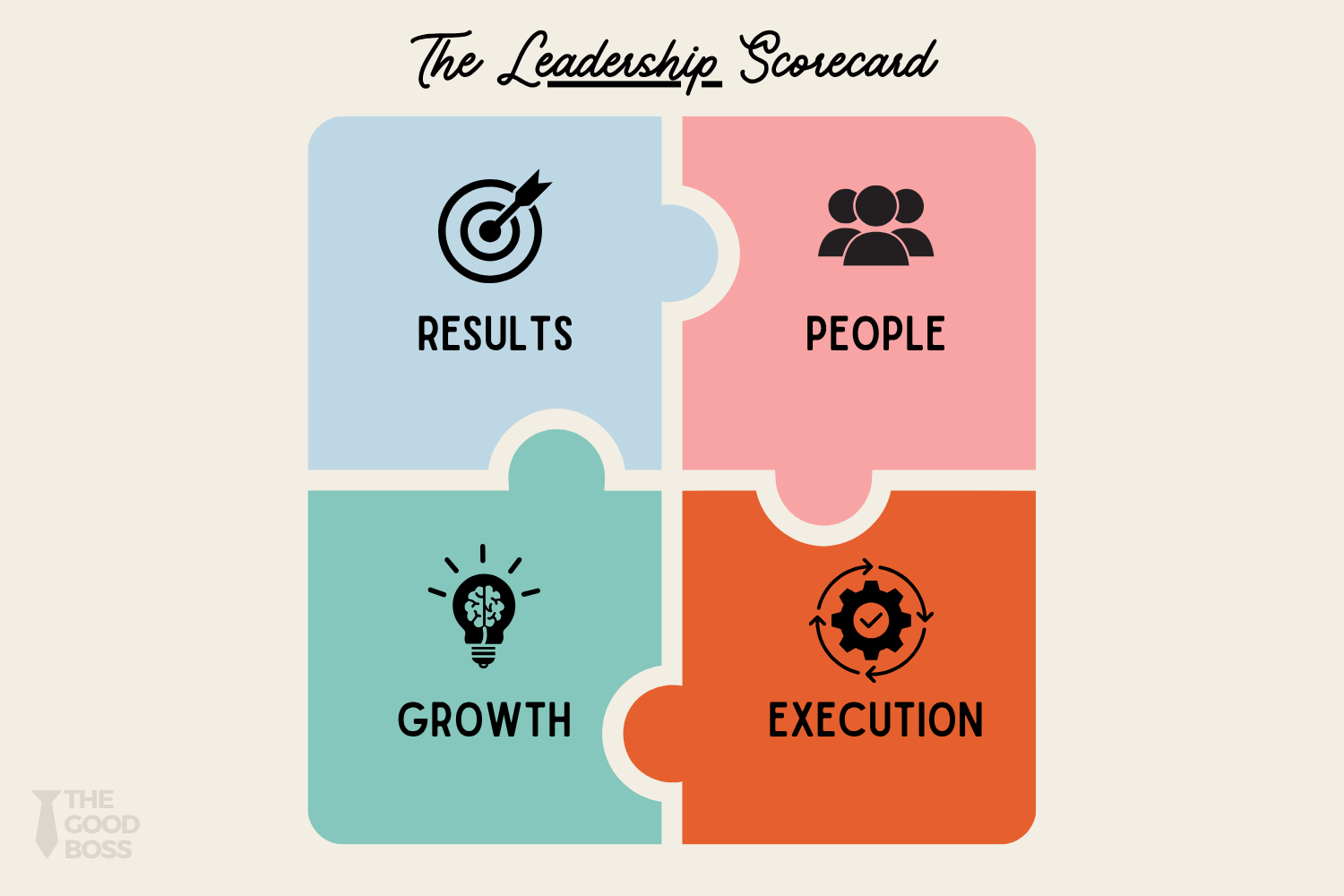
Results: Am I delivering what’s expected of me?
People: Are the people around me thriving?
Execution: Are our systems and rituals helping or hurting?
Growth: Are we learning, improving, and preparing for what’s next?
Each dimension represents a different lens through which you evaluate performance. Let’s break them down, one by one.
Dimension #1. Results: Am I delivering what’s expected of me?
This is the traditional view of success, and arguably the most “investor-friendly” dimension. It encompasses factors like revenue, profit, cash flow, etc.
For organizations, these are often hard numbers. For leaders, this could mean:
Did the team ship the product on time?
Did we meet our OKRs?
Are we delivering value that the business recognizes?
👉🏼 It’s important, but if this is all you measure, you might win short-term battles and lose the long game.
Dimension #2. People: Are the people around me thriving?
In a business, this refers to customers or end-users of the product or solution. But as a leader, your “customers” are often your team, your stakeholders, and sometimes your peers or boss.
Ask yourself these questions as a leader:
Do your team members feel supported and engaged?
Do stakeholders trust you and value your input?
Are you building relationships that lead to long-term success?
👉🏼 You can’t lead effectively if the people around you don’t feel heard or helped.
Dimension #3. Execution: Are our systems and rituals helping or hurting?
This is about how work gets done.
In companies, this might be software engineering practices, manufacturing processes, customer support systems, or IT infrastructure.
In leadership, this shows up as:
Do you have regular, effective team rituals (standups, reviews, 1:1s)?
Is your team’s decision-making fast and clear, or slow and messy?
Are you using your time and energy wisely?
👉🏼 You can’t hit your goals with broken systems. At least not consistently.
Dimension #4. Growth: Are we learning, improving, and preparing for what’s next?
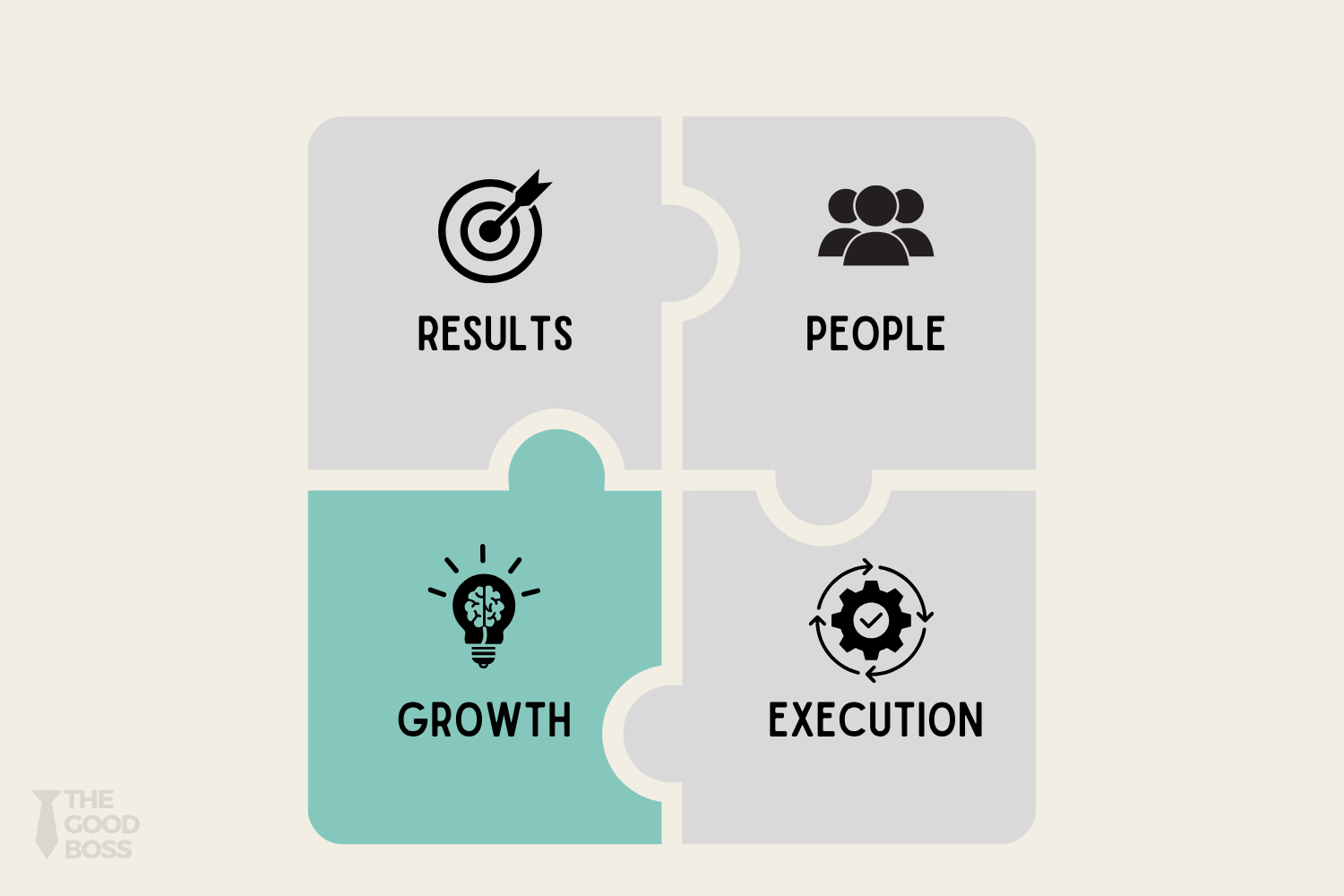
This is the most ignored quadrant, especially when leaders and teams are under pressure. But I think it’s probably the most crucial, as it prepares you for the future.
In organizations, this means investing in innovation, skill-building, and leadership development.
For leaders, it means:
Are you learning and evolving?
Are your team members growing in skills and confidence?
Are you building capabilities for what’s next, not just reacting to now?
👉🏼 The best leaders I’ve worked with aren’t just delivering today. They’re planting seeds for tomorrow.
Putting it All Together
The Leadership Scorecard helps you to stay balanced across the four dimensions. It gives you a dashboard of sorts so you can identify if you’re ignoring any aspect, or overly focused on another.
But how do you actually use this as a leader? Let’s look into that next.
Enjoying the read? Hit the ❤️ button and share/restack 🔁 it with others who might find it helpful. You can also subscribe to The Good Boss for more posts like this every week. Thank you! 🙏
Part 2: Applying the Leadership Scorecard
In this section, you will learn how to apply the Leadership Scorecard in your role as a leader so you can maintain the balance.
We’ll start by translating the four scorecard dimensions into leadership language, and introduce a practical tool: The Leadership Meter.
Then, we’ll walk through real-life scenarios, like leading under pressure or giving feedback, and show how a balanced lens changes how you respond.
Finally, you’ll get access to the Leadership Scorecard Worksheet, a simple but powerful tool to help you track what really matters.
👉🏼 If you’d like to see how these tools, scenarios and worksheets fit together as part of a broader practice system, you can explore the ⚙️ The Good Boss Practitioner space - where leaders apply these frameworks in real situations.
The Leadership Meter
The Leadership Meter is a practical tool you can use to apply the Leadership Scorecard in your role as a leader. Follow these four steps, each tied to one of the scorecard dimensions.