

In this issue:
Drinking From a Firehose
Let’s Start With Some History
What Is The Pareto Principle?
Test Your Understanding
Practice this Framework
Download the worksheet
Create a Situation
Prioritization of your key projects
Common Mistakes to Avoid
Recommended Resources
Final Thoughts & Takeaways
Drinking From a Firehose
Early in my leadership journey, I remember a typical day in my work life. Every morning after reaching the office, I would grab a cup of coffee, log into my computer, and start staring at my task list.
My eyes would go sour as each item screamed for attention. Emails. Meetings. Reports. Fires to put out.
It was like trying to drink from a firehose.
What did the fighter in me do to respond to this? Well, I took up the challenge, and started working harder, frantically trying to get ahead of the tasks.
But you know what: the harder I worked, the more I felt stuck. And it only grew worse as the task list piled up.
Sounds familiar?
Most managers today live the routine I described above, day in and day out, and face the same challenges. They burn themselves trying to get to that magical Zero Inbox.
Thankfully, there is a simple solution - the Pareto Principle - which we will discuss today. This isn’t just a productivity hack; it’s a mindset shift.
Are you ready to multiply your team’s productivity and accelerate your business results? Let’s dive in.
Let’s Start With Some History
Vilfredo Pareto was an Italian polymath from the late 19th century, known for his groundbreaking work in economics and sociology.
His research focused on income distribution and how people make choices—a topic that still fascinates researchers today.
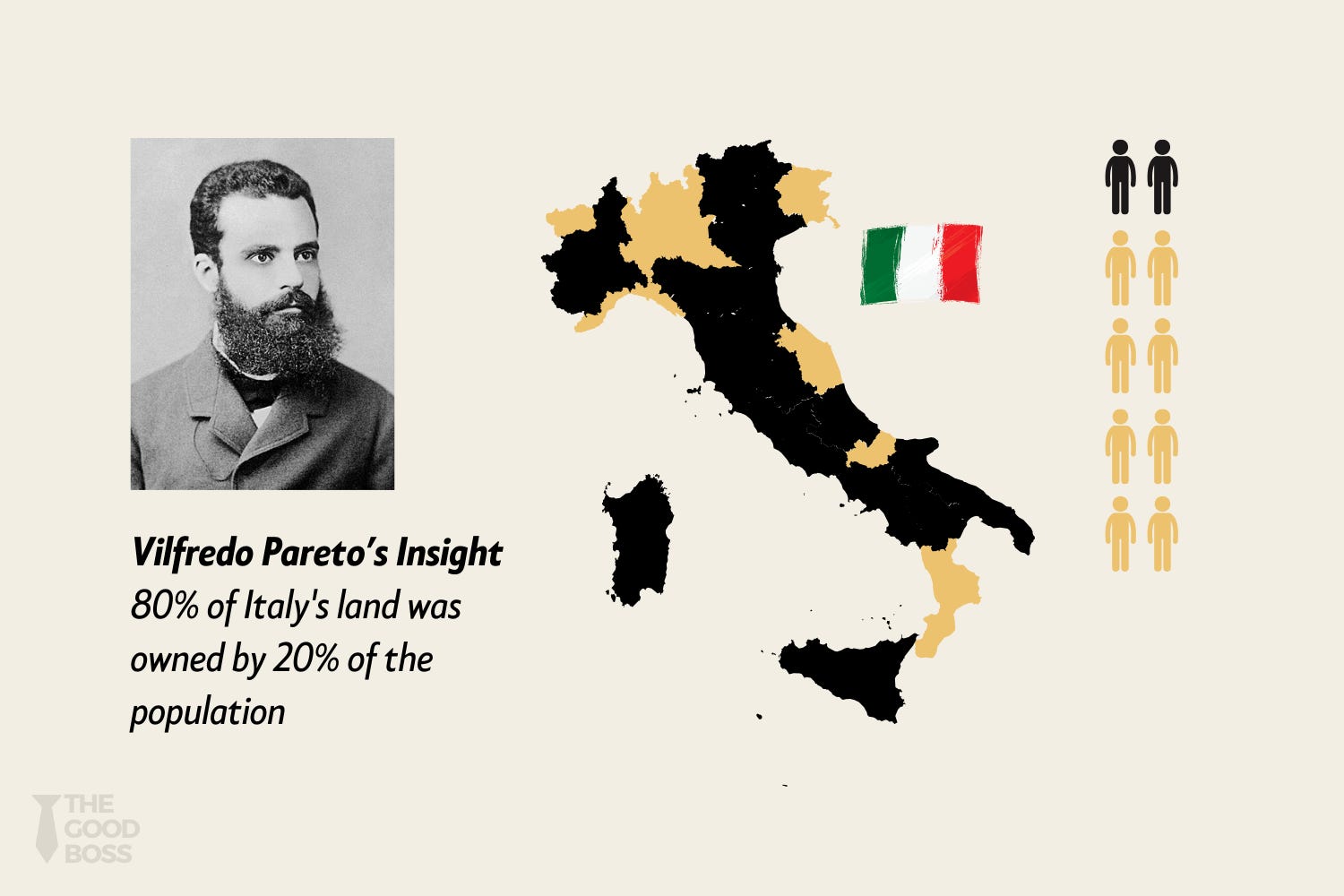
While studying income distribution in Italy, Pareto made a remarkable observation:
About 80% of Italy’s land was owned by just 20% of the population.
This insight fascinated him and became the foundation for what we now know as the Pareto Principle—or the 80/20 rule.
Decades later, in 1941, Joseph M. Juran, a Romanian-American engineer, stumbled upon Pareto’s findings. Juran saw something powerful in Pareto’s observation and took it beyond economics.
He realized this 80/20 pattern applied to quality management, noting that 80% of problems often stem from just 20% of the causes.
Together, their insights gave rise to one of the most powerful principles in productivity, business, and leadership. And while the Pareto Principle started as an economic observation, its real magic lies in how widely it applies—across industries, disciplines, and even your daily to-do list.
What Is The Pareto Principle?
At its core, the Pareto Principle, sometimes called the 80/20 rule, states that for many outcomes, roughly 80% of consequences come from 20% of the causes.

Another way to put it is that 20% of your projects will yield 80% of the results, or 20% of your team will create 80% of the impact.
This principle forces you to think hard about what your priorities are, and where you should be focusing your attention.
Simple at it’s core, and without any rigorous scientific proof, this principle has stood the test of time.
Still not convinced? Ask yourself these questions:
How many hours of your day do you feel most productive? Likely around 2-3 hours out of your typical work day.
How many clothes from your closet do you wear most of the time? You guessed it — around 20%.
How often do you listen to your favorite songs on Spotify or YouTube Music? That’s right, you likely listen to just 1/5th of your playlist most of the time.
How many apps on your phone do you use regularly? Out of the dozens you’ve downloaded, you probably rely on just 20% for most of your needs (and probably need to do some cleaning!)
How many products of Apple generate 80% of their revenue? Yes, around 20%—primarily their iPhone and a handful of other flagship items.
How many customers in your business drive most of your revenue? You’ll likely find that around 20% of your clients contribute to 80% of your profits.
How much airline revenue comes from business and first-class tickets? Unsurprisingly, airlines often earn the bulk of their revenue from a small proportion of passengers—the ones flying business or first class.
Test Your Understanding
Before you move on, take a couple of minutes to check your understanding with a quick quiz.
Are you up for it? Let’s do this!

(If you’re new to Kyoshi: It’s the systems-first leadership coach, built on the same Leadership OS I’ve been writing about in this newsletter for years. Go ahead and sign up for free and try out the quiz now.)
Practice This Framework
Just like you build your physical muscles in the gym, you build your leadership muscle by practice.
🎯 Practice a drill
Got five minutes? Drills are short, focused reps. Kyoshi gives you a situation, and you rework it so it informs, inspires, and influences.
Go ahead and start the drill now!

📝 Download the worksheet
If you like step-by-step prompts, download and use the Pareto Principle worksheet and apply it in your own team or work situation.
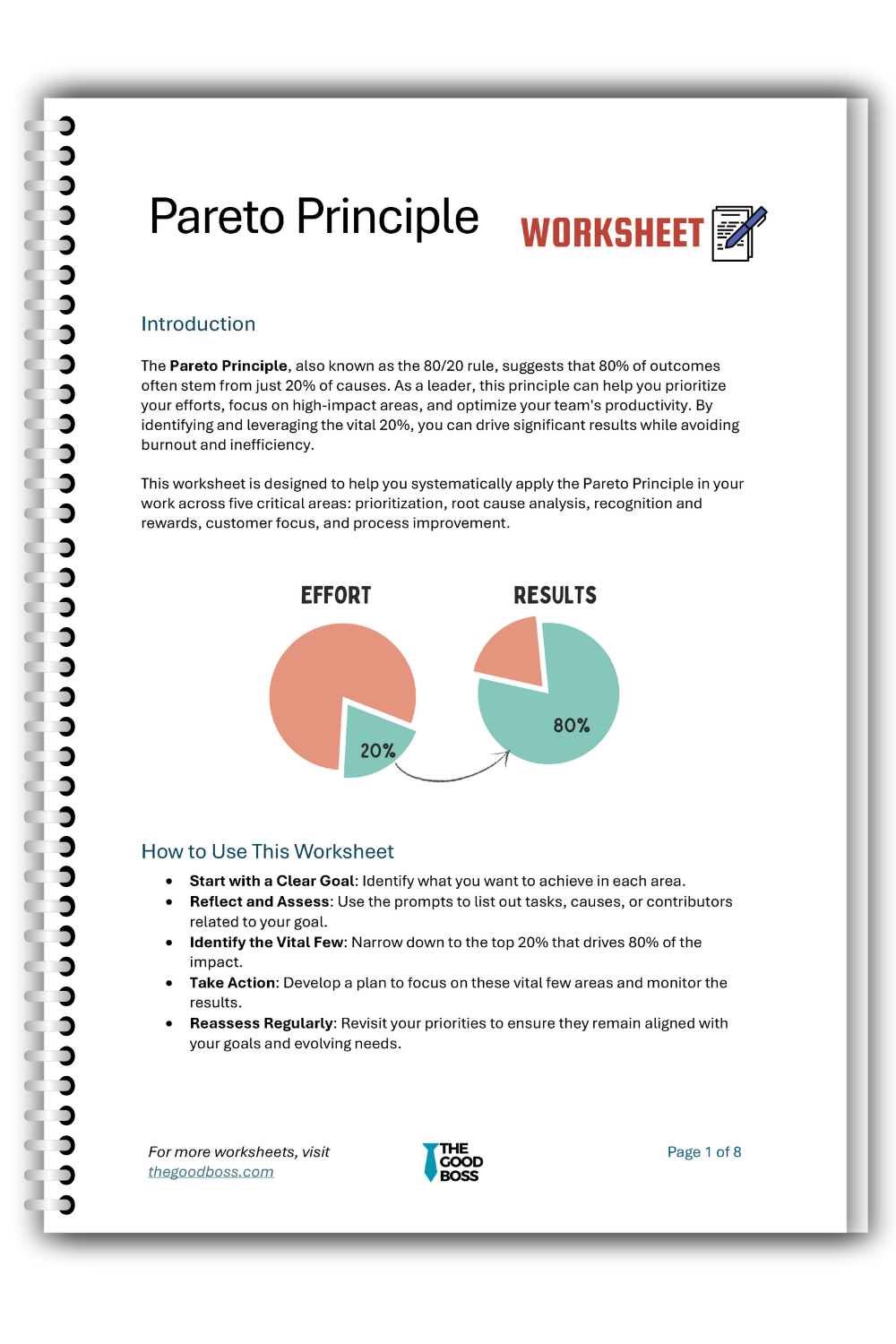
How to download the worksheet
This worksheet is part of the Worksheets Collection, available to all paid subscribers to The Good Boss.
👉🏻 Upgrade to paid now and get instant access to the entire collection, including this worksheet.
If you prefer the standalone worksheet, you can purchase it from here.
🧭 Create a Situation
If you’re looking for a trusted partner to help you create and manage a situation, and actively coach you as you solve it for real, then Kyoshi can help you with all that.
Pick one real situation coming up in the next week or two. Then work with Kyoshi to apply this framework in that situation.
