

In this issue:
Part 1: Understanding the Pygmalion Effect
What is the Pygmalion Effect?
The Psychological Loop of the Pygmalion Effect
Part 2: Applying the Pygmalion Effect
The 3 Steps to Becoming a Pygmalion Leader
Real-Life Leadership Scenarios
The Pygmalion Effect Worksheet
Part 3: Going From Here
Common Pitfalls and How to Avoid Them
Recommended Resources
Final Thoughts
✨
“He just isn’t leadership material.”
That one sentence, said casually in a room of managers, changed the trajectory of someone’s career. I remember sitting in a performance calibration discussion when a senior manager dropped this line about a team member I had worked closely with.
The irony was striking: this person had just led a cross-functional project to success, handling tough deadlines and managing egos along the way. He had done everything right. But now he would likely never be seen as “leadership material”, simply because of one manager’s belief.
And I’ve seen it again and again since. A manager believes someone has “potential,” and suddenly they get stretch assignments, visibility, and coaching. Another one is seen as “slow,” and they get sidelined.
But here's the beauty of it all: both of them usually live up to those expectations. The high-potential employee ends up overdelivering and shining, while the slow employee ends up underperforming and gets managed out.
You may think this is magic. But it’s a well-known psychological behavior called the Pygmalion Effect. In this article, we will learn how the Pygmalion Effect works, and how you can apply it in your own situations to maximize the potential of your teams.
Ready to dive in? Let’s go!

Part 1: Understanding the Pygmalion Effect
In this section, we’ll explore what the Pygmalion Effect is, where it comes from, and why it matters more than ever in leadership.
What is the Pygmalion Effect?
The Pygmalion Effect refers to a simple but powerful idea:
What you expect from people influences what they become.
It started with a 1960s study by psychologists Robert Rosenthal and Lenore Jacobson, which looked like this:
In their study, they told teachers that certain students in their class had been identified as “intellectual bloomers”, which are kids with high potential.
What the teachers didn’t know was that the students were actually chosen at random.
To everyone’s surprise, the study found that over time, those “bloomers” actually did perform better.
Why did that happen? Rosenthal and Jacobson observed that the teachers had unknowingly changed their behavior towards the “bloomers”. They gave those kids more encouragement, more attention, and more time. These subtle shifts in tone, posture, and patience led to real changes in performance.
That is a classic example of the Pygmalion Effect.
The Psychological Loop of the Pygmalion Effect
It may feel like magic, but the Pygmalion Effect is actually deep-rooted in psychology. The best way to represent it is through a psychological loop as follows:
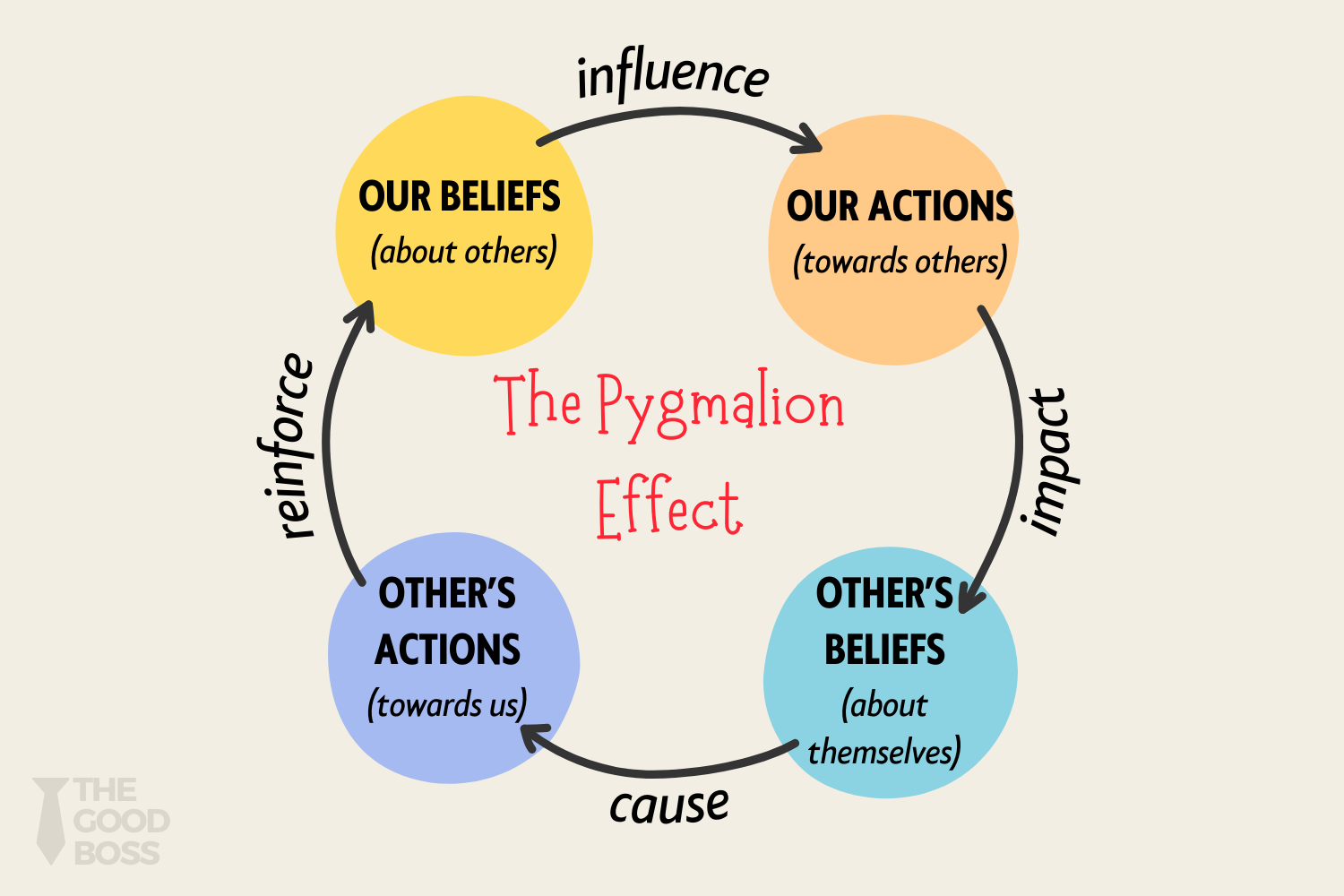
Our beliefs: We form expectations about someone. Maybe we think they’re a top performer. Or we think they’re not “ready yet.”
Our actions: Our behavior shifts. Based on our formed expectations, we either give them more coaching, more space, more opportunity, or we don’t.
Others’ beliefs: They notice. People are incredibly perceptive. They pick up our cues.
Others’ actions: They adapt. They start to live up to (or down to) the expectations we’ve set.
It works both ways:
When expectations are high and communicated with belief, people often rise.
When expectations are low, people often shrink.
The most uncomfortable part of the Pygmalion Effect is that it happens subtly, and as leaders, we often don’t realize we’re doing it. You may be giving one team member more air time, more positive reinforcement, more stretch work, not because of performance, but because of belief.
And belief isn’t always rational. Sometimes it’s shaped by early impressions, bias, or even hearsay.
Next, we will turn our attention to applying the Pygmalion Effect in our role as leaders.

Enjoying the read? I’ll appreciate it if you would take 2 seconds and hit the ❤️ button and share/restack 🔁 it with others who might find it helpful. You can also subscribe to The Good Boss for more posts like this every week. Thank you! 🙏
Feedback is a gift! 💬 If you’re finding this post helpful, would you do me a favor and leave a quick testimonial here, and as a thank-you, I’ll send you a free copy of my book! It only takes a couple of minutes - thank you! 🙏
Part 2: Applying the Pygmalion Effect
In this section, you’ll learn how to apply the Pygmalion Effect in a conscious, constructive way in your own leadership situation, business, or team.
Here’s what we’ll cover:
The 3 Steps to Becoming a Pygmalion Leader, a practical mindset shift you can apply starting today.
Real-Life Leadership Scenarios - common situations where this effect shows up, and how to handle them better and with intention.
The Pygmalion Effect Worksheet, a downloadable worksheet you can use to reflect and build your muscle in applying this framework.
👉🏼 If you’d like to see how these tools, scenarios and worksheets fit together as part of a broader practice system, you can explore the ⚙️ The Good Boss Practitioner space - where leaders apply these frameworks in real situations.
The 3 Steps to Becoming a Pygmalion Leader
Now that we know the subtle impact of the Pygmalion Effect, how do you use that to your advantage? Follow these three steps to becoming a “Pgymalion Leader”: