

“The success of your presentation will be judged not by what you say, but what your audience hears.” — Unknown
✨
Have you ever walked out of a meeting thinking, “I had the facts, the charts, the slides. So why didn’t they buy in?”
You’re not alone.
Persuasion is one of the most high-value skills that most managers lack. I’ve worked with many smart leaders who have killer ideas, but a weak delivery. They over-index on logic and data, but miss out on other key components of a truly persuasive presentation. And the result is raised eyebrows or polite nods, and the dreaded “let’s revisit this next quarter.”
If you’ve ever struggled to get your boss or stakeholders to see what you see, it’s time to learn the art of persuasion that great leaders have used for centuries.
In this post, we’ll break down Aristotle’s Rhetorical Triangle, a timeless framework that reveals the three secret ingredients of influence. You’ll learn how to persuade anyone, without sounding pushy or political.
Here’s what we will cover:
Part 1: Understanding Aristotle’s Rhetorical Triangle
Origins of the Rhetorical Triangle
The Three Secret Ingredients to Persuasion
Putting it Together: Aristotle’s Rhetorical Triangle
Part 2: Applying the Rhetorical Triangle
The 5-Minute Persuasion Formula
Real-life Leadership Scenarios
The Rhetorical Triangle Worksheet
Part 3: Going from here
Common Pitfalls and How to Avoid Them
Recommended Resources
Final Thoughts
Ready to dive in? Let’s go!

Part 1: Understanding Aristotle’s Rhetorical Triangle
In this section, we will learn a bit about the origins of this framework, and how it works.
Origins of the Rhetorical Triangle
Let’s go back in history for a minute, all the way to ancient Greece, around 384 B.C.
This is when Aristotle was born. Aristotle was more than just a philosopher. He was one of the sharpest minds in history. One of his most powerful contributions was his work on persuasion, which he called rhetoric.
Aristotle believed that persuasion wasn’t just about tricks or clever words. It was about understanding your audience, thinking clearly, and making your message land.
His lectures were later compiled into a book titled Rhetoric (and popularized as the Rhetorical Triangle) based on notes taken by his students. These ideas spread quickly, and he even taught them to one of his most famous students: Alexander the Great.
Now, I’m sure you’re curious to know what his secret ingredients to persuasion are, so let’s dig into that.
The Three Secret Ingredients to Persuasion
Aristotle believed that to persuade effectively, you must appeal to not just logic (Logos), but also to emotion (Pathos) and credibility (Ethos).
Now, let’s look at each of the elements one by one:
Ingredient #1: Ethos - Credibility of speaker
Ingredient #2: Pathos - Values of the audience
Ingredient #3: Logos - Logic of the argument
Ingredient #1: Ethos - Credibility of Speaker
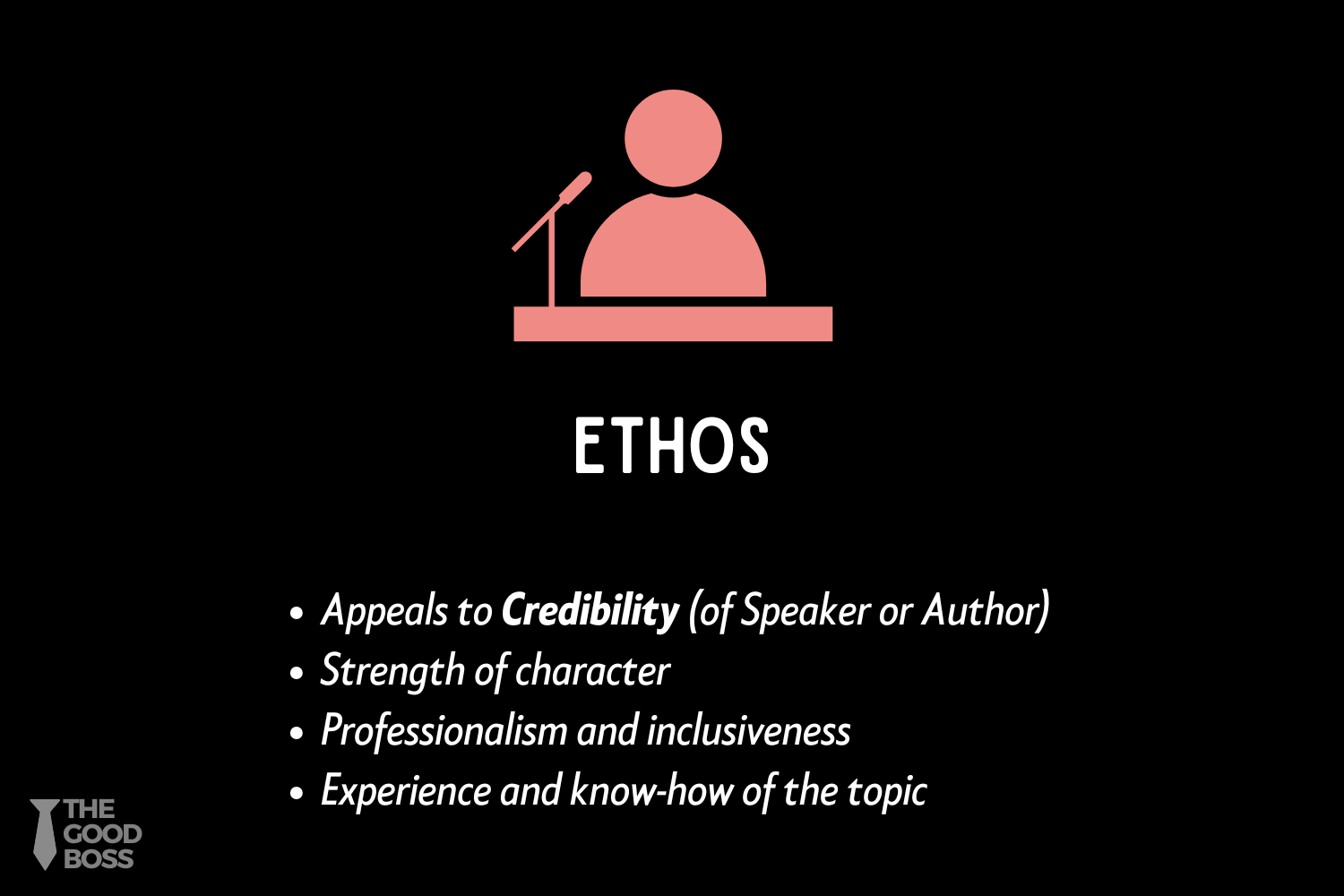
“To be persuasive we must be believable; to be believable we must be credible; to be credible we must be truthful.” — Edward R. Murrow
The first element of the Rhetorical Triangle is Ethos, which appeals to the credibility of the speaker or writer.
Modern-day studies show that the credibility and experience of the speaker play a critical role in the outcome of a persuasive argument.
Have you wondered why it is harder for an unknown or upcoming startup to get funding compared to an established firm?
Or why do people naturally get attracted to some leaders or public figures?
It all goes back to the credibility and character.
Ingredient #2: Pathos - Values of Audience
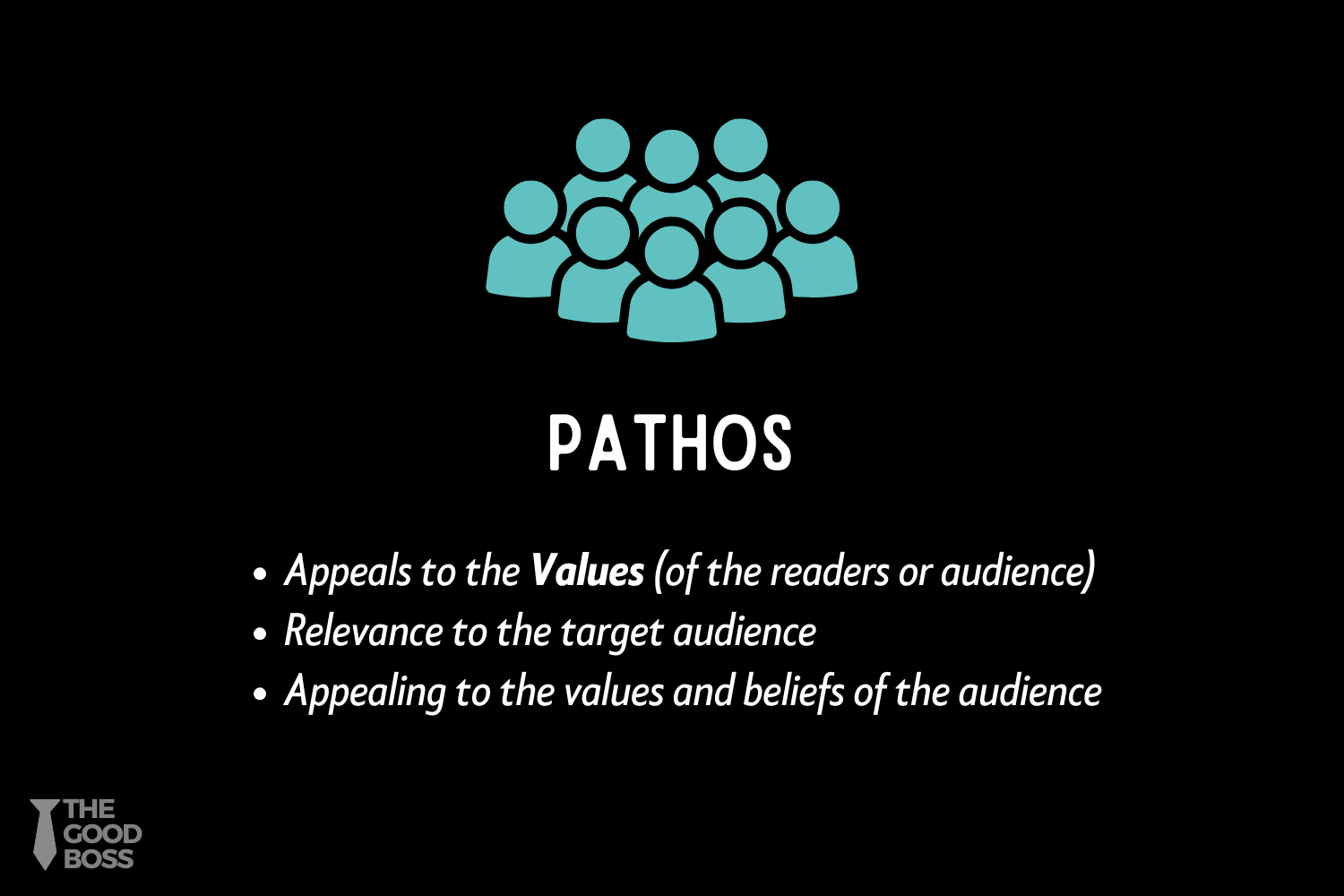
“When dealing with people, remember you are not dealing with creatures of logic, but creatures of emotion.” — Dale Carnegie
The second element of the Rhetorical Triangle is Pathos, which appeals to the values of the audience.
Humans are emotional beings, and to effectively persuade, you need to tap into your audience’s emotional senses.
You need to understand your audience, and know what they want and care about. There is no point delivering a tactical and deep-dive presentation to an executive, or a strategic presentation to a junior employee.
Ingredient #3: Logos - Logic of Argument
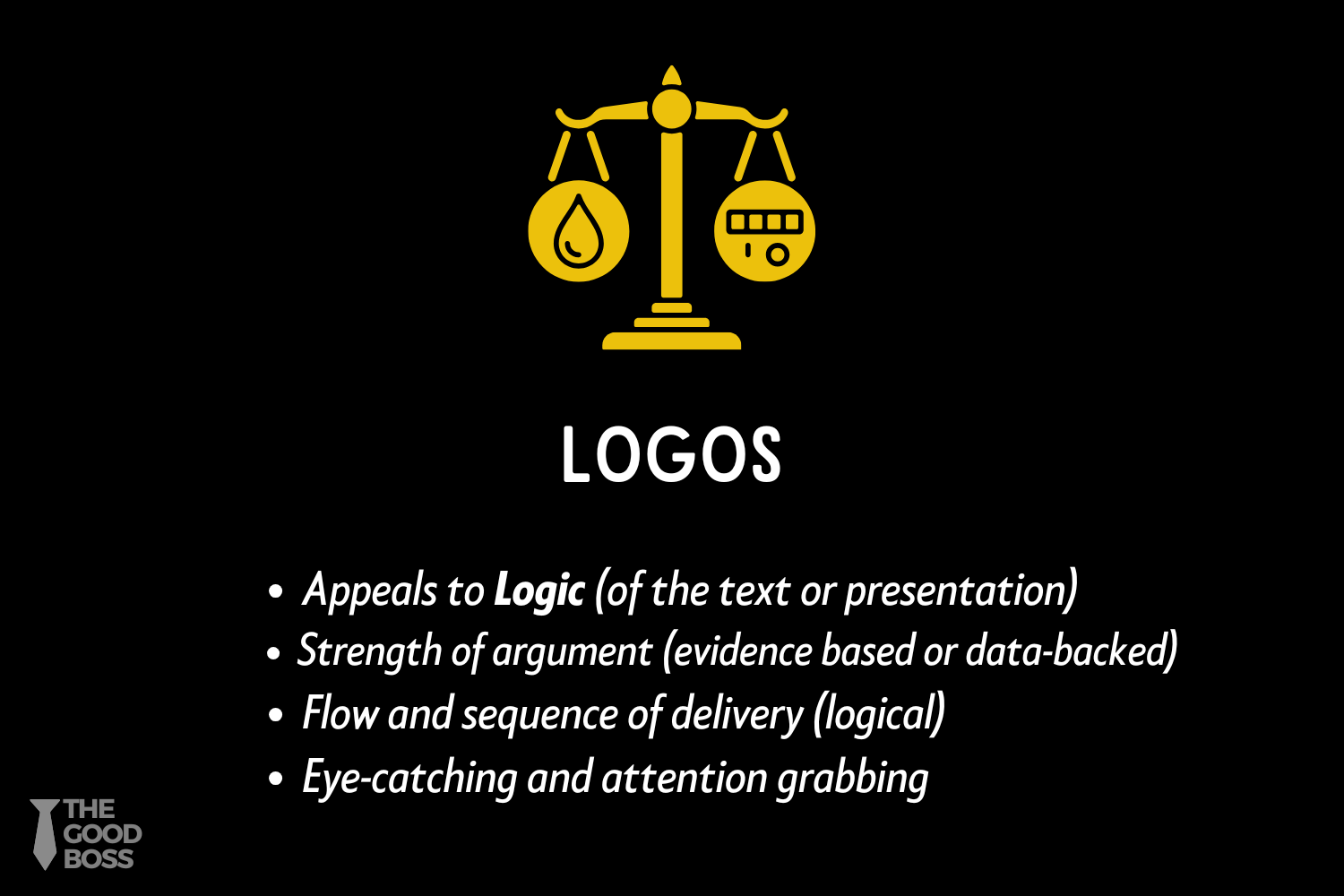
“Logic is invincible, because in order to combat logic it is necessary to use logic.” — Pierre
The third and final element of the Rhetorical Triangle is Logos, which appeals to the logic of the argument.
No matter how strong your credentials, or how relevant your presentation may be, you cannot ignore the strength of the argument itself.
Logos focuses on the content (or text) of the presentation: what is being said, what is being shown, and the flow and sequence of the delivery.
Enjoying the read? Hit the ❤️ button and share/restack 🔁 it with others who might find it helpful. You can also subscribe to The Good Boss for more posts like this every week. Thank you! 🙏
Putting it Together: Aristotle’s Rhetorical Triangle
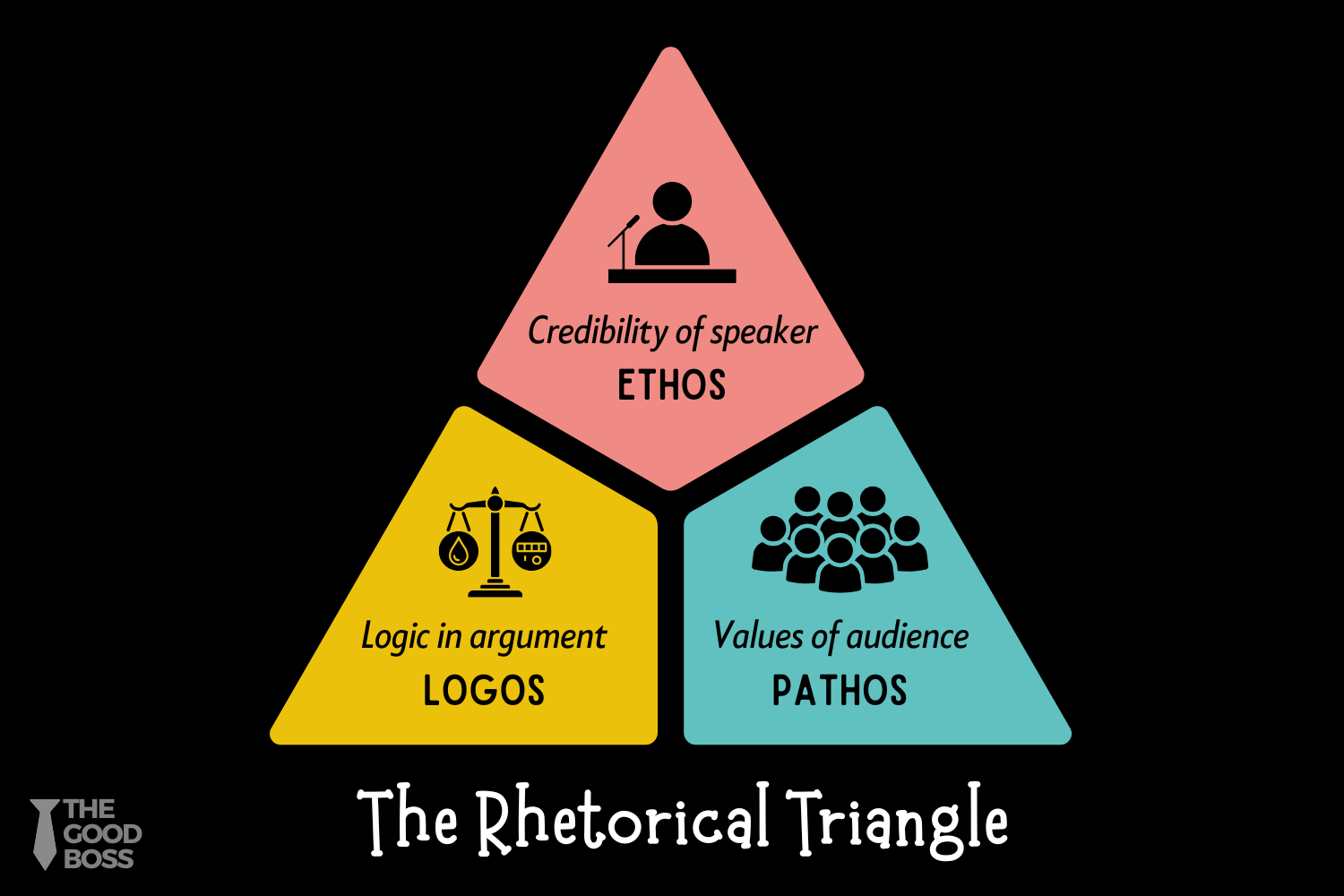
These three elements - Ethos, Pathos, and Logos - don’t work in isolation. The real power of the Rhetorical Triangle lies in how they work together.
When you show that you’re credible (Ethos), connect to what your audience cares about (Pathos), and back it all up with a clear argument (Logos), you don’t just share information, you move people.
Think of it like this:
Ethos opens the door.
Pathos invites them in.
Logos makes them stay.
If even one of these elements is missing, your message will feel off.
Too emotional, and people may not trust it.
Too logical, and they may not care.
Credible, but dry, and you lose attention.
Great communicators use all three, whether they’re pitching a project, giving a keynote, or leading a team through change.
And now that you understand the triangle, it’s time to learn how to apply it in your own leadership role.
Feedback is a gift! 💬 If you’re finding this post helpful, would you do me a favor and leave a quick testimonial here, and as a thank-you, I’ll send you a free copy of my book! It only takes a couple of minutes - thank you! 🙏
Part 2: Applying the Rhetorical Triangle
Now that we have a fair understanding of the three elements, next, we will look at strategies and tactics to help you master the application of these elements in your leadership role.
We will start by learning the 5-Minute Persuasion Formula, a simple method to apply the three ingredients of the triangle in under 5 minutes.
We will then discuss some common real-life leadership scenarios, and how you would apply this framework in each of those.
Finally, we will make it real with the Aristotle’s Rhetorical Triangle Worksheet, which will help you build your muscle in applying and using this framework in your leadership role.
👉🏼 If you’d like to see how these tools, scenarios and worksheets fit together as part of a broader practice system, you can explore the ⚙️ The Good Boss Practitioner space - where leaders apply these frameworks in real situations.
The 5-Minute Persuasion Formula
You don’t need hours to craft a persuasive message. You just need a few focused minutes, and the right ingredients.
Here’s how to quickly apply Ethos, Pathos, and Logos before any important meeting, pitch, or presentation.