

A couple of years ago, my son, who was 9 years old at the time, came to me with his Nintendo Switch 🎮 tossed aside and looking visibly upset. I could see his eyes all wet and about to burst into tears.
When I asked him what was wrong, he wiped his face and said, “I hate this game. I’ve been stuck on this level for DAYS.”
I sat down next to him, and thought about that for a moment. I’m not much of a gamer, but in the spirit of someone who cared, I decided to pick up the controller, and tried my hand at the game.
After a few tries, I couldn’t take it anymore either… I sighed and tossed the controller to the side.
The game was hard, but I knew it wasn’t “unfair”. We had to get the timing right. Our moves had to be deliberate. And our strategy had to change as the levels got harder.
As I thought about it, it struck me that leadership communication actually works very similarly.
When we’re new to the role, we try to understand how it works… What should we say, how, and to whom? Is this enough, or too much? etc. etc.
Over time, as we learn and observe and execute, we typically figure out better ways to communicate.
In 20+ years leading teams and observing other leaders, I’ve seen that some leaders level up in their communication over time, while others just get stuck in the same loop, repeating the same basic moves that no longer work.
But here’s the twist: in video games, you know your score, your lives, essentially something to measure your performance. But in a corporate environment, nobody tells you your “communication score”, or gives you feedback that your communication sucks.
Your team may keep “agreeing”, “smiling” and saying “Got it,” while they’re actually confused or frustrated.
In this post, I’ll walk you through the 3 Stages of Communication in Leadership, aka the ‘3 I’s framework’. It’s a framework I put together based on my observations of how communication actually flows in leadership, and how you can master it as a leader.
Here’s what we will cover:
Stage 1: Inform - “What do they need to know?”
Stage 2: Inspire - “Why should they care?”
Stage 3: Influence - “What do I want them to do?”
The Interplay Between the Three Stages
Test Your Understanding
Practice This Framework
Apply This Framework
The 3-I Checklist
Final Thoughts and Takeaways
Ready to dive in? Let’s go!
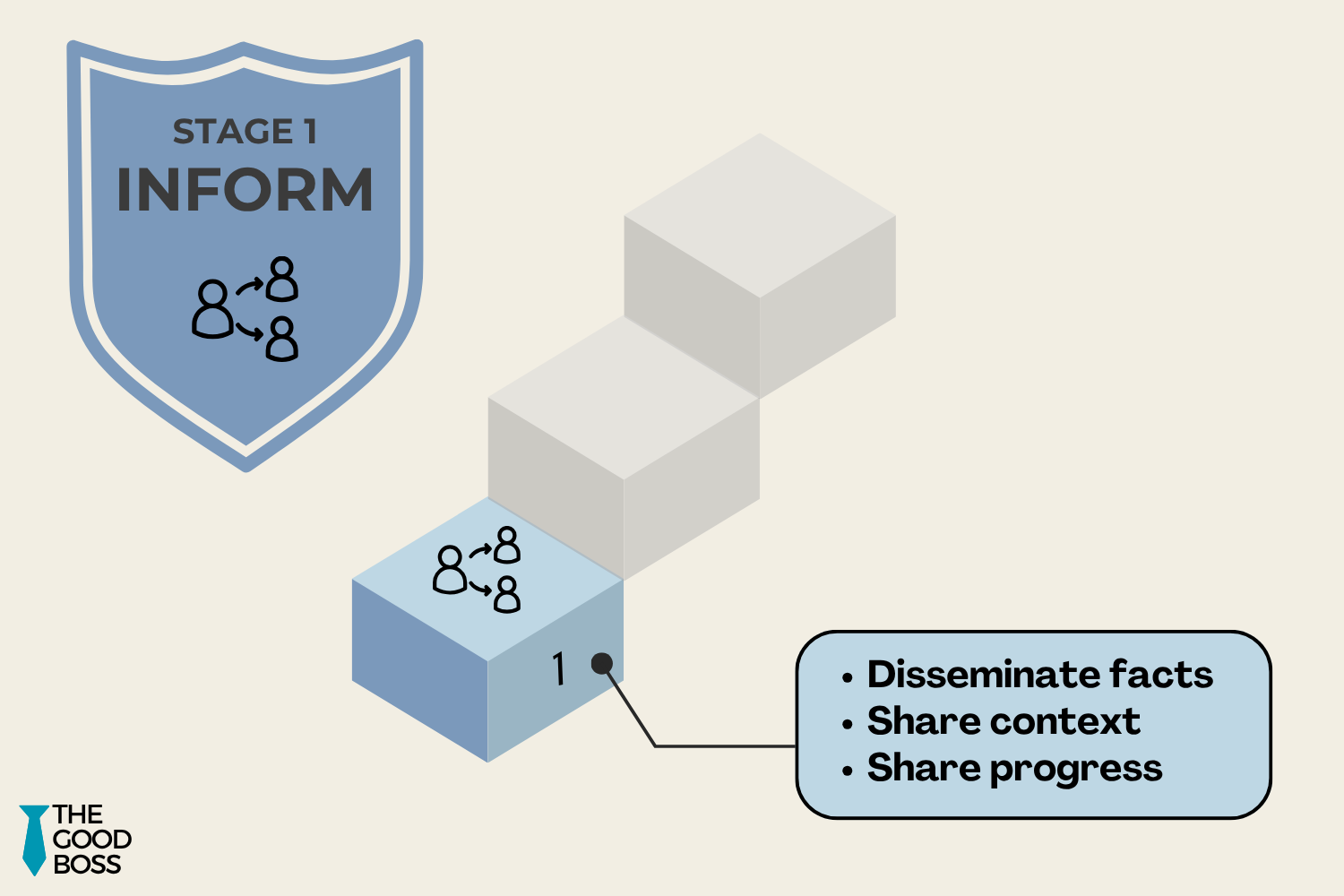
Stage 1: Inform - “What do they need to know?”
“Power today comes from sharing information, not withholding it.” (Keith Ferrazzi)
Going back to the video game analogy…
When you’re new to a game, you start as a rookie. Your focus is on staying alive. As you play, you learn the rules, the details, and the basic moves.
In the same way, your first stage of communication as a leader is Inform.
At its core, informing means laying out facts, data, and relevant information.
As a leader, you need to keep your team and stakeholders updated, and make sure they have what they need to get their job done.
Examples of informing:
Cascading information from leadership to your team
Keeping leadership updated on your team’s progress on projects in flight
Sharing decisions that affect your team or stakeholders
As you share information, you also need to pay attention to how you communicate.
Here are some common mistakes to avoid:
Overloading with information: Some leaders confuse informing with dumping every detail (yeah, I know!) but too much information overwhelms your team and actually buries the key message. Please… not every email needs a 5-page attachment.
Lack of transparency: Hoarding information or sugarcoating problems doesn’t help, and if anything, it kills trust. Like any human being, your team values honesty, even when the news isn’t great. Being open builds trust, while being closed destroys it.
One-way communication: Informing means talking with people, not at them. Make sure that you’re making room for dialogue, questions, or feedback.
👉🏼 As a leader, your goal is to give your team and stakeholders information that is accurate, relevant, and timely.
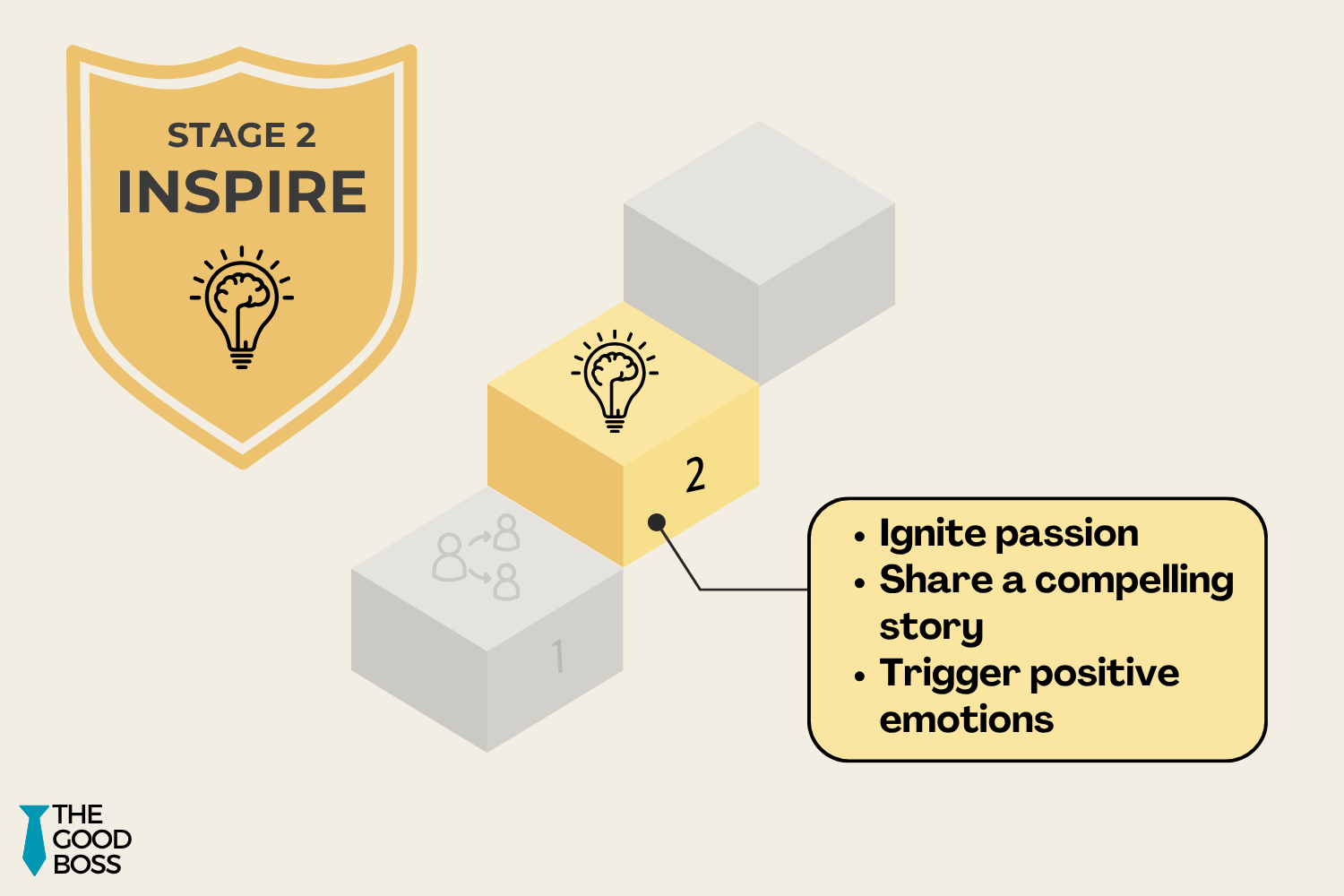
Stage 2: Inspire - “Why should they care?”
“A leader must inspire, or his team will expire.” (Orrin Woodward)
In gaming, as you reach the intermediate level, you pick up strategies and moves you didn’t know about earlier.
Your focus shifts from staying alive to making progress.
In the same way, the second stage of communication is Inspire.
Inspiring goes beyond just “sharing” information. When you inspire, you spark passion, build motivation, and create positive emotions in your audience.
Examples of inspiring:
Sharing a story that resonates with your team
Painting a clear picture of the future
Getting your team excited about a shared goal or vision
When you inspire, you tap into the emotional side of communication. But you need to watch out for a few common pitfalls:
Forgetting the “why”: Some leaders try to motivate by focusing only on what needs to get done, but let’s face it, true inspiration comes from the why. If you don’t connect their work to a bigger purpose, your team won’t feel invested. Period.
Relying on words alone: A powerful speech or a Simon Sinek quote won’t carry you very far, haha :) Your actions matter more. Leaders who don’t live the vision they talk about lose credibility fast… really fast. You need to walk the talk.
Ignoring individual motivations: We’re all wired differently, and get excited about different things. Get to know what drives each person on your team, and adjust how you talk to them. One size does not fit all.
👉🏼 As a leader, your goal is to get your team excited about the shared goals and vision, and about what the future holds.
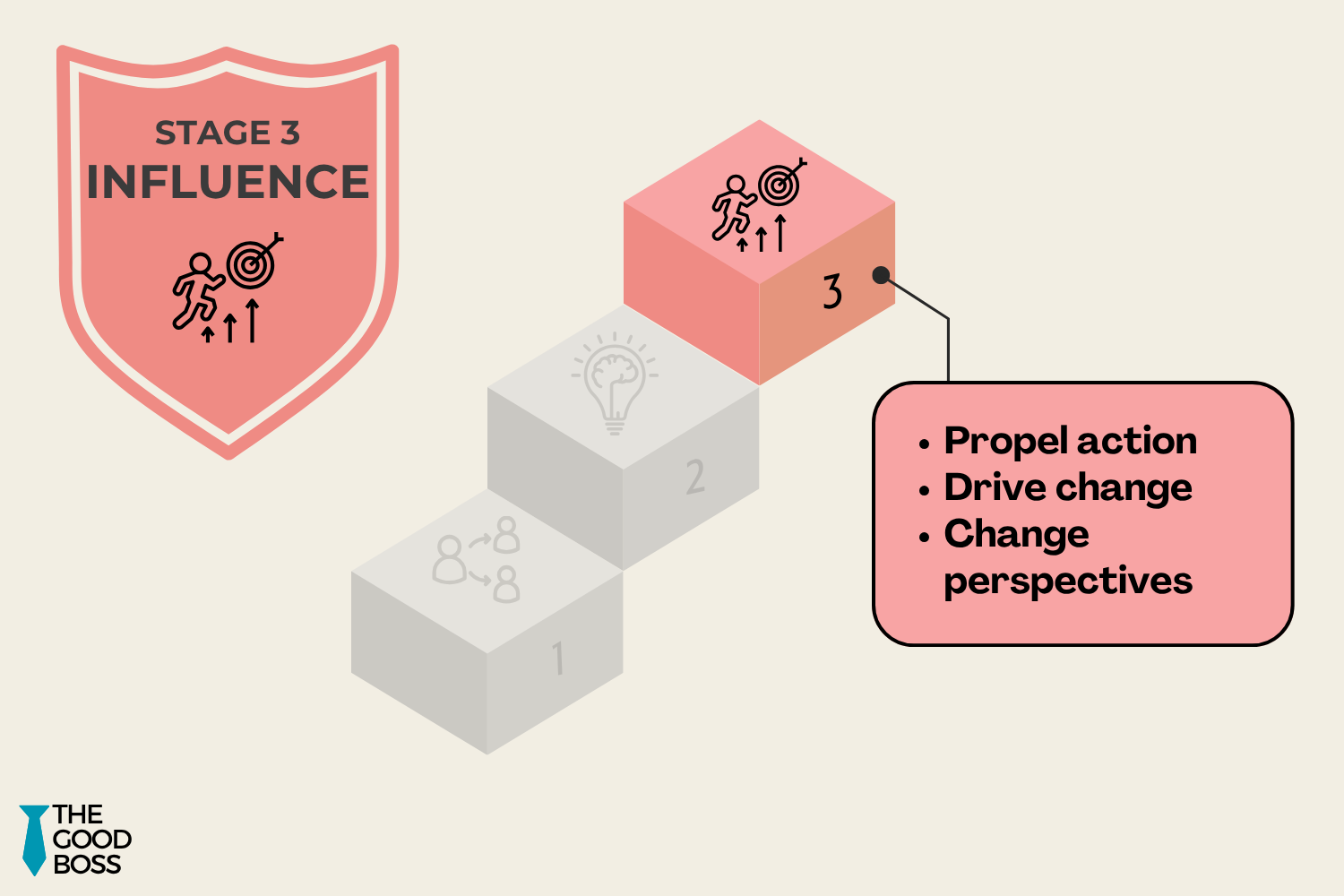
Stage 3: Influence - “What do I want them to do?”
“The key to successful leadership today is influence, not authority.” (Ken Blanchard)
In gaming, when you reach the pro level, you come up with your own strategies, and other players start copying them. Your focus shifts from making progress to creating new paths.
In the same way, Influence is the advanced stage of communication in leadership. Informing and inspiring lay the groundwork. Influence is what turns it into action.
Remember: You can share all the information you have, and inspire your team all you want, but none of it matters if they don’t act on it.
As a leader, you need to influence your team, your stakeholders, and your boss to shape their opinions, attitudes, and behaviors.
Examples of communicating with influence:
Getting others to change their perspective
Driving alignment toward a common goal
Moving people to take action
Influence is the highest stage of communication. It takes strategic thinking and a focus on long-term goals. But watch out for a couple of common traps:
Skipping Inform and Inspire: Influence doesn’t work on its own. If you jump straight to influencing without the groundwork, your team may feel pushed rather than led. Influence works best when it’s built on trust and a shared understanding.
Being too aggressive: If you try to “force” alignment or “push” decisions without involving people, all you’ll get is resistance. Good influence means guiding people to reach the conclusion with you, not dragging them there by force.
👉🏼 As a leader, your goal is to communicate with influence to drive change and alignment toward your team’s or business’s goals.
The Interplay Between the Three Stages
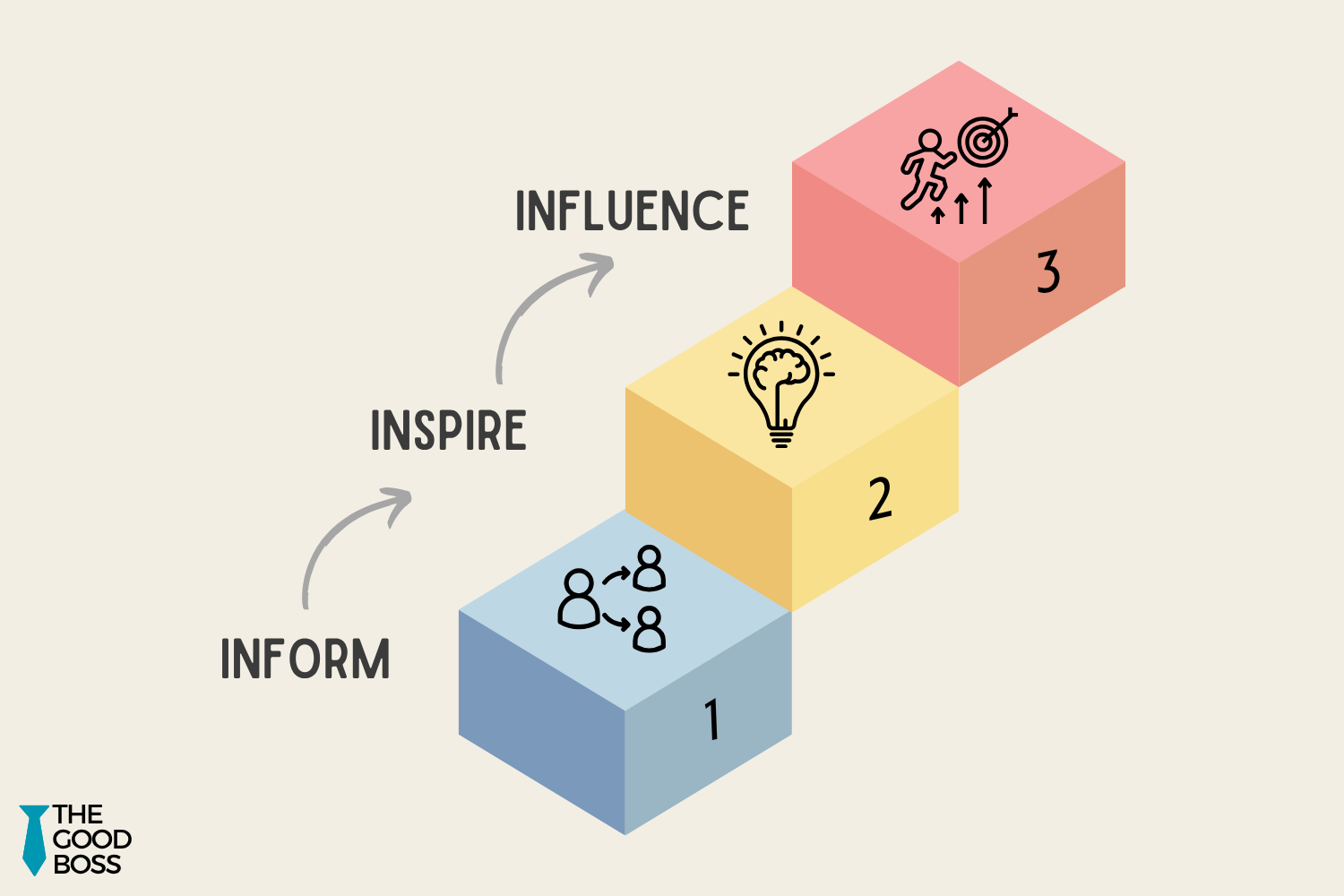
We discussed the three I’s, or stages, of communication in leadership:
Inform. Provide accurate and timely information to your team and stakeholders.
Inspire. Get your teams excited about the shared goals and vision.
Influence. Drive change and alignment towards corporate goals.
But I want to be clear: as you move up the stages, you shouldn’t just “forget” the previous stage.
Effective leaders balance all three:
They inform to create clarity,
They inspire to build energy, and
They influence to make progress and get results.
While the three I’s serve different purposes, they are not mutually exclusive.
In my experience, I’ve seen the three I’s overlapping and supporting each other, and that makes each one stronger.
For example, if you want to inspire your team with a vision of the future, you first need to make sure they have enough context and understand the goals. So informing becomes the foundation for inspiring.
In the same way, once your team is well-informed, you can use inspiration to give their goals meaning and purpose. And then you can use influence to point that energy toward concrete action.
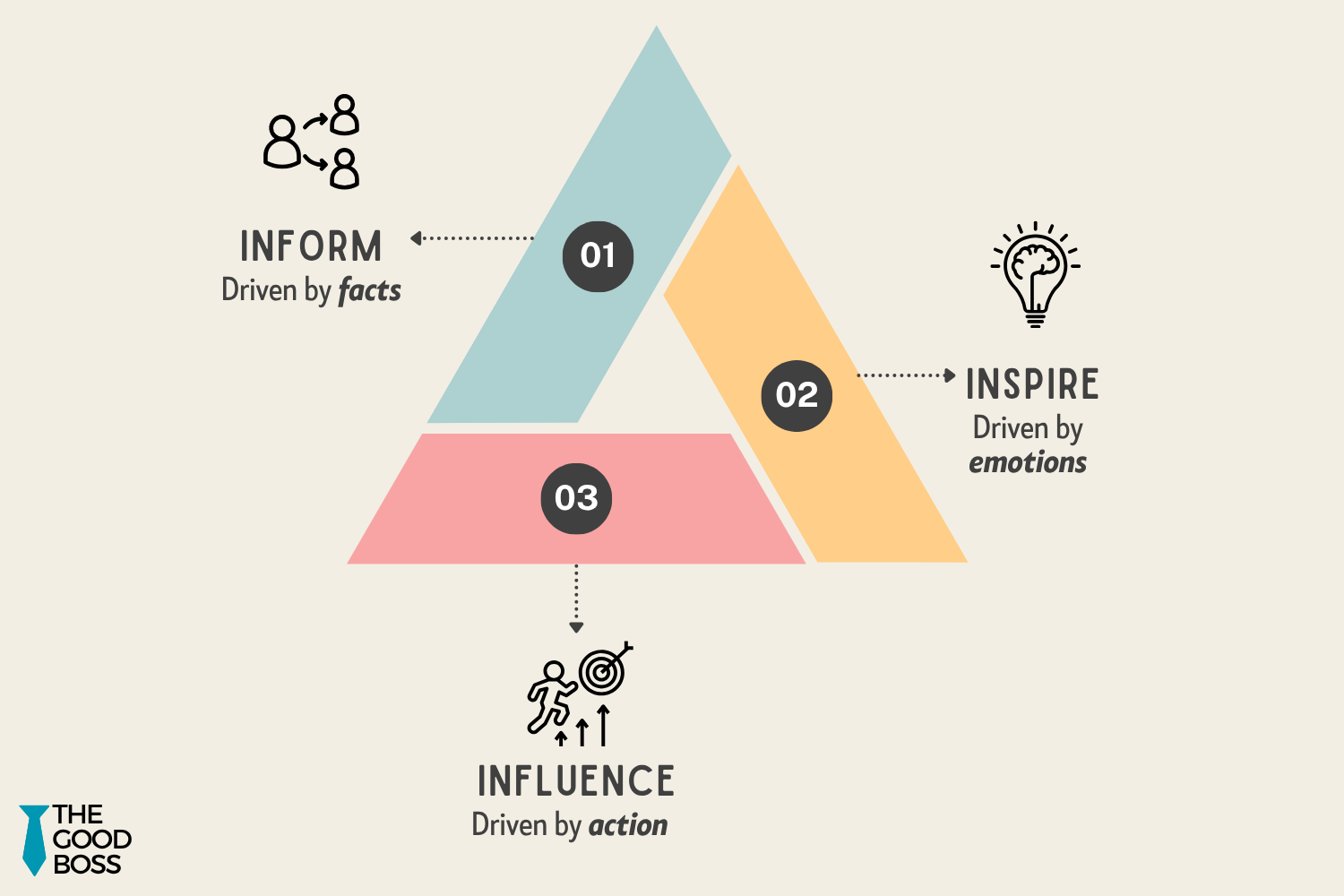
Another way to see how the stages work together is to look at what drives each one:
When you inform, your communication is driven by facts
When you inspire, your communication is driven by emotions
When you influence, your communication is driven by action
So, you can see how the three stages come together, and reinforce each other.
Test Your Understanding
I’m sure you’ll agree that reading about a framework and actually understanding it are two different things. I’ve fooled myself into thinking I understood it many times :)
Before you move on, take a couple of minutes to check your understanding with a quick quiz.
Are you up for it? Let’s do this!

(If you’re new here: Kyoshi is the systems-first leadership coach I recently launched. It’s built on the same Leadership OS I’ve been writing about in this newsletter for years. Go ahead and sign up for free and try out the quiz now.)
Practice This Framework
A model is only useful if you can use it when it counts. In my experience, you don’t build that muscle by “reading” or even “learning”. You build it by reps, just like you do with your physical muscles in the gym.
Here are two ways to practice, depending on what you prefer:
🎭 Practice a role-play
Pick a tough conversation, like your team pushing back on a change, and play it out with Kyoshi. You do the talking, Kyoshi responds as your team would, and at the end of it, you get a de-brief on which stages you hit and which ones you skipped.
Go ahead and start the role play now!

🎯 Practice a drill
Got five minutes? Drills are short, focused reps. Kyoshi gives you a situation, and you rework it so it informs, inspires, and influences.
Go ahead and start the drill now!

Apply This Framework
Now, practice makes you better, but you only really grow when you use a framework on your own problems.
Role plays and drills are useful, but they’re not your situation.
Your situation has its own people, its own history, and, frankly, its own politics.
So here are two ways in which you can actually apply this framework in your own leadership role today.
📝 Download the worksheet
If you like step-by-step prompts, download and use the Three Stages of Communication worksheet and apply it in your own team or work situation.

This worksheet is part of the Worksheets Collection, available to all paid subscribers to The Good Boss.
👉🏻 Upgrade to paid now and get instant access to the entire collection, including this worksheet.
If you prefer the standalone worksheet, you can purchase it from here.
🧭 Create a Situation
If you’re looking for a trusted partner to help you create and manage a situation, and actively coach you as you solve it for real, then Kyoshi can help you with all that.
Pick one real situation coming up in the next week or two. Then walk it through the three stages:
What do they need to know?
Why should they care?
What exactly do you want them to do?

The 3-I Checklist
A question you might be asking is: how do you make sure you’re using all three I’s?
Here’s a simple checklist to run your message through before your next team meeting, 1:1, stakeholder update, or even a Slack message.