


This week, I’m excited to share a guest post from Bobby, whom I got to know through Substack over our shared interest in books, reading, and leadership. I’m sure you’ll enjoy this post, and for more, feel free to subscribe to his newsletter, Leader & Learner!
I’m Bobby Powers, and I run the Leader & Learner publication, where I share two posts per week for curious leaders and learners.
To me, those two topics—leading and learning—have always been intertwined. As soon as I began managing teams, I realized how little I actually knew about leadership, so I turned to books to fill in my knowledge gaps.
When I had to fire someone in my first manager role, books taught me how to be candid but kind. When I began public speaking, books taught me how to tell better stories. And when I was struggling with impostor syndrome, books showed me that many others have felt the same way (one of those books is even included below).
In the past decade, I’ve come to especially love business biographies and memoirs. Below are the five that have taught me the most (alphabetized by author’s last name). The founders and executives in these books have faced wild challenges, and I’ve incorporated their lessons into my own leadership.
These books have also taught me what to avoid as a leader. A couple of the books below are about people I mostly don’t want to emulate. Their lives have served as cautionary tales to help me avoid becoming rich but miserable.
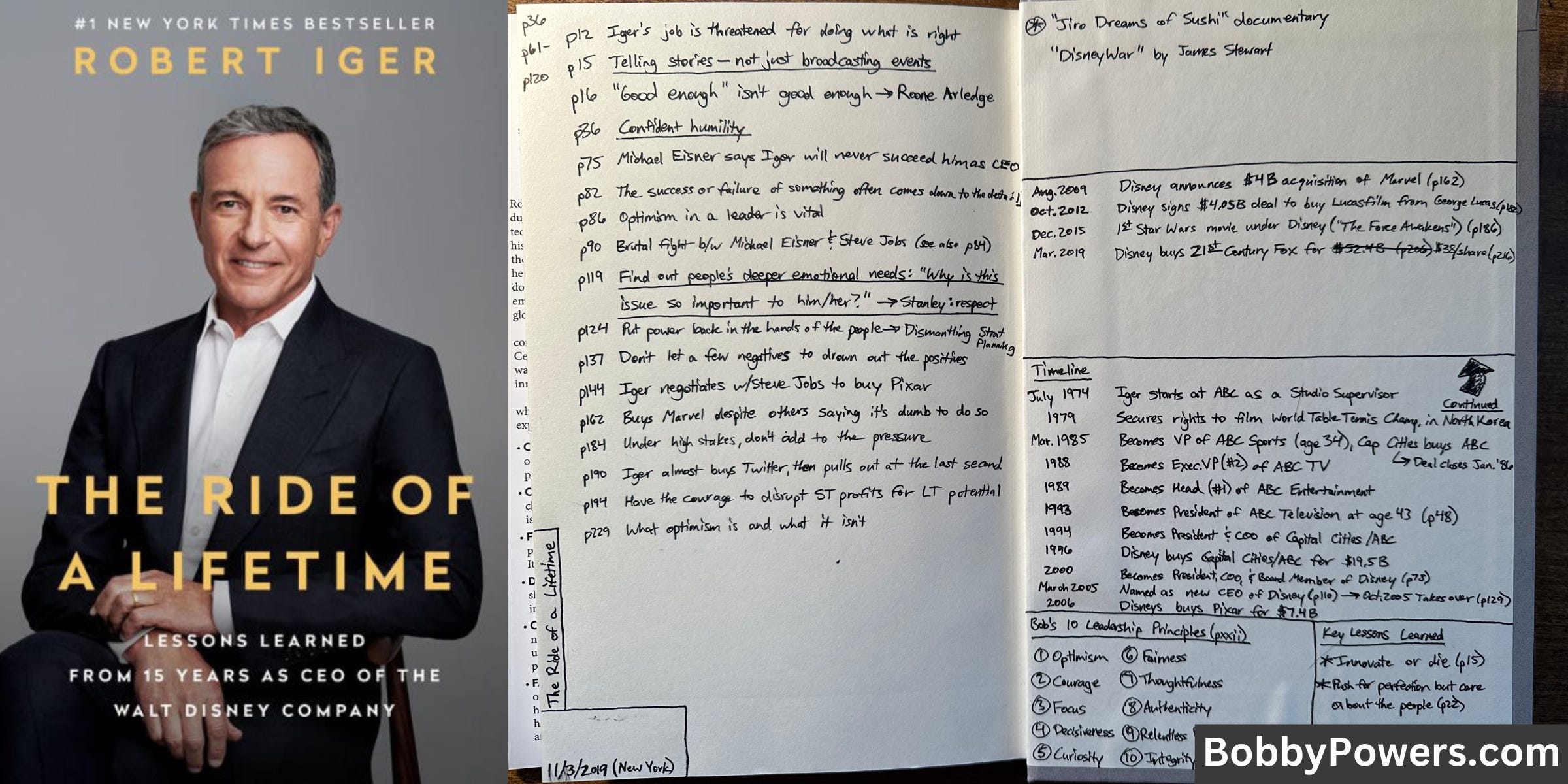
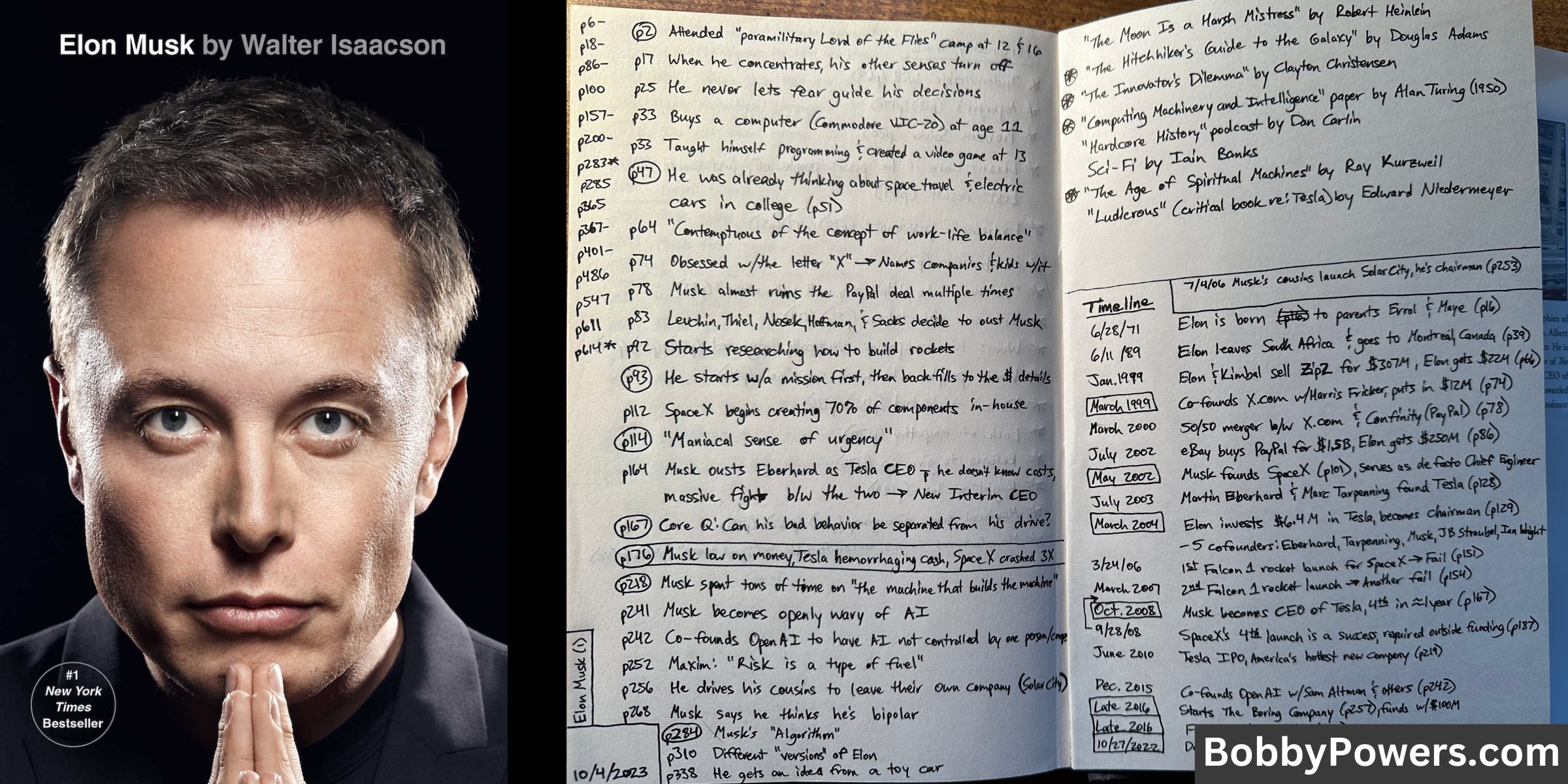
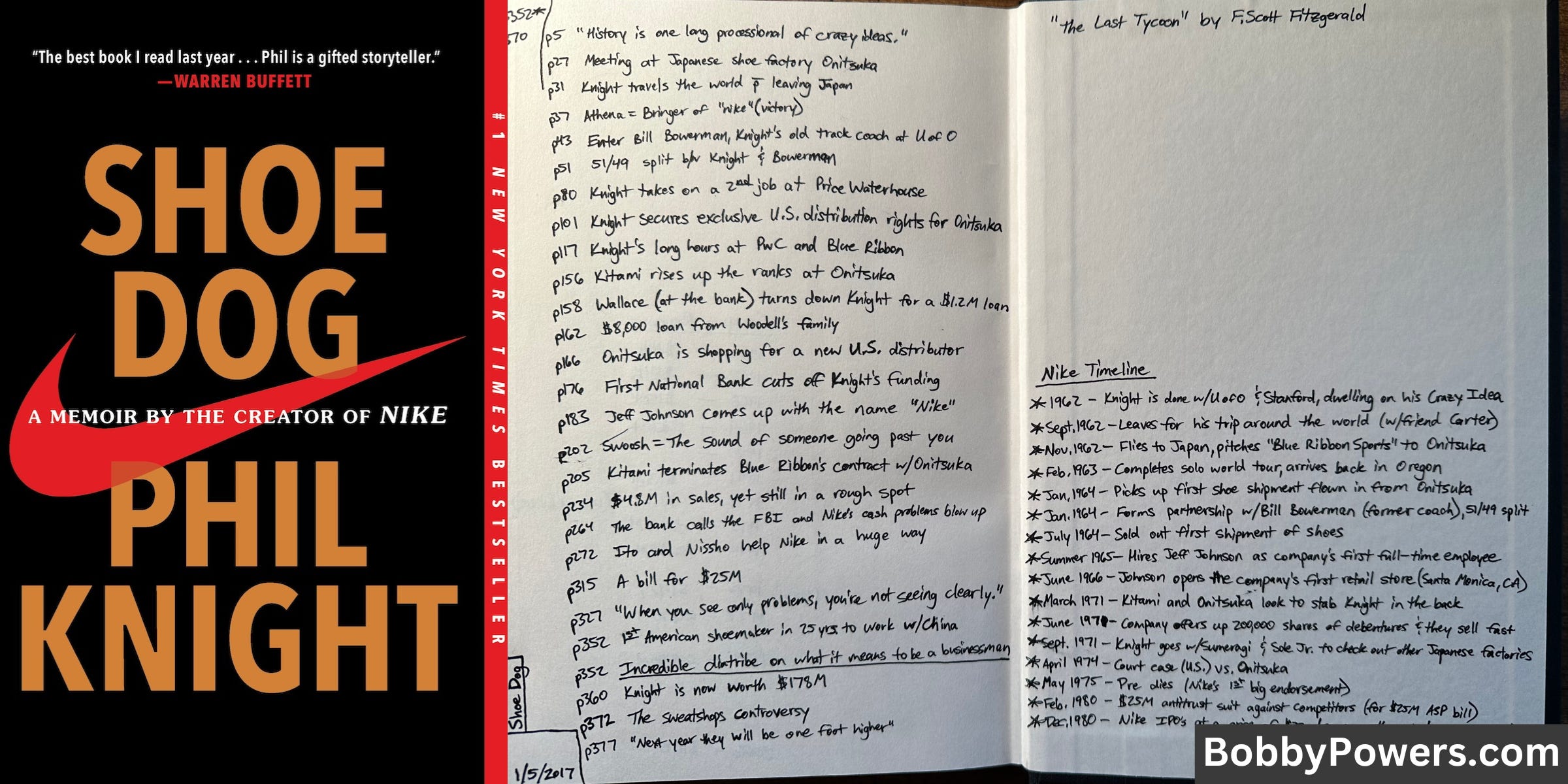
Note: I take copious notes in all of the books I read, including writing my biggest takeaways in the back cover, so I included a picture of my back cover notes for each book.
The Ride of a Lifetime by Robert Iger
“You have to ask the questions you need to ask, admit without apology what you don’t understand, and do the work to learn what you need to learn as quickly as you can. There’s nothing less confidence-inspiring than a person faking a knowledge they don’t possess. True authority and true leadership come from knowing who you are and not pretending to be anything else.” -Bob Iger
Iger served as CEO of Disney for almost 20 years. (Actually, he just stepped down two weeks ago.) His book reads as half memoir, half leadership manual. It’s one of the most honest memoirs I’ve ever read. He even talks about co-workers whom he had difficulty working with at ABC and Disney.
It’s refreshing to read an author who is candid yet still assumes the best of intentions of his colleagues. I learned a lot from this book.
Key Takeaways
Lead with confident humility. Almost everyone feels impostor syndrome (even Iger). The key is to ask for help with your weaknesses while also leading with confidence in your areas of strength.
Roone Arledge, the old head of ABC Sports, taught Iger that “good enough” isn’t good enough. Details matter more than you think because “the success or failure of something so often comes down to the details.”
If something is important to one of your direct reports, clients, or bosses, take the time to learn why it’s so important to them. That’s one of the best ways to empathize with someone and understand more about them as a person.
When the stakes of a project are already high, make sure you don’t put additional pressure on your team. Doing so is counterproductive.
Elon Musk by Walter Isaacson
“He’s amazingly successful getting people to march across a desert. He has a level of certainty that causes him to put all of his chips on the table.” -Reid Hoffman (LinkedIn cofounder), re: Elon Musk
Soooo much to learn from Musk, both good and bad. He’s one of the most intense people I’ve ever read about, and his passion for changing the world and paying extreme attention to small details is unparalleled.
I’ve read many of Walter Isaacson’s biographies, and this is now probably my favorite—not because I think Musk is a good person (he’s horrible), but because he’s fascinating. Many things shocked me in this book, including how ruthless Musk can be. (For example, he fired or laid off about 80% of Twitter’s workforce within months of taking over the company!)
Key Takeaways
Absolute power in a company is dangerous. Every leader needs people to keep them in check. The more rich and powerful you become, the harder you need to work to ensure you’re not surrounded by sycophants.
Spend tons of time on “the machine that builds the machine.” Ironing out small kinks in your operations will make all of your work more efficient and profitable.
Question every requirement. If you don’t know if a part or process is necessary, remove it and see what happens, then iterate from there. Don’t work to optimize a process that should instead be removed.
Rich ≠ Happy. Musk is a miserable human, and you can tell by reading his tweets and watching his interviews. Don’t strive to be rich or powerful. Strive to treat others well and build something beautiful in the world.
Shoe Dog by Phil Knight
“Each new day brought fifty new problems, fifty tough decisions that needed to be made, right now, and we were always acutely aware that one rash move, one wrong decision could be the end.” -Phil Knight
Shoe Dog is a great peek into the realities of entrepreneurship and leadership. Nike co-founder Phil Knight reveals the struggles he faced when starting the iconic sports apparel company, including almost losing his business.
Reading a book like this is such a mind-trip because you know going in that Nike is a multibillion-dollar powerhouse, but every page of the memoir feels like the company will never make it.
Key Takeaways
Even the most famous and successful founders had a rough go of it. Persevere.
Business success is a rollercoaster of massive ups (if you’re lucky) and gut-wrenching downs. You must survive the downs to be around to make money from the ups.
Leadership requires a thousand tradeoff decisions: Which suppliers are you willing to work with? Stay private or go public? How much should you diversify your product line?
Becoming Steve Jobs by Brent Schlender and Rick Tetzeli
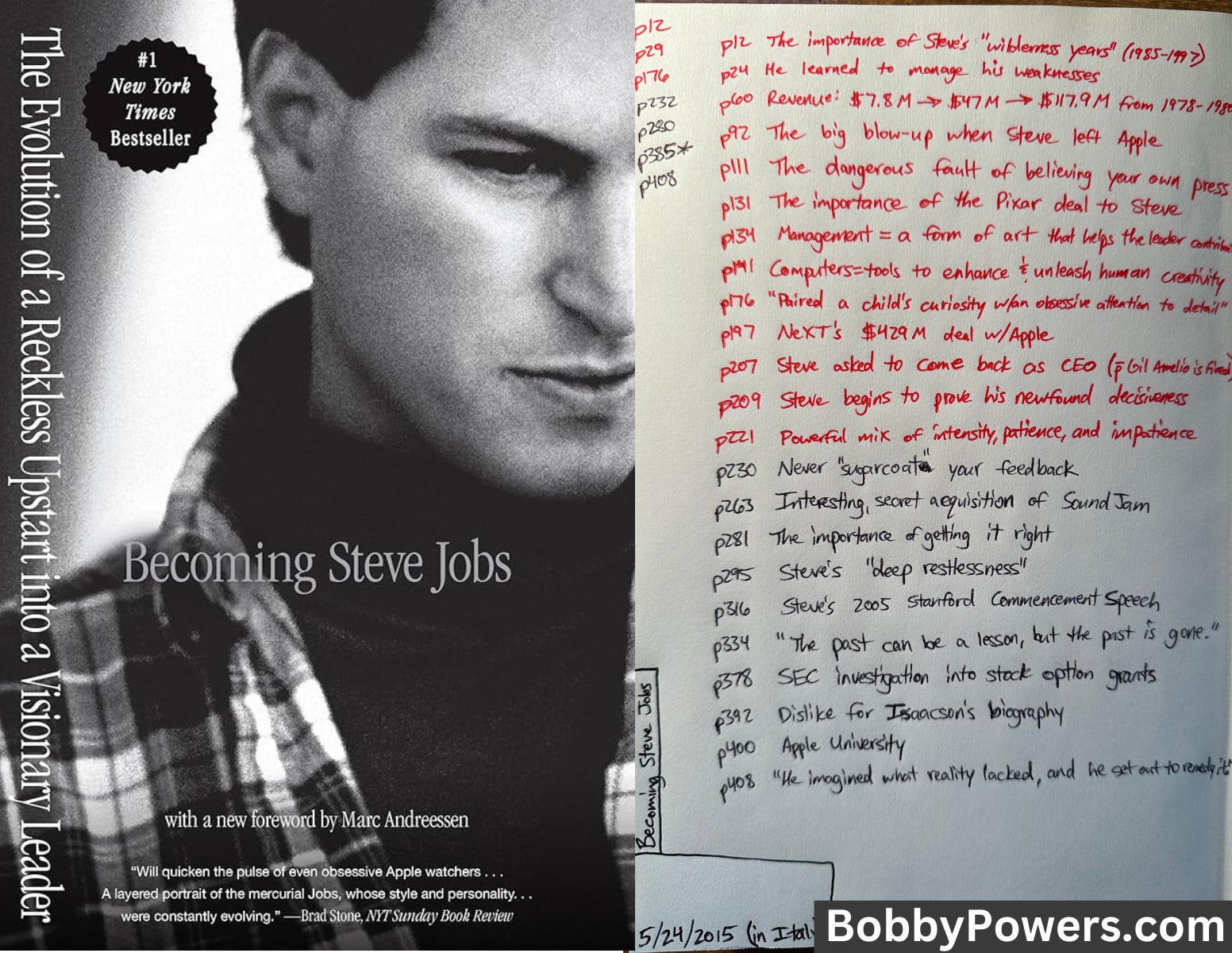
“His was a truly Shakespearean tale, full of arrogance, intrigue, and pride, of perceived villains and ham-handed fools, of outrageous luck, good intentions, and unimagined consequences.” -Brent Schlender and Rick Tetzeli, re: Jobs
I’ve read multiple biographies about Steve Jobs, including the famous bestseller by Walter Isaacson. This one is my favorite because it paints Jobs in shades of gray: hard-working genius, impatient a**hole, caring human, and passionate creator.
Schlender knew Jobs personally for over 25 years, and he tells numerous stories you won’t find in any other Jobs bio.
Key Takeaways
Even the best public speakers in the world (like Jobs) spent hundreds of hours perfecting their craft. No one is just “naturally good” at difficult things.
Vision is one of the most underrated aspects of strong leadership. As Jobs’s wife Laurene said of him, “He imagined what reality lacked, and he set out to remedy it. His ideas were not arguments but intuitions, born of a true inner freedom. For this reason, he possessed an uncannily large sense of possibility—an epic sense of possibility.” That’s why we have products like the iPhone today.
Anyone who’s trying to do something bold and new will be misunderstood (and sometimes thought to be crazy).
Failure is not fatal. Jobs was even kicked out of his own company, but later became one of the most famous innovators in history.
The Everything Store by Brad Stone
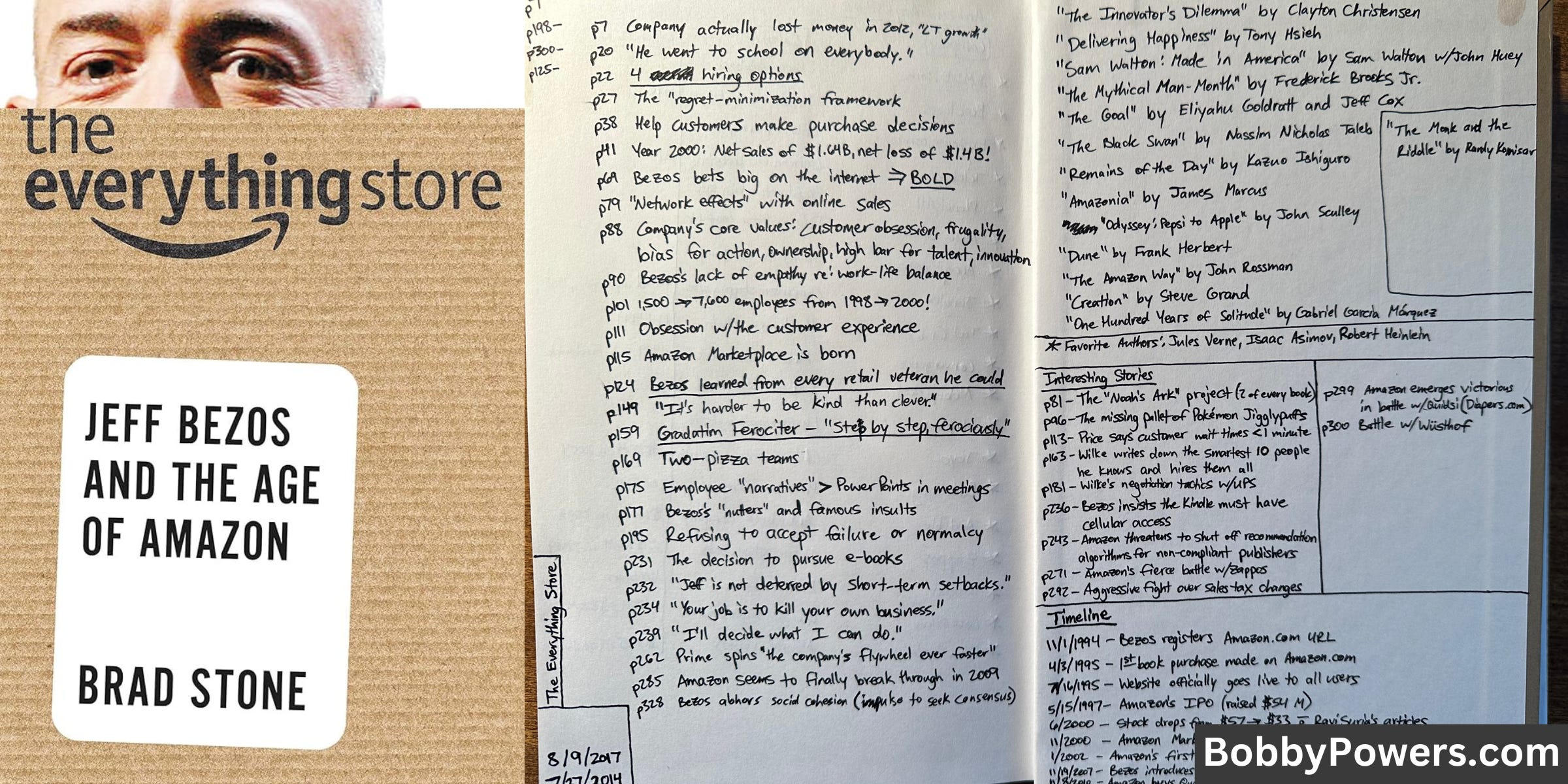
“You have to start somewhere. You climb the top of the first tiny hill and from there you see the next hill.” -Jeff Bezos
Amazon is arguably the most interesting company in the world. In The Everything Store, journalist Brad Stone pulls back the curtain on the company, warts and all. He explains what makes the company successful while also sharing some surprising stories about Bezos and the company’s cutthroat culture.
You’ll learn how Bezos came to create the online retailer and what principles he instilled into Amazon to make it the behemoth it is today.
Key Takeaways
Secure a toehold in a narrow field (like books, in Amazon’s case), then expand from there.
The best way to dominate a field is to become absolutely obsessed with your customer. Find out what they want and build the business around them. If you relentlessly focus on the customer, profits eventually follow.
Rigorously evaluate every prospective employee to join your company. Businesses live or die on their talent.
Bake your core values into everything you do. For example, Amazon’s 16 leadership principles drive every decision at the company.
I loved these biographies and memoirs. If you want to learn more about managing a team, I’m sure you’ll love them too. Drop me a comment below if you have any other business biography recs I should check out next!
And if you enjoyed this guest post, I’d be honored for you to subscribe to my publication, Leader & Learner. Every Tuesday and Thursday, you’ll receive a post that will teach you about leadership, communication, and personal development.
*Note: Each book above includes an affiliate link from Bookshop.org. If you purchase one, you’ll support me and local bookstores at no extra cost to you. Win-win!