

In this issue:
Part 1: Understanding The Three Horizons Model
What is the Three Horizons Model?
How the Three Horizons Model Works
Test Your Understanding
Practice This Framework
Part 2: Applying The Three Horizons Model
Download the Worksheet
Apply to your Situation
The 5-Step Guide
Real-life Leadership Scenarios
Part 3: Going from here
Common Mistakes You Should Avoid
Complementary Frameworks and Other Resources
Final Thoughts
✨
It was one of those phases in my leadership career when everything seemed urgent.
I was leading a high-stakes project at Adobe, where my team was tasked with delivering a mobile version of Adobe Reader for iOS and Android—something that had never been done before.
The pressure was immense. Smartphones were still new at the time, with very low memory and screen space, yet the ‘vocal’ customers expected flawless performance from our apps.
Yeah, no surprises there.
As I was under pressure to deliver immediate results, I couldn’t stop thinking about the long-term vision. Several questions started popping up in my head:

Where were we headed?
What will be the future of the smartphone market?
Is this a bandwagon worth jumping on?
What if smartphones were a flop?
The more fundamental question that kept bugging me was:
How can we ensure this isn’t just a one-off success but the foundation of where these platforms were headed?
I felt like I was being pulled in two directions. On one side were immediate milestones: shipping a product that met user demands and supported the company’s reputation. On the other side were transformative ideas—features and innovations that could redefine mobile document workflows but required significant investment and time.
That’s when I stumbled upon McKinsey’s Three Horizons Model. This framework was exactly what I needed and helped me see that the tension between short-term results and long-term goals didn’t have to be a zero-sum game.
By thinking in horizons, I learned how to keep the present on track while creating space for future innovation.
We had poured so much effort into short-term wins that we had no clear plan for long-term growth. And it wasn’t just our team—this tug-of-war between short-term and long-term priorities is a battle most managers fight daily.
Sound familiar? If you’ve ever felt a tension between delivering results today and preparing for tomorrow, the Three Horizons Model could be your solution. In this article, I discuss strategies you can use to master and start applying this model.
Part 1: Understanding The Three Horizons Model
What is the Three Horizons Model?
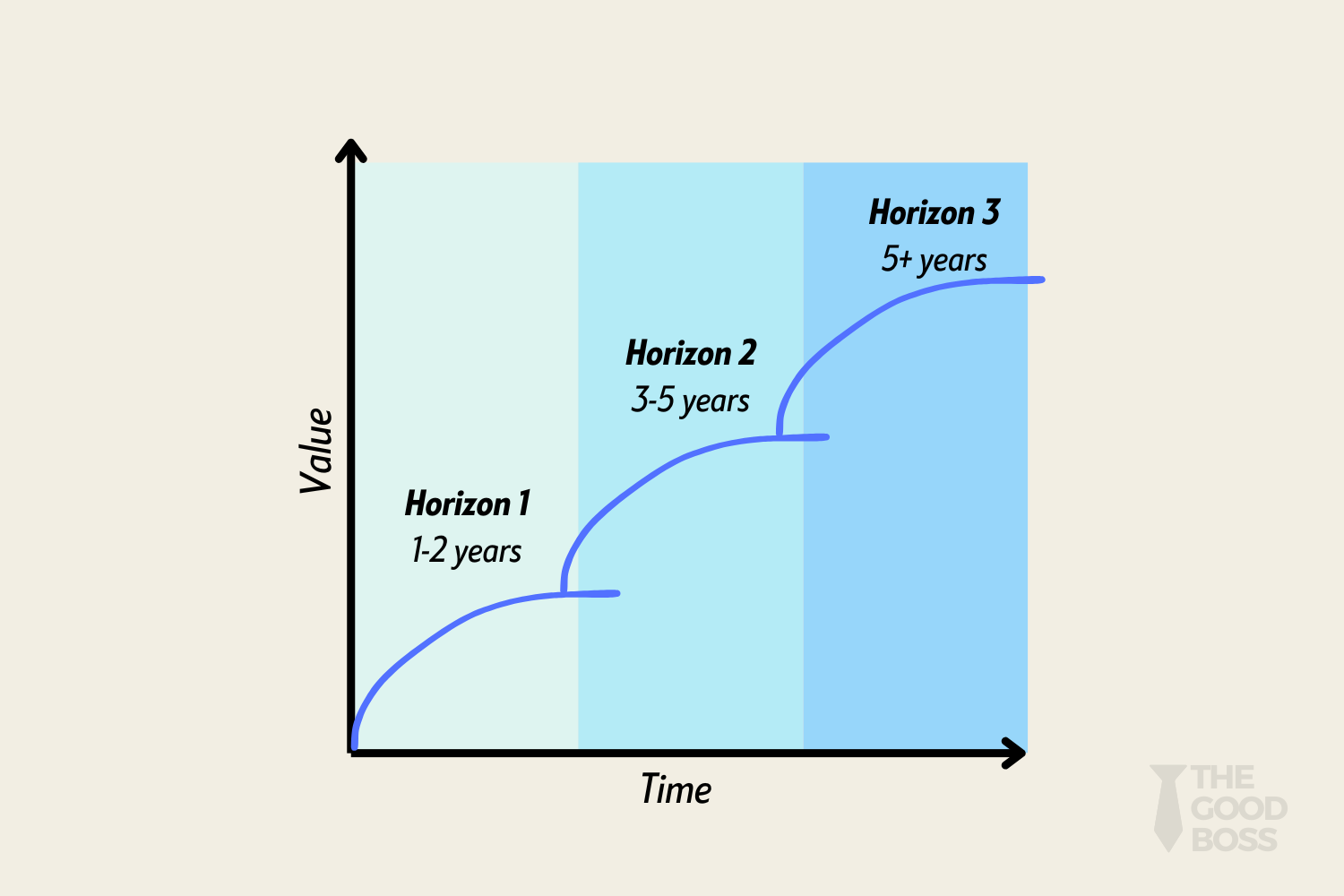
The Three Horizons Model is a strategic framework that helps leaders balance immediate priorities with future opportunities. Developed by McKinsey, it divides organizational focus into three “horizons” of time and activity:
Horizon 1 (H1): 1-2 years. Defend and expand current core business activities that drive revenue and keep the lights on.
Horizon 2 (H2): 3-5 years. Looks at emerging opportunities—new markets, products, or innovations that could grow the business in the mid-term.
Horizon 3 (H3): 5+ years. Seed future businesses —transformative ideas that could reshape your industry or create entirely new markets.
At its core, this model forces you to ask: Are we only thinking about today, or are we investing in tomorrow as well?
How the Three Horizons Model Works
To implement the model, you need to understand the balance each horizon requires:
Horizon 1:
Activities: Incremental improvements, cost-cutting, and operational efficiency.
Mindset: Deliver immediate results and defend the core business.
Example: Enhancing a software feature to retain current customers.
Horizon 2:
Activities: Scaling proven ideas, testing new products, or entering adjacent markets.
Mindset: Build the bridge to the future without losing sight of the present.
Example: Expanding into a new geographic region with existing services.
Horizon 3:
Activities: R&D, exploring disruptive technologies, or conceptualizing future business models.
Mindset: Think big and prepare for uncertainty.
Example: Developing AI-driven solutions that could revolutionize customer interactions.
Test Your Understanding
Before you move on, take a couple of minutes to check your understanding with a quick quiz.
Are you up for it? Let’s do this!

(If you’re new to Kyoshi: It’s the systems-first leadership coach, built on the same Leadership OS I’ve been writing about in this newsletter for years. Go ahead and sign up for free and try out the quiz now.)
Practice This Framework
Just like you build your physical muscles in the gym, you build your leadership muscle by practice.
🎯 Practice a drill
Got five minutes? Drills are short, focused reps. Kyoshi gives you a situation, and you rework it so it informs, inspires, and influences.
Go ahead and start the drill now!

Part 2: Applying The Three Horizons Model
Now, practice makes you better, but you only really grow when you use a framework on your own problems.
Role plays and drills are useful, but they’re not your situation.
Your situation has its own people, its own history, and, frankly, its own politics.
So here are two ways in which you can actually apply this framework in your own leadership role today.
📝 Download the worksheet
If you like step-by-step prompts, download and use the Three Horizons worksheet and apply it in your own team or work situation.
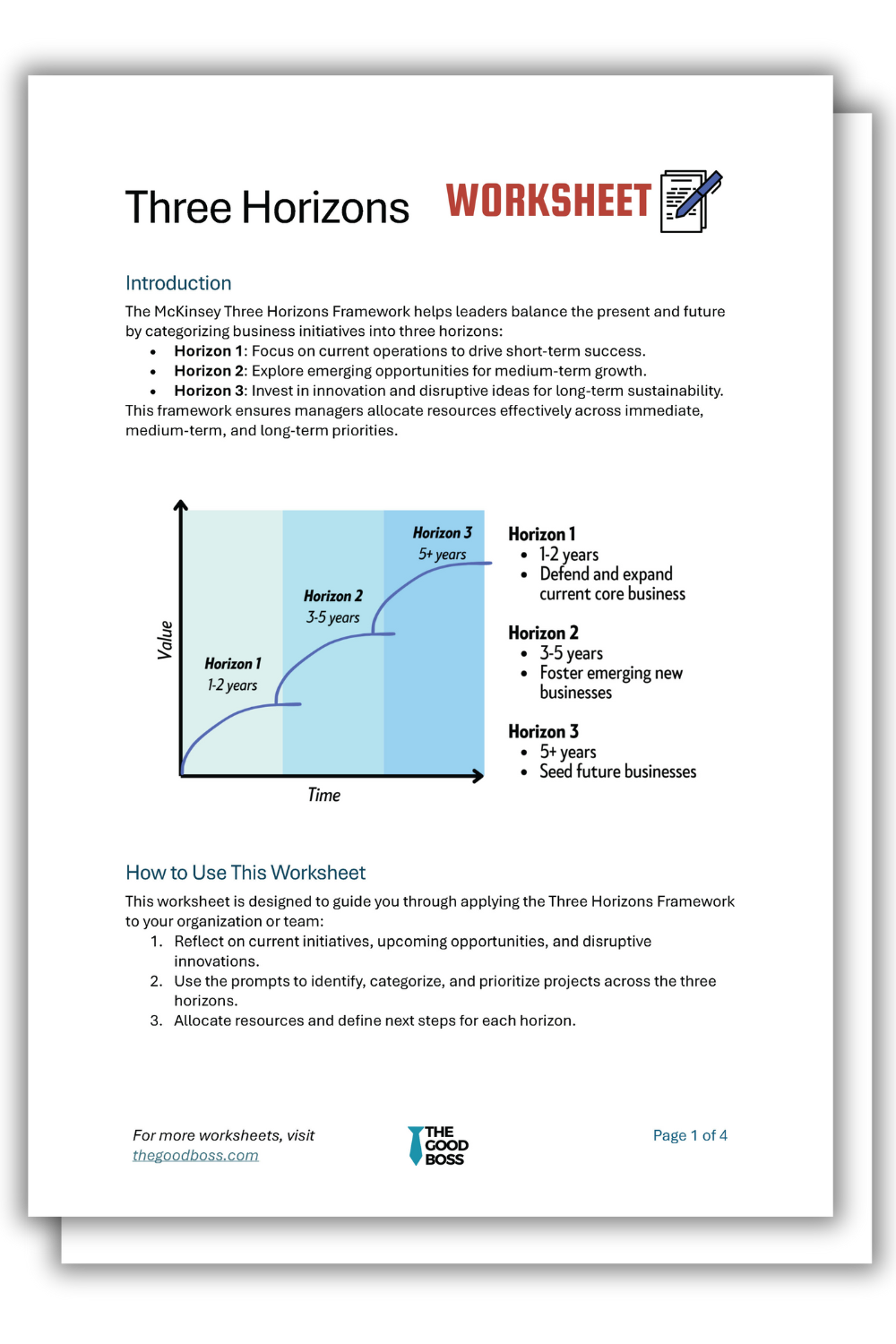
This worksheet is part of the Worksheets Collection, available to all paid subscribers to The Good Boss.
👉🏻 Upgrade to paid now and get instant access to the entire collection, including this worksheet.
If you prefer the standalone worksheet, you can purchase it from here.
🧭 Apply to your Situation
If you’re looking for a trusted partner to help you create and manage a situation, and actively coach you as you solve it for real, then Kyoshi can help you with all that.
Pick one real situation coming up in the next week or two. Then work with Kyoshi to apply this framework in that situation.

The 5-Step Guide
Here’s a step-by-step guide to using the model in your work: