

In this issue:
Why You Don’t Always Act the Way You Intend To
🧠 The Three Brains Framework
How It Actually Works (The Hidden Problem)
Applying The Three Brains Framework in Leadership
The Pause–Align–Choose Method
Real-life Leadership Scenarios
Common Pitfalls
Final Thoughts
Why You Don’t Always Act the Way You Intend To
I remember a moment in a meeting a few years ago. A team member pushed back on a decision I had made. It wasn’t what he said, it was how he said it. Something about the tone didn’t sit right with me. Honestly, I felt offended inside.
I reacted almost instantly - I cut him off, defended my position, and moved the discussion forward. While the meeting continued, I could sense that the energy in the room had shifted - everyone went quiet, and there were no more questions or pushbacks.
At the time, it felt like I had handled it, but later that day, I kept replaying the moment in my head. The more I thought about it, the more uncomfortable it felt. I knew that he wasn’t wrong, and he had a valid point. I also knew deep in my heart that I hadn’t responded to the idea, I had reacted to how it made me feel.
And that’s when it hit me.
In that moment, I wasn’t leading - I was reacting.
If I’m honest, you’ve probably had moments like this too. It may have been a comment in a meeting, a missed deadline, or a message that felt slightly off. And before you know it, you’ve reacted in a way you didn’t intend. Or you overthink, delay your response, and say nothing at all. And later, you ask yourself, “Why did I do that?”
That’s the part most people don’t talk about. In this issue, I’ll unpack the Three Brains Framework, which explains what’s really happening in your mind when you react, overthink, or freeze.
Ready? Let’s dive in!
🧠 The Three Brains Framework
If I were to tell you that you have not one, not two, but three brains, you’d probably think I’m joking, right?
Well, I’m not. Let me explain.
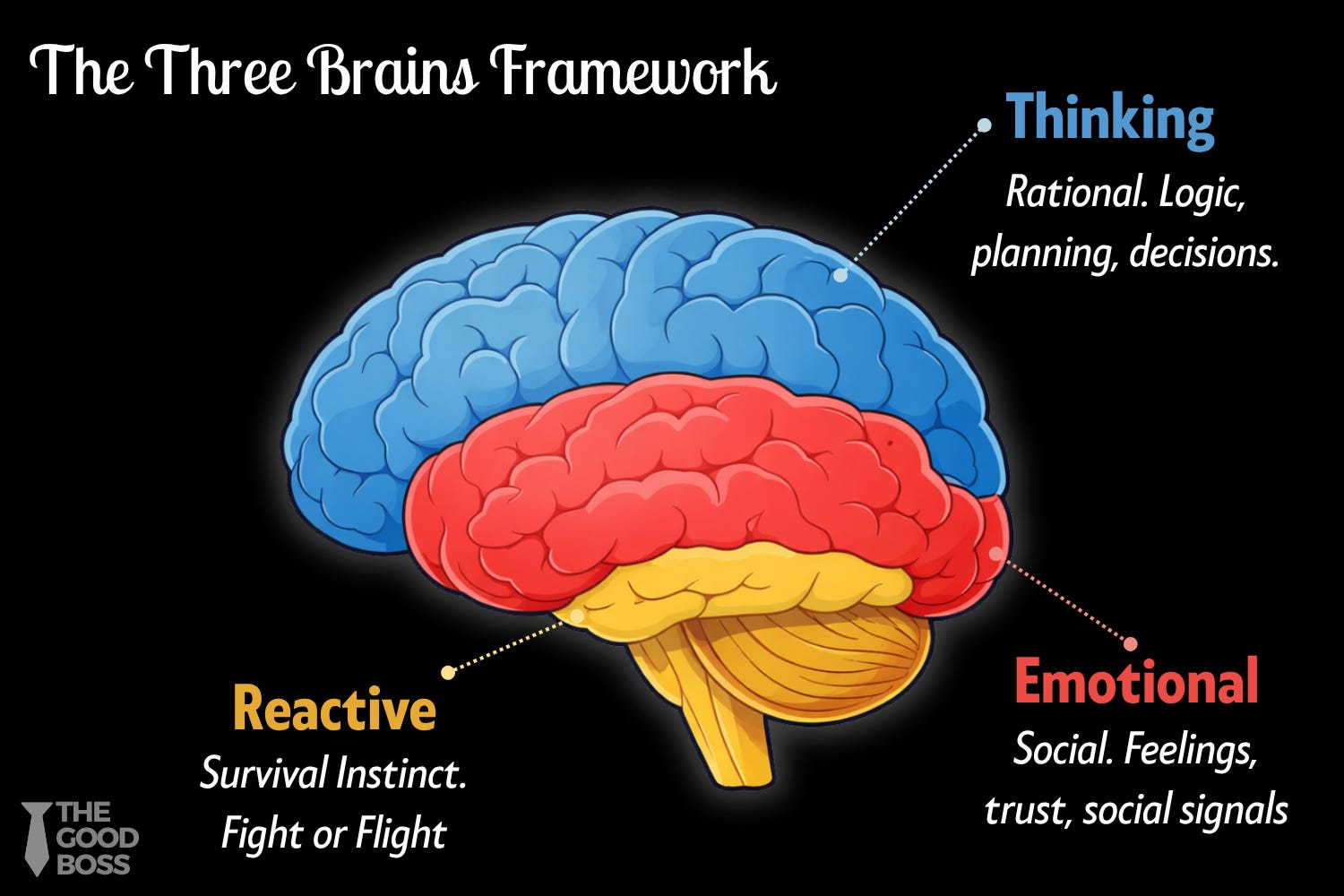
At any moment, one of three systems in your brain is driving how you think, feel, and act. In fact, most of the time, you’re not even aware of which one is in control.
Let’s look at each system.
⚡ The Reactive Brain (Survival Mode)
This is your fastest system, and it’s built to protect you.
It scans for threats - both physical and social. A threat could look like a challenge in a meeting, a missed deadline, or even a tone that feels off (remember the story I shared at the beginning?) It treats all of these as signals that something is ‘wrong’.
When this brain takes over, you don’t pause. You react.
In a leadership setting, the ‘reaction’ shows up quickly.
You interrupt someone mid-sentence.
You shut down ideas that feel risky.
You push back harder than needed.
Sometimes you go silent, not because you’re thinking, but because you’ve disengaged.
It feels decisive in the moment, but what it’s really doing is protecting you, not helping you lead.
❤️ The Emotional Brain (Social Mode)
This is your ‘relationship’ system.
This system reads people. It’s great at picking up tone, body language, and intent. It’s also where trust, fear, and belonging live. And importantly, this brain is critical for leadership, because leadership is human.
But there’s a catch: this brain also has a bias.
It doesn’t just read situations, it interprets them. In your world as a leader, this shows up in subtle ways:
You start favoring people you feel comfortable with.
You avoid giving tough feedback because it feels uncomfortable.
You take things personally, even when they’re not meant that way.
You might delay a decision because it “doesn’t feel right,” even when the logic is clear.
This brain helps you connect with people, which is necessary, but when it dominates your thinking, it can cloud your judgment.
🧠 The Thinking Brain (Rational Mode)
This is your rational brain.
It looks at data, weighs trade-offs, and focuses on outcomes, not reactions or feelings. It helps you to make rational, data-driven leadership decisions.
When this brain is in charge:
You ask better questions.
You listen fully before responding.
You separate the idea from the person.
You focus on what needs to be done, not how the moment feels.
In practice, this is when you handle a tough conversation calmly. You make a decision that’s right for the team, even if it’s uncomfortable.
How It Actually Works (The Hidden Problem)
Now, in reality, you don’t switch between these three brains consciously. They switch for you.
And the problem is: in most situations, they don’t collaborate. They compete with each other, and the one that takes “wins” isn’t always the one you want.
Your reactive brain is built for speed. It doesn’t wait for the context, and it doesn’t check for accuracy. It sees a threat and acts. That’s how it’s wired from the times when we (humans) were hunter-gatherers, and it was useful then when we were in ‘real’ danger facing hunger or a threat in the wild. But it’s less useful when someone disagrees with you in a meeting.
Your emotional brain is slightly slower, but still quick to interpret. It fills in the gaps, assigns meaning and interpretations. It decides how something feels before you’ve fully understood what’s actually happening.
Your thinking brain is slower, and is built for rational judgment. It needs time and space to weigh the options, and consider the outcomes. But by the time it fully engages, the other two have often already acted.
And that is the “hidden problem”.
When you are in high-pressure moments, because of the way it’s wired, the control shifts away from your thinking brain to the other two.
This is why the same patterns show up again and again.
You react before you think.
You take things personally.
You overanalyze simple decisions.
You avoid conversations you know you should have.
Applying The Three Brains Framework in Leadership
For the rest of this article, we will focus our attention on putting the Three Brains Framework into practice in your own organization. As we do that, don’t forget to download the Three Brains Framework Worksheet.
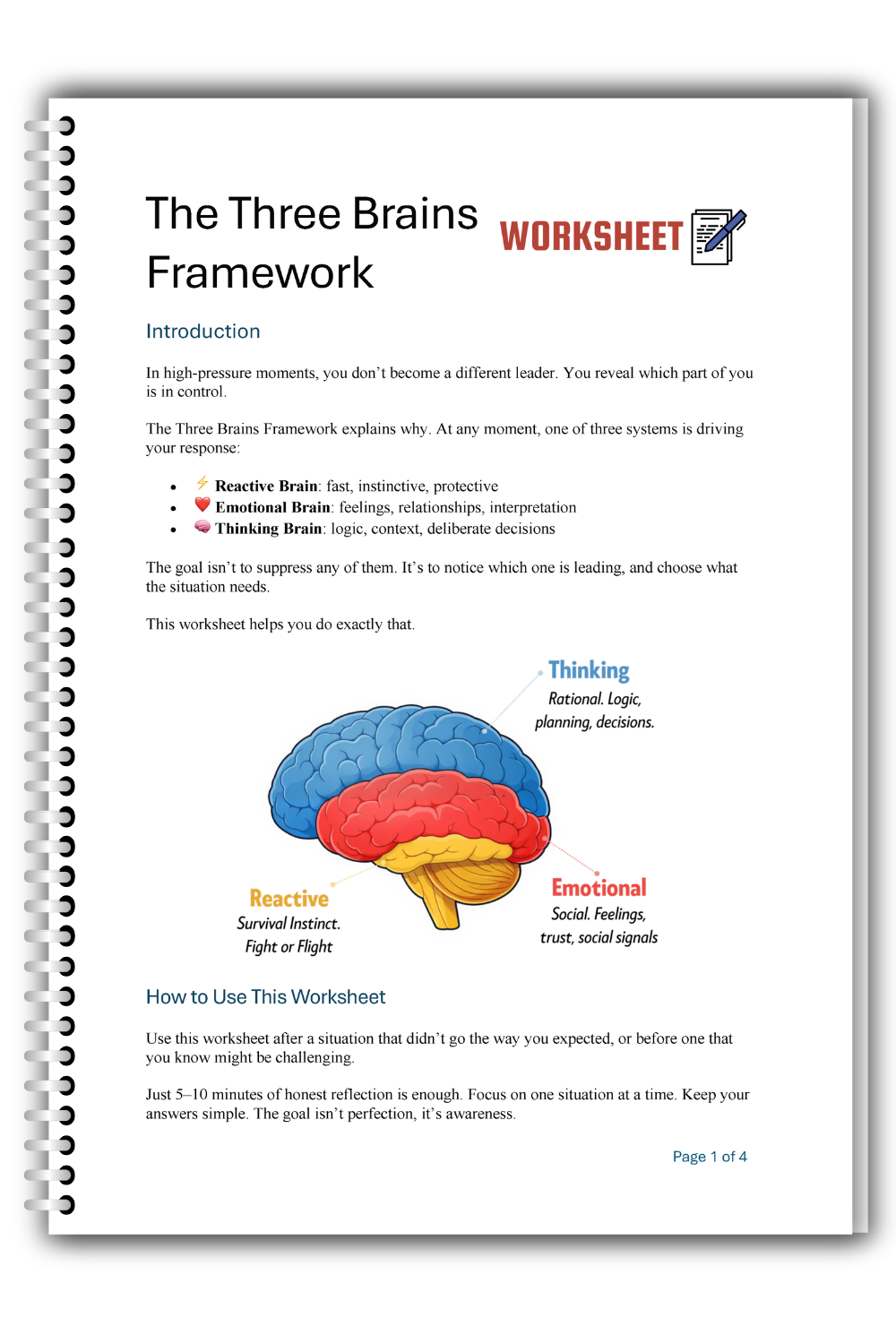
Use this worksheet to:
Figure out which part of you was in control in a moment that didn’t go well
Untangle instinct, emotion, and logic before choosing how to respond
Spot your own patterns so you can lead with intention next time
How to download the worksheet
This worksheet is part of the Worksheets Collection, available to all paid subscribers to The Good Boss.
👉🏻 Upgrade to paid now and get instant access to the entire collection, including this worksheet.
If you prefer the standalone worksheet, you can purchase it from here.
The Pause–Align–Choose Method
When you are in a leadership situation, your goal is to engage all three of your brains, and then choose which one should lead.