

In this issue:
The Confusion at the Heart of the Anxiety
Why Scarcity Makes You More Valuable, Not Less
What Becomes More Important, Not Less
The Leaders Who Should Actually Be Worried
What This Means for You
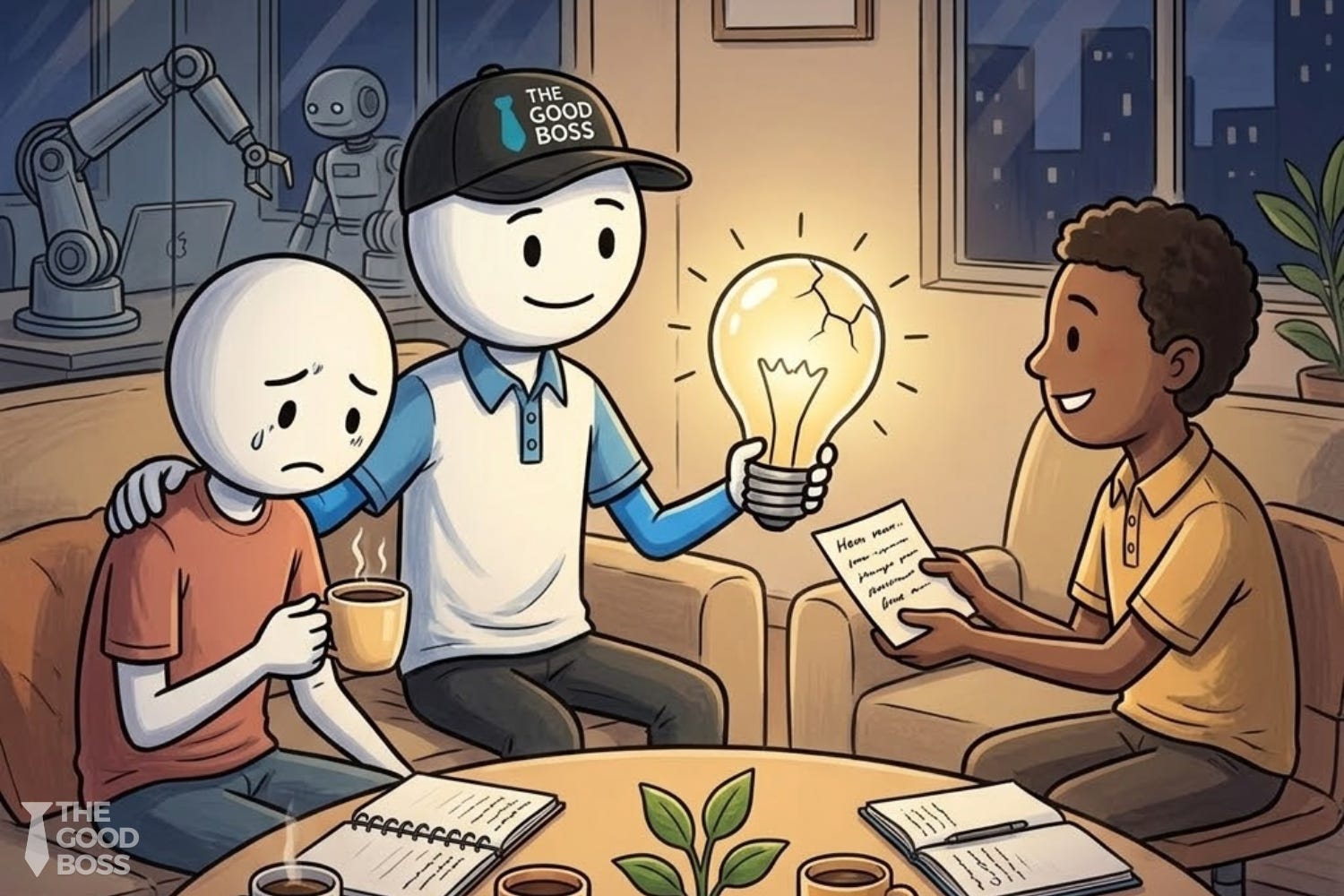
There’s a story going around, and you’ve probably heard it, and even told yourself a version of it.
Let’s face it: AI is getting smarter every day. AI tools are now writing the reports, summarizing the meetings, and even making recommendations to help you make decisions.
Slowly, the things that used to make a leader valuable are getting automated.
So the story goes like this: leadership is shrinking. The space for humans at the top is getting smaller.
And the question that naturally follows from there is: Eventually, what’s left for a leader to actually do?
I want to push back on this, because I think the story is exactly backward.
The best leaders aren’t going to matter less in the AI era. They’re going to matter more than they ever have.
And the leaders who are anxious about this moment are usually the ones who were never really leading in the first place: they were managing, and calling it leadership.
Let me explain why.
The Confusion at the Heart of the Anxiety
Most of the fear about AI and leadership comes from a single confusion: mistaking management for leadership.
Let’s me clear that up:
Management is the visible work. Think status updates, resource allocation, performance tracking, reporting, etc. It’s necessary and valuable, and, let’s be honest, a huge amount of it can now be done faster and better with the help of AI tools.
Leadership is completely different. It’s the less visible work, such as building trust, making a hard call when the data is incomplete, and sitting with a team member in their worst week and making them feel like they still matter.
As you can imagine, AI is coming for management. But so far, it’s nowhere close to leadership. And it likely won’t be for a long time.
This is good news, not bad news, but only if you’ve actually been leading, not just managing.
Why Scarcity Makes You More Valuable, Not Less
Here’s a simple economic truth: value follows scarcity.
For the last few decades, “good management” has been relatively abundant. Most competent professionals, with enough training, could learn to run a status meeting, build a project plan, or analyze a dataset.
As AI absorbs more of that work, those skills become less differentiating, because they stopped being rare.
They still matter, but they’re more abundant and cheap.
Meanwhile, the deeply human skills: emotional intelligence, judgment under uncertainty, the ability to build trust, the courage to have a hard conversation, were always rare. They were just masked by how much time and attention management work was consuming.
Strip away the management noise, and what’s left is the real leadership signal. And in a world flooded with AI-generated output, the leader who can offer genuine human judgment, presence, and trust becomes not just valuable, but essential.
Scarcity is rising. Which means your value, if you’re a real leader, is rising with it.
What Becomes More Important, Not Less
So what skills are more important now with AI taking over more of the management layer?
Judgment. AI can give you ten well-reasoned options, but it can’t tell you which one is right for your specific team, your specific culture, and your specific moment in time. That call of weighing the human factors, the context, becomes more valuable precisely because there’s more information and less clarity.
Trust. As more of the processes become automated and abstracted behind AI-powered dashboards, the leaders who can build genuine human trust become more valuable to the organization. Trust is now becoming one of the scarcest currencies in the workplace.
Genuine connection. The more interactions get automated and run by AI-powered bots, the more people crave the real conversations. Imagine trying to solve a high-stakes issue over coffee with a colleague vs staring at the screen while chatting with a small chat window.
Check out my other post where I discuss these skills in a more detail:

The Leaders Who Should Actually Be Worried
All that being said, I won’t pretend everyone is safe. Some leaders should genuinely be worried.
These are leaders whose entire value proposition was built on the management layer.
The ones who were really good at running the process, but never built real relationships.
The ones who could produce the report, but never built the trust.
The ones who confused being busy with being valuable.
So, in a nutshell: AI isn’t replacing leadership. It’s exposing who was actually doing it in the first place.
I know that’s an uncomfortable truth, but I also think it’s an opportunity.
If you’ve been investing in the deeply human side of leadership all along, even when it felt less “productive”… congratulations! You’re about to be in the most valuable position you’ve ever been in.
What This Means for You
If you’re feeling anxious about AI and your role as a leader, here’s the reframe.
Don’t ask: “What can AI now do that I used to do?”
Ask instead: “Now that AI can handle the management layer, what does that free me up to actually focus on?”
Leadership was always the real job. Now, AI is just making it impossible to hide behind anything else.
💬 Do you find this reframe energizing or anxiety-inducing? Let me know in the comments.
If you found this useful, you might also enjoy:

❤️ Found this helpful?
If you found this post helpful, please like and share it with other managers who can benefit from it, including your boss :) If you have any feedback, please drop your comment below - it helps me keep improving the content. Thank you!

"AI isn't replacing leadership. It's exposing who was actually doing it in the first place." That line is going to live in my head for a while. I've been writing about the creative version of this exact argument, that AI exposes who actually has taste and judgment, not just the ability to generate output. Different domain, same uncomfortable truth. If that resonates, I write about it every three weeks at Control the Loop.