In this issue:
The Manager Who Changed Everything (By Doing Nothing New)
What the Hawthorne Effect Really Is
How Observation Changes Behavior (The Three Layers)
Why This Matters for Leaders
The One Shift: From Watching to Trusting
Common Pitfalls (and How to Avoid Them)
Final Thoughts
The Manager Who Changed Everything (By Doing Nothing New)
A while back, I inherited a team that had a reputation for being disengaged.
The deliverables were late, and there were issues with the quality of the features being released. The previous manager had tried adding more structure, like more check-ins, more reporting, more visibility into who was doing what. But apparently, none of that helped.
When I took over, I was sceptical, and nervous at the same time. I didn’t know what I was getting into, so I decided to do something simple:
I started showing up.
I didn’t overhaul the process, but simply started being there, whether in meetings, working sessions, etc. My intent wasn’t to inspect or interrogate, but to ask questions, and just be present in the day-to-day.
Within a few weeks, I observed a change: the work quality picked up, and so did the energy in the team meetings. And I found myself wondering: was this me, or was something else going on?
The honest answer was: it wasn’t really me.
What changed was that the team knew someone was paying attention. And that alone, the simple fact of being observed, changed how they showed up.
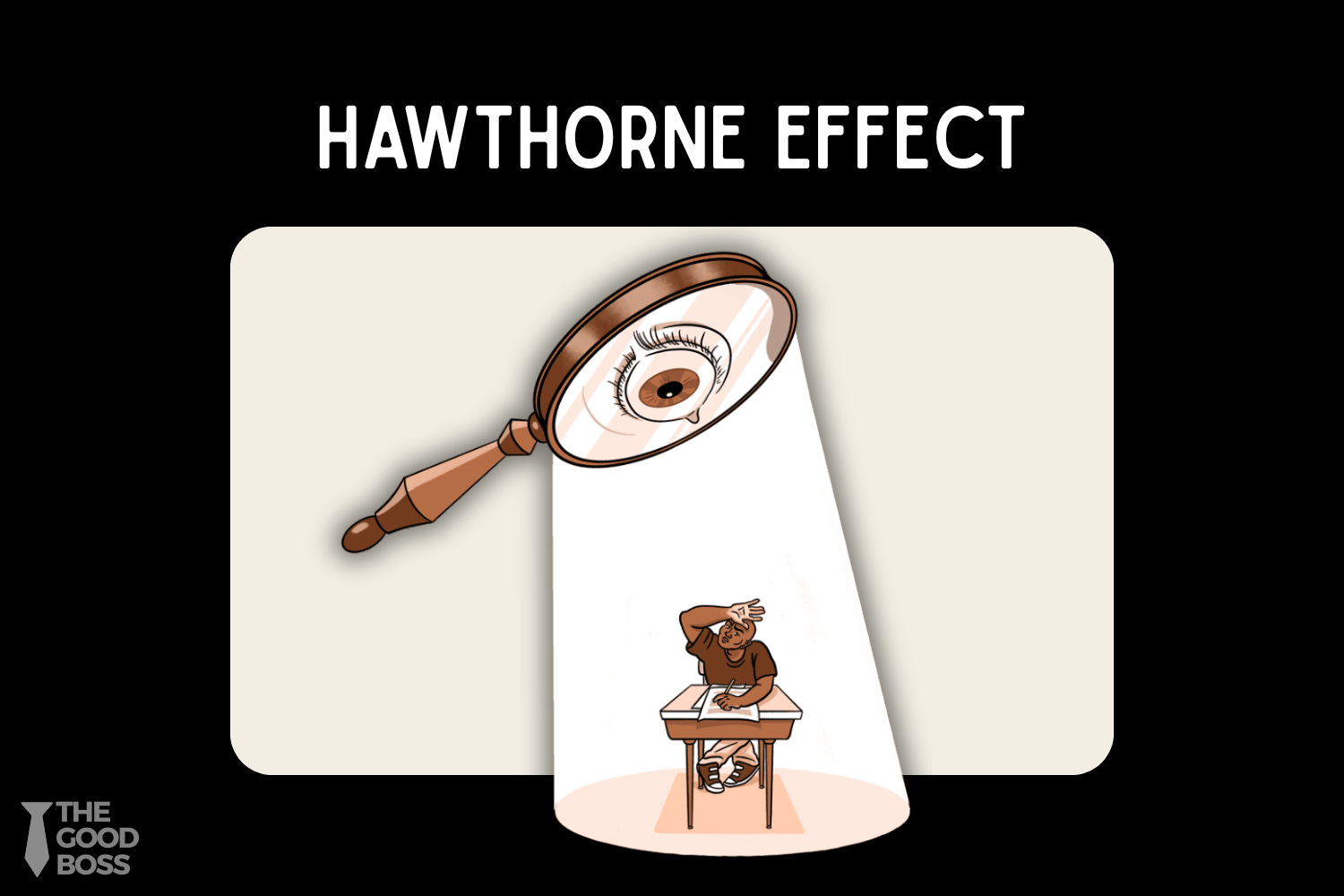
This is called the Hawthorne Effect.

What the Hawthorne Effect Really Is
The Hawthorne Effect traces back to a series of experiments conducted in the 1920s and 1930s at the Hawthorne Works, a Western Electric factory near Chicago.
Researchers set out to study whether changes in physical working conditions, such as lighting levels, break schedules, working hours, etc. affected worker productivity.
What they found surprised them.
Productivity improved almost regardless of what change they made. Whether you changed the lighting to brighter or dimmer, or changed the breaks to longer or shorter, the output still went up. The results were consistently positive, no matter the direction of the change.
The conclusion researchers eventually drew was striking: it wasn’t the changes themselves that were driving the improvement. It was the fact that workers knew they were being observed. The “attention” itself was the variable that mattered.
The Hawthorne Effect, in its simplest form, is this: people change their behavior when they know they are being watched.
I do want to note that subsequent researchers have debated the original findings and their interpretation, and the data from those studies was messier than the clean narrative suggests.
But the core behavioral insight has helped up over the decades of organizational research and real-world leadership experience: attention shapes behavior. And once you understand that, you start seeing it everywhere.
How Observation Changes Behavior (The Three Layers)
The Hawthorne Effect isn’t a single thing. It shows up in three distinct ways in a leadership context, and each one has different implications.