

In this issue:
When Confidence Lies
The Dunning–Kruger Effect
The Confidence vs Competence Curve
Using the Dunning–Kruger Effect in Your Team
A Simple Rule That Will Change How You Lead
Common Pitfalls (and How to Avoid Them)
Final Thoughts

When Confidence Lies
A few years ago, I remember almost promoting the wrong person on my team.
Nila, a software engineer, was confident, decisive, and seemed like a natural leader. She was always ready with an answer, a convincing one, too.
But there was just one problem: She wasn’t very good at her core job, which was to write code. She was slow to design and implement features, and the quality of her work wasn’t the best either.
At the same time, one of my strongest software engineers - Sam - who was a coding superstar, was sitting quietly in the same team. Sam was thoughtful and skilled, but less confident than Nila. He would often second-guess himself.
During the annual calibration cycle, I was about to reward the wrong signal… confidence - until I (thankfully) realized the harsh truth in leadership:
Confidence is easy to see. Competence is not.
The Dunning–Kruger Effect
What I experienced in that moment wasn’t random.
There’s a pattern behind it. And once you see it, you’ll start noticing it everywhere in your team.
It’s called the Dunning–Kruger effect.
This idea came from research by psychologists David Dunning and Justin Kruger. They found something simple, but uncomfortable.
People with low ability tend to overestimate themselves.
People with high ability tend to underestimate themselves.
And this isn’t because of ego, but awareness.
If you don’t know what “good” looks like, you assume you’re already there.
If you do know what “great” looks like, you see how far you still are.
This creates a gap - the gap between confidence and competence.
The Confidence vs Competence Curve
You can think of this as a curve.
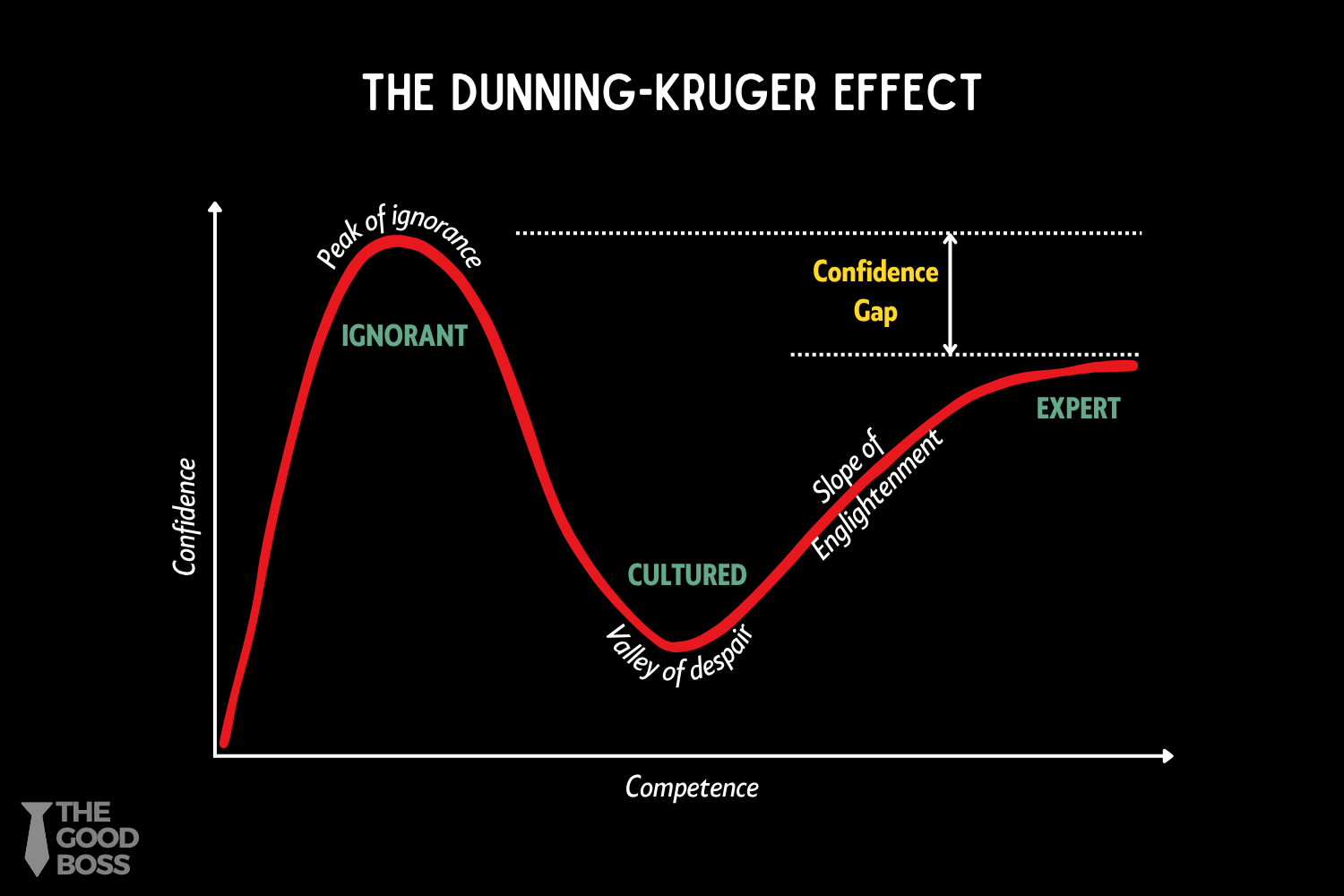
At the start, you don’t know what you don’t know, so your confidence rises fast. You learn a little, and it feels like a lot. You reach the peak of ignorance, with very high confidence but low competence.
Then, as you keep learning, reality hits, and your confidence starts to drop. Doubt starts to creep in, and your progress also slows. At the lowest level of confidence, you enter the valley of despair.
After that, something interesting happens. The “real” learning begins, and your confidence slowly starts to build again. This time, it’s grounded in knowledge, and you ascend the slope of enlightenment. Eventually, as you continue to build competence, you reach the expert level.
Interestingly, the expert-level confidence is typically lower than the level at the initial peak, and this gap is called the Confidence Gap.
In your team today, you like have people at all points on this curve.
But here’s the catch: confidence is loud at the start, and quiet in the middle, and that’s what tricks most managers.
Using the Dunning–Kruger Effect in Your Team
For the rest of this article, we will focus our attention on putting the Dunning-Kruger Effect into practice in your own organization. As we do that, don’t forget to download the Dunning-Kruger Effect Worksheet.
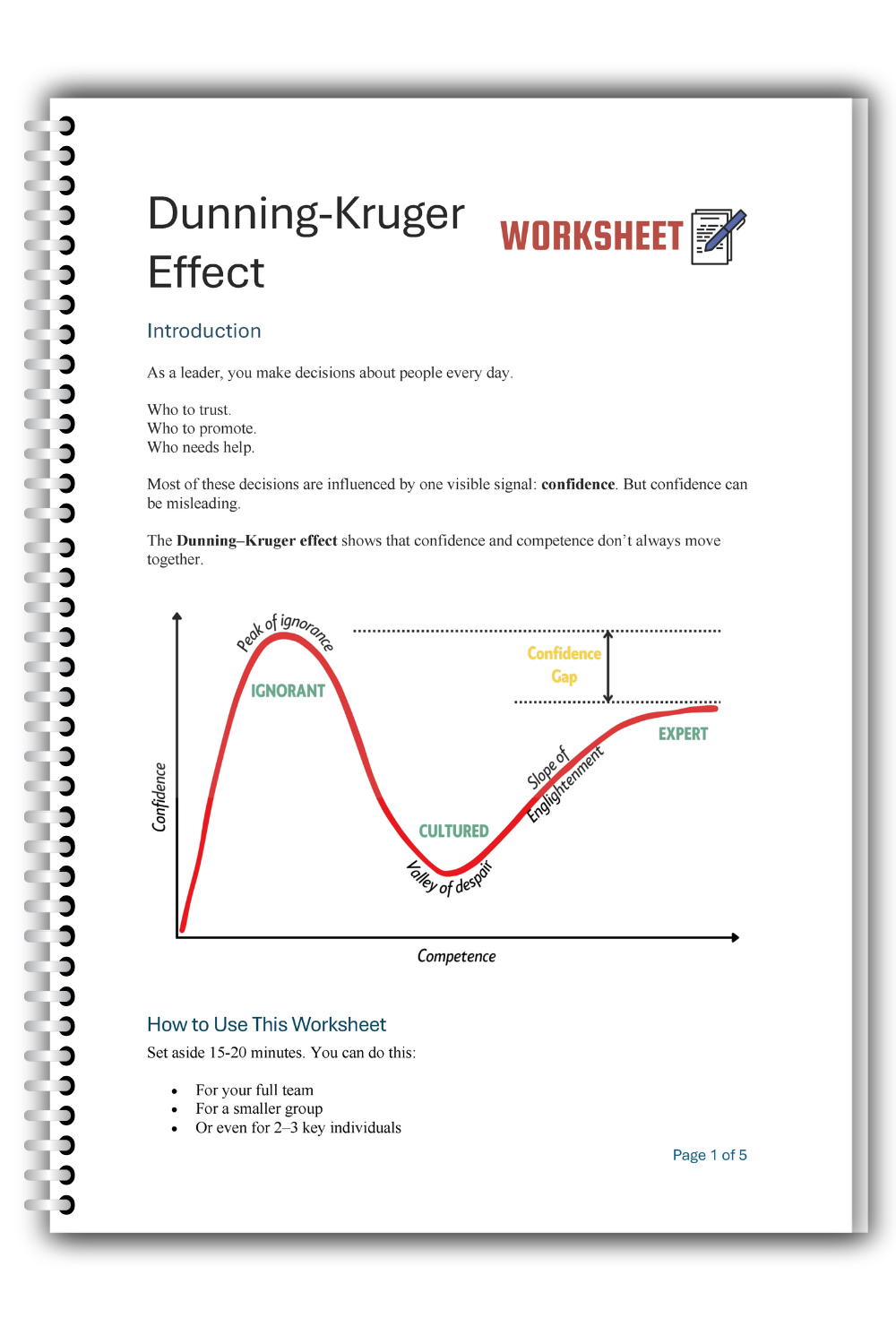
Use this worksheet to:
Stop mistaking confidence for competence when you make people decisions
Spot who needs guidance, who needs support, and who just needs patience
Build a quick, honest picture of where your team really stands
How to download the worksheet
This worksheet is part of the Worksheets Collection, available to all paid subscribers to The Good Boss.
👉🏻 Upgrade to paid now and get instant access to the entire collection, including this worksheet.
If you prefer the standalone worksheet, you can purchase it from here.