

I’ve always loved reading epic fantasy books, and in particular, the maps that come with them. I would spend hours looking at these maps, trying to soak in the regions, the terrain, and figuring out the paths that the characters follow in the book.
My all-time favorite is The Lord of the Rings, and the accompanying Map of Middle-earth.
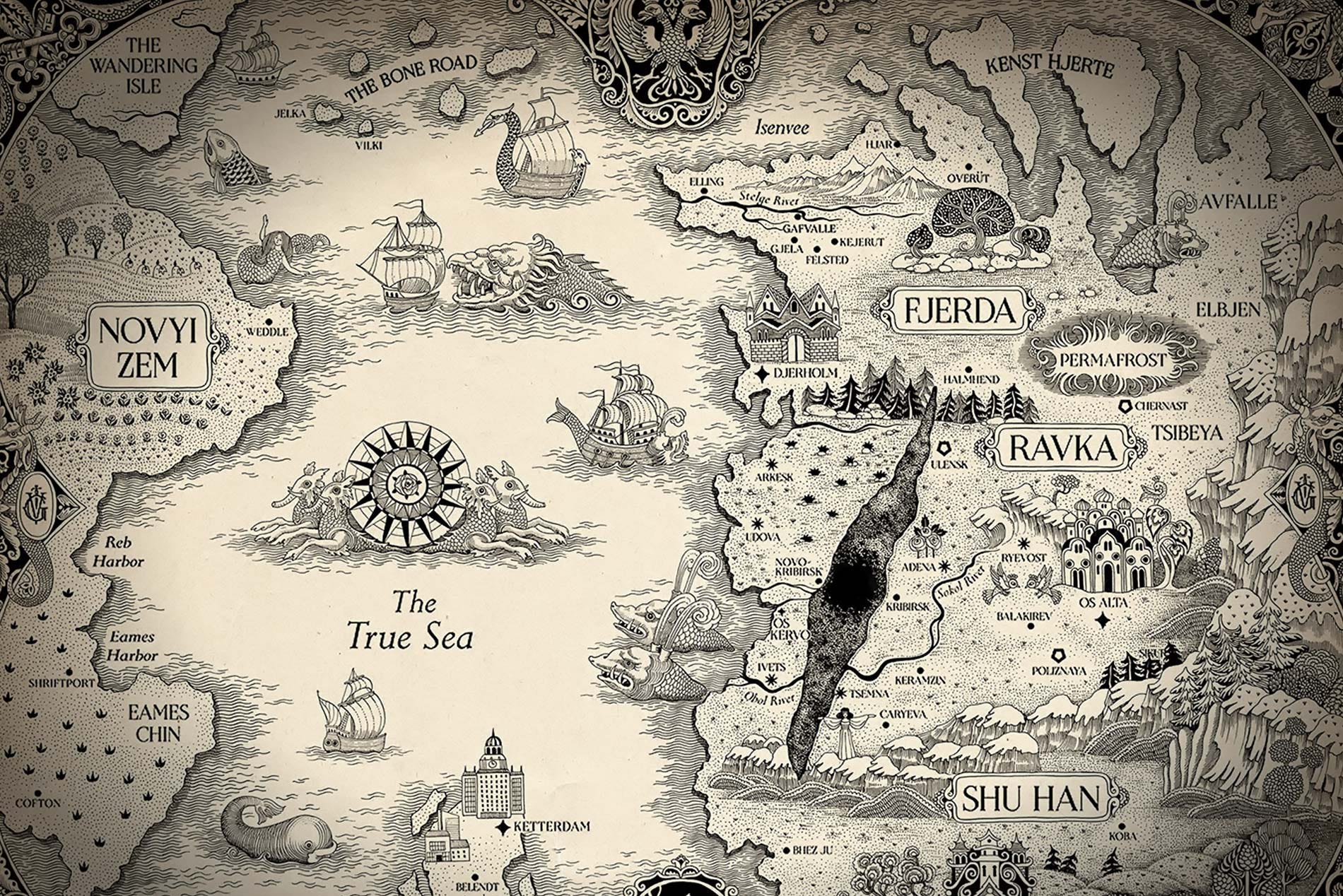
Any other fantasy fans here? Drop your love in the comments! :)
Recently, I started thinking about how leadership plays out on maps, and how my own journey over the past two decades played out.
So, I decided to take that inspiration for fantasy maps, and apply it to the leader’s journey. I’ve been working on this for the past several weeks, and I’m excited to finally bring to you the Map of Leadership series!
How to Read This Map
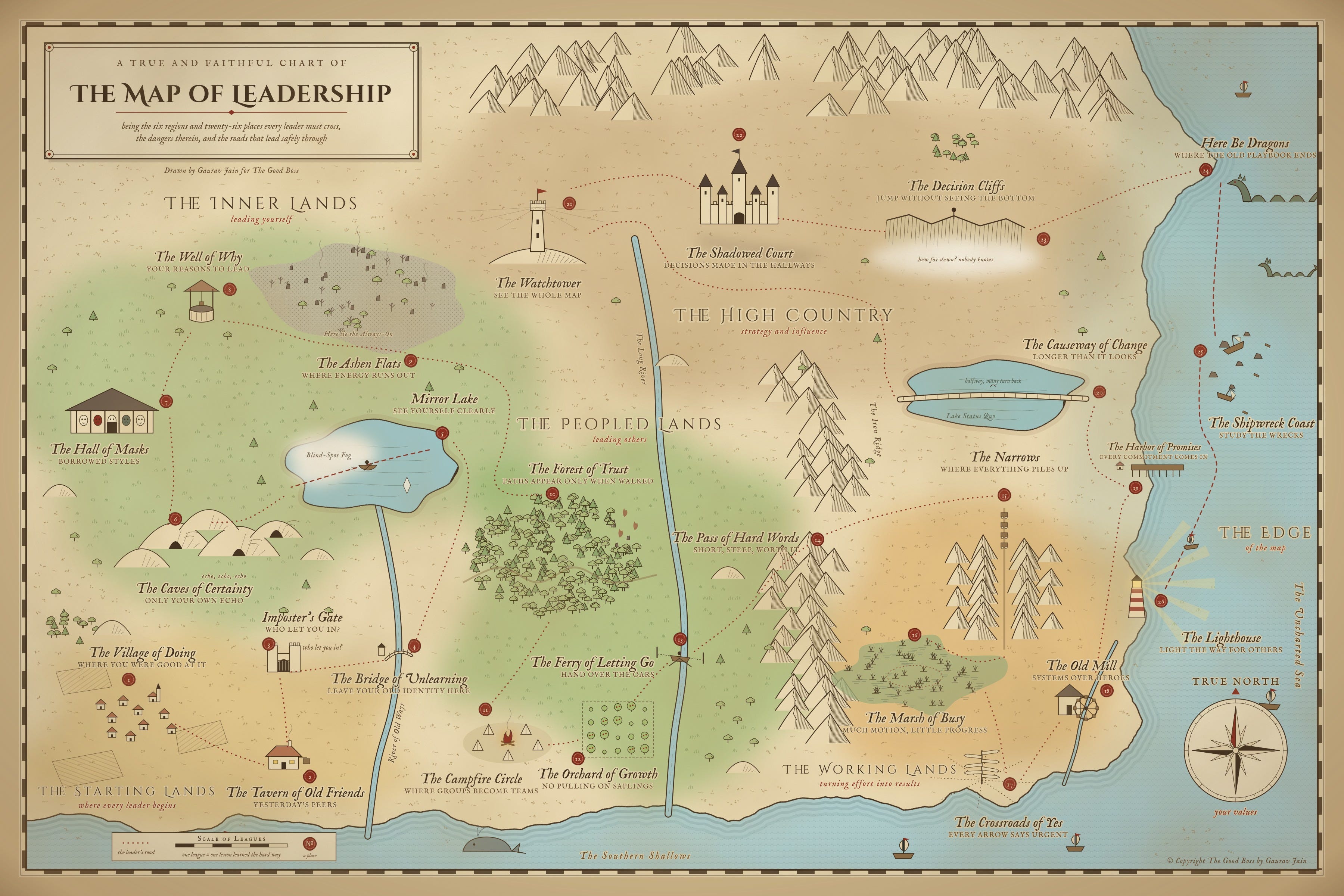
The map has six regions.
If you’ve followed my Leadership OS, four of them will feel familiar, because each one is a layer of the OS drawn as a ‘region’. The other two sit outside the OS: the place every leader comes from, and the edge where nobody has been yet.
Here’s a preview of the map:
The Map of Leadership Series
A six-part journey across the map of leadership
Part 1: The Starting Lands are about the old job, where every leader begins. (📍← we’re here)
Part 2: The Inner Lands are about leading yourself.
Part 3: The Peopled Lands are about leading others.
Part 4: The Working Lands are about turning effort into results.
Part 5: The High Country is about strategy, influence, and the view from above.
Part 6: The Edge of the Map is about uncertainty, failure, and what you leave behind.
As you navigate the map, you’ll learn what each region looks and feels like, and how you can tell if you’re standing in it right now. We will also talk about travelers’ notes to get you through that region onto your journey.
We begin our journey with the Starting Lands. This is going to be a long ride, so grab your cuppa ☕️ (and a notebook, if you like). Let’s begin!
The Starting Lands
The Starting Lands sit in the southwest corner of the map, and they aren’t part of the Leadership OS at all.
This is the region where you lived before you became a manager. This is the village where you were good at the work you did, and had a gang full of friends.
Here’s the full journey map in this region:
The Starting Lands
The journey map
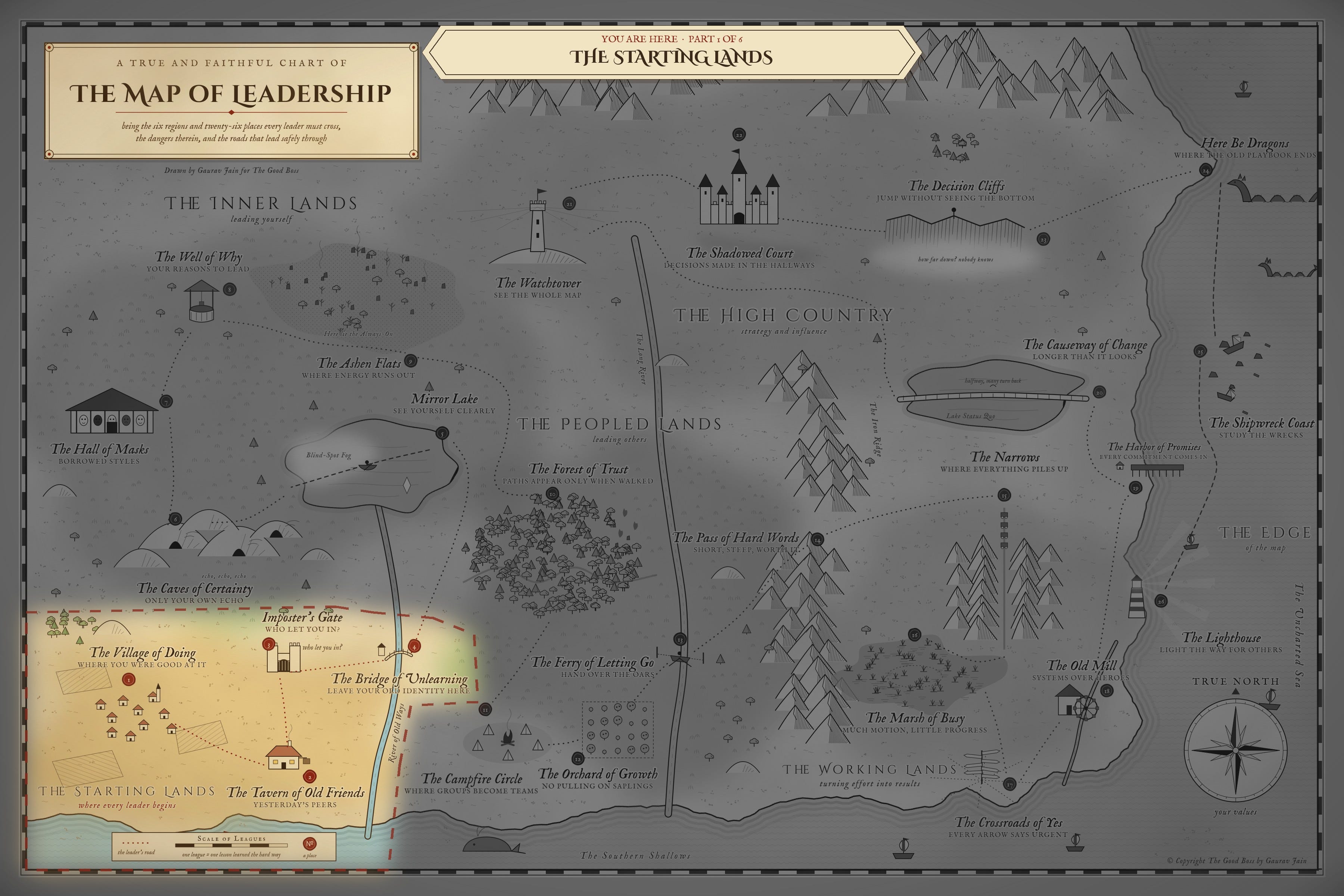
Let’s begin our journey through the Starting Lands with our first stop, the Village of Doing.
1. The Village of Doing
Where you were good at the work
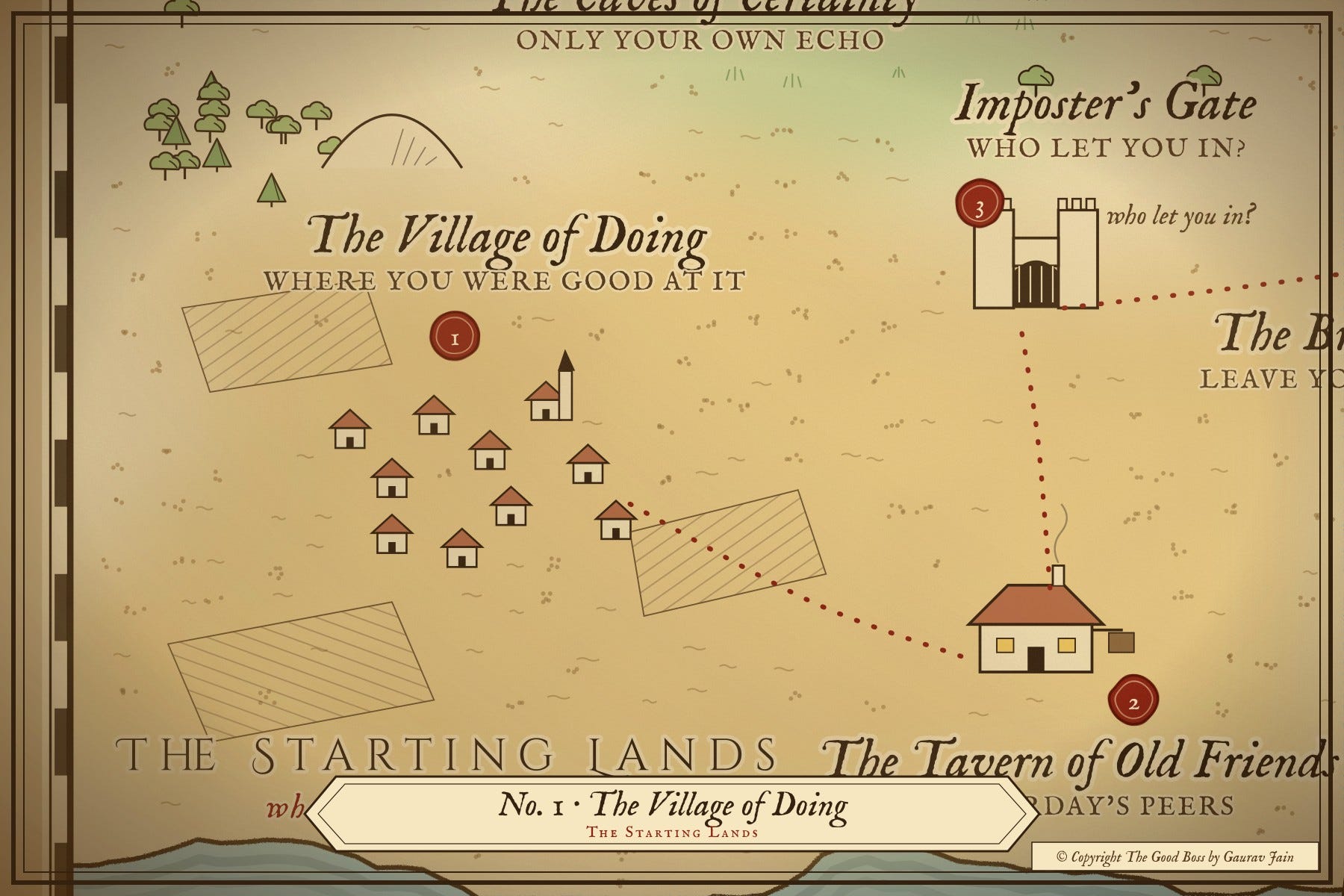
Every leader starts here.
It’s a lovely, homely village. You are clear about the work, you get fast feedback, and you know exactly how good you are because you can see the output with your own eyes.
As an individual contributor, you write the code, or close the deal, or ship the design. Either way, at the end of the day, there’s a pile of things you made, and it’s visible.
The village is so comfortable that most people just want to continue being there, doing what they love doing.
The manager who didn’t leave the village
Arjun was the best engineer on his team, so he got promoted to lead it.
Six months later, he was still writing most of the critical code for the team, and the team was waiting on his reviews.
Two of his senior engineers were bored out of their minds because they weren’t doing anything productive at this point. On paper, the team’s velocity and output looked great because Arjun was carrying it mostly alone.
But the team’s growth was next to none because Arjun hadn’t left the village, even though he thought he had.
You know you’re in the Village of Doing when:
You feel most useful when you’re doing the work yourself
You catch yourself saying “it’s faster if I just do it”
Your calendar has more doing and less deciding
Frameworks to try out
Peter Principle: people rise until they reach a job they can’t do yet. Most of us aren’t incompetent, we just keep living in the village after we’ve been promoted out of it.
Circle of Competence: helps you see where your old knowledge becomes less and the new job begins, so you stop defaulting to the work you’re already good at.
Books to read
The First-Time Manager by Loren Belker, Jim McCormick & Gary Topchik: a gentle, practical guide for first-time managers, written for exactly this moment.
The 5 Levels of Leadership by John C. Maxwell: shows why the title only gets you to level one, and what earns you the rest of the levels.
👣 Traveler’s note
Look at last week’s calendar and mark every block where you did work that someone on your team could have done. Then download the Circle of Competence worksheet and sort that list into what only you can do and what you need to hand over to someone on your team.
🎁 Black Friday deals by The Good Boss
Both deals end Tuesday, Dec 1st at 11:59 pm PT

⚙️ Deal 1: Kyoshi Plus or Pro (annual plans), 30% off, forever
Kyoshi is the systems-first leadership coach built on the Leadership OS.
Practice tough conversations with role-plays, drills, and simulations.
Work through real situations you’re facing in your leadership role
Follow structured Learning Pathways to build your leadership muscle, 24x7.
See the extensive library of leadership books and frameworks come to life
👉🏻 Lock in 30% off on Kyoshi →
📰 Deal 2: The Good Boss (annual plan), 40% off, forever
Full, unrestricted access to The Good Boss Substack paid posts and resources
New framework deep-dives every week, plus 100+ past paid posts
The full Toolkit: 100+ worksheets, mind maps, and posters
Premium access to The Good Boss Community on Skool, with every course unlocked ($97/year value on its own)
Pick one, or both :) Both deals end Tuesday, December 1st at 11:59 pm PT.
2. The Tavern of Old Friends
Where yesterday’s peers become today’s team
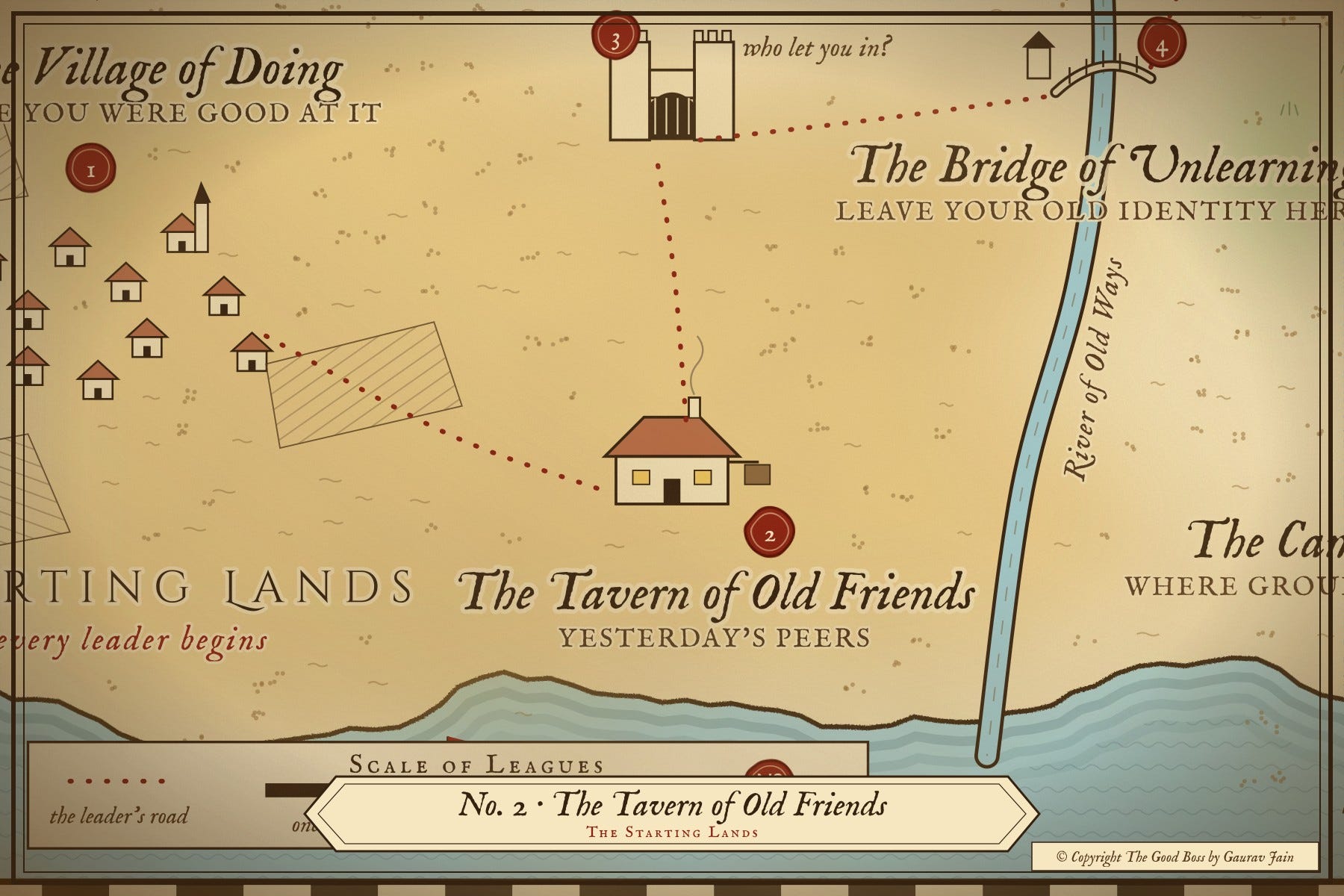
At the edge of the village, there’s a warm, noisy tavern (aka a modern-day bar).
Your old friends are inside, the same people you used to grab lunch with and complain about management with :)
The morning after your promotion to a manager, you walk in, and you can feel the room go a little quiet. It’s not that people are rude, but everyone can feel that something has “changed”.
This is one of the hardest stops on the whole map, because the rules of the tavern were ‘friendship rules’. But now, you are the one who writes their performance reviews, so ‘friendship’ starts to feel weird. I felt the same “shock” when I first got promoted and started managing my ex-peers.
The manager who stayed ‘friends’ with her team members
Leila got promoted to a manager, and her two close friends started reporting to her.
For months, she tried hard to stay like ‘one of the gang’. She kept going to the beer bust on Friday evenings, kept venting about leadership decisions, and kept avoiding the conversation about their ‘missed deadlines’.
Eventually, her team ended up with not one but two problems: they had a manager who wouldn’t act like one, and they had a friend who felt managed behind her back.
You know you’re at the Tavern of Old Friends when:
Your old peers stop talking or go quiet when you walk into the room
You still vent about “management” with your team (even though you’re now one of them)
You avoid giving feedback to the team member because he or she is your ‘friend’
Frameworks to try out
Radical Candor: care personally and challenge directly. With former peers, most of us keep the caring and drop the challenge.
The Four Leadership Support Roles: you used to be their friend. Now you have to pick a role before each conversation: coach, mentor, counselor, or consultant.
Books to read
The Making of a Manager by Julie Zhuo: has one of the most honest takes I’ve read on managing people who used to be your peers.
Difficult Conversations by Douglas Stone, Bruce Patton & Sheila Heen: helps you recognize and say out loud when youre relationships have changed.
👣 Traveler’s note
Have the “our relationship has changed” talk with each former peer in your first month. Rehearse it once in a Radical Candor role-play so you can say the caring part and the challenging part in the same conversation.
3. Imposter’s Gate
Where a voice asks who let you in
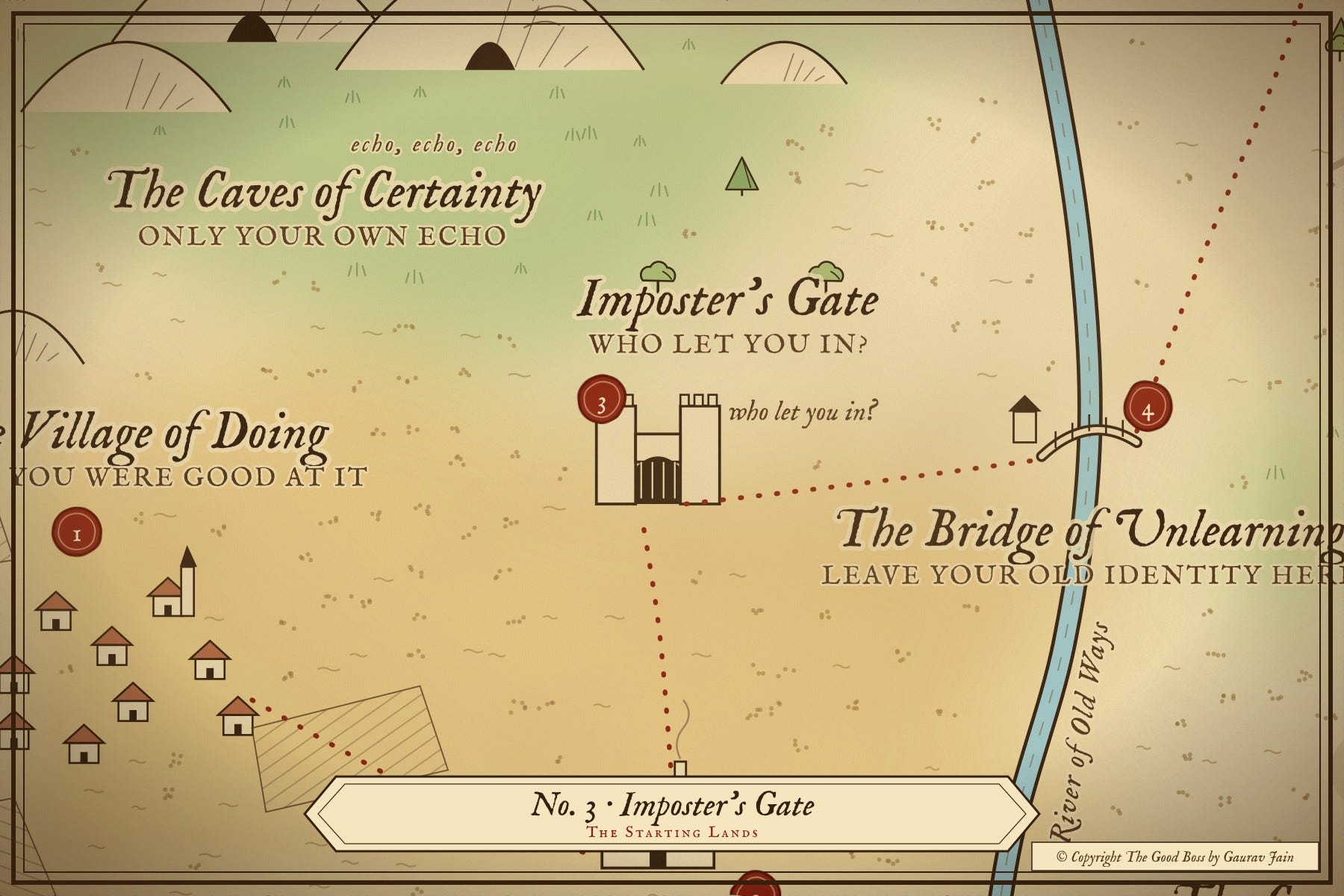
As you walk the road out of the village of doing, you run into a stone gatehouse. It’s the Imposter’s Gate.
Inside the gate, there’s a guard sitting, and the guard asks you one question: “Who let you in?”
Most leaders hear this question in some form or another, including from themselves. When I became a manager for the first time, I would constantly wonder if I deserved to be a manager. I felt like an imposter.
The manager who faked confidence
Marcus was a new manager who never said, “I don’t know.”
When his team asked him a question in the meetings, he would answer it with confidence. He did that even when he wasn’t sure of the answer.
He took credit a little too fast and admitted mistakes a little too slow. His team saw that as arrogance, but inside him, he was actually panicking and ‘faking confidence’.
You know you’re at the Imposter’s Gate when:
You aren’t able to confidently say “I don’t know” in front of your team
You constantly feel like an imposter, and are worried you will get ‘exposed’
You’re controlling the small things because the big things feel out of control
Frameworks to try out
The Insecurity Loop: my name for a pattern I see all the time. A leader feels exposed, covers it with ego, shame or control, the team pulls back, and the distance makes the leader feel even more exposed.
Dunning-Kruger Effect: the other half of the gate. The people most worried about being imposters are often the ones learning fastest.
Books to read
Mindset by Carol Dweck: swaps “prove I belong” for “learn what I don’t know yet”.
Hidden Potential by Adam Grant: a good reminder that how fast you grow matters more than where you start.
👣 Traveler’s note
Say “I don’t know, let’s find out” at least once this week, in front of the team. Then run the Insecurity Loop drill to spot which cover you reach for when you feel exposed: ego, shame, or control.
4. The Bridge of Unlearning
The crossing from doing to leading
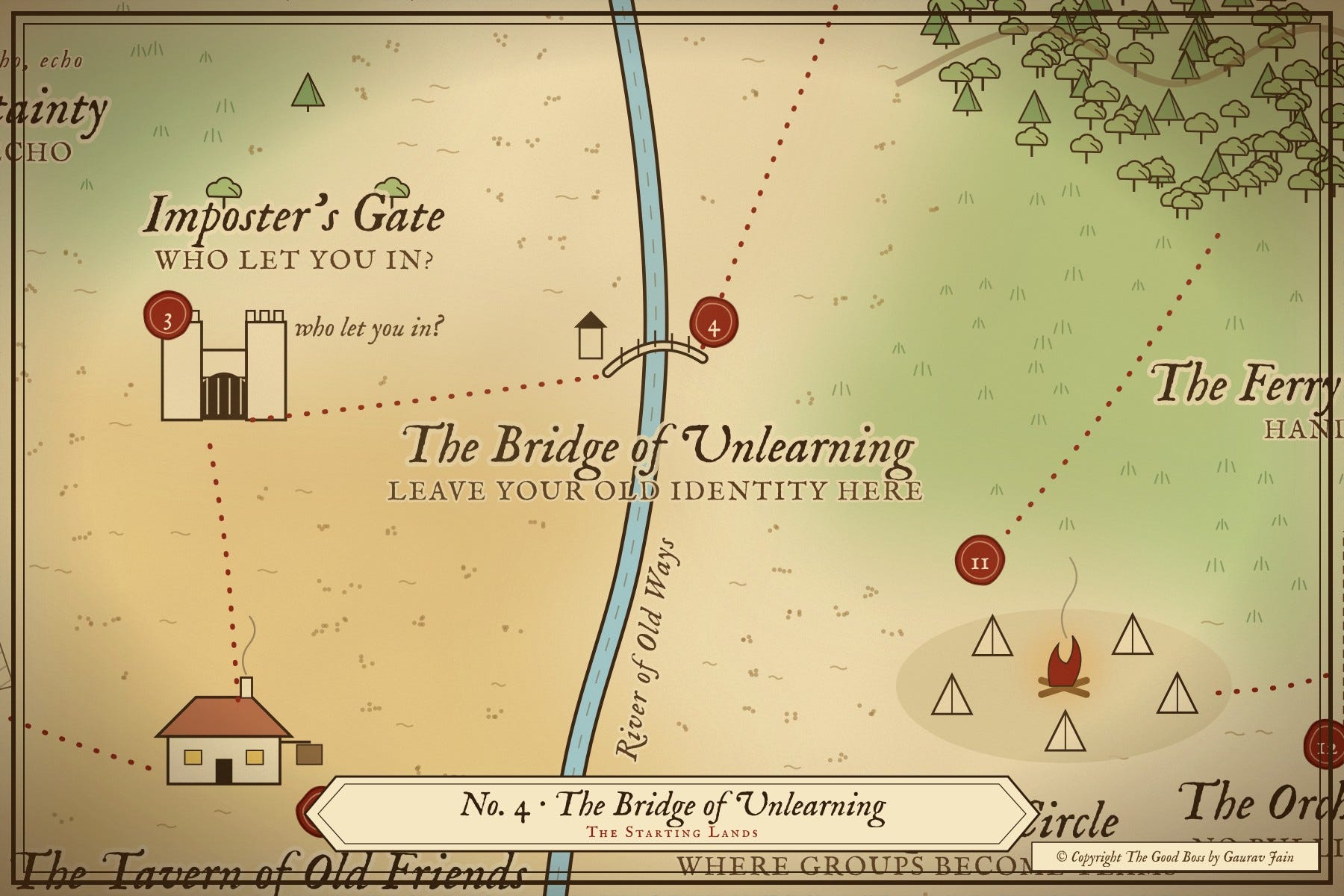
As you continue walking past the gate, you come across a river called the Old Ways, and there’s one narrow bridge across it.
You notice a toll keeper on the bridge, and he steps forward and asks you for one thing: your identity that confirms that you got promoted to manager. And here’s the hint: he’s not looking for “I’m the person who knows the answer”.
Most new managers try to cross, carrying everything they know from the past, from their village. They want to remain the expert and become the leader at the same time.
Unfortunately, the bridge is too narrow for both.
The manager who didn’t want to unlearn
Sofia was a very strong experience designer, and got promoted to a manager.
Several months into her new role, she ran her design reviews by redrawing her team’s work based on what she thought was the right way to do it.
By the end of the year, her team learnt to just wait for her since she was going to redo their work anyway, and they stopped putting in effort.
After she realized this, she started to let go, and the reviews got slower for a bit. But eventually, the work got better.
You know you’re at the Bridge of Unlearning when:
You feel guilty in meetings because you’re “not producing anything”
You rewrite your team’s work instead of giving feedback on it (like Sofia did)
You miss your previous job, but can’t quite seem to put your finger on it
Frameworks to try out
The Leadership Pipeline: explains why this bridge shows up at every level, not just the first. Each step up asks you to drop some of what made you good at the last one.
Managerial Leverage: Andy Grove’s idea that a manager’s output is the output of their team. Use it to rate where your hours actually go.
Books to read
High Output Management by Andy Grove: the original case for measuring yourself by your team’s output, not your own.
The Manager’s Path by Camille Fournier: if you lead engineers, this walks every crossing in detail.
👣 Traveler’s note
Write down the three things you were best at as an individual contributor, and next to each one, what it turns into now. Then take the Leadership Pipeline quiz to check which level you’re actually working at.
Leaving the Starting Lands
Most of us don’t think of the Starting Lands as part of leadership at all, because this is where you were before you became a manager.
In my experience, leaving the village is the most critical first step in becoming an effective leader.
Leaders who never really cross the bridge spend years thinking they’re leading, when they’re still stuck in their old ways.
Next on the map: Part 2, The Inner Lands
We climb past the bridge, reach a lake that shows you your own self, explore caves that echo what you already believe, and walk into the hall of masks.
Download the Poster
If you love maps, as I do, you’ll love the high-resolution PDF poster of the map. Download it now!
❤️ Enjoyed the read?
If you found this post helpful, please subscribe, like, and share it with other managers who can benefit from it, including your boss :) If you have any feedback, please drop your comment below - it helps me keep improving the content. Thank you!
