

When I first read Good to Great by Jim Collins over a decade ago, I thought it was a book about companies and how they make Wall Street happy. I thought it had nothing to do with me and my tiny six-person team.
I’ve re-read it a few times since, and realized again and again that I’d missed the point entirely.
Good to Great is not a book about companies.
Fundamentally, it’s a book about the kind of leader you have to become before a company can get great.
Jim Collins and his research team studied companies that went from average performance to sustained market dominance, and asked a simple question: what did the good-to-great companies do that others didn’t?
In this issue, I’m sharing with you some of my key takeaways from this book, especially as they relate to modern leaders.
Ready? Let’s go!
Level 5 Leadership
Imagine two executives get assigned to run the same struggling division.
Oscar, the first executive, takes the stage at the all-hands, thanks the board for “believing in his vision,” and spends the first month restructuring the org chart around himself.
Grace, the second executive, spends her first month in back-to-back 1:1s with her new team, mostly asking questions and understanding the root causes. And when the team hits their big win, she stands up in front of all and says, “This was the team’s effort, not mine.”
Eighteen months later, Oscar’s division is still waiting for him to make every decision. Grace’s division doesn’t need her in the room to make a good one.
Collins calls this Level 5 Leadership: a paradoxical blend of deep personal humility and fierce professional will.
It’s not the loud, charismatic, magazine-cover leader most of us picture when we hear “great leader.” It’s someone who wants the company (or the team) to win more than they want credit for the win.
I’ve managed this wrong in both directions.
Early in my career, I confused humility with softness. I under-claimed decisions that were genuinely mine to own, which just made me look unsure. The fix wasn’t more ego, but getting comfortable taking the hard calls and giving away the credit for the good outcomes, on purpose, every time.
Level 5 isn’t about being modest as a leader. It’s about redirecting your ambition and drive at the mission, not at your ego.
First Who, Then What
Here’s a mistake I made for years: I’d get budget approval for a new role, and immediately start writing the job description - the “what.” Collins would tell you that’s backwards.
Wei, an engineering manager, ran a platform team that was drowning in tech debt. Instead of hiring a “senior backend engineer with 5+ years in distributed systems,” he hired Mei - someone with less specialized experience but a track record of making every team she joined sharper. He decided he would figure out what she’d actually work on after she joined.
Compare that to Diego, another engineering manager, who spent three months writing the perfect job spec for a role, hired exactly to that spec, and then watched the company strategy shift a few months later… leaving him with the right skills for a job that no longer existed.
First Who, Then What means getting the right people on the bus, the wrong people off it, and the right people in the right seats before you’ve fully nailed down where the bus is going.
Strategy and priorities change. The quality of the people sitting next to you is what actually determines whether you survive the turn when it arrives.
This is uncomfortable advice in a world of exact job ladders and leveling guides.
But the best hiring decisions I’ve made were never about matching a checklist. They were about whether I’d want this person on the team no matter what the team ends up doing.
Confront the Brutal Facts (Without Losing Faith)
Two managers at a large tech company get the same brutal news: the flagship product they’ve spent two quarters on is being cut.
Fatima calls an all-hands and says, “This is a huge win for the team. We learned so much, and I’m confident the next thing will be even bigger.” Her words are positive, but her team isn’t exactly moved by them. After the news, many of them start updating their resumes, because everyone in the room knows BS when they hear it.
Tariq calls his team together and says, “We built the wrong thing. Here’s exactly why, here’s what I missed, and here’s what we’re doing next.” His team is broken for a week, but they’re also grateful for the honesty. Slowly, they rebuild trust, because Tariq just proved he’ll tell them the truth even when it’s ugly.
Collins built this idea around what he calls the Stockdale Paradox, named after Admiral Jim Stockdale, a prisoner of war who survived captivity by holding two things at once: absolute faith that he would eventually prevail, and total honesty about the brutal facts of his present reality.
The leaders who confronted reality without losing faith outlasted the leaders who did one but not the other. In fact, blind optimism has killed as many people as despair has.
At work, this means creating a climate where the truth is heard, not managed or softened. If your team only tells you good news, you’ve trained them to lie to you, and you’ll find out the brutal facts exactly when it’s too late to act on them.
The Hedgehog Concept
Nina and Aisha are engineering managers at a mid-scale company.
Nina’s team said “yes” to everything: a client integration nobody else wanted, an internal tool three other teams were also half-building, and a side project that “might be big.” A year later, they’d shipped a lot and mattered very little.
Aisha’s team, one floor down, said “no” to almost everything that didn’t fit their expertise or passion. A year later, her team had shipped very little and mattered a lot.
Collins calls the discipline behind Aisha’s choices the Hedgehog Concept, named for the old parable of the fox, who knows many things, and the hedgehog, who knows one big thing and does it supremely well.
The Hedgehog Concept sits at the overlap of three questions:
What can you be the best in the world at?
What drives your economic engine?
What are you deeply passionate about?
Great companies stop chasing every opportunity and get relentlessly simple about the one thing that sits inside all three circles.
For a manager, this is the difference between a roadmap that’s a wish list and a roadmap that’s a bet. Most teams don’t fail due to a lack of ideas, but due to refusing to say no to good ideas that aren’t the “right” idea.
I recent wrote a dedicated piece on the Hedgehog Concept, and how you can apply this concept as a leader in your own team and role. Check it out below.

Culture of Discipline
In a financial tech company, two teams both claim to value “ownership.”
Leo’s team has a “values” poster on the wiki and a rule for every process: approval chains, sign-off meetings, a manager checking every ticket before it moves.
Sarah’s team has almost no rules, but everyone on it independently makes the call Sarah would have made, because they’ve internalized why the standard exists, not just what it is.
Collins draws a clean line here: bureaucracy is what organizations build to compensate for incompetence and lack of discipline.
A Culture of Discipline doesn’t need bureaucracy because disciplined people need far fewer rules to stay aligned.
This one reframed something for me.
I used to think adding more processes was the right move whenever something went wrong. Half the time, it was actually a signal that I hadn’t hired, trained, or trusted the right people to make the call without me.
Technology Accelerators, Not Saviors
This is one many of us are facing first-hand these days with the emergence of AI.
In a large tech company, two teams get access to the same new AI coding tool - Claude Code.
Tom’s team treats the tool as the strategy. “AI-first” becomes the whole plan in and of itself. After a few months, nobody in the team can explain what specifically got better, only that “everyone uses the tool now”.
Devi’s team already had brutal clarity on their bottleneck in the SDLC process. Their code review turnaround was killing their velocity, and they used the AI tool to attack that one problem directly. They automated code reviews, added specs to make sure their best practices were followed, and ensured that the quality bar remained high and consistent. In just a month, they noticed that their cycle time actually improved by 2x.
Collins’ point about technology accelerators, not saviors, is this: great companies are often pioneers in applying carefully chosen technologies, but they never let the technology itself define the strategy.
I watch this pattern constantly right now with AI tooling specifically. The teams getting real leverage aren’t the ones with the most tools enabled. They’re the ones who knew exactly what was broken before they picked one up.
If this format resonates with you - a book, broken down into what you can actually as a manager - hit reply and tell me. It’s still new, and it shapes whether I keep doing these.
The Flywheel, Not the Doom Loop
I’ve seen this one play out many times, and I’m personally guilty of it too.
Consider two equally smart, capable managers - Chris and Mona - both working at a large tech company. When AI and AI tools started gaining popularity, both Chris and Mona knew this wasn’t something they could ignore. It was a big shift in technology, and they need to stay ahead of it.
Chris wanted the turnaround for his team to feel dramatic. So he called and all hands with his team and announced a new mission and even a new name for the team. He called them “AI Trailblazers”. Great name and definitely inspirational, but fast forward three months, there wasn’t much of a shift in the actual product or processes the team was working on. So what did Chris do? He announced a different new mission. Eventually, his team learned to wait him out instead of believing him.
Mona, while equally excited about AI, never made any big announcement in her team all hands. She decided to go slow and steady - one small shift at a time. She started with AI tool adoption, followed by experimentation sprints, and integrating them into their workflows. She made the small, boring, compounding decisions that nobody outside the team would have noticed individually. A few months later, her team’s ability to leverage AI, and deliver real value to their customers, had skyrocketed. People up the chain, and in other teams, started asking what her “big strategic move” had been. There wasn’t one.
What Mona had adopted was what Collins calls the Flywheel: enough consistent, disciplined pushes in a single direction that builds momentum towards something bigger and more valuable. From the outside, this can look like a breakthrough.
What Chris was doing was the opposite - the Doom Loop. He was jumping from initiative to initiative, program to program, leader to leader, never staying still long enough for any single push to compound.
Collins’ finding here is almost boring:
There was no single defining action, no miracle moment, in any of the good-to-great companies. All they have is a boring flywheel, which they turn patiently, for a long time.
If you’re waiting for the one big swing that turns your team around, here’s the bad news: it’s probably not coming. The good news is that you don’t need it to.
Putting It Together
The way I see it, the seven ideas we discussed from Good to Great build on each other in roughly three layers.
Level 5 Leadership and First Who, Then What are about who’s in the room and who’s steering.
Confront the Brutal Facts and the Hedgehog Concept are about seeing clearly what matters for you and the organization.
Culture of Discipline, Technology Accelerators, and the Flywheel are about execution - turning clarity into years of compounding, boring momentum.
Found this summary useful? Do reply to this email or drop a comment so I know what’s resonating and what’s not. Also, if you want me to write about any specific book of your interest from a leadership lens, let me know.
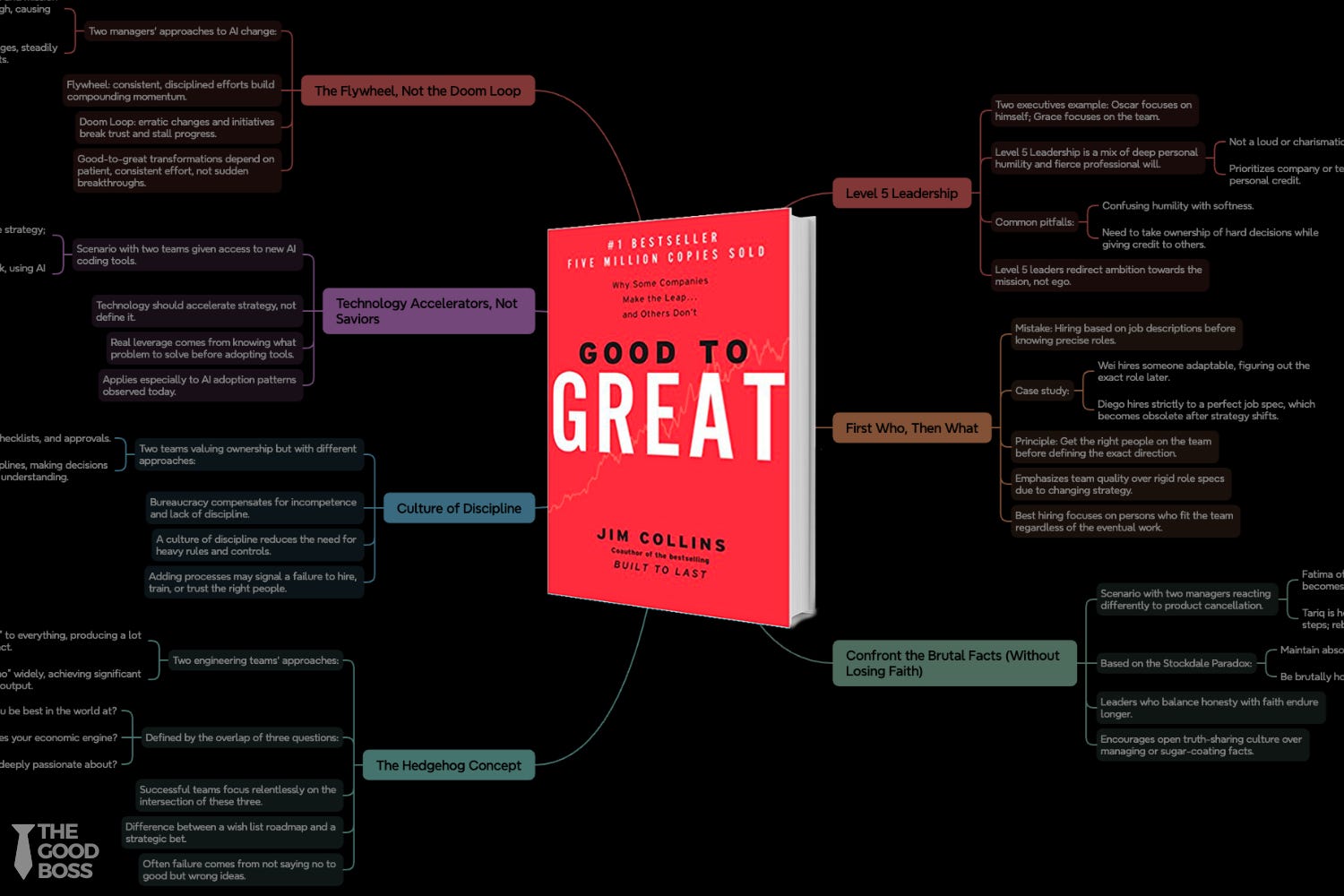
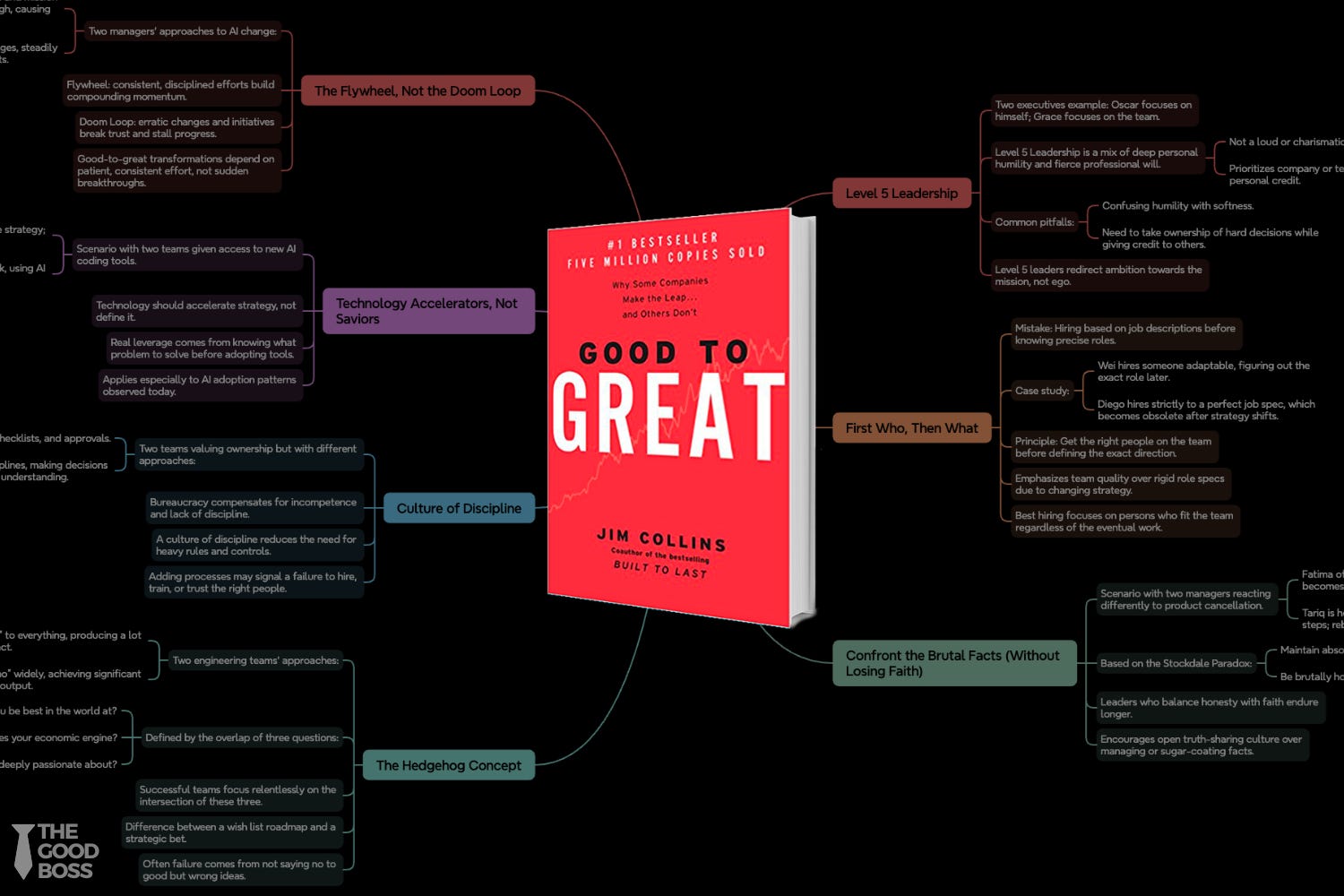
🧠 Download the Mind-map
If you’re a visual person, like I am, you may want to check out the mind-map that I created for a quick visual reference.
❤️ Liked the post?
If you found this post helpful, please like and share it with other managers who can benefit from it, including your boss :)

Love your book summaries. I am sure you are aware that only three of the eleven corporations Jim Collins highlighted continue to be great. Four have bit the dust. Four are no longer held in high esteem. Maybe the real lesson from the book is “Success is rented and the rent is due every day.”