


A few years ago, I was in a business review meeting with my team, looking at charts and reports that showed how our business was doing. The numbers didn’t look good, and as everyone around the table shared their thoughts, it became clear that no one agreed on what to do next.
There were a lot of ideas, worries, and quick fixes , but not much clarity.
I realized then that my job wasn’t just about making decisions; it was about seeing the bigger picture, noticing patterns others might miss, and guiding the team through the confusion.
That’s when I understood what makes a leader truly strategic.
Being a strategic leader isn’t just about having a vision or setting goals. It’s about building a set of skills that help you see changes before they happen, connect the dots, and lead your team through uncertain times.
In this article, I’ll share the six key skills that every strategic leader needs , and how you can start developing them today.
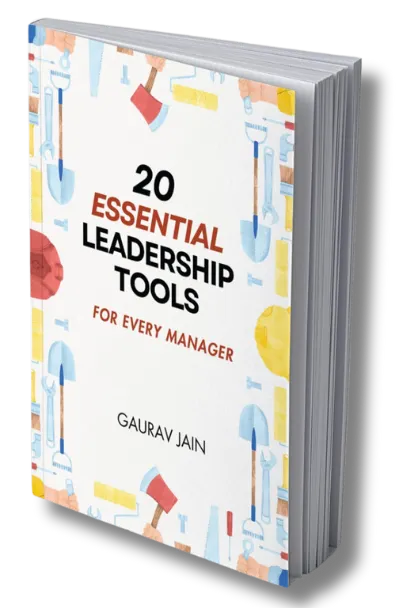
🎁 Free Resource: If you’re new here, download my 20 Essential Leadership Tools for Every Manager guide. It summarizes the essential tools every manager must master. (Preview below).
1. Pattern Recognition

Have you noticed how some topics keep coming up over and over again, but in different forms or appearances?
For example, if you are a people manager, you might notice that several of your team members are missing their individual goals and deadlines, and they’re calling in sick more often. While these might seem like individual-specific instances, they may be pointing at a bigger problem. Perhaps your team is not engaged because of the nature of the work they have been doing for the past six months, or perhaps you haven’t been looking after them.
As another example, if you are a product manager, you might notice that mobile payments are becoming popular with younger buyers. As it stands, this stream of income is tiny compared to the traditional sources of revenue, so it is not seeing much attention just yet, but you can see the patterns and recognize the signs that this is something you and your company should be paying attention to.
As a strategic leader, you can recognize patterns, connect the dots, and act on them swiftly before it's too late.
How to Develop This Skill:
Stay Curious: Always ask yourself why certain things are happening. Look for the “why” behind the “what.”
Look for Patterns in Data: Spend time analyzing data from your industry or within your organization. What trends are emerging? What do the numbers tell you?
2. Systems Analysis

You may have heard of the term ‘Systems Analysis’ in different contexts, but what exactly does it mean?
I like to think of it as a spider’s web. Imagine your organization is the entire web, and the different departments, functions, roles, and people are different sections of the web. It’s all interconnected, and a tug on one part of the web affects the rest.
If you are an engineering manager building software, you may think that what you do has no connection to sales or marketing. “My team’s job is to build software.” you might say. However, if you think of the entire system (your company business), you will be able to make better judgments and decisions about what’s right and make sure that the software your team is building helps the organization overall.
As a strategic leader, you think in terms of the entire system, and are aware of the interconnections and dependencies.
How to Develop This Skill:
Think in Terms of Cause and Effect: When you make a decision, ask yourself, “What else might this impact?” Try to map out the possible effects on different parts of the organization.
Use Business Analysis tools such as the Balanced Scorecard to assess how different parts of the organization are playing together.
3. Mental Agility

I like to think of mental agility as ‘thinking on your feet’.
Not everything you do as a leader will go as planned. You will hit roadblocks, projects will fail, your customers will be furious.
Mental agility is the ability to adjust your plans and adapt your approach if you run into such situations. It is about knowing how to deal with complex and unexpected situations.
As an example, if you have just released a new product, and are not seeing the kind of adoption numbers that you expected, approach that as an opportunity. Review the customer sentiment, dig into the data, and adjust your strategy. Maybe the market you are targeting is not ready for this product, or the customers prefer a competing product.
As a strategic leader, you think on your feet and adapt to unexpected situations quickly.
How to Develop This Skill:
Practice “What-If” Scenarios: Think through possible challenges and how you would react. You can use frameworks like the Animal Risk Matrix.
Embrace Feedback: Be open to input from your team and others. Sometimes, the best solutions come from different perspectives.
4. Structured Problem-Solving

As a leader, you are constantly dealing with problems.
But how do you solve those problems? Structured problem-solving is about breaking down complex problems into smaller, manageable parts and finding solutions step by step.
Instead of getting overwhelmed by big challenges, structured problem-solving helps you tackle them piece by piece. It ensures you don’t jump to conclusions or miss important details. This skill is essential when facing tough decisions or managing projects with many moving parts.
For example, if you notice your team’s productivity is dropping, you can approach this in a structured way. Review the team data, ask the team through surveys, and gather enough data to make an informed assessment of what is going on.
As a strategic leader, you approach problems in a structured way, and tackle them systematically.
How to Develop This Skill:
Use Problem-Solving Frameworks: Frameworks like the 5 Whys or First Principles Thinking can help break down problems and find root causes.
Map Out the Problem: Write down the different elements of the problem and how they are connected. This helps you see the whole picture.
5. Visioning

Now, I know you are not a fortune teller.
However, you can still hold a strong imagination of what you want your team or organization to achieve in the long run.
Visioning is the ability to “see that future” (the one you imagine ) clearly and vividly. It’s about inspiring your team and other stakeholders towards that vision and rallying them to put their energies into achieving it.
Visioning gives direction to your team. It helps them understand the bigger purpose behind their work and motivates them to strive for something greater. What’s more, if you have a strong vision, it will keep your team aligned, motivated, and inspired.
As a strategic leader, you have a strong vision of the future, and you inspire others to work towards that vision.
How to Develop This Skill:
Use Visioning frameworks such as The Golden Circle (Start With Why) and BHAG (Big Hairy Audacious Goal) to craft the vision for your organization.
6. Political Savvy

Politics at the workplace is real. In any organization, there are relationships, power dynamics, and unwritten rules.
Remember that you are ultimately dealing with people, and people are political creatures. Political savvy is about understanding how the dynamics work and using this knowledge to build alliances, influence others, and get things done.
As a leader, you need to work with different personalities, manage a variety of stakeholders, and build support for what you are trying to do. Imagine that you need to garner support from your leadership for a new project idea - how do you get that support? You may have all the data to back up your proposal, but what if one member of the senior leadership team doesn’t support it because they want another team to work on that idea?
At one point in my career, I hated politics, but then I eventually came to realize that there are good politics and bad politics, and good politics is essential to success.
As a strategic leader, you know how to navigate and approach different people and authority figures to get your work done.
How to Develop This Skill:
Build Relationships: Take time to get to know people in different roles. Understanding what matters to them can help you work together more effectively.
Learn the “Hidden” Rules of Office Politics: Observe how others navigate the organization, especially those who are good at influencing others. Pay attention to their approach.
💬 Let me know in the comments: Which of the 6 skills do you think is the most valuable?
❤️ Found this helpful?
If you found this post helpful, please like and share it with other managers who can benefit from it, including your boss :) If you have any feedback, please drop your comment below - it helps me keep improving the content. Thank you!

Thanks. I needed this clarity reminder today. My aproach to a GOT politic environment is a mixture of pausing, observing, and being ready and alert for taking risks when my turn to share knowledge and advice from the strategic point of view comes.
These skills are vital, and I believe learning aspects of social sciences and humanities offer these very skill sets