In this issue:
The Escalation That Wasn’t Really Ours to Fix
Understanding The Eisenhower Matrix
Why Urgent Always Wins (Unless You Interrupt It)
Putting the Matrix Into Practice: The Worksheet
A Simple Habit: The Friday Filter
How This Plays Out in Real Teams
Common Pitfalls (and How to Avoid Them)
Final Thoughts
The Escalation That Wasn’t Really Ours to Fix
A few years back, we’d just wrapped annual planning. The roadmap was locked, the team was in full execution swing, and everyone knew what they were building and why.
Then, mid-Q2, my VP dropped a note: a customer escalation needed a look. The customer had emailed our CEO directly, not once, but twice, and was loud about it. I got on a couple of calls to understand the actual concern.
They were convinced one of our existing platform features was “buggy.” In reality, it wasn’t our bug at all - it was a Windows-side issue.
But the CEO and VP were watching, and the noise was real, even if the root cause wasn’t. So we made the call: pause the roadmap, pull one of our teams off planned work, and build a “fix”.
We just wanted the noise to stop, or at least subside.
To be honest, I wasn’t fully on board in the moment. But the pressure was real, the audience was senior, and I went along with it anyway.
It worked, in the narrow sense that the customer went quiet. Phew! But we’d spent real engineering time solving a problem that was never actually ours, at the direct cost of the plan we’d just spent weeks building.
Looking back, I regretted how easily “the CEO is watching” overrode “this isn’t actually our bug”, and how long it took me to even ask that second question.
Urgent had a sponsor, Important didn’t, and that’s usually all it takes.
Understanding The Eisenhower Matrix
The Eisenhower Matrix is named after Dwight D. Eisenhower, who is said to have said:
“What is important is seldom urgent, and what is urgent is seldom important.”
Stephen Covey later popularized it as a 2x2 tool in The 7 Habits of Highly Effective People. I talked about this in my previous post, in case you want to check it out.
In plain terms, every task sits somewhere on two axes:
How urgent it is
How important it is.
When you cross those, you get a 2x2 grid:
Urgent + Important: Do. The outage, the exec escalation, the thing with a deadline today, and real consequences if you miss it.
Important, not Urgent: Schedule. The roadmap, the coaching conversation, the strategy work. Nothing bad happens today if you skip it. Something bad happens in six months if you keep skipping it.
Urgent, not Important: Delegate. Most meetings. Most “quick” requests. Loud, but low-stakes if handled by someone other than you.
Neither: Delete. The stuff that survives purely on habit, the recurring sync nobody remembers agreeing to, the report nobody reads.
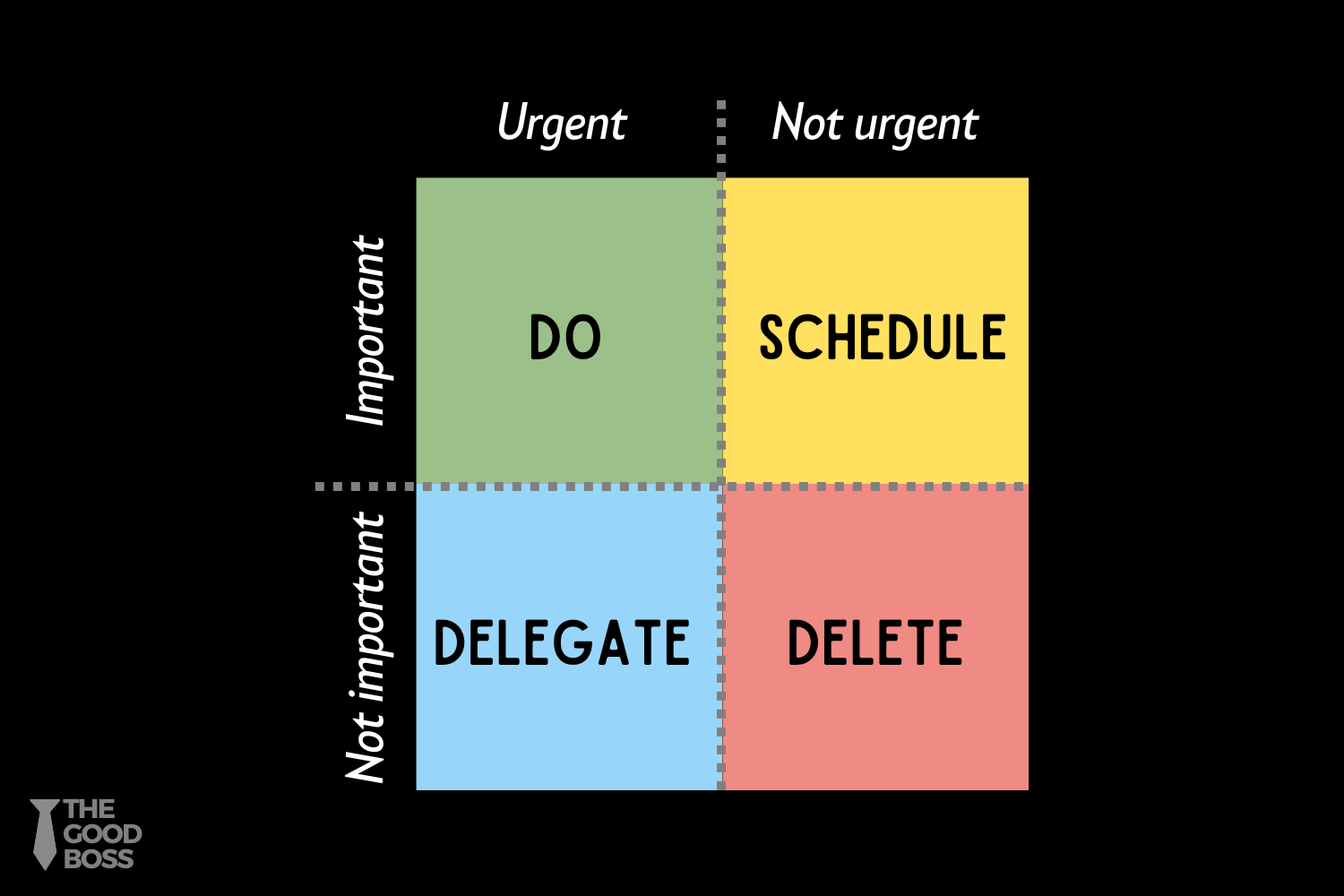
Two of these boxes look almost identical from the inside of a busy week: Do and Delegate both feel urgent, same adrenaline, same “I need to handle this now” pull. The only real difference is whether it actually requires you specifically, right now, or whether it just landed on you because you were “reachable”.
Most leaders never separate the two; they just react to loudness and call it “prioritization”.
The other confusion runs the other way: Schedule and Delete both feel optional in the moment, because neither is shouting at you today. But they’re not the same box at all.
Delete is genuinely low-value - these are things that can disappear and nothing will change. Schedule is often your highest-value work, strategically important, except it has no deadline attached yet.
That’s the actual insight buried in this framework: importance and urgency aren’t correlated the way your instincts assume.
Some of the most impactful work you’ll ever do will never once feel “urgent”, which means if urgency is your only filter, you will systematically starve the thing that matters most.
Why Urgent Always Wins (Unless You Interrupt It)
Now let’s be real: urgency has its own gravity. A ping, a Slack message, an exec asking “any update?”… all of it produces a small, immediate hit of relief when you respond. I got the same hit when my VP pinged me regarding the customer escalation I mentioned earlier.
Important work, on the other hand, produces no such feedback. Nobody notices when you protect two hours for planning, while everybody notices when you’re slow to reply to a fire.
So, by default, your attention drifts, quadrant by quadrant, toward whatever is the loudest, not whatever matters most. If you leave this unmanaged and going on auto-pilot, your entire week can get consumed by Do and Delegate, with Schedule permanently postponed to “some future date that will never arrive”.
Why this matters for managers specifically: your team inherits your ratio. If you’re always in fire-drill mode, they learn that’s what gets rewarded, such as speed of response over quality of thinking.
The quadrant you live in becomes the quadrant they optimize for.
Putting the Matrix Into Practice: The Worksheet
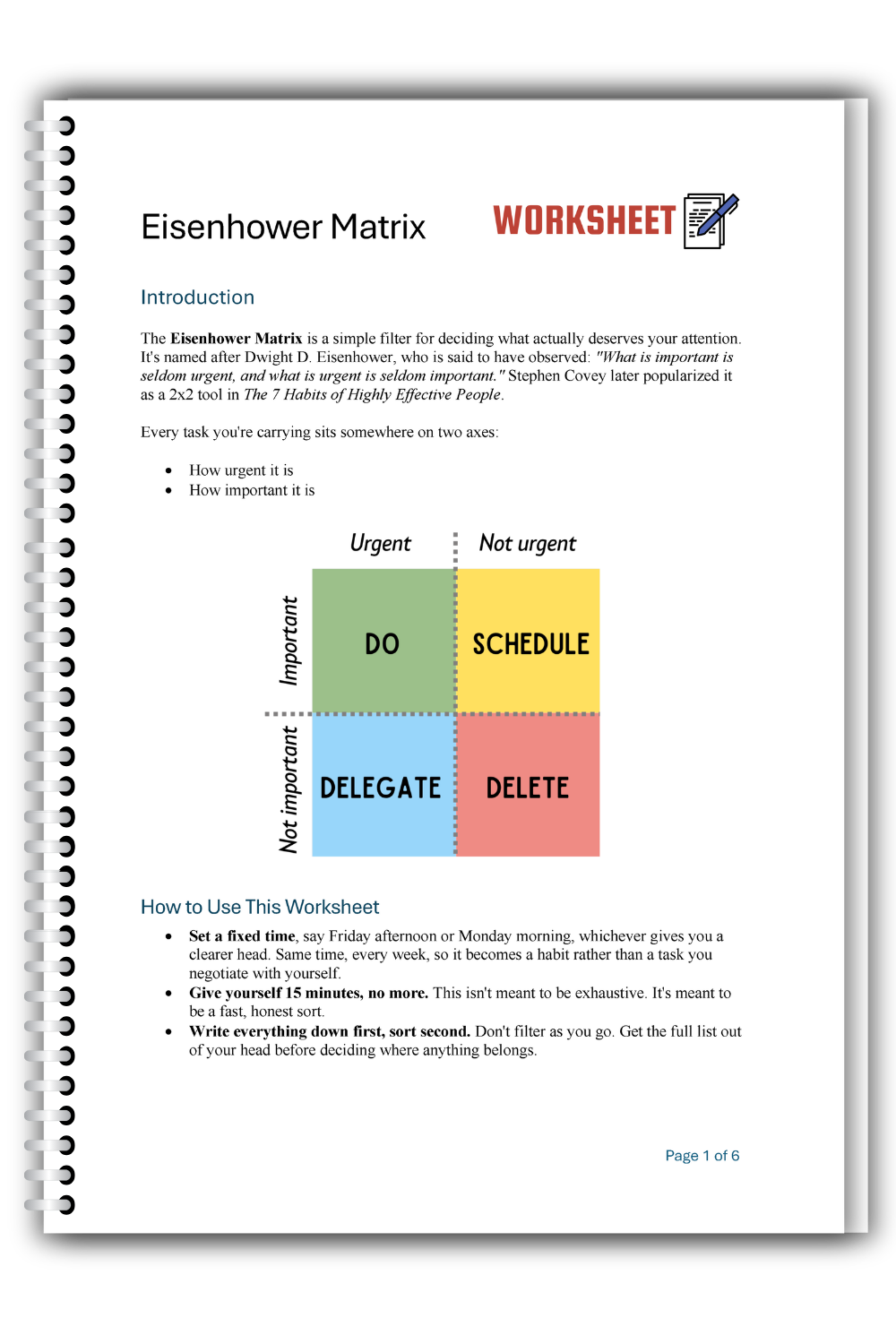
For the rest of this article, we will focus our attention on putting the Eisenhower Matrix into practice in your own organization. As we do that, don’t forget to download the Eisenhower Matrix Worksheet.
Use this worksheet to:
Separate what needs you now from what just feels urgent
Catch the important work you keep deferring
Turn good intentions into a calendar block
How to download the worksheet
This worksheet is part of the Worksheets Collection, available to all paid subscribers to The Good Boss.
👉🏻 Upgrade to paid now and get instant access to the entire collection, including this worksheet.
If you prefer the standalone worksheet, you can purchase it from here.
A Simple Habit: The Friday Filter