
The Hidden Rulebook 📔 of Corporate Politics (and How to Use It to Your Advantage)
24 Rules Every Leader Follows But No One Shares

Many in the corporate workforce believe that “good work speaks for itself.”
Early on in my career, I used to believe in that too. I thought that if I would just focused on delivery, results, and being a good team player, recognition would automatically follow.
And for a while, it did.
Until it didn’t.
I remember the time when a peer manager who was less competent and less experienced than me got the opportunity I’d been quietly working toward. It was a soul-crushing experience for me, and I was devastated.
After an initial period of frustration and resentment, I entered a phase of introspection, reflection, and observation. And then, I could finally see what was going on.
The other manager had made some moves that I was ignoring. He was playing by the unspoken rules that most leaders follow but don’t share.
I call this the hidden rulebook.
In this post, I will unravel the 24 unspoken rules from that rulebook that influence and shape careers, projects, promotions, and power inside organizations, whether we like it or not.
Most of us learn them the hard way. But you don’t have to, as I’m sharing the full rulebook here for free (and you can thank me later!)
Here’s a bird’s-eye view of all six chapters and twenty-four rules we will learn in this post:
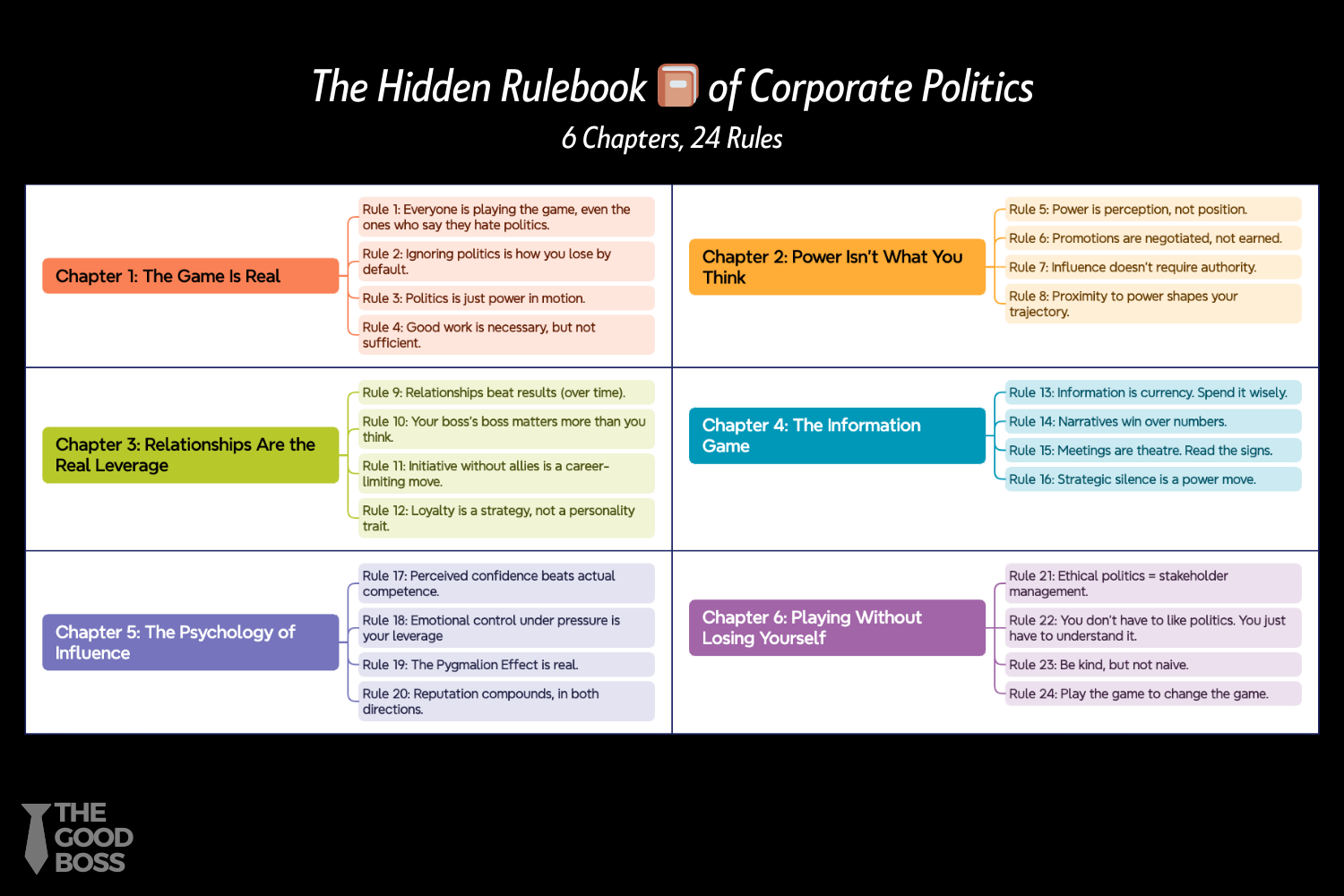
Ready to dig in? Let’s go!

Chapter 1: The Game Is Real
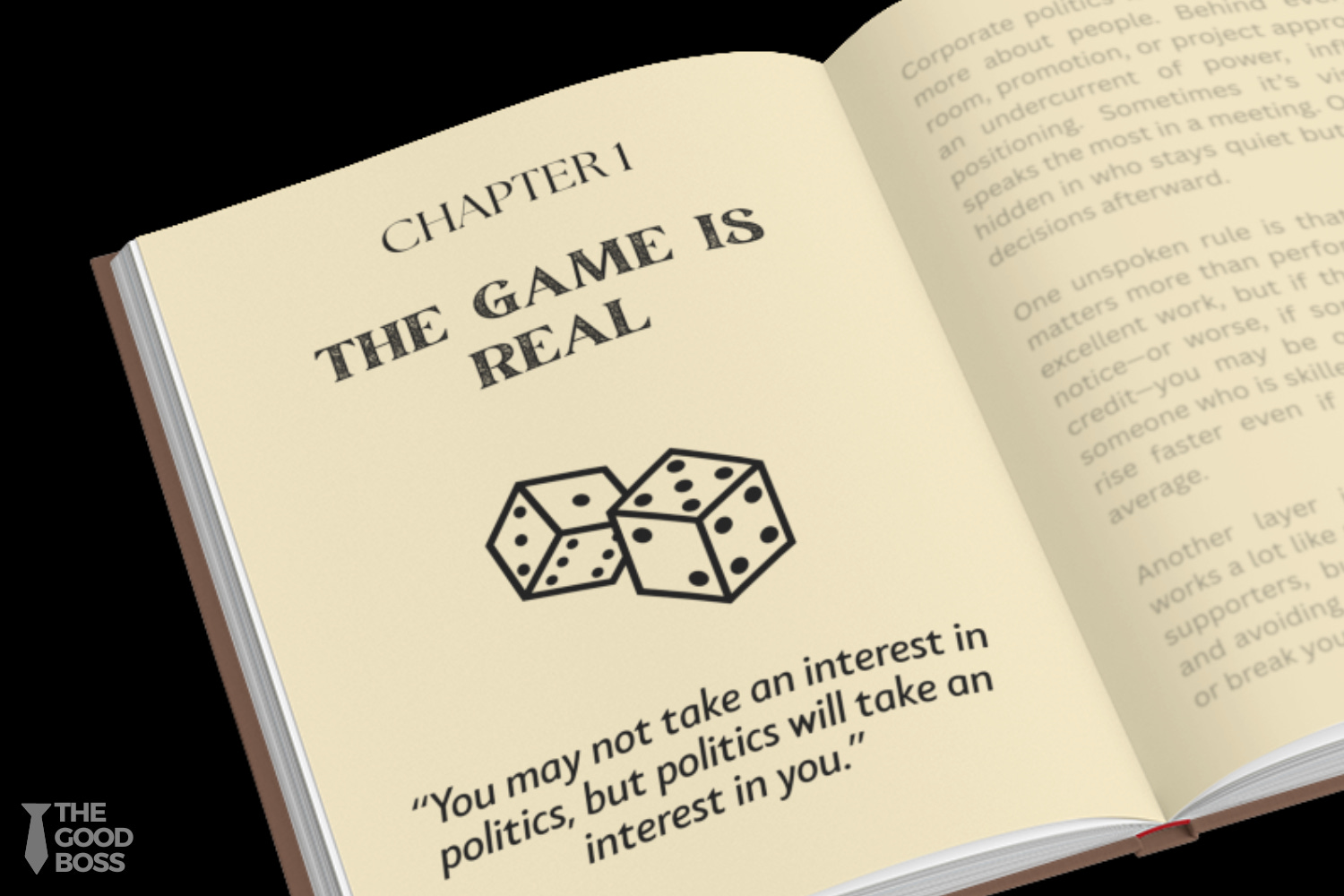
“You may not take an interest in politics, but politics will take an interest in you.” – Pericles
Most professionals, including managers, resist the idea of "office politics." It feels beneath them, or dirty.
But ignoring politics doesn’t make it go away, it just makes you easier to outmaneuver. This chapter lays out the foundational truths: You’re in the game, whether you know it or not.
Rule 1: Everyone is playing the game, even the ones who say they hate politics.
We’ve all seen colleagues who loudly claim “I’m not political”. But the reality is that those same people are often playing the game in more subtle ways.
My thumb rule is simple: Don’t watch what people say. Watch what they do.
You’ll see this when someone “just happens” to have a friendly conversation with a senior leader over lunch, or volunteers to organize a team event that brings them close to the key decision-makers. They might frame it as “just being helpful,” but they’re building visibility and goodwill. In corporate talk, we sometimes call these ‘brownie points.’
Watch closely, and you’ll notice how certain people always seem to know what’s coming before it’s announced. That’s not luck. It’s political awareness in action.
👉🏼 Takeaway: The people who claim they hate politics are often playing it best, just more quietly.
Rule 2: Ignoring politics is how you lose by default.
As much as you may not like politics, the harsh truth is this: Opting out doesn’t protect you. It disarms you.
Let me be clear, though: I’m not saying that you need to manipulate. But you do need to “understand the terrain.”
A talented engineer on my team once refused to engage in any cross-functional meetings. He was a brilliant engineer, but considered any non-technical or leadership meeting a waste of his time. “Let my work speak for itself,” I remember him say.
And here’s what happened: when the annual performance calibration discussions came around, none of the senior leaders outside my team had any idea who he was or what impact he had created. I tried my best to vouch for his case, but after a while I started sounding like a broken record. In the end, he didn’t make the promotion list because he wasn’t known, not because he wasn’t good.
Opting out is a political move, and not a smart one.
👉🏼 Takeaway: If you’re not in the political game, you’re letting others play it for you.
Rule 3: Politics is just power in motion.
Politics is not dirty by default. I think of politics as how influence, trust, and decisions move. The better you understand it, the better you can shape outcomes and drive results.
I like to think of politics as organizational dynamics.
Consider this: A product decision doesn’t just get made based on data alone. It gets made based on alignment, risk appetite, egos, and (importantly) perceived credibility of the person involved. When a well-liked junior PM convinces multiple stakeholders to back her roadmap, she’s not being “political” in the negative sense. She’s just navigating power structures effectively.
That’s politics, done well.
👉🏼 Takeaway: Politics isn’t dirty. It’s just how trust, influence, and decisions move inside companies.
Rule 4: Good work is necessary, but not sufficient.
Performance gets you considered. Politics decides whether you get chosen.
A couple of years ago, two team leads were under consideration for a newly created senior role. On paper, the choice looked obvious. Ravi had led three major projects, all delivered on time and under budget.
But there was a problem: Ravi had stayed in his lane. He rarely engaged outside his team, didn’t attend cross-functional syncs unless required, and wasn’t known by many leaders beyond his immediate circle.
On the other side was Anika. Her delivery record was good, but not perfect. She had one delayed project and a few customer escalations. But she had built deep trust with other departments, mentored people beyond her team, and often stepped in to help unblock peers across functions. In rooms where she wasn’t present, people still vouched for her.
When it came time to decide, leadership picked Anika. She was seen as the more “complete” leader.
👉🏼 Takeaway: Results get you into the conversation. Politics decides how it ends.
P.S. If you’re enjoying reading this article, I’ll appreciate it if you would take 2 seconds and hit the ❤️ button and share/restack 🔁 it with others who might find it helpful. You can also subscribe to The Good Boss for more posts like this every week. Thank you! 🙏
Chapter 2: Power Isn’t What You Think
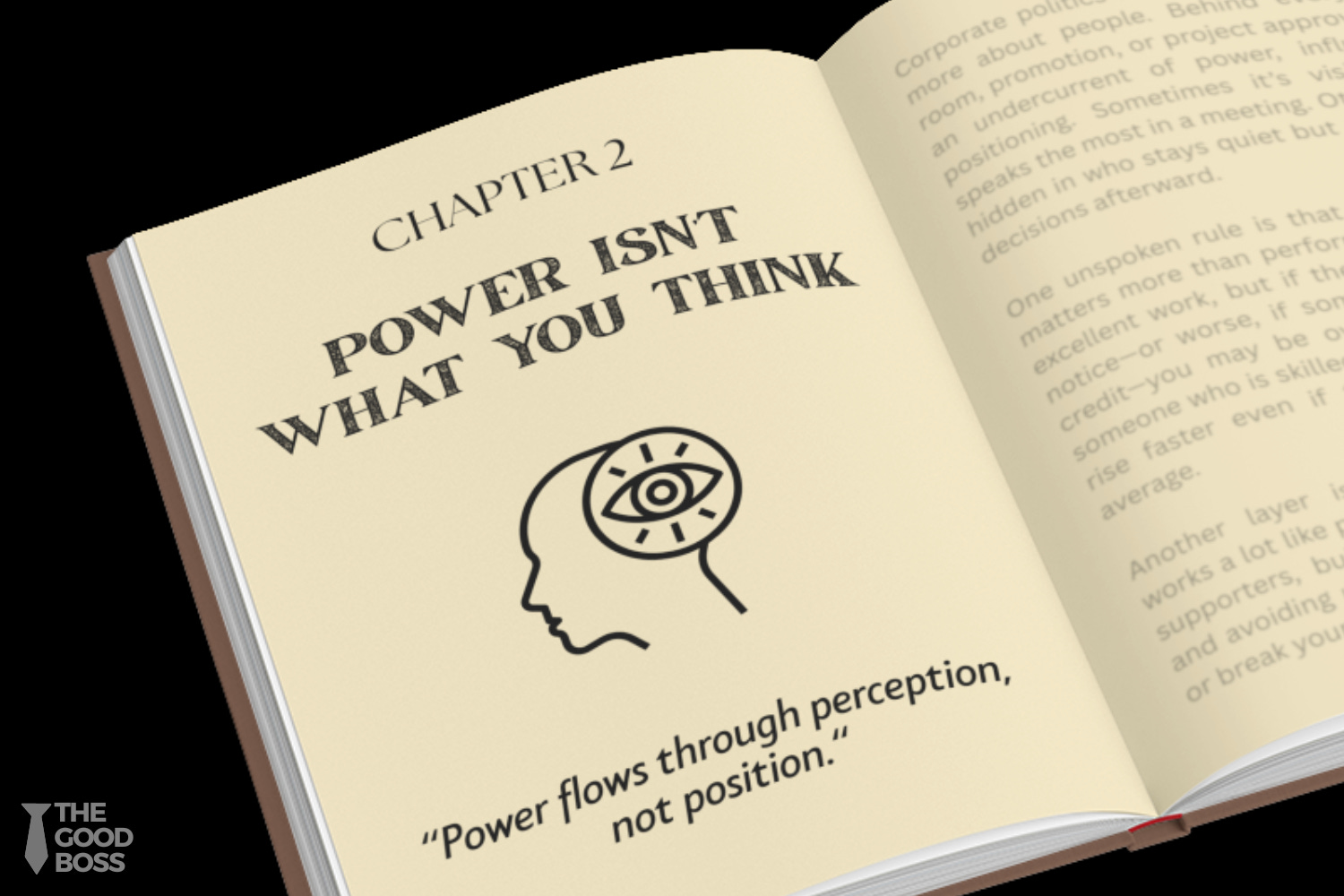
Power flows through perception, not position.
In the corporate circles, we’re generally told that we should respect titles and hierarchies. But the reality is that inside companies, power doesn’t flow by job title. It flows through trust, perception, and most importantly, influence.
In this chapter, we will unpack how real power works, and how to spot it even when it’s not obvious.
Rule 5: Power is perception, not position.
Titles are overrated. Influence is often held by the trusted “informal leaders” in the room.
You may have noticed that in some meetings, when a certain person nods or backs an idea, everyone else quickly follows, even if that person isn’t the most senior in the room.
That’s informal power.
I once worked with a principal engineer who wasn’t anywhere near the top of the hierarchy, but he was so trusted across teams that any initiative he supported got fast-tracked.
His power wasn’t on the org chart. It lived in people’s heads.
👉🏼 Takeaway: The fanciest title isn’t always the most powerful voice in the room.
Rule 6: Promotions are negotiated, not earned.
Here’s the harsh truth that many of us need to swallow sooner or later: Hard work alone doesn’t get you promoted. Visibility, narrative, and advocacy do.
I remember a peer manager who had done a stellar job leading a high-profile project. But she hesitated to communicate her wins in broader forums that senior leaders were watching, and assumed “they already know.” She was being humble and modest.
Meanwhile, another manager who worked on another project worked the hallway conversations, got coffee with key leaders, and ensured his version of success was known. He didn’t hesitate to self-promote his work at every opportunity. And, as you can imagine, he was seen as the more “strategic” choice, and was promoted ahead of the other manager.
👉🏼 Takeaway: Promotions are made in quiet, unseen negotiations, usually long before they’re announced.
Rule 7: Influence doesn’t require authority.
You need just two things to shape outcomes: credibility and timing.
You don’t need a big title or to be at the top of the hierarchy.
I remember when a junior analyst in one of our cross-functional teams flagged a customer insight that helped us to change our roadmap priorities. It was a brilliant insight that directly helped us to save costs and direct our focus on what mattered to our customers.
She wasn’t in charge of any major project, but because she brought clarity and timing to a critical issue, she gained instant influence. She started getting invited into more discussions, not because of her level, but because of her insight.
👉🏼 Takeaway: Influence rides on credibility and timing, not hierarchy.
Rule 8: Proximity to power shapes your trajectory.
You may have heard the saying, “Out of sight is out of mind.”
If you’re looking for growth opportunities, always be on the lookout for high-visibility projects. Identify the rising leaders in your domain and try to build a positive relationship with them. Sit close to where the key decisions are being made - you’ll be surprised at how much more information you get access to by simply being closer to the action.
One of the smartest engineers I knew spent years working on a backend service that was critical, but she was never invited to a leadership meeting to ‘demo’ the service, as it wasn’t customer-facing. Another, slightly less experienced developer joined a task force run by the CTO. The second one got promoted faster because he was closer and more visible to the senior executives, not because he was smarter.
👉🏼 Takeaway: Sitting close to influence accelerates trust. People bet on those they can see.
P.S. Feedback is a gift! 💬 If you’re finding this post helpful, would you do me a favor and leave a quick testimonial here, and as a thank-you, I’ll send you a free copy of my book! It only takes a couple of minutes - thank you! 🙏
Chapter 3: Relationships Are the Real Leverage
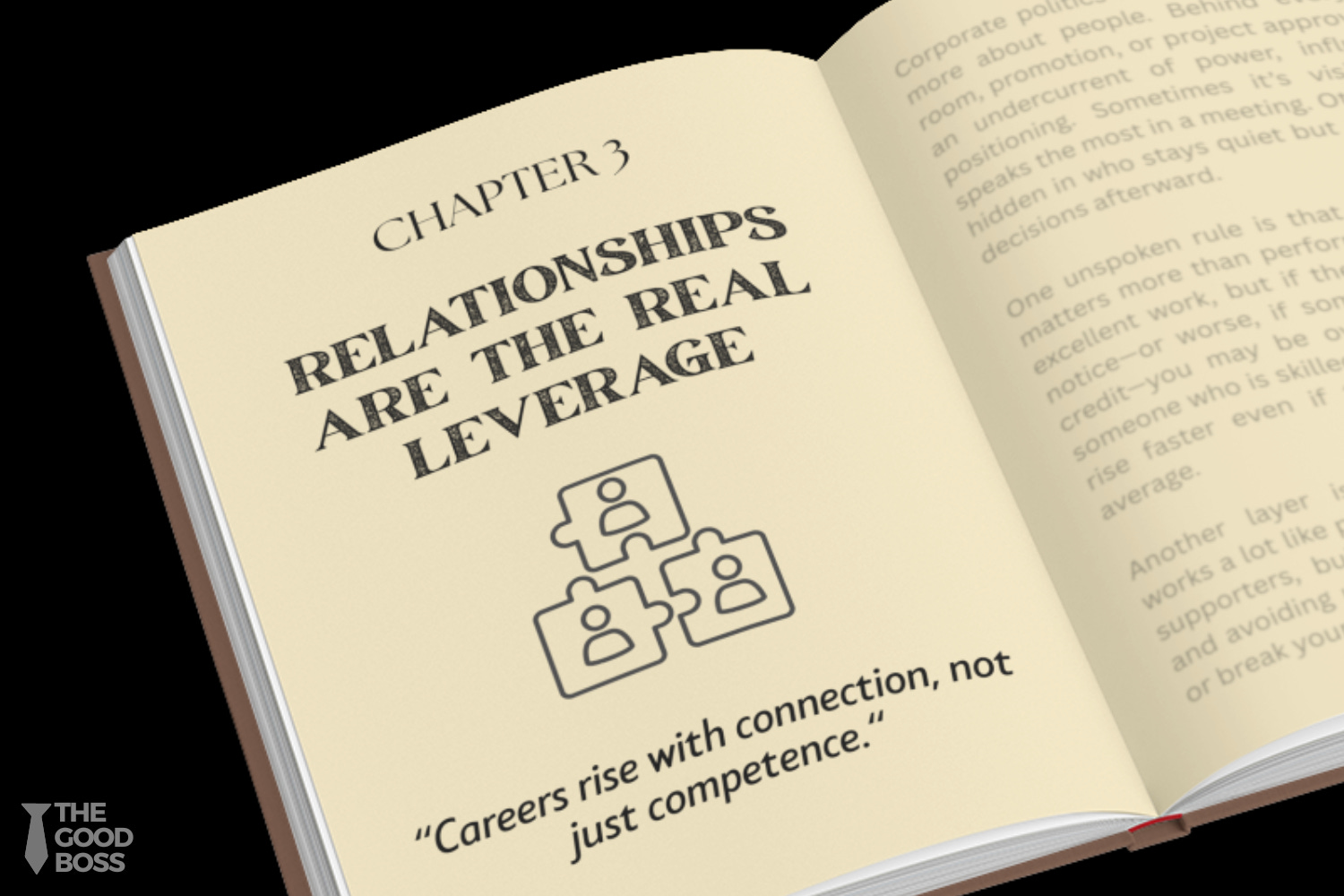
Careers rise with connection, not just competence.
It’s not just what you do, it’s who knows you’re doing it.
Relationships are the oil that keeps the political machine running. If you don’t build them intentionally, you’ll find yourself sidelined, even if your work is top-notch.
In this chapter, we unpack the power of relationships, and how you can use them strategically to build your political capital.
Rule 9: Relationships beat results (over time).
People support those they know and trust, not always those who deliver the most.
In a recent reorg I witnessed, two teams with very different cultures were merged. One manager who had delivered strong quarterly results failed to build trust with the new leadership. Another manager, with slightly less impressive outcomes, had invested time in building relationships, and was more ‘known’ than the other.
As part of the reorg, when leadership roles were reassigned, the latter manager got the job to lead the entire team.
👉🏼 Takeaway: In the long run, relationships often outpace raw delivery.
Rule 10: Your boss’s boss matters more than you think.
Learn to be visible across levels. Career ceilings are often set two levels up.
A high-performing engineering manager (let’s call him Arjun) once came to me confused and disappointed after being passed over for a senior role. He had led multiple successful launches, and had glowing reviews from his direct manager, a Director who openly championed him.
But when the promotion list was finalized by the VP and a couple of other senior leaders, Arjun’s name barely came up. Not because he wasn’t good enough, but because they didn’t really know him.
They had vague impressions. They’d seen his name on a few emails, and maybe heard secondhand praise. But they hadn’t interacted with him directly.
Since then, I’ve started advising all high-potential leaders: Don’t just build down (with your team) or across (with peers). Build up and across levels. Present in forums where your skip-level shows up.
👉🏼 Takeaway: If your name doesn’t come up in skip-level conversations, your career might not either. Visibility is leverage.
Rule 11: Initiative without allies is a career-limiting move.
Going rogue may feel bold and courageous, which is generally regarded as a good leadership trait.
However, it rarely works without political cover.
I was once part of a change initiative where a peer manager jumped ahead and launched a new process without aligning with the leadership first.
Unfortunately for him, it backfired. The teams involved felt blindsided, and senior leaders were annoyed they weren’t consulted. Despite good intentions, the manager lost credibility.
👉🏼 Takeaway: Without allies and alignment, even the best ideas can sink.
Rule 12: Loyalty is a strategy, not a personality trait.
This is one of the most paradoxical rules in the rulebook: smart people stay loyal publicly, even while hedging their bets privately.
A couple of years ago, in a company-wide reorg, two senior managers were reassigned to new teams. One immediately distanced herself from her previous leader, openly criticizing their decisions in her new group. She thought it would show loyalty to the new leadership. It didn’t. The new leaders saw her as politically risky - if she could badmouth one boss, she could do it again.
Another manager took the opposite approach. He publicly thanked his previous leader, spoke well of the team he came from, and quietly started building new relationships behind the scenes. That earned him trust in both camps. When leadership had to choose who to place on a critical initiative later, they chose him.
👉🏼 Takeaway: In politics, loyalty is calculated. And the perception of loyalty buys you breathing room when the landscape changes.
P.S. If you’re constantly juggling fires, decisions, and people issues, and ready to bring more clarity, calm, and intention to your leadership, that’s why I built The Ultimate Leadership Toolkit Bundle, powered by The Leadership Mastery System™.
Chapter 4: The Information Game
Who controls the narrative, controls the decision.
In corporate settings, information is power, but only if you know how to use it.
From hallway whispers to carefully crafted presentations, this chapter explores how control over narrative, timing, and most of all, silence shapes outcomes.
Rule 13: Information is currency. Spend it wisely.
Oversharing can weaken your position. Know when to speak, and when to wait.
At one company I worked with, a senior manager casually mentioned an upcoming product ‘sunset’ during a weekly team sync. He thought it would show transparency and spark early excitement. Instead, word spread quickly across other departments, and creaetd panic among support teams. Leadership had to scramble to clean up the mess, and the manager’s judgment was quietly questioned going forward.
Meanwhile, another leader on the same project waited until the quarterly business review to reveal a key performance insight. She tied it directly to business impact, presented it with crisp visuals, and made sure the right people were in the room. The result was quite the opposite: applause and nods from the leadership.
You may think she was withholding information. But she was being strategic about when and where to share it.
👉🏼 Takeaway: Remember this: when information is currency, timing is leverage.
Rule 14: Narratives win over numbers.
People remember stories, not data. Frame your results in the language of impact.
In a quarterly leadership meeting, two product managers presented updates on similar initiatives. The first walked through a slide deck packed with charts: usage stats, latency improvements, ticket volumes. Technically solid, but honestly, forgettable. Most people nodded politely and moved on.
The second leader opened with a simple story:
"A month ago, one of our customers (an architecture firm in Spain) was stuck. Their rendering software kept crashing, costing them hours of billable time. Our team dug in, found the bottleneck, and fixed it in a week. Now they’ve increased productivity by 28%, and just upgraded their plan."
That story caught attention, and was remembered by the leadership. Needless to say, she got the extra budget.
👉🏼 Takeaway: The data gives you credibility. The story gives you power.
Rule 15: Meetings are theatre. Read the signs.
The real conversation in meetings often happens outside of the words that are said. It’s in the moments of silence - the silent gestures and the body language.
During a recent quarterly strategy review, a PM confidently presented a bold new initiative. He had rehearsed it well, and no one interrupted. In fact, the room was very quiet. He took no objections or questions as a sign of alignment.
He was mistaken.
If he had been watching closely, he would’ve seen the signs: one VP glanced briefly at another when the PM mentioned the projected ROI. Another leader crossed their arms and leaned back. No one asked follow-up questions. They just let it land with a silent thud.
👉🏼 Takeaway: In high-stakes meetings, silence isn’t agreement. It’s often a placeholder for political caution.
Rule 16: Strategic silence is a power move.
Saying nothing can be more powerful than rushing to speak.
In a product planning meeting last month, I could feel the tensions running high. The PM and engineering directors were locked in a heated debate: The PM was pushing for an aggressive release timeline, while the engineering director was warning about technical debt and capacity issues. The room was split, and I could see the PMs and the engineering members picking their respective sides.
Except for one person: Emily, a principal engineer, who just listened for five minutes, and then leaned forward and said calmly, “What if we phased the launch, so we de-risk the architecture while still hitting the main milestones?”
The room went silent. No one had thought to offer a bridge. Everyone had been too busy defending their corner.
👉🏼 Takeaway: Strategic silence is a superpower. Use it to time your voice for maximum impact.
P.S. If you’re enjoying reading this article, I’ll appreciate it if you would take 2 seconds and hit the ❤️ button and share/restack 🔁 it with others who might find it helpful. You can also subscribe to The Good Boss for more posts like this every week. Thank you! 🙏
Chapter 5: The Psychology of Influence
People follow what feels right, especially under pressure.
Influence isn’t just about what you say. It’s about how people feel when you say it.
This chapter focuses on the human dynamics of power: confidence, charisma, perception, and the role of long-built reputations.
Rule 17: Perceived confidence beats actual competence.
If you don’t believe in yourself, don’t expect others to.
I distinctly remember, at a decision meeting, two managers were asked to pitch competing solutions for a key customer problem, and the idea was to pick one of them for funding.
The first presenter, Lisa, had deep domain knowledge and solid analysis. However, she fumbled through her slides, and sounded tentative with words such as “I think” or “maybe”.
Peter, the second presenter, had a rough proposal, with a less solid analysis. However, he delivered it with absolute conviction and energy. He stood tall, made eye contact, and sounded like someone who could rally a team and get it done.
After the meeting, I heard one decision makers say, “His idea needs work, but I trust him to lead the project.” That’s the power of perceived confidence.
👉🏼 Takeaway: In high-stakes rooms, people often don’t bet on the idea, they bet on the person. And if you don’t project belief in yourself, no one else will fill that gap for you.
Rule 18: Emotional control under pressure is your leverage
EQ often beats IQ in political settings. Learn to read the room, and regulate yourself and your emotions.
Consider this: during a tense executive review, two product leaders were grilled about delays in the release of their product.
One visibly tensed up, responded defensively, and took a jab at another department.
The other stayed calm, acknowledged the delay, and reframed the issue as an opportunity to reduce future risk.
Guess who was asked to lead the next cross-functional initiative? It wasn’t about who was right, but who was able to handle pressure and remain trustworthy.
👉🏼 Takeaway: In high-stakes rooms, people follow composure more than credentials.
Rule 19: The Pygmalion Effect is real.
What others believe about your potential shapes how they treat you, and what you become.
I remember a quiet but technically capable designer who spent two years doing excellent work with little recognition. Her manager never talked her up, and peers assumed she was “junior.” Then, in one leadership forum, a director casually referred to her as “a rising star.”
Within weeks, she was invited to a strategy sprint, asked to mentor others, and given more autonomy.
Nothing about her changed, except how others saw her. And that changed everything else.
👉🏼 Takeaway: Belief is contagious. When others see potential in you, they help unlock it.
Rule 20: Reputation compounds, in both directions.
One good political move builds on the next. So does one bad one.
One engineering manager always showed up to exec syncs with crisp insights and clear asks. Over time, his reputation spread and leaders started bringing him into unrelated strategy calls because “he always makes things clearer.”
Meanwhile, another leader once dismissed a peer’s contribution in a group chat, hoping to score points. That moment stuck, and months later, when leadership discussed high-potential talent, his name wasn’t even brought up.
👉🏼 Takeaway: Every move builds your political credit, or your political debt.
P.S. Feedback is a gift! 💬 If you’re finding this post helpful, would you do me a favor and leave a quick testimonial here, and as a thank-you, I’ll send you a free copy of my book! It only takes a couple of minutes - thank you! 🙏
Chapter 6: Playing Without Losing Yourself
Integrity is your edge, if you use it wisely.
You don’t have to compromise your values to play the game of politics. But you do have to play smart, though.
This chapter offers ways to engage politically without becoming “political”, and shows how ethical leaders shape systems from within.
Rule 21: Ethical politics = stakeholder management.
You can be strategic without being manipulative.
Before launching a new internal tool that would affect multiple departments, a senior engineering leader didn’t just drop it into a leadership review. Instead, she scheduled one-on-one conversations with every key stakeholder. She asked how their teams might be affected, listened to concerns, and incorporated feedback into the rollout plan.
So when she finally presented it in the big meeting, every key leader nodded along. No friction. No surprise resistance. Not because they were “sold”, but because they felt involved.
She wasn’t playing games. She was managing the politics by managing the people.
👉🏼 Takeaway: Ethical politics is simply the art of inclusive decision-making done with intention.
Rule 22: You don’t have to like politics. You just have to understand it.
It’s not about loving the game. It’s about learning how not to lose at it.
I remember working with an engineering manager who was brilliant and deeply respected by his team, and he prided himself on staying out of “company politics.” He focused solely on delivery. But year after year, his budget got trimmed and his headcount requests were denied. He was happy and vented in private but never engaged with decision-makers.
Eventually, one of his close peers suggested he start attending business reviews and casually connect with product and finance leaders. Within two quarters, things changed. His roadmap was suddenly on the radar, and his team got more support.
He didn’t play politics in the traditional sense. He just stopped ignoring how decisions were actually made.
👉🏼 Takeaway: You don’t have to like politics. You just have to understand how it’s played.
Rule 23: Be kind, but not naive.
Empathy is strength, but gullibility is stupidity.
I recall a product manager once shared her team’s backlog, roadmap drafts, and even her next strategy pitch with a peer in another department. Two weeks later, she found out that the peer had presented a similar strategy in a leadership review, positioning it as their own initiative.
That incident really hit her hard, but he learnt an important lesson.
She learned to share important information in increments, avoid sharing early-stage work, and be aware of who is in the room. She continued to collaborate, and paired it with political awareness.
👉🏼 Takeaway: Trust is earned in steps, not handed out all at once.
Rule 24: Play the game to change the game.
Understand the rules so you can teach others how to play with integrity.
One of the best leaders I’ve worked with didn’t just navigate politics, he made it safer for others to do the same. He regularly pulled rising managers aside to explain how promotions really worked, how to build allies, how to frame their value in ways leadership would understand.
He hosted a quarterly offsite called “Politics Without Poison,” where people could ask questions anonymously and learn the realities of influence. He was giving people the tools to operate with confidence and ethics.
👉🏼 Takeaway: The best way to fix a system is from within, by teaching others to rise with integrity.
P.S. If you’re constantly juggling fires, decisions, and people issues, and ready to bring more clarity, calm, and intention to your leadership, that’s why I built The Ultimate Leadership Toolkit Bundle, powered by The Leadership Mastery System™.
Conclusion
I used to believe that if I just focused on doing great work, things would work themselves out.
But as I moved through my career, I realized that good work is only part of the equation. Visibility, perception, relationships, and timing - all of these matter too.
What felt unfair at first started to make sense once I began to see the full picture.
You don’t have to love the political game. You just have to learn how to play it well enough to protect your work, amplify your impact, and support others who haven’t learned it yet.
So, which of the 24 rules resonated most with you? Let me know in the comments below! 👇
P.S. If you’re constantly juggling fires, decisions, and people issues, and ready to bring more clarity, calm, and intention to your leadership, that’s why I built The Ultimate Leadership Toolkit Bundle, powered by The Leadership Mastery System™.

What to read next…

The Good Boss is funded by paid subscriptions from readers like yourself. If you aren’t already, consider becoming a paid subscriber to receive the full experience!

PS: If you’re enjoying The Good Boss, I will appreciate it if you would take 2 seconds and hit the ❤️ button and share/restack 🔁 it with others who might find it helpful. Thank you!
Also, I’d love your feedback! 💬 Leave a quick testimonial here, and as a thank-you, I’ll send you a free copy of my book! It only takes a couple of minutes - thank you! 🙏
A fantastic compendium.
The central thesis of my book "Beyond Slides" is that people focus disproportionately on hard skills and almost completely ignore soft skills.
Turns out, hard skills are table stakes: necessary, but not sufficient, to achieve a great career.
This is one of my top favourite articles of The Good Boss Gaurav, there's so much value packed and the situations give solid context to the takeaways.