In this issue:
The Cover That’s About to Disappear
Why This Has Been Hiding in Plain Sight
The Crisis Isn’t AI. It’s What AI Reveals.
How to Make Sure You’re on the Right Side of This
My Honest Take: The Bottom Line
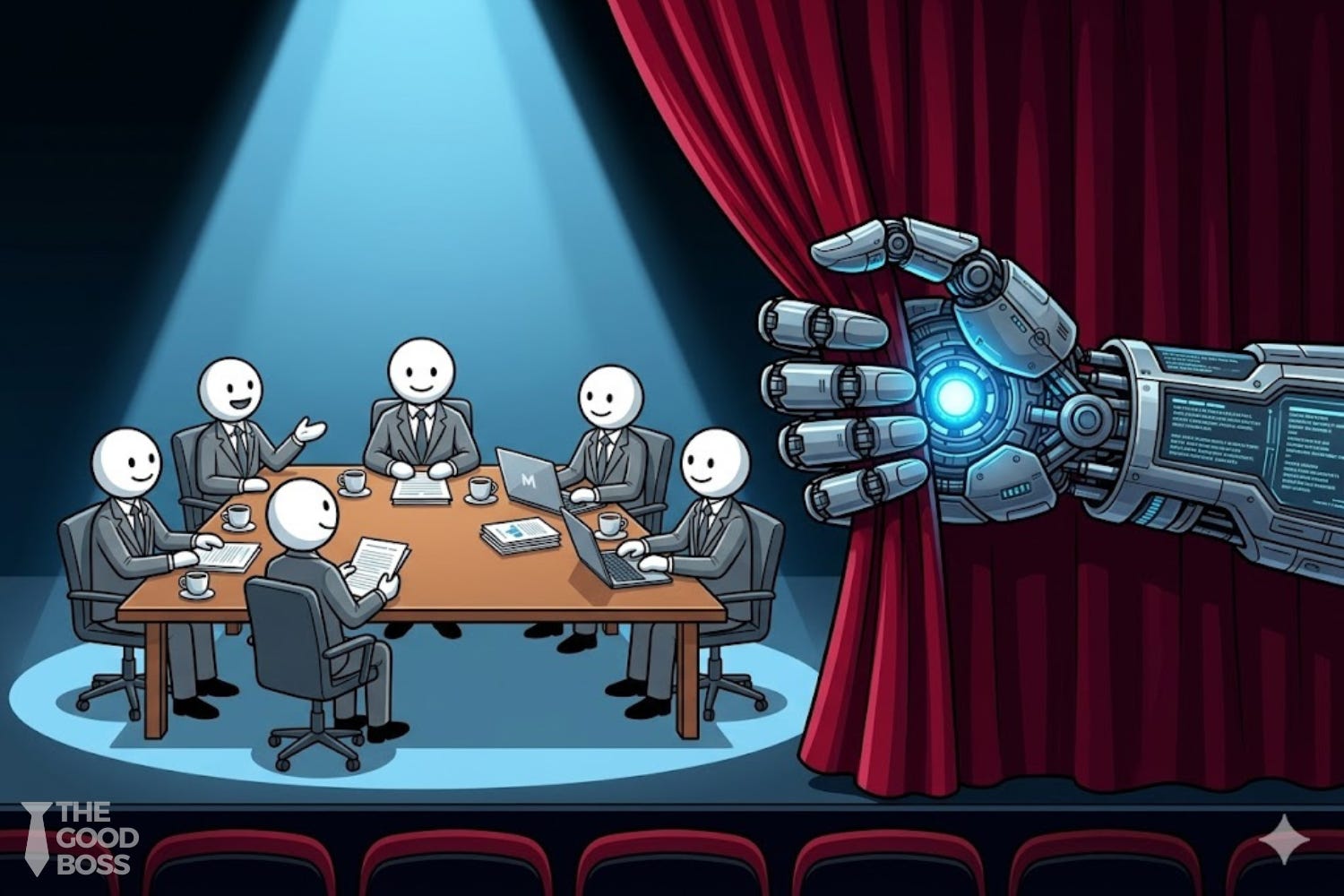
For years, there’s been a silent problem in leadership that nobody wants to talk about:
A lot of people in “leadership” roles weren’t actually leading.
Remember the “leaders” who would run long meetings, track metrics, and respond to emails and Slack at impressive speeds? These leaders look busy, and sound competent.
But I’m sure you’ll agree with me that many of these managers were actually really poor leaders. So, what was really happening, you might ask?
For a long time, the appearance of leadership and the substance of leadership were nearly impossible to tell apart from the outside.
AI is about to change that, or should I say, is already changing that.
The Cover That’s About to Disappear
Here’s what I mean by “cover.”
For decades, the “busywork” of management has provided a kind of camouflage. If you were constantly in meetings, constantly writing decks, constantly responding to emails and Slack, you looked like a leader.
Your volume of activity covered the depth of impact.
Nobody had the tools, or frankly, the desire, to decouple “doing a lot of management tasks” from “actually leading people well.” The two got bundled together, and most organizations never bothered to unbundle them.
That bundle is falling apart. With AI tools, you can easily draft the report, summarize the meeting, build the project plan, and analyze the data.
What’s more: it’s often faster and more thorough than a manager who used to spend hours on it. I’ve come to rely on and trust these tools with every passing day, as I’m sure you have, too.
Why This Has Been Hiding in Plain Sight
Mind you, this isn’t a new problem. In fact, it’s an old problem that’s now impossible to ignore.
In your own experience, have you noticed…
The manager who’s everywhere, yet adds little to no value to the organization.
The leader who’s always “slammed” but whose team feels lost and directionless.
The person who’s exceptional at producing the appearance of progress, but whose team’s actual trust, growth, and morale have been eroding the entire time.
As I said, this isn’t new.
We’ve all noticed the managers who are busy but not leading, who’re visible but not making an impact. We’ve just never had a clean way to prove it.
Performance reviews measure output and what’s visible, and output so far looked like leadership, so the illusion held.
Today, AI is breaking that illusion because it’s about to produce the same outputs with minimal or no leadership behind it at all.
The Crisis Isn’t AI. It’s What AI Reveals.
To be clear, the “crisis” I’m talking about isn’t that AI is going to take away leadership roles.
To me, the real crisis is that a large number of people currently occupying leadership roles have been getting credit for management output, not leadership impact, and that distinction is getting exposed to everyone.
I’m sure this is going to get uncomfortable in many, if not most, organizations.
Some leaders will discover, in a fairly public way, that they don’t have much left once their task list is automated and managed by AI tools. Some teams are going to realize that the person who looked like their ‘leader’ for years was mostly just... busy.
And some leaders, the ones who were doing the real work all along, the trust-building, the coaching, the hard conversations, the steady presence in difficult moments, are finally going to get seen for what they were actually contributing. Maybe even for the first time.
This is the real crisis:
The slow, non-dramatic structural reveal of who was leading and who was simply occupying a leadership-shaped role.
Maybe it’s not even a crisis. It’s a relief.
How to Make Sure You’re on the Right Side of This
If this is making you uneasy, here are a few places to start:
Audit your week. How much of what you did this week was task execution versus genuine leadership (e.g., coaching, hard conversations, trust-building, judgment calls)?
Find the conversation you’ve been avoiding. If there’s a hard conversation sitting on your to-do list, that’s a clear signal of where you need to pay attention.
Stop hiding behind “busy”. If your calendar is full but your team’s trust, growth, and morale are low or stagnant, you need to clean up your calendar and schedule your real priorities as a leader.
I don’t mean to scare you, but here’s me taking the action of sharing what needs to be shared with you:
You need to get honest about your leadership impact while there’s still time to close the gap, before AI closes it for you.
And mind you, when it does, which will be sooner than you think, it will be very publicly, in front of your whole team.
My Honest Take: The Bottom Line
For years, “busyness” was a reasonable proxy for leadership impact, because we had no better way to measure it.
With AI, that proxy is disappearing, and what’s left is the only thing that ever actually mattered: whether you made the people around you better.
Some leaders have nothing to worry about, as they’ve been doing the real work all along, often without much recognition for it. Others, on the other hand, have a choice to make, and honestly, not much time left to make it.
💬 Be honest: which one are you? What are you doing differently as a leader with AI? Let me know in the comments below.
If you found this useful, you might also enjoy:


❤️ Found this helpful?
If you found this post helpful, please like and share it with other managers who can benefit from it, including your boss :) If you have any feedback, please drop your comment below - it helps me keep improving the content. Thank you!